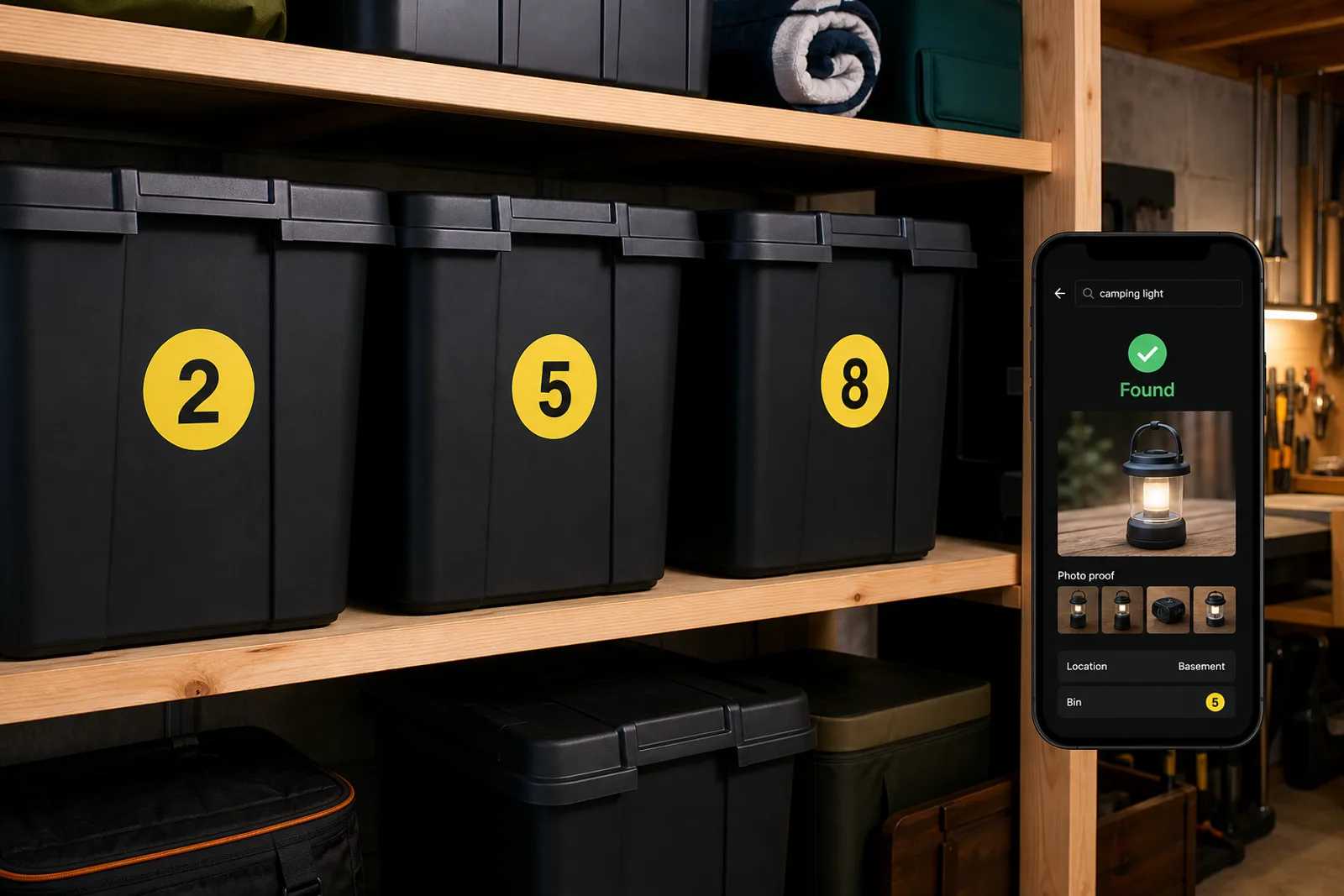
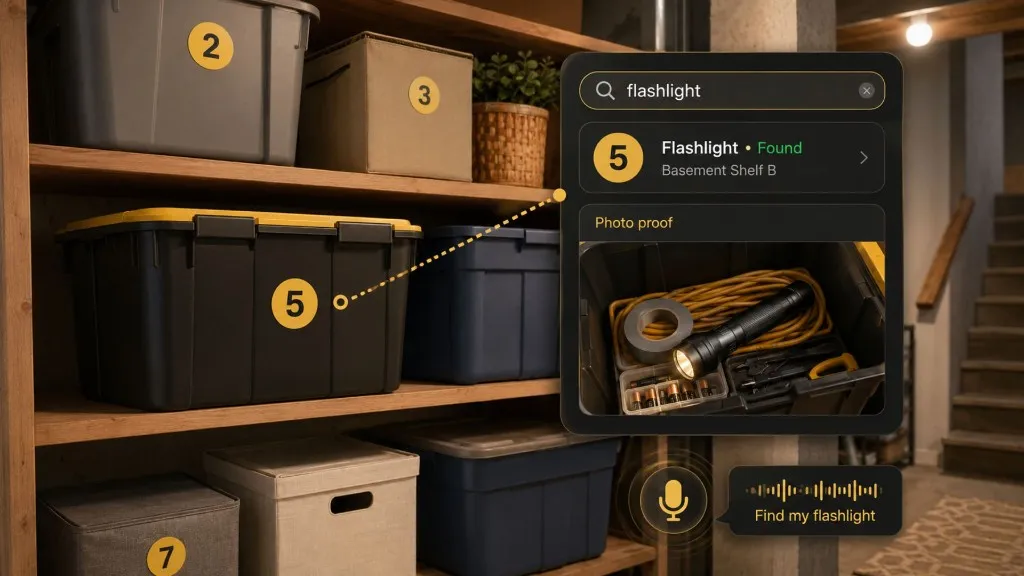
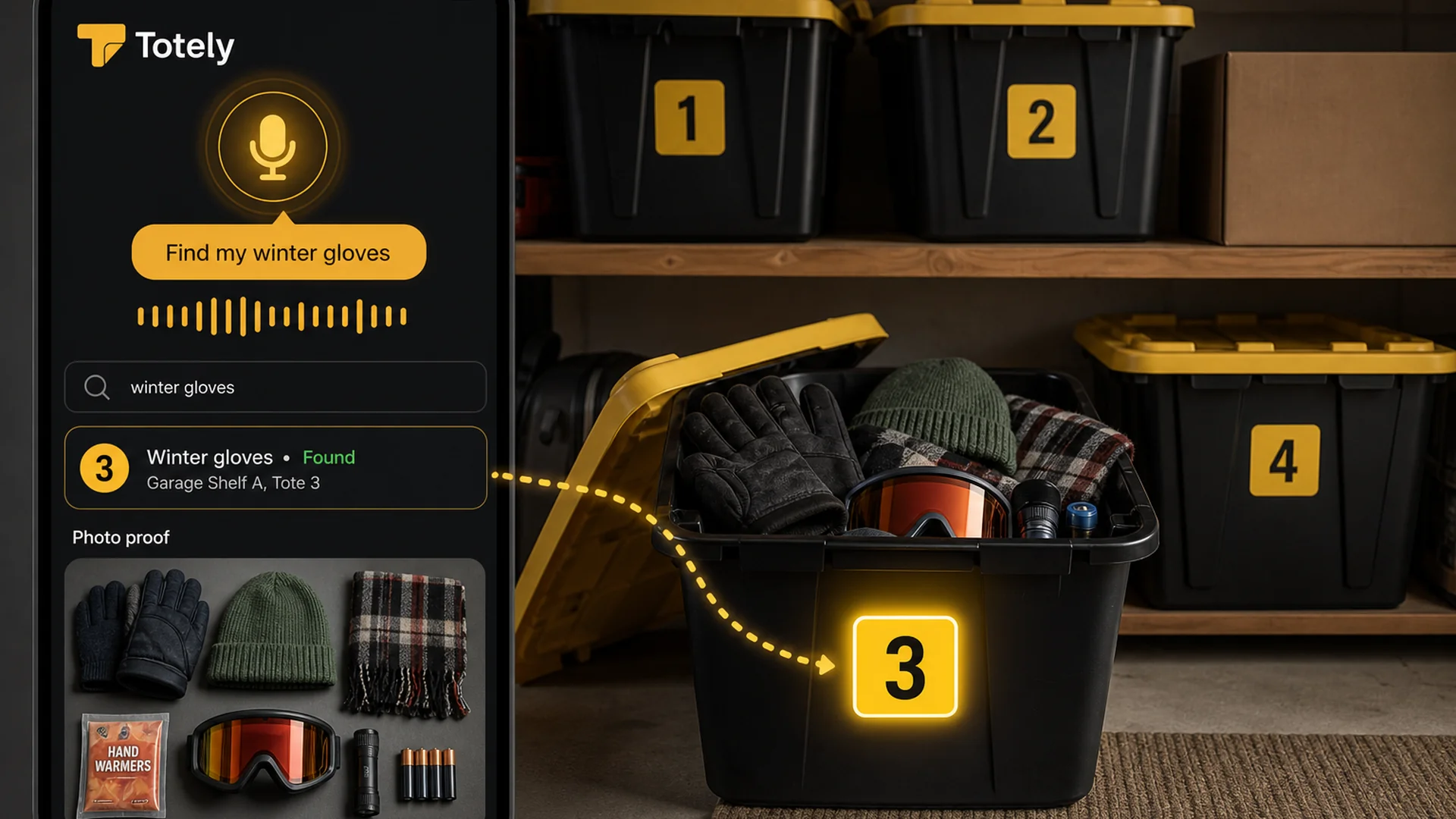
Garage Storage: The Missing Layer Most Systems Forget
Garage storage is not just shelves, cabinets, hooks, and bins. Learn the missing layer that keeps garage items findable after everything is put away.
By Steve Watts · Co-Founder, Totely
September 20, 2026 · Updated September 21, 2026 · 16 min read
Most garage storage advice starts with the same goal:
Get things off the floor.
That is a good goal.
A garage floor fills up fast with tools, sports gear, extension cords, paint supplies, holiday bins, camping gear, car supplies, bikes, shoes, kids’ toys, lawn equipment, and the random things nobody knows where to put.
So people buy shelves.
They add cabinets.
They hang hooks.
They install overhead racks.
They stack bins.
They label a few totes.
For a little while, the garage looks better.
Then real life happens.
Someone moves the batteries.
The extension cord gets borrowed.
Holiday lights go into a different bin.
The bike pump needle disappears.
A sprinkler nozzle ends up with painting supplies.
The garage still has shelves, cabinets, hooks, and bins.
But nobody knows where anything is.
That is the missing layer in garage storage.
A garage does not just need more places to put things.
It needs a way to remember what is inside those places.
Quick Links
The Garage Storage Problem Most Advice Misses
Most garage storage systems solve one visible problem:
The garage looks messy.
So the solution becomes visible too:
- garage shelves
- garage cabinets
- pegboards
- hooks
- slatwalls
- overhead racks
- bike racks
- tool chests
- storage bins
- tote racks
- workbenches
- wall-mounted organizers
Those are useful.
But they mostly solve the space problem.
They do not automatically solve the retrieval problem.
The retrieval problem sounds like this:
- “Where is the extension cord?”
- “Which bin has the spare batteries?”
- “Did we already buy sprinkler parts?”
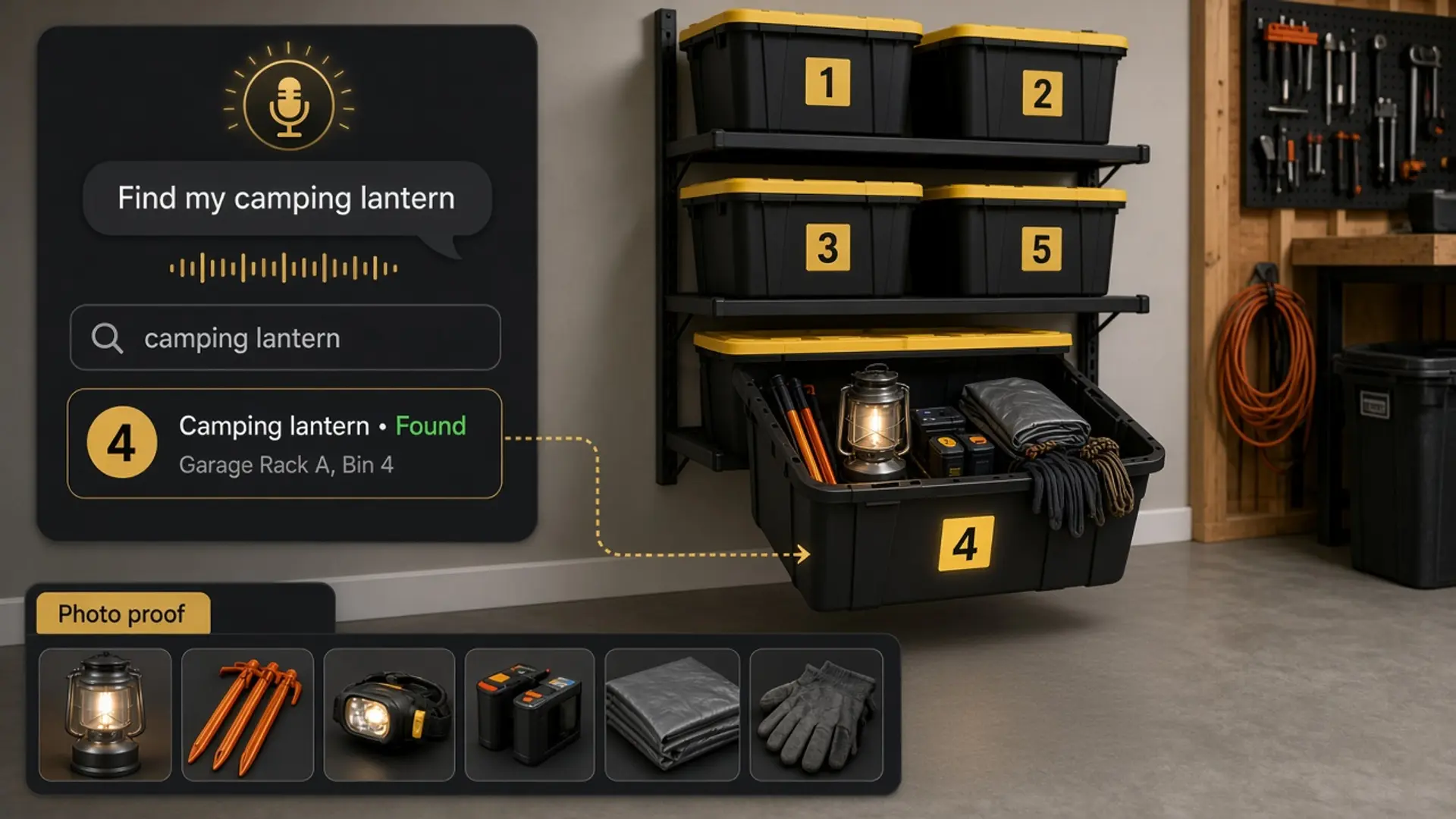
- “Where did the camping lantern go?”
- “Which shelf has the bike pump needle?”
- “Are the holiday hooks with ornaments or lights?”
- “Where is the paint tape?”
- “Is this tote tools, camping, or random garage stuff?”
A garage can look organized and still be hard to use.
That is the difference between storage and searchable storage.
The Three Layers of Garage Storage
A garage storage system works best when it has three layers.
- Physical storage
- Access zones
- Searchable memory
Most people stop at layer one.
Some people get to layer two.
Almost nobody builds layer three.
That is why the garage slowly turns back into a mystery system.
Layer 1: Physical Storage
Physical storage is the visible part.
This includes:
- shelves
- cabinets
- hooks
- racks
- bins
- totes
- drawers
- pegboards
- slatwalls
- overhead storage
- wall-mounted systems
- workbenches
- sports organizers
- bike storage
- tool storage
This layer matters because the garage needs structure.
Without physical storage, everything ends up on the floor.
A good physical system should:
- clear walkways
- keep heavy items low
- use wall space
- use vertical space
- protect fragile items
- separate messy categories
- make frequent items easier to grab
- keep dangerous or sharp items out of casual reach
- make the garage easier to clean
Physical storage is the foundation.
But it is not enough by itself.
Layer 2: Access Zones
Access zones decide where things belong based on how you actually use them.
This is where garage storage gets smarter.
Instead of asking only, “Where can this fit?” ask:
When will we need this again?
A good garage has zones like:
- daily access
- weekly access
- seasonal access
- project access
- outdoor access
- kids’ gear
- sports gear
- tools and hardware
- car supplies
- holiday storage
- long-term storage
- donation or outgoing items
This matters because every garage has prime real estate.
The easiest shelves, hooks, and bins should hold things you need most often.
The hardest-to-reach spaces should hold things you rarely need.
Layer 3: Searchable Memory
This is the missing layer.
Searchable memory answers:
- what is inside
- where it is
- when it was last updated
- what it looks like
- what else is stored with it
- whether it belongs in a tote, shelf, cabinet, drawer, or wall zone
This layer turns the garage from “organized-looking” into actually findable.
It is the difference between:
“I think it is somewhere in the garage.”
and:
“The extension cord is in Garage Wall B, Bin 4.”
That is the part shelves and labels do not handle well on their own.
Why Labels Alone Break Down
Labels are helpful.
But labels are not the whole system.
A label usually says something broad:
- tools
- camping
- holiday
- sports
- car stuff
- outdoor
- paint
- kids
- misc
The problem is that garage contents change.
A bin that started as camping may later hold:
- camping lantern
- work gloves
- spare batteries
- extension cord
- tarp clips
- headlamp
- random painter’s tape
The outside label still says camping.
But the thing you are looking for might not match the label anymore.
That is how mystery bins happen.
A visible number stays stable.
The contents can change.
The memory record can update.
That is a stronger system.
Garage Storage Zones That Actually Work
Here is a practical way to think about garage storage by zone.
Zone 1: Grab-Fast Wall Zone
Use this for items you need often.
Good candidates:
- broom
- rake
- shovel
- extension cord
- work gloves
- bike pump
- reusable shopping bags
- dog leash
- small ladder
- flashlight
- everyday tools
Storage ideas:
- hooks
- pegboard
- slatwall
- wall rail
- open shelf
- shallow bin
- labeled drawer
- small numbered tote
The goal is fast access.
Do not bury these items in deep bins.
Zone 2: Shelf and Tote Zone
Use this for items that need containers.
Good candidates:
- car supplies
- camping gear
- holiday decor
- extra household supplies
- painting supplies
- kids’ outdoor toys
- seasonal sports gear
- sprinkler parts
- extension accessories
- party supplies
Storage ideas:
- open shelving
- clear bins
- lidded totes
- stackable bins
- numbered totes
- tote racks
- shelf zones
This is where searchable memory matters most.
A shelf full of bins can look clean and still be impossible to search by memory.
Zone 3: Heavy-Low Zone
Use this for heavy or dense items.
Good candidates:
- tools
- hardware
- paint cans
- tile
- car fluids
- books or files
- large batteries
- heavy camping equipment
Storage ideas:
- bottom shelves
- lower cabinets
- rolling carts
- heavy-duty shelf units
- sturdy floor-level bins
Keep heavy items low when possible.
Follow product instructions and safety guidance for storage systems, chemicals, tools, and overhead racks.
Zone 4: Overhead Seasonal Zone
Overhead garage storage can be useful.
But it should not become a place where important things disappear.
Good candidates:
- lightweight seasonal bins
- rarely used holiday items
- empty luggage
- bulky but light items
- camping chairs
- pool toys
- seasonal decor
Avoid overhead storage for:
- heavy items
- fragile items
- things you need often
- things you cannot safely lift
- anything that could be dangerous if dropped
If something goes overhead, the location needs to be specific.
Not garage.
Use something like:
Garage Overhead Rack, Left Side, Bin 2
Zone 5: Cabinet Zone
Cabinets are good when you want items hidden, protected, or separated.
Good candidates:
- cleaners
- car supplies
- small tools
- hardware
- paint supplies
- garden supplies
- sharp items
- household overflow
Cabinets make the garage look calmer.
But closed doors can also hide things.
If a cabinet holds multiple shelves or bins, give each section a simple location.
Examples:
- Garage Cabinet A, Top Shelf
- Garage Cabinet A, Drawer 2
- Garage Cabinet B, Bin 3
Zone 6: Project Zone
Most garages have project clutter.
That is not always bad.
It just needs boundaries.
Good candidates:
- active repairs
- painting project supplies
- garden setup
- sports-season prep
- donation staging
- return pile
- school project materials
Use a temporary project bin or shelf.
Then clear it when the project is done.
Otherwise the project zone becomes permanent clutter.
What to Store Where
A useful garage is organized by retrieval, not just category.
| Item type | Best garage storage spot | Why |
|---|---|---|
| Extension cord | Wall hook or mid-height bin | Often used and easy to misplace |
| Spare batteries | Small drawer or numbered bin | Small, useful, easy to duplicate-buy |
| Work gloves | Wall basket or front-access bin | Needed often |
| Sprinkler parts | Small parts bin or shelf tote | Easy to lose in mixed garage storage |
| Holiday decor | Lidded bins or tote rack | Seasonal and container-friendly |
| Camping gear | Numbered totes or mid-height shelf | Many small items travel together |
| Tools | Pegboard, cabinet, or tool chest | Needs visibility and access |
| Paint supplies | Lower shelf or cabinet | Best grouped and contained |
| Bike accessories | Wall zone or small bin near bikes | Easy to misplace |
| Sports gear | Open bin, rack, or wall zone | Better when kids can return it |
| Car supplies | Cabinet or shelf bin | Good category for contained storage |
| Rare seasonal items | Higher shelf or overhead rack | Low-frequency access |
Before You Buy More Garage Storage
Do not start by buying shelves.
Start by looking at what the garage needs to do.
Ask:
- What do we need weekly?
- What do we need seasonally?
- What is too heavy to store high?
- What is dangerous or sharp?
- What do kids need to reach?
- What should be out of kids’ reach?
- What belongs near the car?
- What belongs near the door?
- What should leave the garage entirely?
- What do we keep buying because we cannot find it?
Then buy or build storage around those answers.
This prevents the classic garage mistake:
Buying more storage for things you do not actually need to keep.
A Simple Garage Storage Map
Here is a simple garage layout.
| Zone | Location name | Storage type | Example contents |
|---|---|---|---|
| Wall A | Garage Wall A | hooks and pegboard | shovel, broom, rake, bike pump |
| Wall B | Garage Wall B | numbered bins | extension cord, gloves, batteries |
| Shelf A | Garage Shelf A | open shelves | car supplies, cleaning supplies |
| Rack A | Garage Rack A | tote rack | camping gear, outdoor toys |
| Overhead A | Garage Overhead A | overhead rack | light seasonal bins |
| Cabinet A | Garage Cabinet A | closed cabinet | paint, hardware, small tools |
| Floor Zone | Garage Outgoing Zone | open bin | donations, returns, project overflow |
The exact layout does not matter.
The naming does.
A named location gives every item a real address.
That address is what makes the garage searchable later.
How to Make Garage Storage Searchable
Here is the simplest version.
Step 1: Number the Containers
Give every tote, bin, drawer, shelf section, or cabinet section a simple visible number.
Examples:
- Bin 1
- Bin 2
- Bin 3
- Bin 4
- Shelf 1
- Drawer 2
- Cabinet A
Use simple numbers.
Do not make the outside complicated.
Step 2: Name the Zone
Use short location names.
Examples:
- Garage Wall B
- Garage Shelf A
- Garage Cabinet A
- Garage Overhead Rack
- Garage Tool Wall
- Garage Holiday Shelf
- Garage Sports Zone
Now Bin 4 becomes more useful:
Garage Wall B, Bin 4
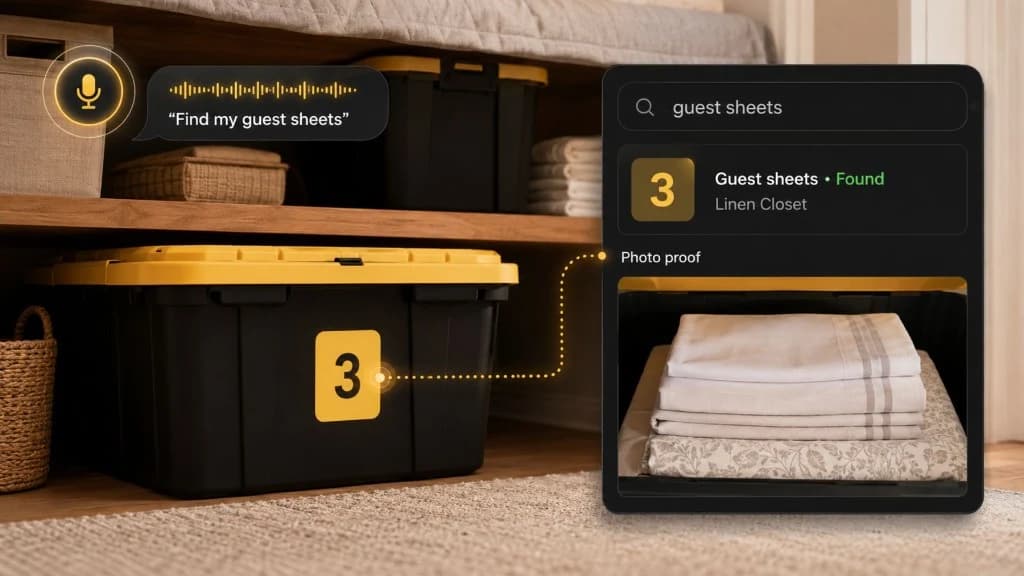
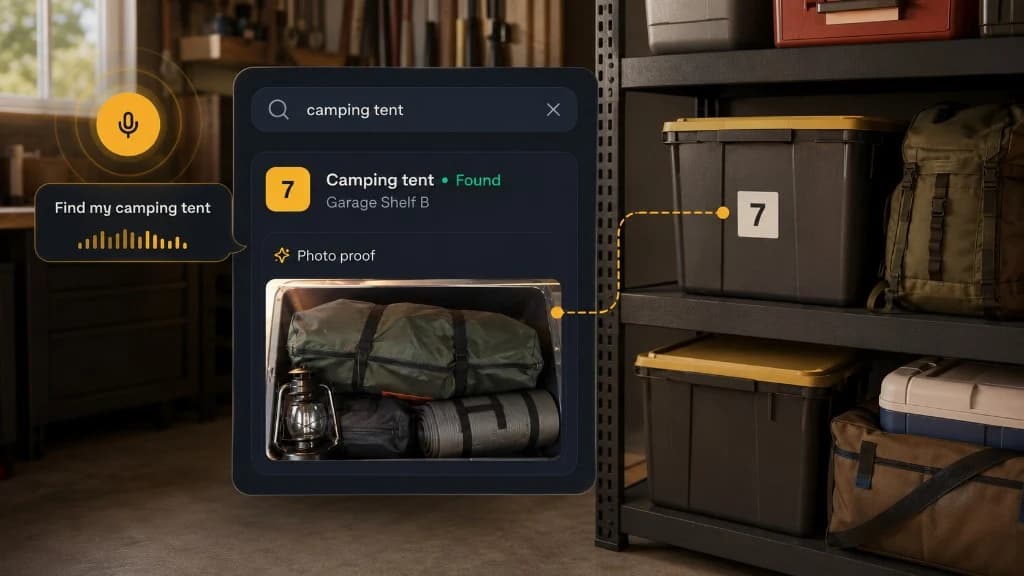
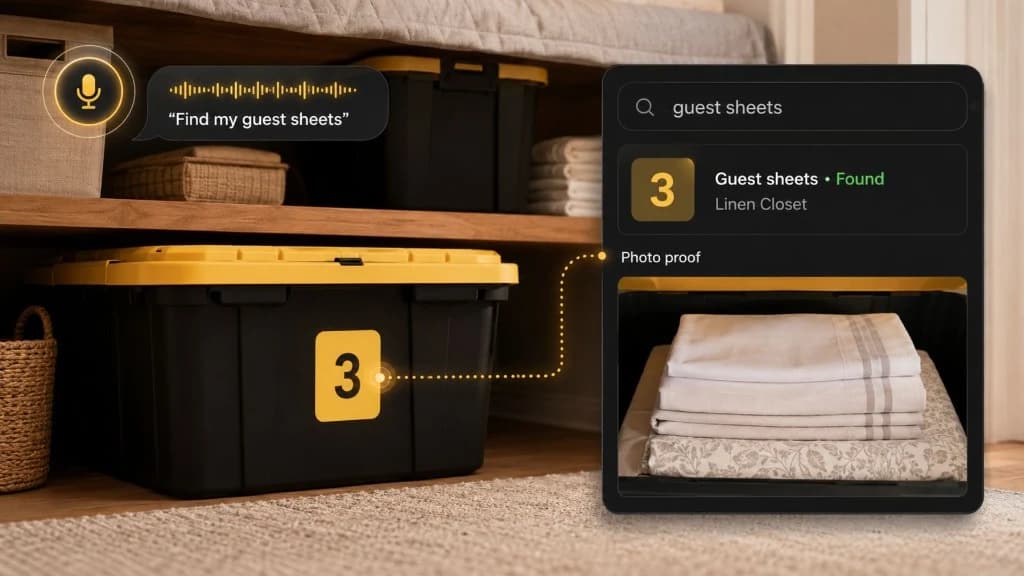
Step 3: Photograph the Contents
Before closing a bin or cabinet, take a quick photo.
The photo does not need to be beautiful.
It needs to show what is inside.
For example, a useful garage bin photo might show:
- orange extension cord
- work gloves
- spare batteries
- flashlight
- sprinkler nozzle
- bike pump needle
- painter’s tape
That photo becomes proof.
You do not have to trust your memory.
Step 4: Add Real Search Terms
Add the item names you would actually search later.
Examples:
- extension cord
- spare batteries
- work gloves
- flashlight
- sprinkler nozzle
- bike pump needle
- painter’s tape
- camping lantern
- outdoor timer
- holiday hooks
- drill charger
Avoid vague words like:
- misc
- stuff
- garage things
- random
- extra
Search works best when the record uses the same words you would say later.
Step 5: Save the Exact Location
Use the physical address.
Examples:
- Garage Wall B, Bin 4
- Garage Shelf A, Middle Shelf
- Garage Cabinet A, Drawer 2
- Garage Overhead Rack, Left Side, Bin 3
- Garage Rack A, Bin 5
The more exact the location, the less wandering later.
Step 6: Update When Contents Change
Garage storage changes.
That is normal.
Update the record when:
- you move a bin
- you add an important item
- you remove something important
- a category changes
- the photo is outdated
- a seasonal bin gets repacked
- a project bin becomes permanent storage
A memory system only works if it stays close to reality.
But the update should take seconds, not a whole garage reset.
How Totely Fits
Totely is the digital memory layer for garage storage.
It does not replace shelves, cabinets, hooks, overhead racks, bins, or labels.
It makes them work better.
The workflow is simple:
- Number the bin, tote, shelf, drawer, cabinet, or zone.
- Snap a photo before closing it.
- Let AI build the first item list from what it can see.
- Review or edit the record if needed.
- Save the exact garage location.
- Add notes for fragile, heavy, seasonal, front-access, replacement, restock, or safety context.
- Search naturally later.
- Use photo proof before opening everything.
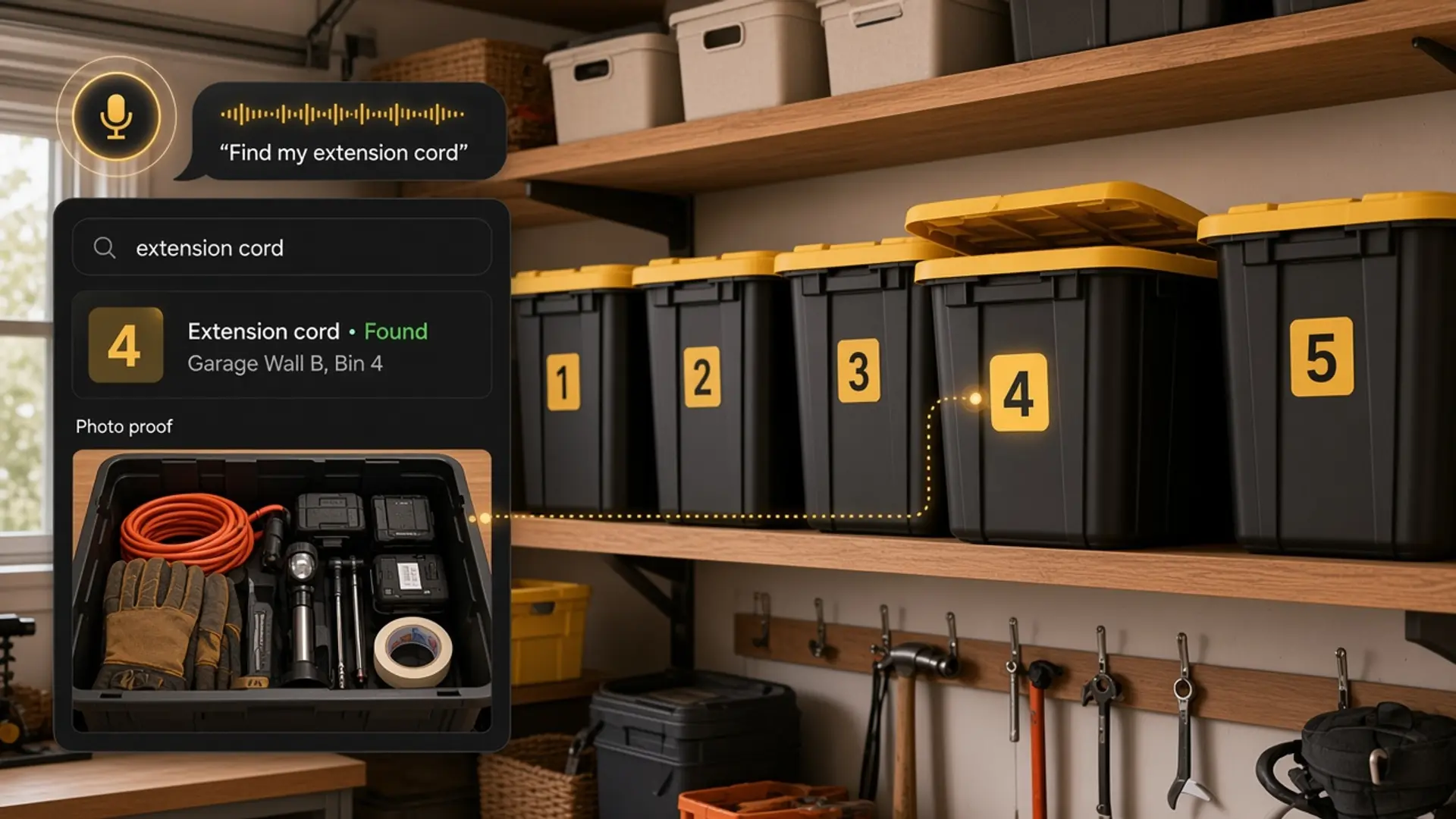
Search:
extension cord
Totely shows:
Garage Wall B, Bin 4
with photo proof.
Search:
bike pump needle
Totely shows:
Garage Wall B, Bin 4
Search:
sprinkler nozzle
Totely shows:
Garage Wall B, Bin 4
That is the missing layer.
The shelf holds the bin.
The memory tells you which bin matters.
Example: Finding the Extension Cord
Physical setup:
- garage wall with shelves and hooks
- simple visible numbers
- Bin 4 on Garage Wall B
- photo record saved in Totely
Contents of Bin 4:
- orange extension cord
- work gloves
- spare batteries
- flashlight
- sprinkler nozzle
- bike pump needle
- painter’s tape
Saved location:
Garage Wall B, Bin 4
Later, someone asks:
“Where is the extension cord?”
Search:
extension cord
Result:
Garage Wall B, Bin 4
with photo proof.
You open one bin.
Not six.
What Garage Storage Should Feel Like
A good garage storage system should make the garage easier to live with.
Not just better for one weekend.
It should help you:
- park the car
- walk safely
- find tools
- avoid duplicate purchases
- put things back
- let other family members find things
- handle seasonal changes
- keep projects contained
- keep dangerous items more controlled
- use shelves and walls intentionally
- avoid mystery bins
The real test is not how the garage looks right after organizing.
The test is what happens three months later.
Can you find the thing?
Can someone else find the thing?
Can you put it back without guessing?
That is the standard.
Garage Storage FAQ
What is the best garage storage system?
The best garage storage system depends on what you store, how often you use it, how much wall and ceiling space you have, and whether you need shelves, cabinets, bins, hooks, or overhead racks. The strongest systems combine physical storage with a way to remember what is inside each container and where it lives.
What is the first step in garage storage?
Start by sorting the garage by use, not by product. Identify what you need daily, weekly, seasonally, rarely, and never. Then build storage zones around those groups.
Are garage storage cabinets better than shelves?
Cabinets are better for hiding, protecting, or separating items. Shelves are better for visibility and faster access. Many garages need both.
Are clear bins good for garage storage?
Clear bins can help because you can see some contents, but they do not solve everything. Once bins are stacked, crowded, or moved, clear plastic is not the same as searchable memory.
What should not be stored high in a garage?
Avoid storing heavy, dangerous, fragile, or frequently used items high. Keep heavy items low and follow manufacturer guidance for shelves, racks, overhead systems, and any hazardous materials.
Is overhead garage storage a good idea?
Overhead garage storage can be useful for light, seasonal, or rarely used items. It works best when the items are not too heavy and the location is clearly recorded.
How do I organize garage bins?
Give each bin a simple visible number, take a photo of the contents, save the exact garage location, and add the real item names you would search for later.
How do I keep my garage organized long term?
Make the system easy to maintain. Keep frequent items accessible, update containers when contents change, avoid vague labels, and give every bin, shelf, cabinet, and zone a clear location.
Does Totely work for garage storage?
Yes. Totely works for garage totes, bins, shelves, drawers, cabinets, racks, overhead storage, sports gear, tool zones, holiday bins, and storage units.
Do I need QR codes for garage storage?
No. QR codes can be useful in some setups, but you can start with simple visible numbers, photos, saved locations, and natural search.
Build the Garage You Can Actually Use
Garage storage is not just about buying the right shelf.
It is not just about cabinets.
It is not just about hooks, pegboards, slatwalls, overhead racks, bins, or labels.
Those things matter.
But they are the physical layer.
A garage also needs access zones.
And it needs memory.
Because the real goal is not simply to put things away.
The real goal is to find them again.
So clear the floor.
Use the walls.
Add shelves.
Use cabinets where they help.
Put heavy things low.
Group by how often you need things.
Then give every important bin, shelf, drawer, cabinet, and zone a searchable memory.
That is how garage storage keeps working after the organizing day is over.
Stored, not lost.