How to Organize Totes So You Can Find Anything Fast
Learn how to organize totes with numbers, photos, labels, and searchable storage so you can find holiday decor, tools, clothes, and gear faster.
By Steve Watts · Co-Founder, Totely
January 15, 2026 · Updated August 27, 2026 · 15 min read
How to Organize Totes So You Can Find Anything Fast
Storage totes are supposed to make your home easier to manage.
They hold the holiday decorations, kids' clothes, camping gear, craft supplies, garage tools, keepsakes, extra bedding, and all the random household things you do not need every day.
At first, totes feel like a win. The clutter disappears. The shelves look cleaner. The garage, closet, basement, attic, or storage room feels more under control. The same tote system also works off-site when you organize a storage unit with numbered containers and a retrieval path.
Then you need one specific thing.
The extension cord. The snow gloves. The birthday candles. The camping lantern. The gift bags. The 4T rain boots. The ornament hooks. The spare batteries.
Suddenly, every tote looks the same.
That is why learning how to organize totes is not just about stacking bins neatly. It is about building a system that helps you know what is inside each tote, where that tote lives, and how to find one item without opening everything.
The best tote system combines simple categories, large numbers, photos, locations, and a searchable inventory. That way, your storage does not just look organized. It actually works.
Quick Links
- Why Storage Totes Become Mystery Boxes
- The Best Way to Organize Totes
- Step 1: Sort Before You Store
- Step 4: Give Every Tote a Number
- Step 5: Take a Photo of What's Inside
- Step 6: Track the Items You Actually Search For
- Step 8: Store Totes by Use and Frequency
- How Totely Makes Totes Searchable
- Organize Totes FAQs
Why Storage Totes Become Mystery Boxes
Most tote systems fail for one simple reason: they are built for putting things away, not finding them later.
A tote labeled "Holiday" might make sense on the day you pack it. But six months later, that label does not tell you whether it holds tree lights, gift wrap, ornament hooks, outdoor timers, candles, or stocking holders.
A tote labeled "Kids Clothes" may start with one size and season. Over time, it can become a mix of coats, shoes, pajamas, costumes, and hand-me-downs. A clearer approach is to organize kids clothes by size (and season when useful) so the next size is findable.
A tote labeled "Garage" is even more dangerous. That could mean tools, tape, batteries, gloves, cords, hardware, camping gear, or anything that did not have a better home.
The label is not always wrong. It is just incomplete.
Professional organizing advice often recommends labels because they help maintain order, but labels work best when they are part of a larger system. Better Homes & Gardens notes that clear bins can help people see contents more easily, especially for seasonal decor, off-season clothes, toys, hobby supplies, household utility items, toiletries, and linens. But visibility alone still has limits once bins are stacked, packed tightly, or stored above eye level. Better Homes & Gardens
That is why the real goal is not simply to label totes.
The goal is to make storage labels searchable so the outside can stay simple while the details stay findable.
The Best Way to Organize Totes
The best tote organization system answers five questions:
- What is this tote?
- What is inside it?
- Where does it live?
- How often do I need it?
- Can I find one item without opening every tote?
A good system uses both physical organization and digital memory.
The physical side makes the storage area easier to use: shelves, zones, tote sizes, labels, and safe stacking.
The digital side makes the tote contents easier to search: photos, item lists, notes, and locations.
Together, they solve the problem most storage systems miss.
A tote can be neatly stacked and still be impossible to search. But when each tote has a number, a photo, and a contents record, it becomes part of a system your future self can trust.
Step 1: Sort Before You Store
Before you organize totes, sort what you are actually storing.
This is the step that prevents your totes from becoming expensive clutter containers.
Start with one category or one area. Do not empty your entire garage if that will overwhelm you. Choose holiday decor, kids' clothes, craft supplies, garage tools, camping gear, or keepsakes.
Then make quick decisions:
- Keep
- Donate
- Toss
- Repair
- Move somewhere else
Professional organizers often warn against buying bins before you know what you need to store. Recent organizing advice from the Washington Post notes that true organization comes from making thoughtful decisions first, not just buying more containers. It also recommends starting small and storing items where they are actually used. The Washington Post
That applies perfectly to totes.
A tote should have a job. If you do not know what belongs in it, it will eventually become a mystery box.
Step 2: Choose the Right Tote Size
Bigger is not always better.
Large totes can hold more, but they can also become heavy, vague, and hard to move. Small totes are easier to lift and categorize, but too many small totes can create clutter if they are not clearly tracked.
Choose tote size based on the items inside. If you already own standard 27 gallon bins, keep those for lightweight bulky categories rather than dense tools or hardware.
Use larger totes for lightweight bulky items like pillows, blankets, stuffed animals, seasonal linens, or soft holiday decor.
Use medium totes for mixed household storage like camping gear, party supplies, kids' clothes, tools, seasonal decor, or craft materials.
Use small totes for dense or tiny items like batteries, hardware, ornament hooks, office supplies, first-aid extras, cords, labels, and small tools.
A simple rule:
The heavier the contents, the smaller the tote should be.
This keeps storage safer and easier to move.
Step 3: Group Items by How You Use Them
The best tote categories match real life.
Do not organize only by what items are. Organize by how your household uses them.
For example, instead of putting all "paper products" together, you may want a gift wrap tote that includes wrapping paper, gift bags, tissue paper, tape, ribbon, tags, scissors, and birthday candles. Those items belong together because they are used together.
Instead of one broad "winter" tote, you might have one winter clothing tote and one winter activity tote. Gloves, hats, scarves, and snow pants may go in one. Sledding gear, hand warmers, boot dryers, and outdoor gear may go in another.
Useful tote categories include:
- Holiday setup
- Tree decor
- Gift wrap
- Kids' clothes by size
- Winter gear
- Camping gear
- Sports gear
- Craft supplies
- Garage tools
- Household backstock
- Keepsakes
- Moving or temporary storage
The goal is not perfect categories. The goal is fewer guesses later.
If the category would not help you find something six months from now, it is too vague.
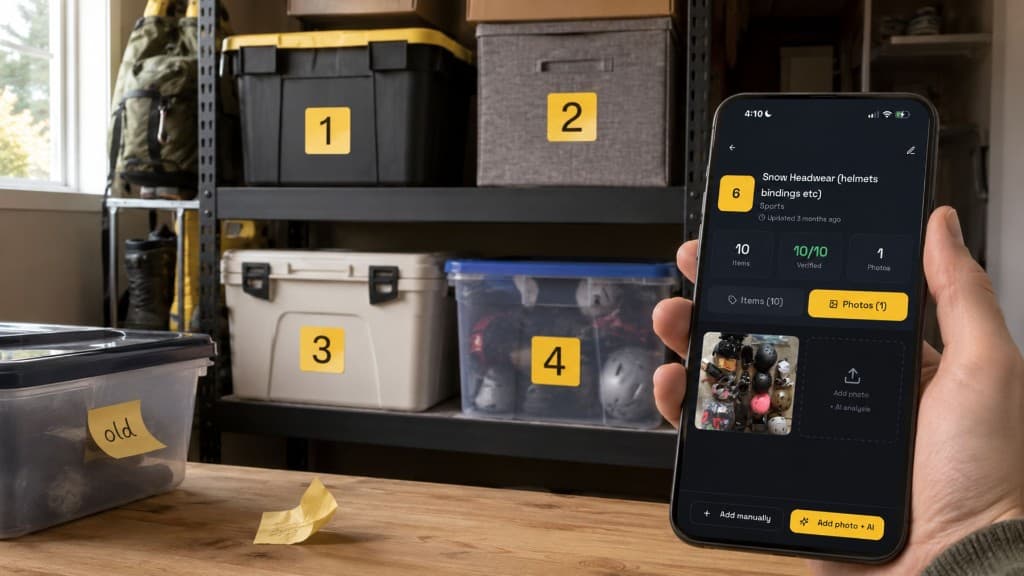
Step 4: Give Every Tote a Number
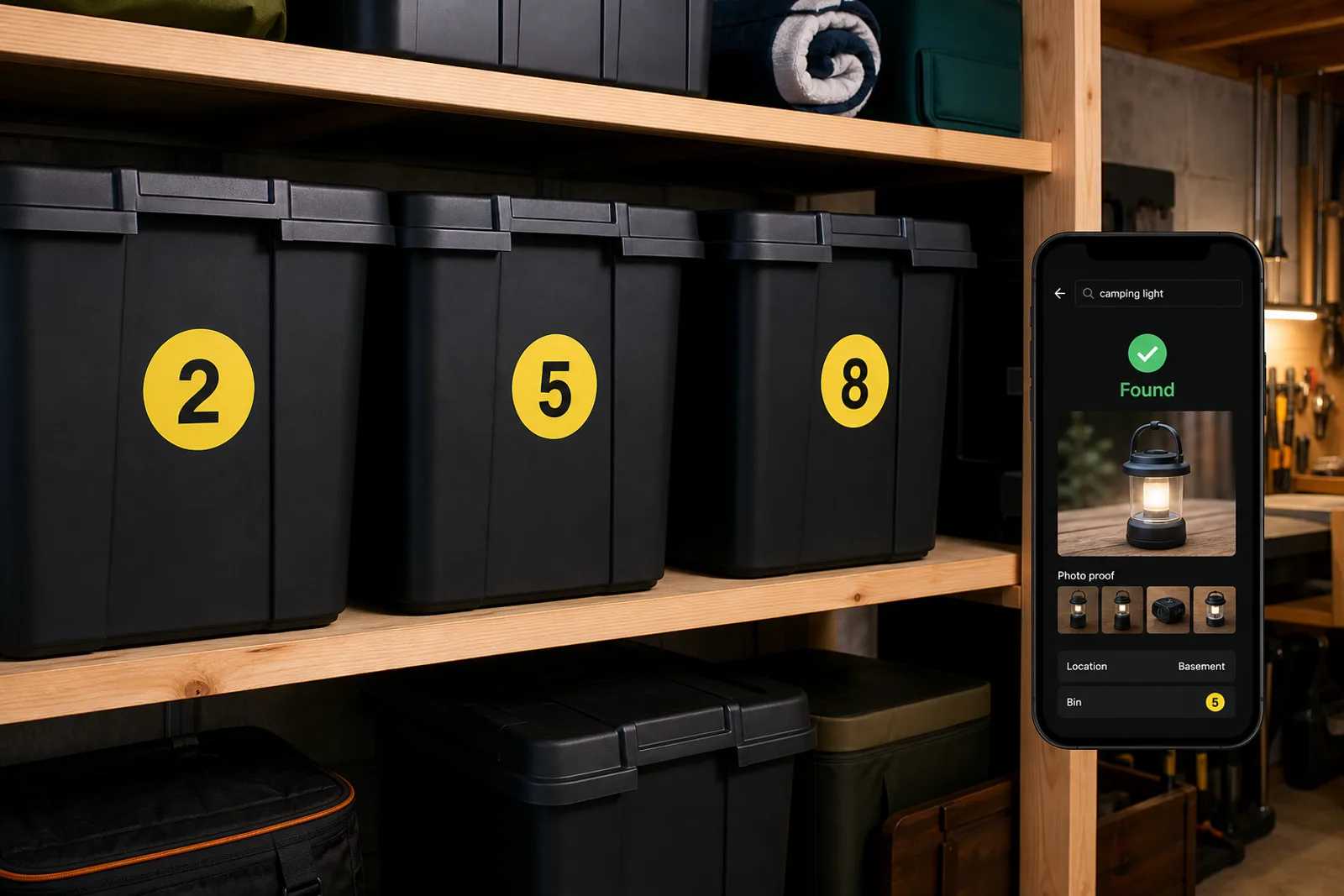
Every tote should have a large, simple number.
Use:
Tote 1
Tote 2
Tote 3
Tote 4
The number gives the tote a permanent identity.
This matters because categories change. A tote that starts as "Holiday Decor" might later include batteries, outdoor timers, gift wrap, extension cords, and spare hooks. If the outside label only says "Holiday," it becomes less helpful over time.
But if the tote is always Tote 6, you can update the contents record without replacing the label.
The number should be easy to see from a distance, especially if totes are stacked, stored on high shelves, tucked under a bed, or placed in a garage with low lighting.
A broad category can still help, but the number should be the anchor.
For example:
Tote 6 — Holiday Setup
Tote 9 — Camping Gear
Tote 12 — Kids 4T–5T
The number identifies the tote. The category gives quick context. The inventory tells the full story.
Step 5: Take a Photo of What's Inside
Before closing the lid, take a quick photo of the tote contents.
This is one of the easiest ways to make totes easier to find later.
Photos help because stored items are visual. You may not remember whether to search for "cord," "adapter," "extension cable," or "green outdoor cord." But if you can see a photo, you can recognize the item faster.
For deep totes, take one photo of the top layer and another after moving larger items aside. For small items, group similar things together before taking the picture.
A useful photo does not need to be perfect. It needs to be clear enough for future-you to understand what was inside when the tote was packed.
Photos are especially helpful for:
- Holiday decor
- Craft supplies
- Kids' clothes
- Garage items
- Camping gear
- Keepsakes
- Moving boxes
- Sentimental items
- Mixed household storage
A photo gives your tote label context.
It is the difference between "Tote 8" and "Oh, that is the tote with the tree lights and outdoor timer."
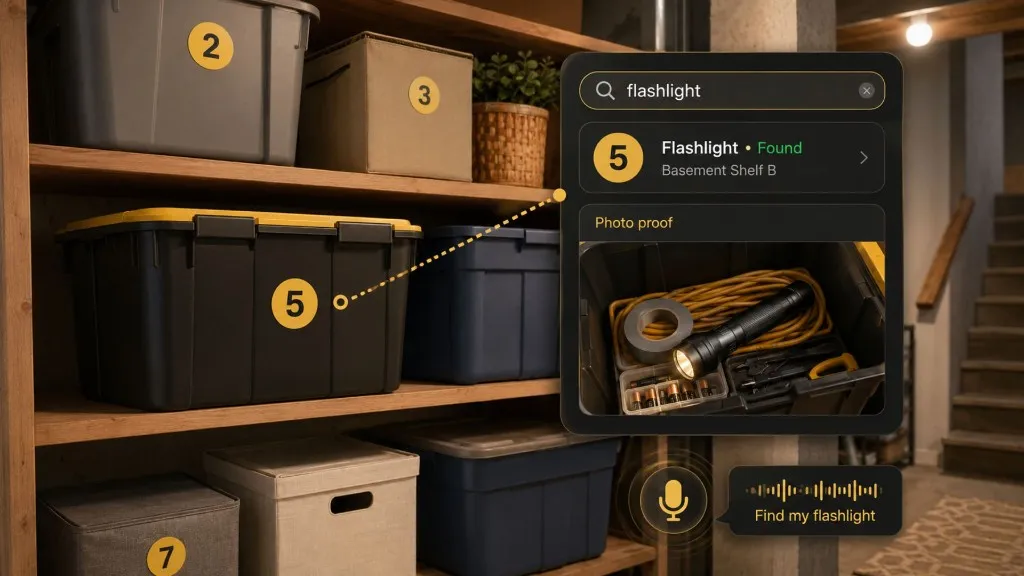
Step 6: Track the Items You Actually Search For
Do not turn your tote system into a full-time data entry project.
You do not need to list every tiny thing. You need to list the things someone will actually look for later.
For example:
Tote 4 — Gift Wrap
Contents: gift bags, tissue paper, ribbon, gift tags, tape, scissors, birthday candles
Tote 7 — Garage Tools
Contents: extension cords, work gloves, bungee cords, flashlight, tape measure, air mattress pump
Tote 11 — Kids Clothes
Contents: 4T rain boots, 5T snow pants, winter coat, soccer cleats, Halloween costume
That level of detail is enough to stop the digging.
Use the words your household uses. If everyone says "camping light," do not overthink it and write "portable LED lantern." A storage system should match real search habits.
The point is not to impress anyone.
The point is to find the thing.
Step 7: Add the Exact Tote Location
A tote inventory is only useful if it tells you where the tote lives.
"Garage" may not be enough.
Use locations like:
Garage shelf, top row, left side
Basement rack, second shelf
Hall closet, top shelf
Primary bedroom, under bed, right side
Storage unit, back wall
Attic, front left corner
This matters because many homes have several storage zones. Holiday decor may live in the garage, kids' clothes in a closet, keepsakes in the basement, and extra bedding under a bed.
A searchable tote record should connect the item to the tote and the tote to the location.
That way, when you search for "air mattress pump," you do not just learn that it is in Tote 7. You know Tote 7 is on the garage shelf, second row, right side. When you are planning shelves, rows, and slots from scratch, plan a tote organizer around retrieval—not just how many bins fit.
That is the difference between a clue and an answer.
Step 8: Store Totes by Use and Frequency
Where you store each tote should depend on how often you need it.
Daily or weekly items should be easy to reach. Seasonal or occasional items can go higher, farther back, or into longer-term storage.
Garage organization experts often recommend using upper shelves or harder-to-reach storage for infrequently used items and keeping frequently used items within easy reach. Livingetc
That simple rule works for all tote storage.
Use easy-access spots for:
- Kids' active gear
- Tools you use often
- Pet supplies
- Cleaning backstock
- Sports gear in season
- Everyday household extras
Use harder-to-reach spots for:
- Holiday decor
- Off-season clothes
- Rarely used party supplies
- Keepsakes
- Camping gear off-season
- Seasonal linens
- Long-term documents
Think of your storage space like a grocery shelf. The things you use most should be easiest to grab.
Step 9: Do Not Stack Totes Too Deep
Stacking saves space, but it can also make storage harder to use.
If you have to move four heavy totes to reach the one you need, the system will slowly fall apart.
Whenever possible, use shelves instead of deep stacks. Shelving lets you slide out one tote without unbuilding the whole pile.
If stacking is unavoidable, stack by frequency:
- Most-used totes on top
- Least-used totes on bottom
- Heavy totes low
- Fragile items protected
- Matching sizes stacked together
Avoid stacking totes so high that they become unsafe or annoying to access.
A storage system you hate using is not really organized. It is just contained.
Step 10: Update the System When Contents Change
Totes change over time.
That is normal.
You add new items. You remove old ones. Someone borrows something. You combine bins after a holiday. Kids outgrow clothes. Seasonal gear rotates. A moving box becomes long-term storage.
The system only needs to stay close enough to reality that you trust it.
Update a tote when:
- You add several new items
- You remove something permanently
- You move the tote to a new location
- You combine two totes
- You change seasonal contents
- You notice the photo no longer matches
The update should be easy. Take a new photo, adjust the key item list, and confirm the location.
Do not aim for perfect.
Aim for useful.
What Not to Do When You Organize Totes
Some tote systems fail because they are too vague. Others fail because they are too complicated.
Avoid both.
Do Not Label Everything "Misc"
"Misc" is a temporary feeling, not a storage category.
If a tote holds mixed items, list the key contents. A mixed tote can still be searchable. A mystery tote cannot.
Do Not Buy Totes Before Sorting
Buying more totes can feel productive, but it can also hide clutter faster.
Sort first. Then choose the tote size and quantity based on what actually needs to be stored.
Do Not Put Too Much Detail on the Outside
A crowded label becomes hard to read.
Keep the outside simple: number plus broad category. Put detailed contents in the searchable record.
Do Not Assume You Will Remember
You might remember for a week.
You probably will not remember next season.
Storage is most useful when it does not depend on memory.
How Totely Makes Totes Searchable
Totely is built for the exact problem storage totes create: you put things away, then forget what is inside.
Instead of relying on vague labels, memory, or opening every bin, Totely helps you make totes, bins, boxes, and hidden storage searchable—see the home inventory app for the photo-and-location workflow.
With Totely, you can:
- Label each tote with a clear number or numbered tag.
- Snap a photo of what is inside.
- Record key items so they are searchable.
- Add the location so you know where the tote lives.
- Search later before opening every container.
That means your garage totes, closet bins, holiday boxes, under-bed containers, craft storage, kids' clothes bins, and moving boxes can all become part of one simple system.
Totely acts like a digital memory layer for your home storage.
Your totes hold the stuff. Totely helps you remember what is inside.
A Simple Tote Organization System You Can Copy
Use this format for each tote:
Tote Number: Tote 5
Category: Camping Gear
Location: Garage shelf, second row
Contents: lantern, tent stakes, air mattress pump, headlamps, camp mugs, rain ponchos
Photo: Taken before closing
Notes: Check batteries before next trip
For the outside label, keep it simple:
Tote 5
Camping Gear
That is enough for the physical tote.
The searchable record holds the details.
Organize Totes FAQs
What is the best way to organize totes?
The best way to organize totes is to sort items by how you use them, give every tote a number, take a photo of the contents, record key searchable items, and add the tote's exact location. This makes it easier to find items without opening every container.
Should I organize totes by room or category?
Use the method that matches how you search. Organize by room if the tote supports one space, like kitchen extras or living room decor. Organize by category if the items are used together, like camping gear, holiday setup, gift wrap, or kids' clothes by size.
How do I label storage totes?
Use a large tote number and a broad category on the outside. Keep detailed contents, photos, notes, and locations in a separate searchable record. This keeps labels readable while still making the contents easy to find.
Are clear totes better than opaque totes?
Clear totes can help you see some contents, but they are not always better. Once clear totes are stacked, packed tightly, or stored high on a shelf, they can still be hard to search. Opaque totes can work well if they are numbered and connected to a searchable inventory.
What should I put in each storage tote?
Put items together based on how they are used. For example, gift wrap should include bags, tissue paper, ribbon, tags, tape, and scissors. Camping gear might include lanterns, tent stakes, headlamps, and camp mugs. The goal is to reduce searching later.
How can Totely help me organize totes?
Totely helps you label totes, photograph contents, record key items, add locations, and search later. It turns storage totes, bins, boxes, and hidden storage into searchable storage so you can find what you need faster.
Make Every Tote Easier to Find
You do not need a perfect storage room to organize totes well.
You need a system that keeps working after the lid closes.
Start with one tote. Sort what belongs inside. Give it a number. Take a photo. Record the items you are likely to search for. Add the location. Prove it works with the One-Tote Test before you tackle every shelf.
With Totely, your totes can become searchable, so you can stop digging through mystery bins and start finding anything fast.