The Storage Container Trap: Why Organized Bins Still Become Impossible to Search
Learn why organized bins become impossible to search and how storage tote labels, photos, and a digital inventory make every tote findable.
By Steve Watts · Co-Founder, Totely
May 26, 2026 · Updated August 27, 2026 · 19 min read
The Storage Container Trap: Why Organized Bins Still Become Impossible to Search
You did the responsible thing.
You bought the storage bins. You sorted the holiday decorations, kids' clothes, craft supplies, tools, keepsakes, camping gear, and mystery cords. You stacked everything neatly in the garage, basement, attic, closet, or storage unit. Maybe you even added labels.
Then, a few months later, you needed one specific thing.
The snow gloves. The air mattress pump. The Christmas tree timer. The tax folder. The extra birthday candles. The blue extension cord you know you own.
So you opened one bin. Then another. Then another.
That is the storage container trap: the moment when organized storage still becomes impossible to search.
The problem is not that you failed at organizing. The problem is that most storage systems stop at the container. They help you put things away, but they do not help you remember what is inside every tote later.
Totely was built around a simple idea: you should be able to store things out of sight without losing track of them.
Quick Links
What Is the Storage Container Trap?
The storage container trap happens when household items are technically organized, but practically impossible to find.
Your shelves may look better. Your bins may be stacked neatly. Your garage or basement may feel more under control. But when you need one specific item, you still have to open multiple containers to find it.
That is because most storage systems are designed around putting things away, not finding things later.
A clear bin can help. A handwritten label can help. A shelf system can help. But none of those fully solve the bigger problem: household storage changes over time.
A tote that starts as "Christmas Decor" may eventually hold tree lights, gift bags, stocking holders, extra tape, ornament hooks, and one random Halloween candle that got tossed in during cleanup.
The outside label stays the same, but the inside story changes.
That is the trap.
Why Organized Bins Still Become Hard to Search
Most people assume storage becomes unsearchable because the area is messy. But even tidy storage can become frustrating if the contents are not easy to remember.
The real issue is that storage containers hide information.
Once an item goes into an opaque tote, it disappears from view. If you only use that item once or twice a year, it also starts to disappear from memory. Holiday decorations, winter gear, baby clothes, tax records, camping supplies, keepsakes, and extra household items are especially easy to lose track of because they spend most of the year out of sight.
A bin can look perfectly organized from the outside while still becoming a black box on the inside.
Labels Describe Categories, Not Contents
Most storage bin labels are broad: "Christmas," "Tools," "Baby Clothes," "Garage," "Crafts," "Decor," or the most dangerous label of all, "Miscellaneous."
Those labels are better than nothing, but they usually do not answer the question you actually have.
You are not really asking, "Where is the holiday category?" You are asking, "Where are the red ornaments?" or "Where is the camping lantern?" or "Where are the 3T snow pants?"
A category label helps you guess. It does not help you know.
That is why storage tote labels need to do more than name the general theme of a container. The best label should help you find the actual item inside without opening every bin.
Contents Change, But Labels Do Not
Storage is not static. Real households move things around constantly.
You take something out. You add something new. Someone else puts an item back in the closest available bin. After a holiday, you clean up quickly and combine containers. During a move, you pack based on speed instead of perfect categories.
That is normal. The problem is that traditional labels cannot keep up.
A label that was accurate in January may be wrong by March. A bin that once held only "Winter Gear" may now hold snow boots, pet sweaters, spare batteries, and a box of light bulbs.
The label is still readable. It is just no longer reliable.
Family Members Use Different Logic
One person's "garage supplies" is another person's "tools." One person's "holiday decor" is another person's "living room decorations." One person's "kids' clothes" is another person's "hand-me-downs."
When multiple people use the same storage system, labels can become even less dependable in shared garages, closets, basements, apartment storage rooms, moving boxes, and storage units.
This is why a good storage system needs more than a label. It needs shared household memory—a single place everyone can search, even if they would have labeled the tote differently themselves.
The System Depends Too Much on Your Memory
Most storage systems quietly depend on future-you remembering what past-you did.
That works for a week or two. It breaks down once seasons change, kids grow, boxes move, hobbies shift, or someone else adds items to the closest available container.
The storage did its job. Your memory should not have to.
Why Traditional Storage Bin Labels Fail
Storage bin labels are useful. The problem is not labeling itself. The problem is expecting one small label to do the work of a full inventory.
A label can identify a container. It cannot always explain what is inside that container right now.
Handwritten Labels Are Fast, But Limited
Handwritten labels are easy to create, which is why so many people start there. A strip of masking tape and a marker can quickly turn a blank tote into "Christmas," "Tools," or "Baby Clothes."
The trouble starts later. As contents change, handwritten labels become messy. You cross things out, add extra notes, tape over old labels, or eventually ignore the label altogether. The container may still have a name, but the name no longer reflects everything inside.
Handwritten labels are helpful for the first layer of organization. They are not enough for searchable storage.
Printable Labels Look Nice, But Still Go Out of Date
Printable labels can make shelves look clean and polished. They are great for creating a consistent look across bins, closets, and garage shelves.
But a pretty label can make a storage system look finished before it is actually findable.
A polished label that says "Holiday Decor" looks better than masking tape, but it still does not tell you whether the spare ornament hooks, outdoor timer, red ribbon, or stocking holders are inside.
The issue is not the appearance of the label. The issue is the missing information behind it.
Clear Bins Help Visually, But Only to a Point
Clear bins can be useful when items are large, colorful, and easy to recognize. They work well for things like pillows, yarn, wrapping paper, or sports balls.
But clear bins become less helpful when they are stacked high, packed tightly, filled with small items, stored in dim spaces, or covered by other containers. They show the outer layer. They do not give you a searchable list of contents.
If you have ever stared at a clear bin and still had to open it to know what was inside, you have already experienced the limit of visual storage.
Color Coding Helps Sort, But Not Search
Color coding can be great for broad categories—orange for Halloween, red and green for Christmas, blue for winter gear, gray for garage tools.
That helps with sorting. It does not fully solve searching.
Color coding can tell you, "This is probably seasonal." It cannot tell you, "The replacement Christmas bulbs are in Tote 14."
That difference matters.
The Hidden Cost of Unsearchable Storage
The storage container trap is annoying, but it also creates real household costs.
You lose time opening bins. You move one tote to reach another. You open the wrong container, find something unrelated, and create a small mess while trying to solve a simple problem.
You also buy duplicates. When you cannot find something, it is easy to assume you do not have it. That is how households end up with extra tape, batteries, gift bags, extension cords, light bulbs, craft supplies, winter gloves, and small tools they already own somewhere.
Sometimes the cost is not buying more. Sometimes the cost is using less of what you already own.
Craft supplies stay untouched because they are hard to find. Camping gear feels like too much effort to pull together. Holiday decorations get skipped because the pieces you want are buried somewhere. Kids' clothes are discovered after the child has already outgrown them.
Unsearchable storage makes your own belongings less useful.
And maybe most frustrating of all, it makes you lose confidence in a system you already spent time building. When you organize and still cannot find what you need later, it feels like you failed.
But you did not fail. The system was incomplete.
Physical organization helps you store things neatly. Digital memory helps you find them again. You need both.
The Better Question: "How Will I Find This Later?"
Most storage advice focuses on what to do before you put things away: sort by category, use matching bins, label everything, put heavy items on lower shelves, keep seasonal items together.
That advice is helpful, but it misses the question that matters most:
How will I find this later without opening every bin?
A better storage system starts with retrieval in mind.
Before you close a tote, ask what you would search for if you needed the item six months from now. Think about the words another family member might use. Consider whether the item belongs to a room, season, person, hobby, holiday, event, or size.
This small mindset shift changes everything. You are no longer just storing things. You are creating a system your future self can actually use.
How to Escape the Storage Container Trap
You do not need to reorganize your entire home in one weekend. In fact, the best storage systems are the ones you can maintain in real life.
Start with one shelf, one category, or even one tote.
Step 1: Give Every Tote a Unique ID
Every storage container should have a unique identifier—Tote 1, Garage 03, Holiday 08, Basement 12, or Kids Clothes 05. The exact format matters less than consistency.
The goal is to make each container easy to identify without relying only on a vague category label. A unique tote number is especially helpful when bins look alike. Instead of saying, "It is probably in one of the gray bins on the left," your system can say, "It is in Tote 12."
That is a big difference.
Step 2: Use Labels That Work From Close Up and Far Away
The best storage tote labels do two jobs: they identify the tote visually, and they connect the tote to more detailed contents.
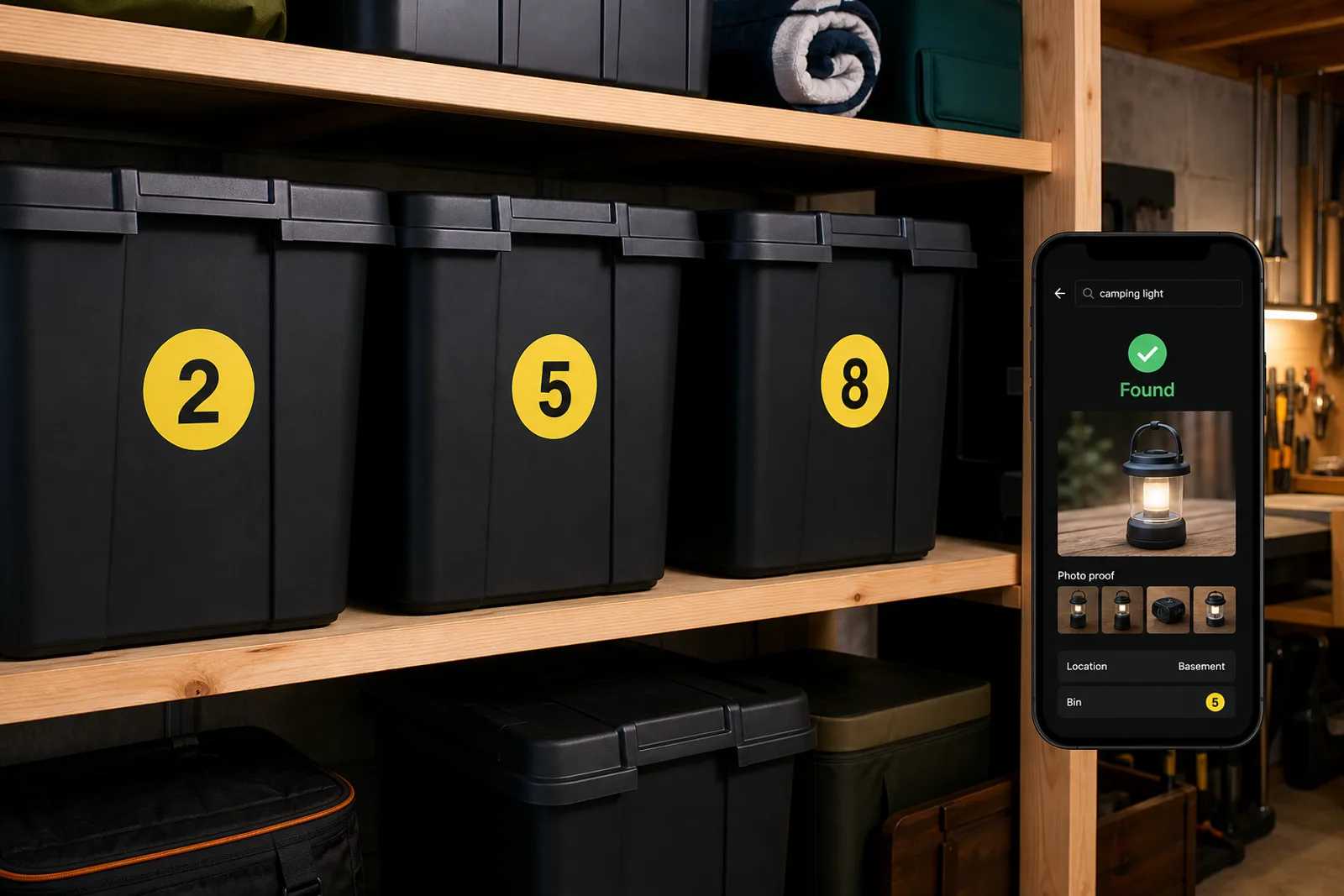
A large visible number helps you spot the right bin from across the garage, attic, basement, or storage room. A searchable photo inventory on your phone shows what is inside without opening the tote.
That combination works in real-life conditions—dim garages, high shelves, stacked totes, quick cleanups, moving boxes, and shared family spaces. A good label should help you find the tote before you touch it.
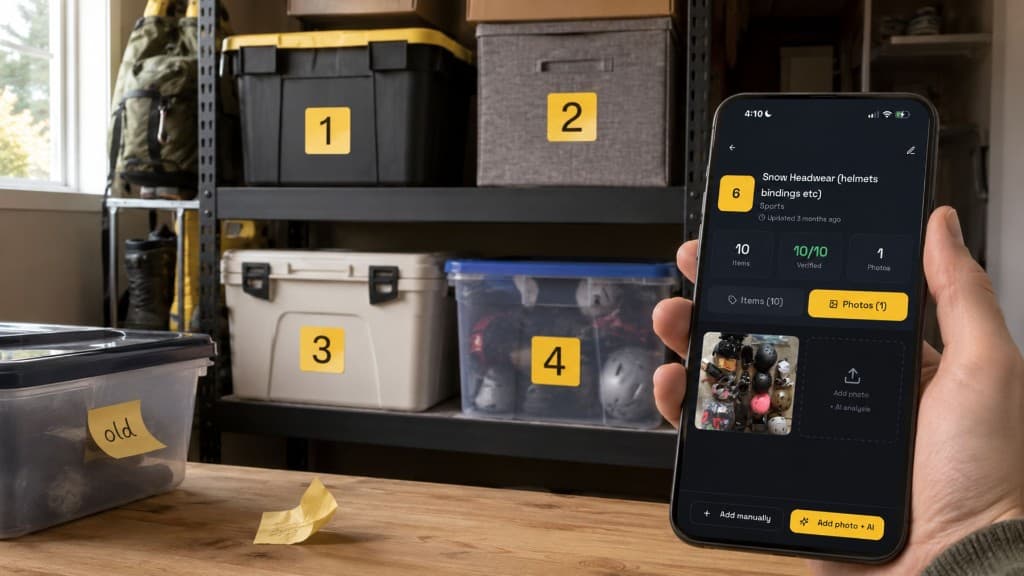
Step 3: Take a Photo Before You Close the Bin
A photo is one of the easiest ways to make a storage bin more searchable.
Before you close the lid, take a quick picture of the contents. It does not need to be perfect. It only needs to give you enough visual proof to recognize what is inside later.
Photos are especially helpful for bins that hold mixed items—holiday decor, craft supplies, baby clothes, keepsakes, electronics, party supplies, camping gear, office records, and moving boxes.
A photo gives your future self context that a label cannot.
Step 4: Record the Items People Actually Search For
You do not need a perfect museum-level inventory of every tiny object. That gets overwhelming fast.
Instead, record the items someone in your household is likely to search for later. A "Christmas Decor" tote might include white tree lights, red ornaments, stocking holders, and an outdoor timer. A "Camping Gear" tote might include tent stakes, headlamps, and an air mattress pump. A "Kids Clothes" tote might include a 3T winter coat, 4T rain boots, and snow pants.
The goal is not perfection. The goal is findability.
Step 5: Add Location Details
A searchable storage system should tell you more than what bin an item is in. It should also tell you where that bin lives.
"Christmas lights are in Tote 8" is helpful. "Christmas lights are in Tote 8, garage shelf, top left" is much better.
Location details matter because many households have more than one storage zone. A tote number is useful. A tote number plus location is powerful.
Step 6: Update the Inventory When Contents Change
A storage system only works long-term if it is easy to update.
This is where many manual systems fail. A spreadsheet may work for a week. A notebook may work until it gets misplaced. A label may work until the contents change.
When you remove or add something, update the tote record. When you combine bins after a holiday, update the contents. When you move a bin from the garage to a storage unit, update the location.
The system does not need to be perfect. It needs to stay close enough to reality that you trust it.
How Totely Makes Storage Bins Searchable
Totely is designed for the exact moment when regular storage labels stop being enough.
Instead of relying on memory, vague labels, or repeated bin-opening, Totely helps you create a searchable record of what is inside each tote.
Label the Tote
Each tote gets a clear numbered label that is easy to identify from a distance. The number links the physical tote to a photo-based digital inventory you can search anytime.
The label is not just a name tag. It is a bridge to what is inside.
Snap the Contents
Before closing the tote, take a photo of what is inside.
This gives you visual proof for later. Instead of wondering whether you are opening the right container, you can check the photo first.
For busy households, this is a huge improvement over trying to type every item by hand.
Search Naturally
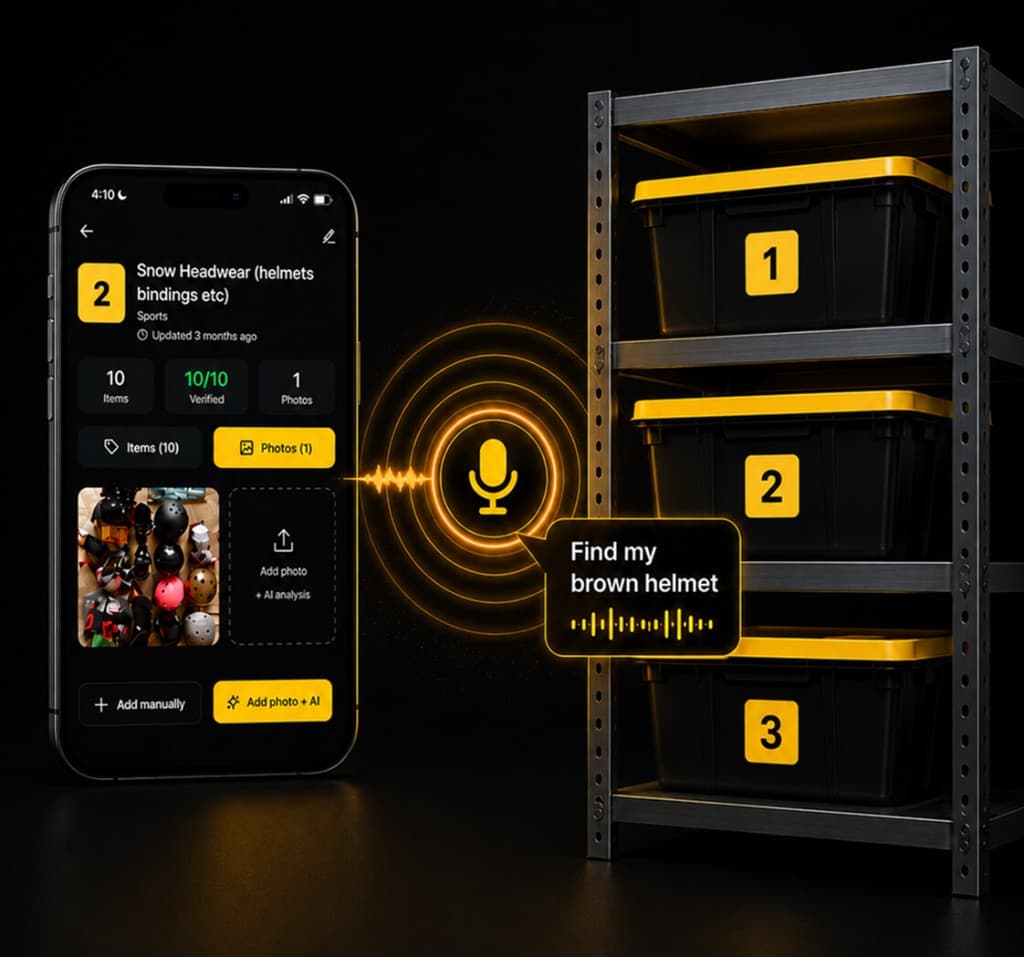
When you need something later, search for the item instead of searching through bins.
You might search "camping tent," "Christmas lights," "3T winter coat," "gift bags," "glue gun," "tax folder," "Halloween candles," or "air mattress pump."
The goal is simple: find the right tote before you start digging.
Keep Storage Useful Over Time
The real benefit of Totely is not just the first day you organize. It is the day months later when you need one specific thing and can actually find it.
That is the difference between organizing once and maintaining a system.
Totely acts as the digital memory layer for your physical storage. Your bins hold the stuff. Totely helps you remember what is inside.
Best Places to Use a Searchable Storage System
The storage container trap can happen anywhere, but some areas are especially prone to it.
Garage Storage Totes
Garages often hold a mix of tools, holiday decor, sports gear, car supplies, gardening items, outdoor toys, and extra household goods. That makes garage storage one of the best places to use numbered tote labels and a digital inventory—so you can search for an extension cord instead of opening six bins.
Holiday Decoration Bins
Holiday decor is a perfect example of storage that feels organized until you need one specific strand of lights, wreath, or ornament. A searchable system helps because seasonal items sit in bins for most of the year, then demand precision when the season arrives.
Kids' Clothes and Hand-Me-Downs
Kids' clothing storage gets confusing quickly because size, season, child, and condition all matter. A searchable tote system can help you find the right size before it is outgrown and separate items to save, donate, repair, or pass along.
For parents, this can turn a stressful pile of "future clothes" into a system that is actually useful when the next growth spurt hits.
Moving Boxes
Moving boxes are storage containers with a deadline. A searchable moving system helps you record room, box number, priority, fragile items, and destination—especially when you will not unpack everything right away.
Instead of opening every box labeled "Kitchen," you can search for the coffee grinder, serving tray, or first-night essentials.
Craft and Hobby Supplies
Craft supplies are easy to overbuy because small items disappear into bins, drawers, and boxes. If you have ever purchased something twice because the original was "somewhere," craft storage is often the first category worth fixing.
Sentimental Items and Keepsakes
Sentimental storage is emotionally important but rarely used. That makes it easy to forget what you saved and where you saved it.
A photo-based record can help you remember what is in each keepsake box without opening every container. Searchable storage is not only about efficiency. Sometimes it is about making meaningful things easier to find again.
A Simple One-Tote Test
If your storage area feels overwhelming, do not start with every bin. Start with one tote.
Choose a container that causes regular frustration—the holiday bin you open every year, the kids' clothes bin you keep meaning to sort, the garage tote with random tools, the craft bin that always gets messy, or the keepsake box you do not want to forget.
Then give it a unique number, take a photo, record the most searchable items, and put it back in a specific location.
That one tote will show you the difference between stored and searchable. Once you feel the relief of finding something without digging, it becomes much easier to repeat the system. Follow Totely’s One-Tote Test to run the same loop with photo proof and search.
What to Put on a Storage Tote Label
A good storage tote label should be simple on the outside and detailed behind the scenes.
On the physical label, include a large tote number, a broad category, and an optional location name.
Example:
Tote 08
Holiday Decor
Garage Shelf A
Inside the digital record, include what would be too much for a physical label: specific item names, photos, location, category, season, notes, and the last updated date.
For example:
Tote 08: Holiday Decor
Location: Garage Shelf A, top row
Contents: white tree lights, red ornaments, mantel garland, stocking holders, ornament hooks, outdoor timer, tree skirt
Notes: fragile ornaments are inside the small red box
That combination gives you a clean physical label and a detailed searchable storage inventory.
Why "More Bins" Is Not the Same as Better Organization
Buying more containers can make a space look cleaner, but it does not automatically make the space easier to use.
In fact, more bins can sometimes make the storage container trap worse, because more bins mean more places an item could be hiding.
The goal is not just to contain your belongings. The goal is to create a system where you can retrieve them without stress.
A better storage system answers four questions:
- What do I own?
- Which tote is it in?
- Where is that tote located?
- Can I confirm it before opening the bin?
When your system can answer those questions, your storage becomes useful again.
The Future of Home Storage Is Searchable
For years, home organization has focused on how storage looks: matching bins, pretty labels, clean shelves, and satisfying before-and-after photos.
Those things are nice. But they are not enough.
The next step is searchable storage—containers connected to the information you need later.
It means you can find the camping lantern without unpacking the garage. You can locate the winter gloves before the first snow day. You can pull out the birthday candles without checking four kitchen bins. You can find the right hand-me-down size before your child outgrows it.
Most importantly, your future self does not have to remember every decision your past self made.
That is the real goal of organization: not just putting things away, but being able to find them when life asks for them back.
Storage Container Trap FAQs
What is the Storage Container Trap?
The storage container trap is what happens when items are placed into bins, boxes, or totes and become difficult to find later. The space may look organized, but the contents are not searchable, so you still have to open multiple containers to find one item.
Why do storage bin labels stop working?
Storage bin labels often stop working because contents change over time. A label like "Holiday Decor" or "Garage Supplies" may be accurate at first, but it rarely lists every specific item inside. Once items are added, removed, or moved around, the label becomes less reliable.
What is the best way to label storage bins?
The best way to label storage bins is to use a unique tote number, a clear category, and a searchable photo inventory. A visible number helps you identify the tote from a distance; the digital record shows what is inside.
How do I make storage totes searchable?
To make storage totes searchable, give each tote a unique ID, take a photo of the contents, record specific items, and include the tote's location. A home inventory app like Totely can help you search for an item and see which tote it is in without opening every bin.
Are clear storage bins better than labeled bins?
Clear storage bins can help you see some contents, but they are not always enough. They become harder to use when stacked, packed tightly, stored in dark areas, or filled with small items. Labeled and searchable bins are more reliable when you need to find one specific item quickly.
What should I inventory first?
Start with the storage area that frustrates you most. For many households, that is holiday decor, garage storage, kids' clothes, craft supplies, camping gear, moving boxes, or keepsakes. You do not need to inventory everything at once. Start with one tote and build from there.
Make One Tote Searchable Today
The storage container trap does not happen because you are disorganized. It happens because most storage systems hide the details you need later.
You already did the work of putting things away. Now make sure you can find those things again.
Start with one tote. Label it. Snap the contents. Record what is inside. Give it a clear location.
With Totely, every tote can become searchable, so you can stop opening every bin and start finding what you need faster.