How to Keep Track of Storage Bins
How to keep track of storage bins over time with numbers, photos, exact locations, and searchable records.
By Ben Stallsworth · Co-Founder, Totely
April 8, 2026 · Updated August 27, 2026 · 15 min read
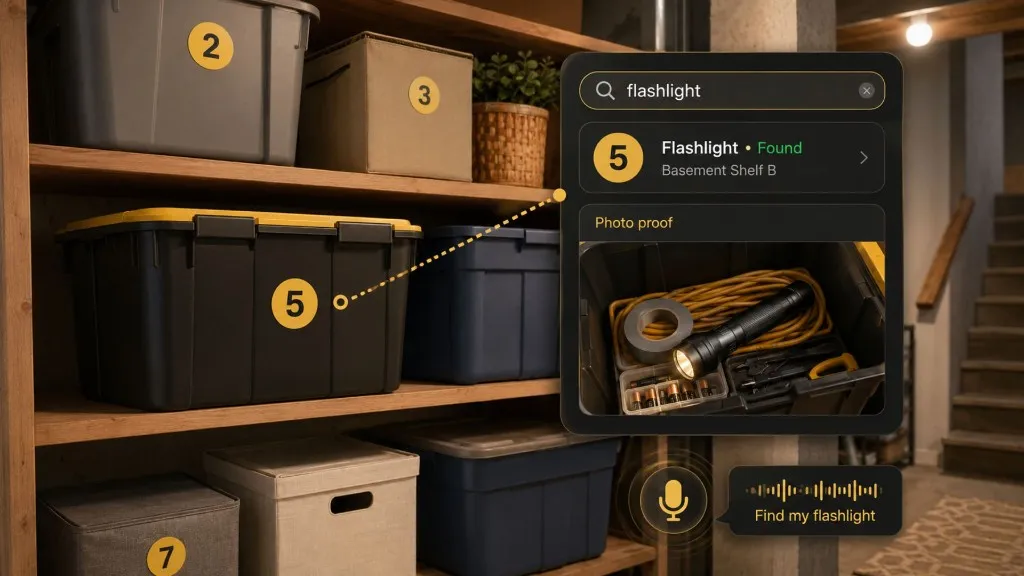
This article owns tracking and memory—keeping bins findable after moves, seasons, and content changes. Labeling steps live in how to label storage bins. For labels that stay useful when contents change, pair simple tote numbers with a searchable record.
Storage bins are easy to fill and stack.
They are much harder to track over time.
At first, everything makes sense. Christmas decorations go in one bin. Camping gear goes in another. Kids' clothes, baby clothes, craft supplies, winter coats, beach towels, holiday wrapping supplies, school papers, tools, garden gloves, sports gear, guest linens, and household backstock all get their own containers.
Then life keeps moving.
A bin gets shifted from the garage to the attic. A seasonal tote moves under the bed. A moving box becomes long-term storage. The camping bin loses the tent stakes but gains extra batteries. The Christmas bin gets ribbon, replacement bulbs, extension cords, and gift tags tossed in after cleanup. The kids' clothes bin changes sizes. The craft bin fills with yarn, vinyl rolls, and half-finished projects.
Suddenly, you still own the item — you just do not know where it is.
That is the real challenge when you keep track of storage bins: not just what is inside, but where each bin lives, when it changed, and how to find one specific item later without opening everything. If those bins live on a garage rack, plan a tote organizer so rack positions stay as findable as the bin numbers.
A good storage bin tracking system should be simple enough to maintain and detailed enough to trust.
Quick Links
- Why Storage Bins Become Hard to Track
- Give Every Bin a Simple Number
- Track What Is Inside, Not Just the Category
- Save the Exact Location of Each Bin
- Use Photos So You Do Not Rely on Memory
- Update Bins When Contents Change
- Make the System Work for the Whole Household
- Avoid the Spreadsheet Trap
- How Totely Helps You Keep Track of Storage Bins
- Storage Bin Tracking FAQs
Why Storage Bins Become Hard to Track
Storage bins become hard to track because they change quietly.
Most bins do not stay perfectly categorized. They become useful containers for whatever needs a home at the time: seasonal swaps, holiday cleanup, camping trips, home projects, kids growing, moving, school years, guest visits, hobbies, repairs, and household backstock.
The label may stay the same, but the contents do not.
A bin labeled "holiday" may hold Christmas decorations, holiday lights, wrapping supplies, batteries, tape, gift tags, and extra extension cords. A bin labeled "camping" may hold camping gear, tent stakes, headlamps, rain ponchos, bug spray, dry bags, and a first-aid kit. A bin labeled "kids" may hold baby clothes, seasonal clothing, school papers, winter coats, and sentimental artwork.
The second problem is location drift.
A storage bin may start in the garage, move to the basement, get tucked into a hallway closet, slide under a bed, or end up in a storage unit. Once bins move, memory starts to fail. If bins go off-site, keep a storage unit searchable with zones, numbered containers, and saved locations — not just a list of bin numbers.
That is normal. It does not mean you are disorganized.
It means your system needs to track more than a label.
You need a simple way to know:
What is inside? Where is it now? When did it change? What specific item am I trying to find?
Give Every Bin a Simple Number
The easiest way to start tracking storage bins is to give each one a simple number.
Not a long label. Not a paragraph on the lid. Not a category that will become outdated.
A number.
Use large, clear numbers that are easy to read from a shelf:
1 2 3 4
The number gives each bin a stable identity. Even if the contents change, the bin is still Bin 1. Even if it moves from the garage shelf to the hall closet, it is still Bin 1.
That matters because tracking depends on consistency.
A category label like "garage" can become inaccurate. A number stays useful.
For example:
Bin 1 might start as Christmas setup supplies. Bin 2 might hold camping first-open gear. Bin 3 might store kids' winter clothing. Bin 4 might hold craft supplies. Bin 5 might hold household backstock.
If Bin 3 moves from under the bed to the hallway closet, you do not need a new identity. You only update the location.
That is why numbered bins are easier to maintain over time.
They give your storage system a stable backbone.
See storage tote labels that work for why numbers beat long exterior labels when contents change.
Track What Is Inside, Not Just the Category
Categories help you get close.
Specific contents help you find the item.
A bin category might be "camping gear." But if you are looking for tent stakes, headlamps, flashlights, batteries, rope, rain ponchos, or a repair kit, that category may still leave you opening multiple bins.
A useful storage bin tracking record should include the words people actually search for later.
Weak: Camping
Better: Camping first-open gear — tent stakes, ground tarp, headlamps, lanterns, batteries, first-aid kit, rain ponchos, repair kit.
Weak: Garage
Better: Quick repair — batteries, extension cords, tape, work gloves, flashlight, small tools, hardware.
Weak: Kids
Better: Kids' winter clothing — winter coats, gloves, hats, scarves, snow pants, boots, seasonal shoes.
Weak: Memories
Better: Sentimental keepsakes — family recipes, photo albums, school papers, handwritten letters, small heirlooms.
The goal is not to record every tiny object forever. It is to capture the key items someone will actually try to find.
If you would ask, "Where are the extension cords?" or "Do we still have holiday lights?" or "Which bin has the baby clothes?" then those words belong in the record.
Save the Exact Location of Each Bin
A storage bin record is incomplete without location.
"Garage" is better than nothing, but it may not be enough.
A useful location sounds like this:
Garage shelf, top row Hall closet, left side Under bed, left side Attic shelf, back corner Basement shelf, second row Storage unit, front shelf Entry closet floor Craft room cabinet, bottom shelf
Exact location matters because storage often spreads across the home.
Christmas decorations may live in the attic. Guest linens may be in a storage bench. Seasonal clothing may be under the bed. Craft supplies may be in a closet. Camping gear may be in the garage. Moving boxes may sit in a storage unit. Household backstock may be in a hallway closet.
All of that can work beautifully, but only if the system remembers the locations for you.
A good tracking record should capture:
Bin number Location Photo Key contents Category or use case Notes for fragile, sentimental, or seasonal items Last updated date, if available Who updated it, if shared household tracking is supported Whether anything needs restocking, repair, cleaning, donating, or seasonal rotation
That may sound like a lot, but it does not have to become administrative work.
The core record is simple: number, photo, contents, location.
Everything else is optional context that helps when it matters.
For small homes where bins live in many places, see seasonal storage ideas for small homes.
Use Photos So You Do Not Rely on Memory
Photos make storage bin tracking much easier.
A written list can tell you that a bin has "holiday lights," but a photo can show whether they are indoor lights, outdoor lights, white lights, colored lights, net lights, or a small tangle of replacement bulbs and clips.
A list can say "craft supplies," but a photo can show yarn colors, vinyl rolls, ribbon, paint pens, project bags, and tools.
A list can say "kids' clothes," but a photo can show winter coats, baby clothes, snow pants, boots, seasonal shoes, or school-year items.
This matters because people recognize things faster than they recall them from memory. The Nielsen Norman Group usability guidance explains that reducing memory burden and making information visible can lower cognitive effort, which is the same principle that makes photo-based storage records easier to use than memory alone.
A photo also helps the whole household.
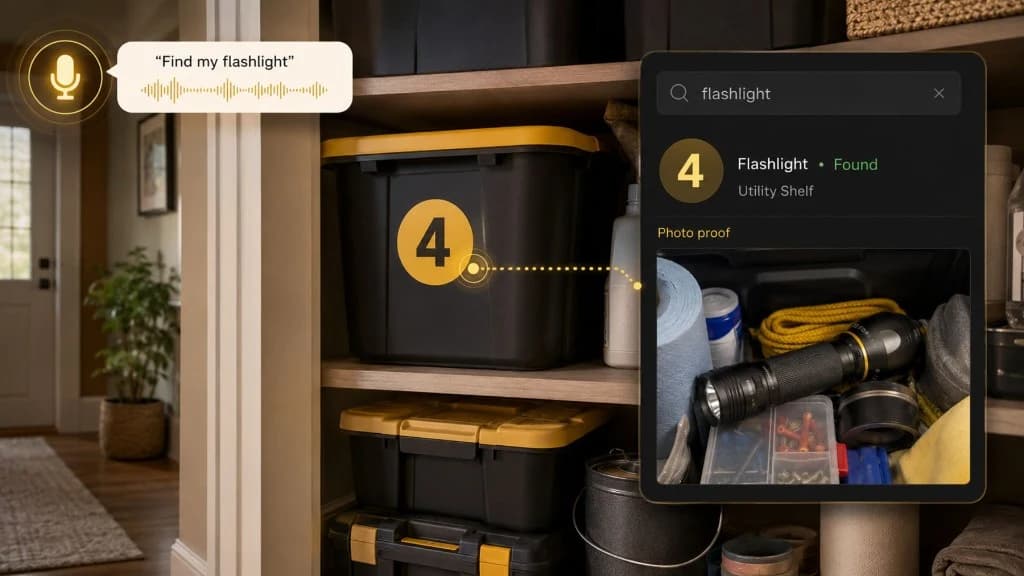
One person might search "camping lights." Another might search "headlamps." Someone else might search "flashlights." The photo gives visual proof that everyone can understand.
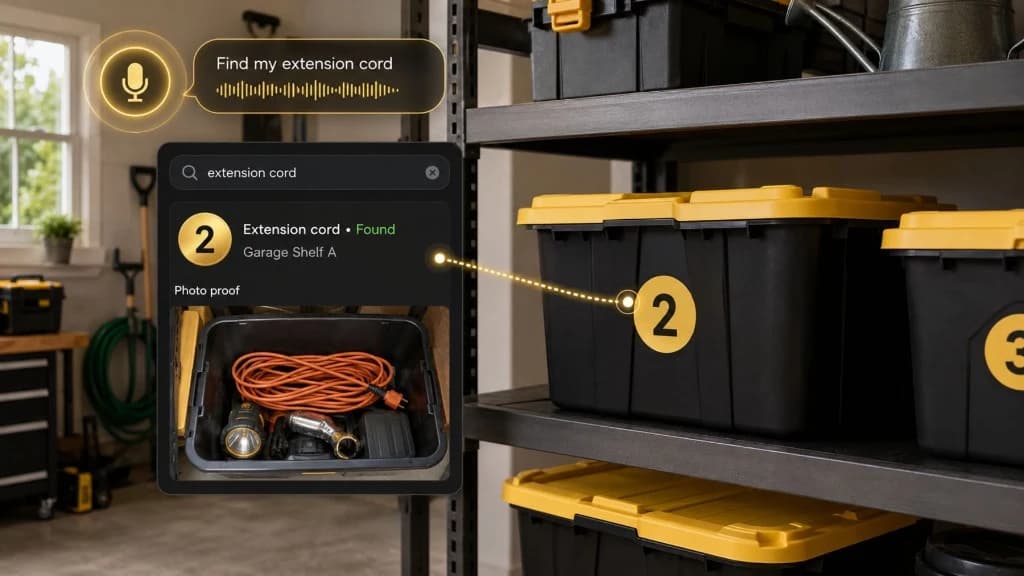
That is why photo proof is so powerful: it confirms the bin before you open it.
Update Bins When Contents Change
Storage bin tracking only works if updates are easy.
The moment updating feels like a chore, the system starts falling behind.
You do not need to update every bin every week. You only need to update bins when something meaningful changes.
Good update moments include:
Seasonal swaps When winter coats, beach towels, holiday decor, rain gear, or seasonal clothing move in or out.
After holidays When Christmas decorations, holiday lights, wrapping supplies, batteries, gift tags, ribbons, and extension cords are packed away.
After camping trips When camping gear, tent stakes, headlamps, rain ponchos, dry bags, repair kits, and first-aid supplies change.
After kids grow When baby clothes, kids' clothes, seasonal shoes, school papers, winter gear, or sentimental items move sizes or stages.
After moves or renovations When moving boxes become long-term storage, or bins shift to new closets, attics, basements, garages, or storage units.
After household projects When tools, hardware, garden gloves, sprinkler parts, batteries, extension cords, and small appliances get used, moved, or replaced.
After restocking or repair When something needs more batteries, cleaning, repair, donation, or seasonal rotation.
The update should be quick: open the bin, snap a new photo, adjust the key contents if needed, and confirm the location.
The easier the update, the more likely the system is to survive real life.
For topic-specific packing workflows, see how to organize Christmas decorations in storage bins, how to organize camping gear in storage totes, how to organize 27 gallon storage bins, and how to organize kids clothes by size.
Make the System Work for the Whole Household
A storage bin system should not rely on one person being the keeper of all household knowledge.
If only one person knows where the guest linens, school papers, holiday wrapping supplies, beach towels, family recipes, garden gloves, and small appliances are stored, the system is fragile.
A shared tracking system makes stored items easier for everyone to find and return.
The language should match the household, not a formal inventory system. Use the words people actually say:
"Snow pants" instead of "winter outerwear." "Beach towels" instead of "summer textiles." "Extension cords" instead of "utility cables." "Baby clothes" instead of "infant apparel." "Family recipes" instead of "culinary documents."
This is where many systems fail. They use categories that sound organized but do not match how people search.
A good shared system should answer questions like:
"Where are the batteries?" "Which bin has the guest sheets?" "Do we still have sprinkler parts?" "Where did the camping headlamps go?" "Which box has the small appliances?" "Where are the Christmas gift tags?" "Did we keep the baby clothes?" "Where are the family recipes?"
The easier the system is for everyone to use, the less the household depends on memory.
Avoid the Spreadsheet Trap
A spreadsheet can help track storage bins, especially if you like rows, columns, and manual control.
But spreadsheets often fail for storage bins because the real work happens away from the desk.
You are usually standing in a garage, digging under a bed, opening a hallway closet, unpacking a moving box, cleaning up after Christmas, or getting camping gear ready. In that moment, opening a spreadsheet, finding the right row, typing updates, and adding photos can feel like too much.
That is not a motivation problem. It is a friction problem.
The Nielsen Norman Group defines interaction cost as the mental and physical effort required to complete a task, including actions like typing, searching, switching attention, and remembering information. Systems with lower effort are easier to keep using.
For storage bin tracking, lower friction usually means:
Use a number instead of rewriting labels. Use a photo instead of relying on memory. Use natural search instead of scanning rows. Use exact locations instead of vague categories. Update only when contents actually change.
The best system is not the most detailed one.
It is the one you will actually keep current.
How Totely Helps You Keep Track of Storage Bins
Totely is built for the exact problem storage bins create: useful things get packed away, then become hard to find later.
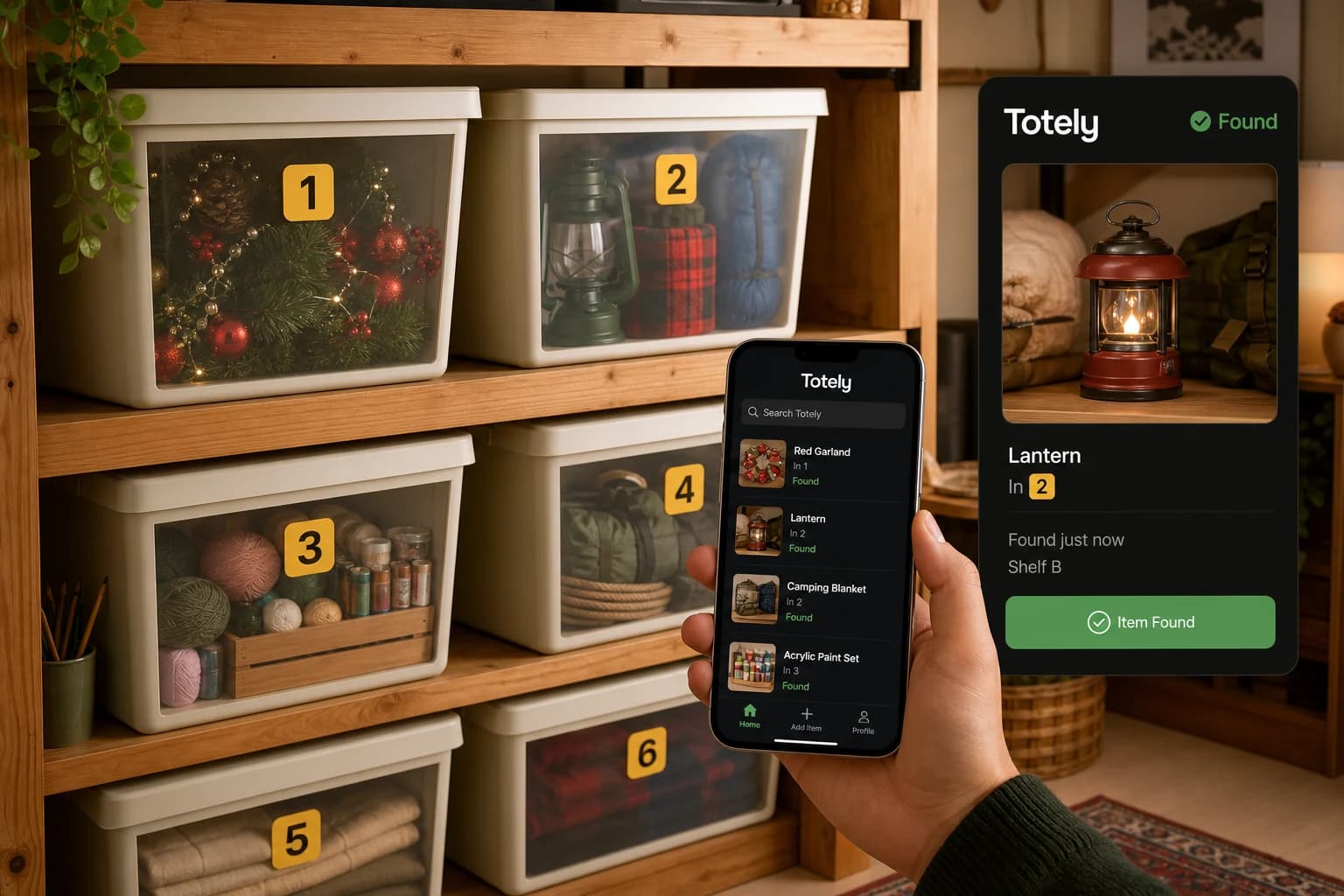
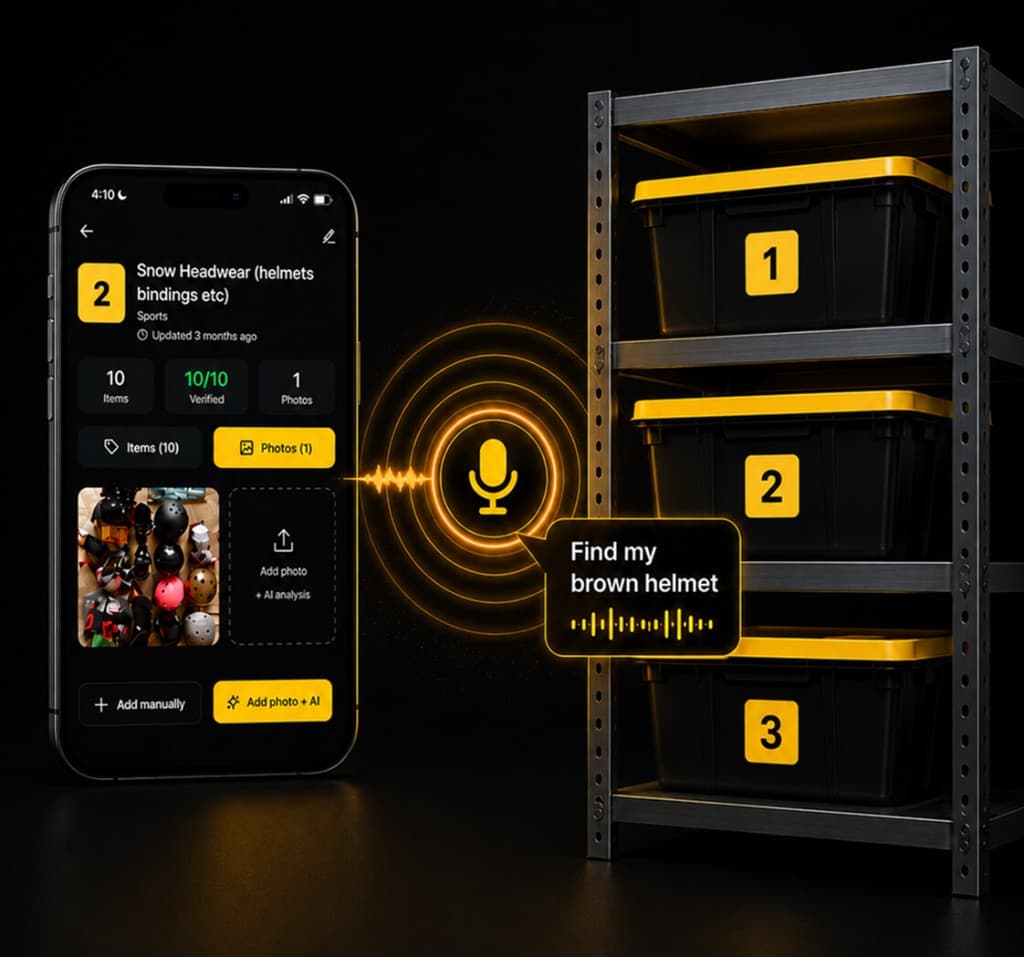
Instead of relying on memory, vague labels, or a spreadsheet that depends on manual updates, Totely helps you make bins, totes, boxes, shelves, and storage zones searchable with a searchable home inventory.
Here is the simple flow:
Number the bin, tote, box, shelf, or storage zone
so it has a clear identity.
Snap a photo
of what is inside.
Let AI build the first item list
from what it can see.
Review or edit if needed
so the words match how your household searches.
Save the exact location
such as "garage shelf top row," "hall closet," "under bed left side," "attic shelf," or "storage unit front shelf."
Add notes for fragile, sentimental, seasonal, restock, cleaning, or repair items
when useful.
Search naturally later
for "holiday lights," "tent stakes," "baby clothes," "guest linens," "family recipes," "extension cords," or "sprinkler parts."
Use photo proof
to confirm what is inside before opening the bin.
Totely does not require QR codes, barcodes, or manual entry of every item.
It simply reduces the maintenance friction: number the container, snap one photo, review the first item list, save the location, and search later.
That is how storage bins become searchable instead of just stacked.
Try the One-Tote Test on one bin, or see garage storage ideas for totes and bins for a full garage layout.
A Storage Bin Tracking System You Can Copy
Here is a simple system you can adapt across garages, closets, attics, basements, storage units, under-bed spaces, shared family areas, and moving boxes.
A Storage Bin Tracking System You Can Copy
Bin 1: Christmas Setup
Location: Attic shelf, front left. Contents: Christmas decorations, holiday lights, ornament hooks, wrapping supplies, gift tags, replacement bulbs, batteries. Notes: check lights before next season.
Bin 2: Camping First-Open Gear
Location: Garage shelf, middle row. Contents: camping gear, tent stakes, ground tarp, headlamps, lanterns, rain ponchos, first-aid kit, repair kit. Notes: restock batteries and bug spray before next trip.
Bin 3: Kids' Seasonal Clothing
Location: Under bed, left side. Contents: baby clothes, kids' clothes, winter coats, snow pants, seasonal shoes, hats, gloves. Notes: review sizes before winter.
Bin 4: Craft Supplies
Location: Hall closet, top shelf. Contents: yarn, vinyl rolls, ribbon, paint pens, project bags, scissors, unfinished craft supplies. Notes: photo updated after school project cleanup.
Bin 5: Garage Quick Repair
Location: Garage shelf, bottom row. Contents: batteries, extension cords, tape, tools, work gloves, garden gloves, sprinkler parts, flashlight, hardware. Notes: replace tape after next hardware run.
Bin 6: Sentimental and Family Records
Location: Bedroom closet, top shelf. Contents: sentimental items, family recipes, school papers, photo albums, handwritten letters, small keepsakes. Notes: fragile paper items; handle carefully.
Bin 7: Guest and Household Backstock
Location: Storage bench. Contents: guest linens, extra blankets, small appliances, household backstock, light bulbs, extra towels. Notes: check before buying duplicate linens.
Box 8: Moving Box — Kitchen Extras
Location: Storage unit, front shelf. Contents: small appliances, mugs, dish towels, extra utensils, coffee filters. Notes: open first if setting up kitchen.
This system works because each record answers the real tracking questions: what is inside, where it lives, and what someone should know before opening it.
Storage Bin Tracking FAQs
What is the best way to keep track of storage bins?
The best way to keep track of storage bins is to give each bin a simple number, take a photo of what is inside, record the key contents, and save the exact location. This makes each bin easier to search, update, and find over time.
How do I know what is inside each storage bin?
Create a simple record for each bin with the bin number, photo, key contents, category or use case, and location. Focus on the specific items people search for later, like holiday lights, tent stakes, baby clothes, batteries, extension cords, guest linens, or family recipes.
Is a spreadsheet good for tracking storage bins?
A spreadsheet can work if you are comfortable updating it manually, but it often becomes hard to maintain when bins change frequently or live in different places. A photo-based, searchable system is usually easier because it reduces typing, memory, and manual upkeep.
How do I track storage bins in different locations?
Use exact locations in each bin record. Instead of "garage" or "closet," write "garage shelf top row," "hall closet left side," "under bed left side," "attic shelf," or "storage unit front shelf." This helps when bins are spread across the home.
How often should I update my storage bin inventory?
Update your storage bin inventory whenever contents or locations change. Good update moments include seasonal swaps, holidays, camping trips, moves, kids growing into new sizes, household projects, restocking, repairs, or storage cleanouts.
How can Totely help me keep track of storage bins?
Totely helps you number each bin, snap a photo, let AI build the first item list, review or edit if needed, save the exact location, add useful notes, and search naturally later. Photo proof helps you confirm what is inside before opening every bin.
Make Your Storage Bins Searchable
Keeping track of storage bins is not about creating a perfect inventory.
It is about making stored items easy to find when real life asks for them.
Start with one bin. Give it a number. Take a photo. Save the key contents. Add the exact location. Update it when something changes.
With Totely, your storage bins can become searchable, so Christmas decorations, holiday lights, camping gear, tent stakes, kids' clothes, baby clothes, seasonal clothing, winter coats, beach towels, craft supplies, yarn, vinyl rolls, batteries, extension cords, tools, garden gloves, sprinkler parts, sports gear, sentimental items, family recipes, school papers, guest linens, moving boxes, household backstock, small appliances, and holiday wrapping supplies do not disappear just because they are packed away.
Your bins can stay stacked.
Your memory does not have to carry the whole system.