Storage Tote Labels That Work
Best practices for storage tote labels that still work later—simple numbers, photo records, and search when contents keep changing.
By Steve Watts · Co-Founder, Totely
May 25, 2026 · Updated August 27, 2026 · 13 min read
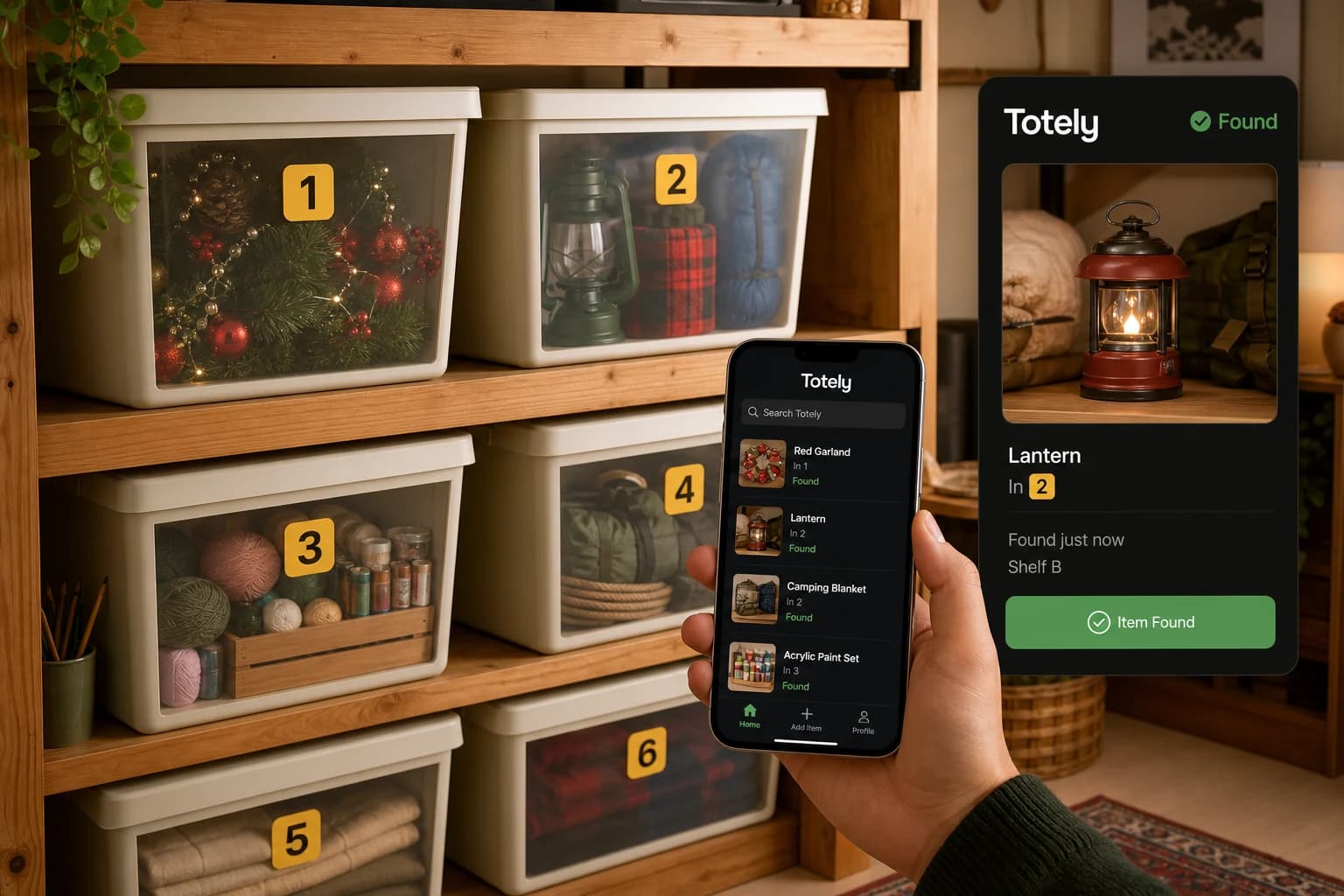
This post is about best practices—what makes tote labels keep working after contents change. For the step-by-step how-to, use how to label storage bins. For Totely’s commercial storage tote labels method — number, photo, search — see the pillar page.
Most storage tote labels work perfectly on the day you make them.
You pack the bin, write "Christmas," "camping," "kids," "garage," "crafts," or "miscellaneous" on the outside, stack it neatly on a shelf, and feel wonderfully organized.
Then real life starts changing the contents.
The Christmas bin gets extra batteries, ornament hooks, ribbon, gift tags, and extension cords tossed in. The camping tote loses the headlamps but gains beach towels. The kids' clothes bin starts with 3T pajamas, then slowly collects baby clothes, snow pants, school papers, and seasonal shoes. The garage tote labeled "tools" somehow holds tape, sprinkler parts, work gloves, bungee cords, and one flashlight that everyone forgets exists.
That is the problem with most storage tote labels: they describe what the tote used to hold, not always what is inside now.
A better tote label system keeps the outside simple and the inside specific. Instead of trying to fit every detail onto the label, use a clear number on the tote, then connect that number to a photo-based, searchable record of what is actually inside.
That way, your labels do not have to do all the work.
They just have to point you to the right container.
Quick Links
- Why Most Storage Tote Labels Fail
- Use Simple Numbers Instead of Long Exterior Labels
- Keep the Details in a Searchable Record
- Label Totes by Location and Retrieval Moment
- Use Photos to Confirm What Is Inside
- Make Labels Easy for the Whole Household
- How Totely Makes Storage Tote Labels Searchable
- Storage Tote Label FAQs
Why Most Storage Tote Labels Fail
Storage labels usually fail for one of three reasons.
First, they are too broad. A label like "holiday," "garage," "kids," "camping," or "storage" may help you get close, but it does not tell you whether the tote holds holiday lights, tent stakes, garden gloves, kids' snow pants, guest linens, batteries, or family recipes.
Second, they become outdated. Totes are rarely permanent. You remove things, add things, combine bins, split bins, move items to another shelf, or use a tote temporarily during a move. The label stays the same because updating it feels like one more little task.
Third, they are written for the person who packed the tote. If you packed it, "garage extras" might make sense to you. But if someone else is looking for extension cords, sprinkler parts, sports gear, or tools, that label may not help at all.
A good storage label should work for the whole household, not just the person with the best memory.
That means the label should be stable, easy to read, and connected to the actual contents.
Use Simple Numbers Instead of Long Exterior Labels
Long exterior labels sound helpful, but they can become hard to maintain.
A detailed label might say:
Christmas lights, ornaments, ribbon, hooks, stockings, gift tags, spare bulbs
That works until you move the stockings, use up the ribbon, add extension cords, and toss in extra batteries. Now the outside is wrong.
A simple number works differently.
The number stays the same even when the contents change.
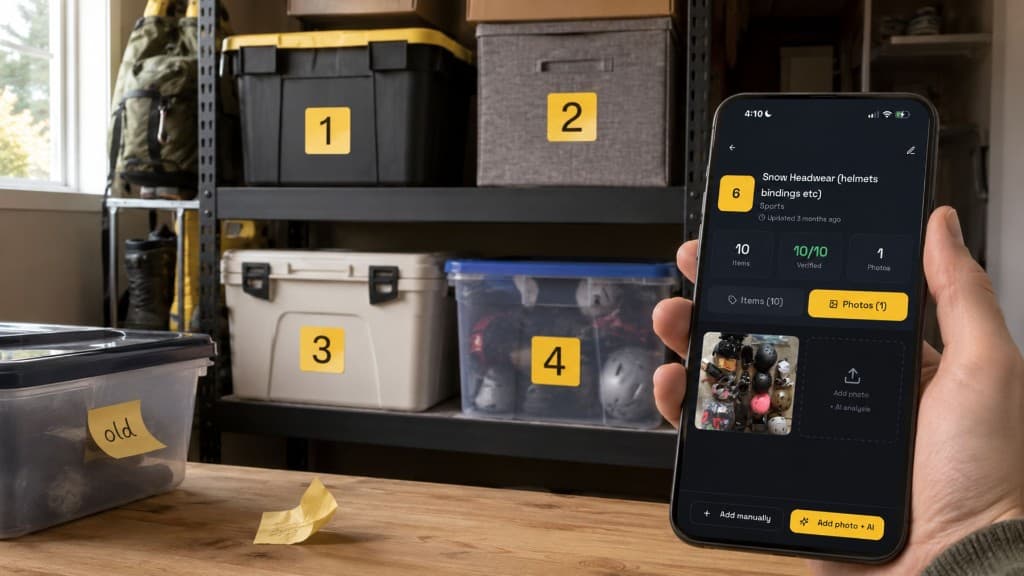
Use large, clear numbers on the outside of each tote:
1 2 3 4
Then keep the details somewhere easier to update.
This creates a flexible system:
Tote 1 can be "Christmas setup" today and still be Tote 1 next year when you add timers, clips, and replacement bulbs.
Tote 2 can hold camping gear now, then be updated later when the tent stakes move to a smaller setup pouch.
Tote 3 can store kids' clothes by size and season without needing a crowded label on the lid.
A number gives the tote a permanent identity. The contents record gives it context.
That is what makes the system easier to maintain long-term.
Keep the Details in a Searchable Record
The outside of the tote should be simple.
The inside record should be specific.
Instead of trying to write every item on the label, keep a searchable record that includes the tote number, location, photo, and key contents.
Tote 1 Location: Garage shelf, top row Contents: holiday lights, ornament hooks, ribbon, gift tags, extension cords, replacement bulbs, batteries
Tote 2 Location: Hall closet Contents: guest linens, extra blankets, winter bedding, pillowcases
Tote 3 Location: Under bed, left side Contents: 4T pajamas, winter coats, snow pants, boots, seasonal kids' clothing
Tote 4 Location: Craft closet Contents: yarn, vinyl rolls, fabric scissors, paint pens, ribbon, unfinished project bags
This is much more useful than a label that only says "holiday," "linens," "kids," or "crafts."
The record can include the words people actually search for later: batteries, extension cords, tent stakes, garden gloves, sprinkler parts, beach gear, winter gear, sentimental items, school papers, moving boxes, guest linens, household backstock, or family recipes.
If someone would say, "Where are the spare hooks?" or "Do we still have sunscreen?" or "Which tote has the baby clothes?" those words belong in the record.
See how to keep track of storage bins for keeping those records trustworthy over time.
Label Totes by Location and Retrieval Moment
Most tote labels are organized by category.
Categories help, but they are not always how people search.
A retrieval moment is the situation when you need the item.
For example, "Christmas" is a category. "Decorating the tree" is a retrieval moment. That moment needs ornaments, ornament hooks, tree skirt, tree topper, lights, ribbon, and maybe batteries.
"Camping" is a category. "Arriving at camp" is a retrieval moment. That moment needs tent stakes, ground tarp, headlamps, lanterns, flashlights, and the first-aid kit.
"Kids" is a category. "First cold week" is a retrieval moment. That moment needs winter coats, gloves, hats, scarves, boots, snow pants, and seasonal kids' clothing.
When you label or record totes by retrieval moment, they become easier to use.
Garage
Quick repair tote: extension cords, batteries, tape, flashlight, work gloves, bungee cords, small tools.
Holiday
Christmas setup tote: ornament hooks, ribbon, gift tags, replacement bulbs, extension cords, outdoor timer.
Kids
Winter kids' clothing: snow pants, boots, gloves, hats, scarves, 5T coat.
Camping
First-open camping tote: tent stakes, guylines, headlamps, lantern, ground tarp, repair kit.
This small shift makes storage feel less like hidden inventory and more like a system designed for real life.
For deeper examples by topic, see garage storage ideas for totes and bins, how to organize Christmas decorations in storage bins, how to organize camping gear in storage totes, and how to organize kids clothes by size in storage totes.
Use Photos to Confirm What Is Inside
A written list is useful.
A photo is often faster.
Photos help because stored items are visual. You may not remember whether the tote holds the red ribbon or gold ribbon, the large extension cord or short indoor cord, the toddler snow pants or school-age snow pants, the camp mugs or the camp utensils.
A photo can answer those questions quickly.
Photos are especially helpful for:
When Photo Proof Helps Most
Christmas decorations
Ornaments, fragile pieces, ribbon, stockings, holiday lights, gift tags.
Camping gear
Tent stakes, headlamps, camp mugs, rain ponchos, repair kit.
Kids' clothes
Baby clothes, winter gear, next-size clothing, seasonal shoes.
Craft supplies
Yarn, vinyl rolls, beads, fabric, project bags, paint pens.
Garage supplies
Batteries, extension cords, tools, garden gloves, sprinkler parts.
Sentimental items
Photo albums, letters, family recipes, school papers, heirlooms.
Moving boxes
Kitchen tools, guest linens, books, small appliances, cords.
A photo also reduces the need to remember exact wording. Maybe you would search "holiday lights," but another person might search "Christmas lights" or "outdoor lights." A photo gives both of you visual confirmation before anyone opens the tote.
That is the goal: photo proof before digging.
Make Labels Easy for the Whole Household
A storage system should not rely on one person being the family search engine.
If only one person knows where everything is, the system is not really shared. It is just one person's memory spread across several bins.
Labels should make storage easier for everyone: partners, kids, roommates, grandparents, houseguests, movers, or anyone helping put things away.
This is where simple number labels shine.
A number is easy to read from a distance. It does not require someone to decode your handwriting, remember your category system, or guess what "misc." meant six months ago.
Instead of saying, "It's in one of the garage bins," you can say:
"Look for Tote 4 on the garage shelf."
Or better:
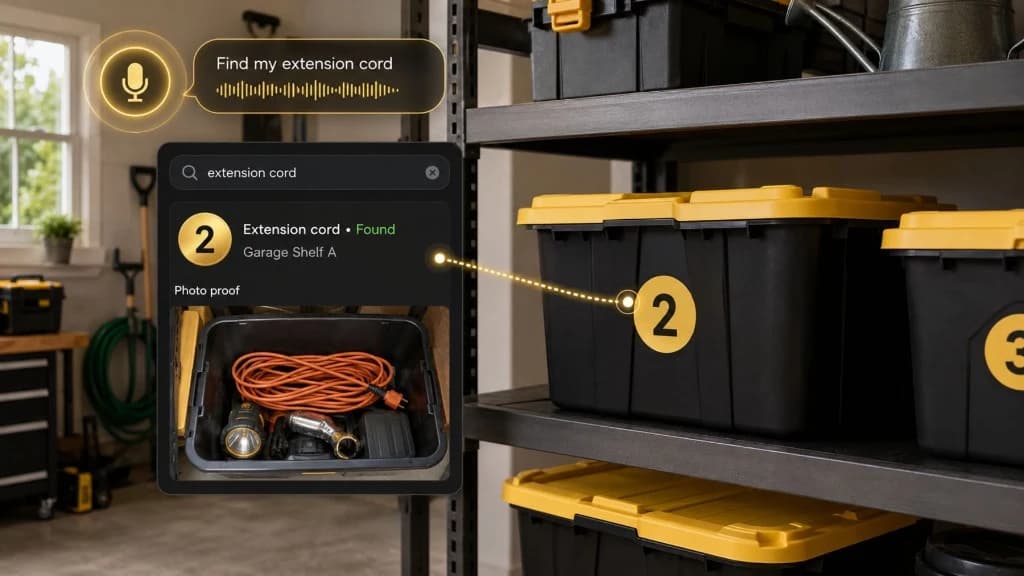
Search for "extension cord" and see that it is in Tote 4.
When labels and numbers sit on a dedicated rack, tote rack organization ties each visible number to a row, slot, and photo record.
That is a much easier system for a household to maintain.
It also helps when items move. If Tote 4 moves from the garage to a storage unit, the number still works. You only update the location. For the off-site layout itself — zones, aisle access, and where each numbered tote should sit — organize off-site storage so the unit stays usable after move-in.
The outside stays simple. The system stays flexible.
Avoid the "Miscellaneous" Label Trap
"Miscellaneous" is the label version of giving up.
It is also one of the fastest ways to create a mystery tote.
Sometimes a tote really does hold a mix of things. That is normal. Homes are full of awkward leftovers: extra batteries, tape, spare hooks, extension cords, school papers, sentimental items, moving supplies, craft overflow, garden gloves, and small tools.
But instead of labeling the tote "miscellaneous," try to name the reason those items are together.
Instead of "Miscellaneous Garage"
Quick repair and utility supplies.
Instead of "Miscellaneous Holiday"
Christmas setup supplies.
Instead of "Miscellaneous Kids"
Next-size seasonal clothing.
Instead of "Miscellaneous Crafts"
Project extras and refill supplies.
Instead of "Miscellaneous Storage"
Household backstock.
If you cannot name the reason, the tote may need to be split, edited, or photographed more carefully.
A vague tote is not a failure. It is just a sign that the system needs a little more context.
How Totely Makes Storage Tote Labels Searchable
Totely is built around a simple idea: storage tote labels work best when the outside stays simple and the inside stays searchable. Pair the number with a digital home inventory so contents stay findable after the label ages.
Instead of trying to write every item on the tote, you can give each tote, bin, box, shelf, or storage zone a clear number and let Totely hold the details.
Here is the simple flow:
Number the tote, bin, box, shelf, or storage zone
so it has a clear identity.
Snap a photo
of what is inside.
Let AI build the first item list
from what it can see.
Review or edit if needed
so the words match how your household searches.
Save the location
such as "garage shelf top row," "hall closet," "under bed left side," or "storage unit front shelf."
Search naturally later
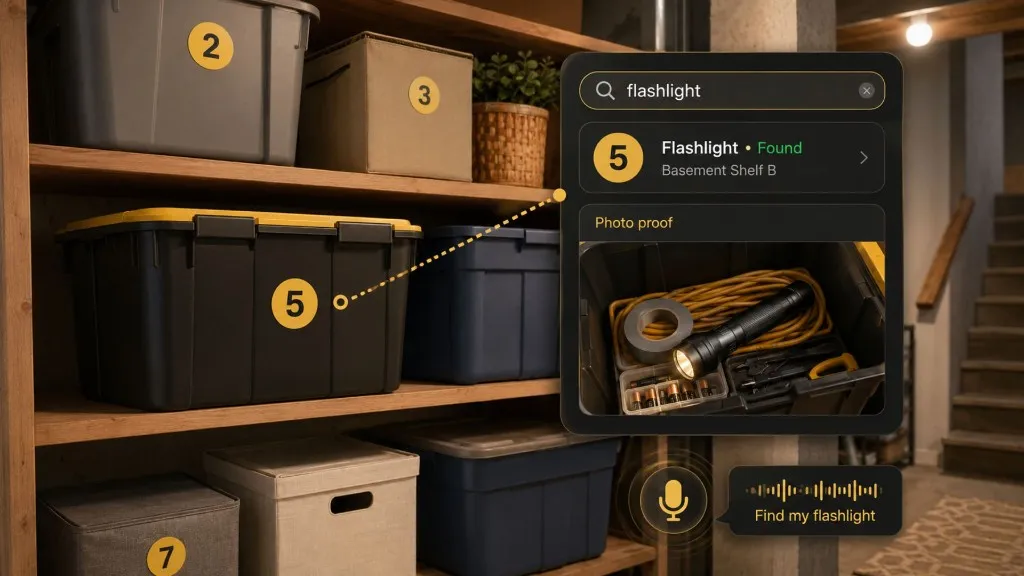
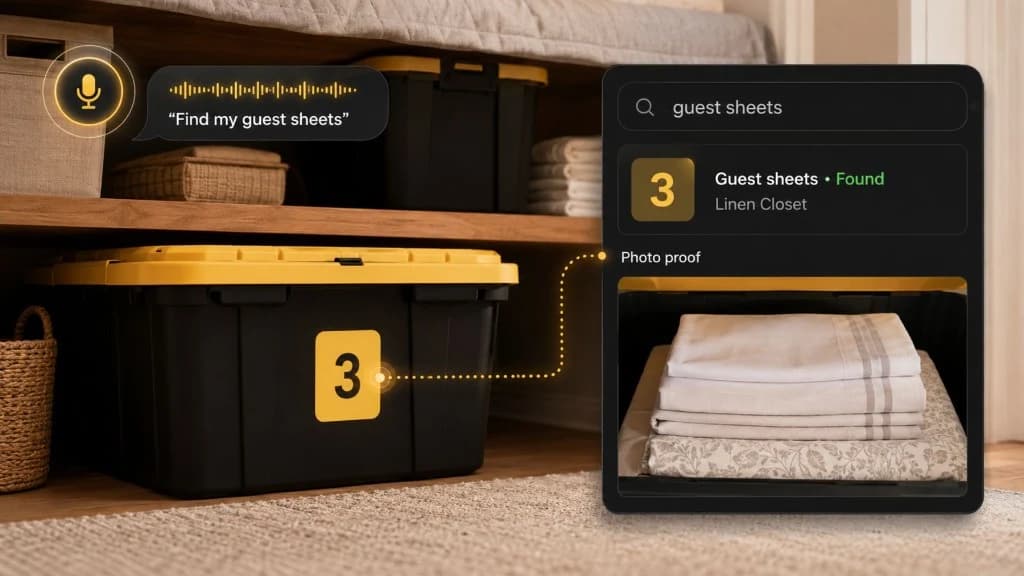
for "holiday lights," "tent stakes," "baby clothes," "garden gloves," "family recipes," "guest linens," or "extension cords."
Use photo proof
to confirm what is inside before opening the tote.
Totely does not require QR codes, barcodes, or manually typing every item.
It simply helps you turn a numbered tote into a searchable record.
That way, the label is easy to maintain, and the contents are easy to find.
Try the One-Tote Test on one bin before you relabel the whole house.
A Storage Tote Label System You Can Copy
Here is a simple label system that works across garages, closets, attics, basements, rentals, storage units, moving boxes, and under-bed storage.
A Storage Tote Label System You Can Copy
Tote 1: Christmas Setup
Location: Garage shelf, top row. Contents: holiday lights, ornament hooks, ribbon, gift tags, extension cords, replacement bulbs, batteries.
Tote 2: Camping First-Open Gear
Location: Garage shelf, middle row. Contents: tent stakes, guylines, ground tarp, headlamps, lanterns, flashlights, repair kit, bungee cords.
Tote 3: Kids' Winter Clothing
Location: Under bed, left side. Contents: winter coats, gloves, hats, scarves, snow pants, boots, seasonal shoes.
Tote 4: Craft Supplies
Location: Craft closet. Contents: yarn, vinyl rolls, paint pens, fabric scissors, ribbon, project bags, beads.
Tote 5: Garage Quick Repair
Location: Garage shelf, bottom row. Contents: batteries, extension cords, tape, work gloves, small tools, hardware, flashlight.
Tote 6: Sentimental Keepsakes
Location: Hall closet, top shelf. Contents: photo albums, letters, family recipes, school papers, handmade gifts, small heirlooms.
Tote 7: Guest and Household Backstock
Location: Storage bench. Contents: guest linens, extra blankets, paper goods, light bulbs, spare towels.
If you use moving boxes, number those too. "Kitchen" is helpful, but "Box 8: coffee maker, mugs, filters, dish towels, scissors" is much more useful when the box sits unopened for a few weeks.
The system works because each container has a stable identity, a searchable contents record, and a real location.
Storage Tote Label FAQs
What is the best way to label storage totes?
The best way to label storage totes is to use large, simple numbers on the outside and keep the detailed contents in a searchable record. This keeps the tote easy to identify while giving you room to track specific items, photos, and locations.
Should I write contents on the outside of storage bins?
You can write a broad category on the outside if it helps, but avoid trying to list everything on the label. Contents change over time, and long exterior labels become outdated quickly. A simple number plus a searchable record is easier to maintain.
Are numbered storage totes better than written labels?
Numbered storage totes are often easier to maintain because the number stays the same even when the contents change. Written labels can still be useful, but broad labels like "garage," "holiday," "kids," or "miscellaneous" usually need a more detailed record behind them.
How do I label storage totes when contents change?
Use a stable number on the tote and update the contents record whenever the tote changes. If you add holiday lights, remove camping gear, move kids' clothes, or combine household backstock, you can update the photo, item list, or location without replacing the whole exterior label.
How do I keep track of what is inside each tote?
Take a photo of each tote's contents, save the tote number, record the key items inside, and add the location. Focus on the words people will search for later, such as batteries, extension cords, tent stakes, baby clothes, craft supplies, family recipes, or guest linens.
How can Totely help with storage tote labels?
Totely helps you number each tote, snap a photo, let AI create the first item list, review or edit it, save the location, and search naturally later. Photo proof helps you confirm what is inside before you open every container.
Make the Outside Simple and the Inside Searchable
The best storage tote labels are not the longest labels.
They are the ones people can actually use later.
A simple number on the outside is easy to read, easy to maintain, and easy for the whole household to follow. The detailed record behind that number is where the useful information lives: photos, contents, locations, and the words you will search for later.
Start with one tote.
Give it a number. Snap a photo. Save what is inside. Add the location. Then search for the item before you dig.
With Totely, storage labels become more than stickers.
They become shortcuts to what you already own.