Storage Tote Rack Ideas: Make Totes Easy to Reach and Search
Storage tote rack ideas for garages, basements, and shelves. Learn how to choose, zone, number, and search totes without unstacking every bin.
By Steve Watts · Co-Founder, Totely
September 20, 2026 · Updated September 20, 2026 · 18 min read
A storage tote rack can fix one of the most annoying garage problems:
You need the tote on the bottom.
Again.
So you move the top tote.
Then the second tote.
Then the third tote.
Then you realize the thing you needed was not in that stack anyway.
A good tote rack changes that.
Instead of stacking heavy bins on top of each other, each tote gets its own slot, shelf, rail, or cubby. You can pull out the tote you need without dismantling half the garage.
That is a big improvement.
But it is not the whole system.
A rack helps you reach totes.
It does not automatically tell you which tote has the camping lantern, spare batteries, extension cord, holiday lights, or winter gloves.
That is where most storage tote rack ideas stop too early.
The best system does two things:
- It makes every tote easy to reach.
- It makes the right tote easy to find.
Quick Links
What a Storage Tote Rack Actually Solves
A storage tote rack solves the physical access problem.
It helps with:
- less stacking
- fewer buried totes
- easier pull-out access
- better garage wall use
- cleaner basement storage
- more organized seasonal storage
- easier visual scanning
- better separation between categories
- fewer piles on the floor
The main goal is simple:
Every tote should have a real home.
That home might be a shelf, a cubby, a sliding rail, a wall-mounted system, a rolling rack, or a DIY wood frame.
But the job is the same.
You are trying to stop totes from becoming a mystery pile.
What a Tote Rack Does Not Solve
A rack does not automatically solve memory.
Even if every tote is perfectly reachable, you can still stand in front of the rack and think:
- Which tote has the camping lantern?
- Did we store the tent stakes with camping gear or garage tools?
- Where did the battery charger go?
- Are the holiday lights in the red tote or the black-and-yellow tote?
- Which bin has the spare extension cord?
- Did we already own a second headlamp?
- Is this the tote we need, or is it the one behind it?
This is the missing layer.
A rack gives you access.
A memory system gives you retrieval.
You need both if you want the setup to keep working after the first organizing weekend.
Storage Tote Rack Ideas by Space
The best rack depends on where it lives.
A garage wall needs a different plan than a basement corner, storage unit, shed, or small utility room.
1. Garage Wall Tote Rack
A garage wall is usually the best place for a full tote rack.
Why it works:
- lots of vertical space
- easy access from the driveway
- good for seasonal gear
- good for sports gear
- good for camping gear
- good for tools and supplies
- keeps totes off the floor
- creates a dedicated storage zone
Best for:
- holiday bins
- camping gear
- sports gear
- winter gear
- car supplies
- household overflow
- extension cords
- outdoor accessories
Planning tip:
Use the most accessible rows for items you need more often. Put rare seasonal totes higher or farther away.
2. Freestanding Garage Tote Rack
A freestanding rack can work well when you do not want to build into the wall.
Good for:
- renters
- garages with finished walls
- people who may move
- temporary storage setups
- storage units
- basement storage
- anyone who wants a rack without a permanent install
Things to check:
- total weight rating
- shelf depth
- tote compatibility
- whether it needs wall anchoring
- whether the floor is level
- whether it can tip forward
- whether it blocks doors, cars, or work areas
A freestanding rack can still need stabilization.
Do not assume freestanding means carefree.
3. DIY Wood Storage Tote Rack
A DIY rack can be a great choice if you want the rack built around totes you already own.
Good for:
- custom garage walls
- odd spaces
- matching a specific tote size
- large tote collections
- long-term garage systems
- people comfortable with measuring, cutting, and assembly
DIY rack ideas usually use:
- 2x4 framing
- side rails
- runners
- cleats
- cubbies
- cross bracing
- wall anchoring
- optional casters
The biggest mistake is copying a plan without checking your exact tote dimensions.
Tote size names are not enough.
A “27 gallon” tote from one brand may not match another “27 gallon” tote from another brand.
Measure your actual totes before building.
4. Rolling Storage Tote Rack
A rolling storage tote rack can be useful if you need flexible access.
Good for:
- workshops
- garages with deep walls
- storage behind the rack
- seasonal rotation
- craft overflow
- lightweight household bins
- shared spaces
Watchouts:
- caster quality
- caster locks
- loaded weight
- floor slope
- rack height
- tipping risk
- whether the rack is too heavy to move safely
A rolling rack sounds convenient.
But once it is loaded with heavy totes, it can become awkward fast.
Use rolling racks for lighter or medium-weight storage, not overloaded bins.
5. Low Rack for Heavy Totes
Some totes do not belong high.
Heavy totes should usually stay low.
Good candidates for lower rack positions:
- tools
- hardware
- books
- paper files
- car supplies
- extension cords
- batteries
- emergency supplies
- dense camping gear
A low rack may not look as dramatic as a full wall system, but it can be safer and more useful.
The goal is not to use every inch of height.
The goal is to retrieve things without creating a new problem.
6. Seasonal Tote Rack
Seasonal storage is one of the best use cases for a tote rack.
You can group by season:
- winter gear
- spring garden supplies
- summer beach gear
- fall decorations
- holiday lights
- ornaments
- camping gear
- fishing gear
- school supplies
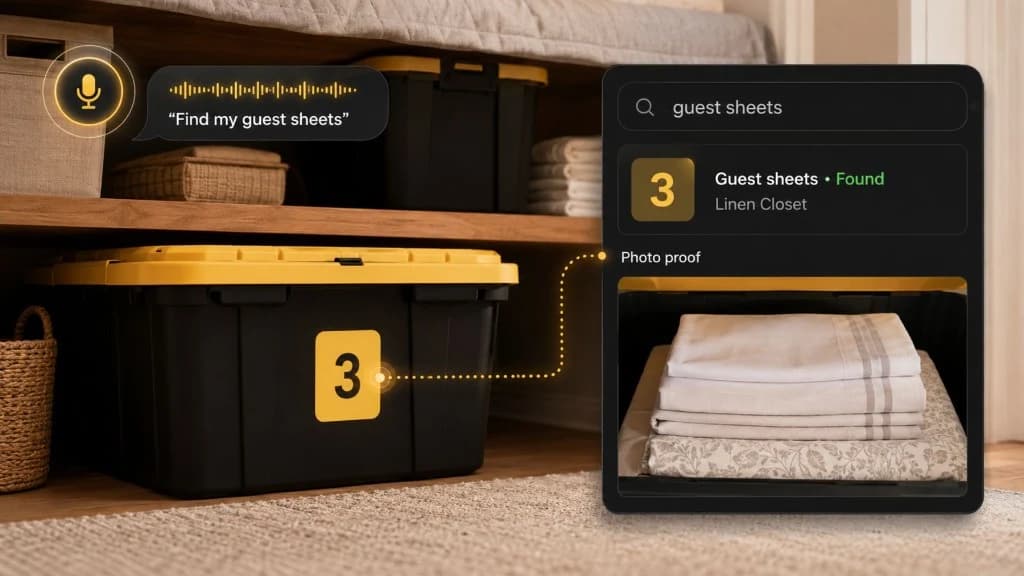
- guest linens
A seasonal rack works best when each tote has:
- a visible number
- a simple category
- a saved location
- a photo of the contents
- a few searchable item names
Seasonal storage is where memory fades the fastest.
You may remember the setup in December.
You may not remember it next November.
7. Storage Unit Tote Rack
A tote rack can also work in a storage unit.
Good for:
- keeping totes off the floor
- creating walkable aisles
- separating seasonal items from long-term storage
- avoiding wall-to-wall mystery stacks
- keeping front-access items visible
Storage-unit tip:
Do not bury the items you are most likely to need.
Put frequent-access totes near the front.
Use the back of the unit for true long-term storage.
And save the exact location, not just “storage unit.”
A location like Storage Unit, Front Left Rack, Bin 3 is far more useful than storage.
Buy vs Build: Which Tote Rack Makes Sense?
There is no single best storage tote rack.
There is only the best rack for your space, budget, tools, bins, and access needs.
| Situation | Better fit |
|---|---|
| You want fast setup | Buy a rack |
| You already own mismatched totes | Build or use adjustable shelving |
| You want a clean garage wall | Buy or build a dedicated rack |
| You need custom dimensions | Build |
| You do not want to cut lumber | Buy |
| You want a temporary setup | Freestanding rack |
| You need mobility | Rolling rack, if weight is manageable |
| You want the lowest material cost | DIY, if you already have tools |
| You have very heavy totes | Low shelves or heavy-duty rack |
| You want the easiest long-term retrieval | Any rack plus a searchable memory layer |
The rack style matters.
But the retrieval system matters more.
Measure the Tote Before You Choose the Rack
This is the step that saves frustration.
Before you buy or build, measure the tote.
Measure:
- width at the widest point
- depth
- height with lid
- lid lip
- handle width
- bottom footprint
- side taper
- how much clearance it needs to slide
- how much hand space you need to grab it
Do not assume gallon size is enough.
A 27 gallon tote may be common, but dimensions still vary by brand and style.
Also consider whether the tote will slide by the lid, sit on a shelf, hang by its lip, or rest on rails.
Different rack systems hold totes differently.
What to Look For in a Storage Tote Rack
If you are buying a rack, check these details before you commit.
Tote Compatibility
Does the rack fit the totes you own?
Or does it require a specific tote brand and size?
If bins are not included, confirm what actually fits.
Look at:
- maximum tote width
- maximum tote height
- maximum tote depth
- lid clearance
- rail spacing
- number of totes per row
- whether totes slide smoothly
Weight Rating
Check the rack’s weight guidance.
Then be honest about what you store.
A tote full of pillows is different from a tote full of tools.
A tote full of ornaments is different from a tote full of books.
Keep dense and heavy totes lower.
Do not overload racks.
Follow manufacturer instructions or trusted build plans.
Wall Stability
Tall racks may need wall support.
This matters for:
- freestanding racks
- DIY racks
- high racks
- rolling racks
- racks with heavy upper bins
- garages with kids, pets, or frequent activity
If the instructions say to secure the rack to a wall, do that.
A rack that tips is not an organization win.
Casters
Casters can be useful.
But only if the rack is actually safe and manageable when loaded.
Look for:
- locking casters
- appropriate weight rating
- smooth floor compatibility
- stable base
- manageable rack height
- a clear path to move it
If the rack is going to stay in one place, skip casters or lock them down.
Shelf Depth
Shelf depth matters more than people think.
Too shallow, and bins overhang.
Too deep, and you waste space or hide things behind the front row.
A good rack should fit the tote without making it hard to grab.
Access Angle
Can you pull the tote out easily?
Or do you have to lift, tilt, drag, or fight it?
A tote rack should reduce friction.
If the rack makes every bin awkward to remove, it is not really solving the problem.
How to Plan Rack Zones
The best rack is not organized only by category.
It is organized by retrieval.
Think about how often you need each tote.
Zone 1: Front-Access Items
These are the bins you may need any month of the year.
Examples:
- extension cord
- camping lantern
- batteries
- work gloves
- tape measure
- pet supplies
- bike pump
- tools
- spare chargers
- flashlight
Best placement:
- middle row
- easy reach
- front-facing
- no ladder
- no heavy lifting
Zone 2: Seasonal Items
These bins matter at predictable times.
Examples:
- holiday lights
- ornaments
- winter gloves
- beach towels
- camping gear
- Halloween costumes
- Thanksgiving linens
- school supplies
Best placement:
- grouped by season
- visible number
- photo-recorded
- not buried behind unrelated categories
Zone 3: Heavy Items
These should stay lower.
Examples:
- tools
- books
- hardware
- files
- emergency supplies
- car accessories
- dense camping equipment
Best placement:
- bottom row
- stable shelf
- no high lifting
Zone 4: Rare Access Items
These bins do not need prime space.
Examples:
- old baby clothes
- keepsakes
- archive papers
- extra decor
- backup household items
- rarely used holiday pieces
Best placement:
- top row if light
- side section
- back zone
- less convenient but still recorded
Zone 5: Overflow and Empty Totes
If you keep extra totes, give them their own place.
Empty totes can quickly become clutter.
Best placement:
- top shelf
- nested if possible
- one clear overflow zone
- not mixed with active storage
A Simple Garage Tote Rack Map
Here is an example layout.
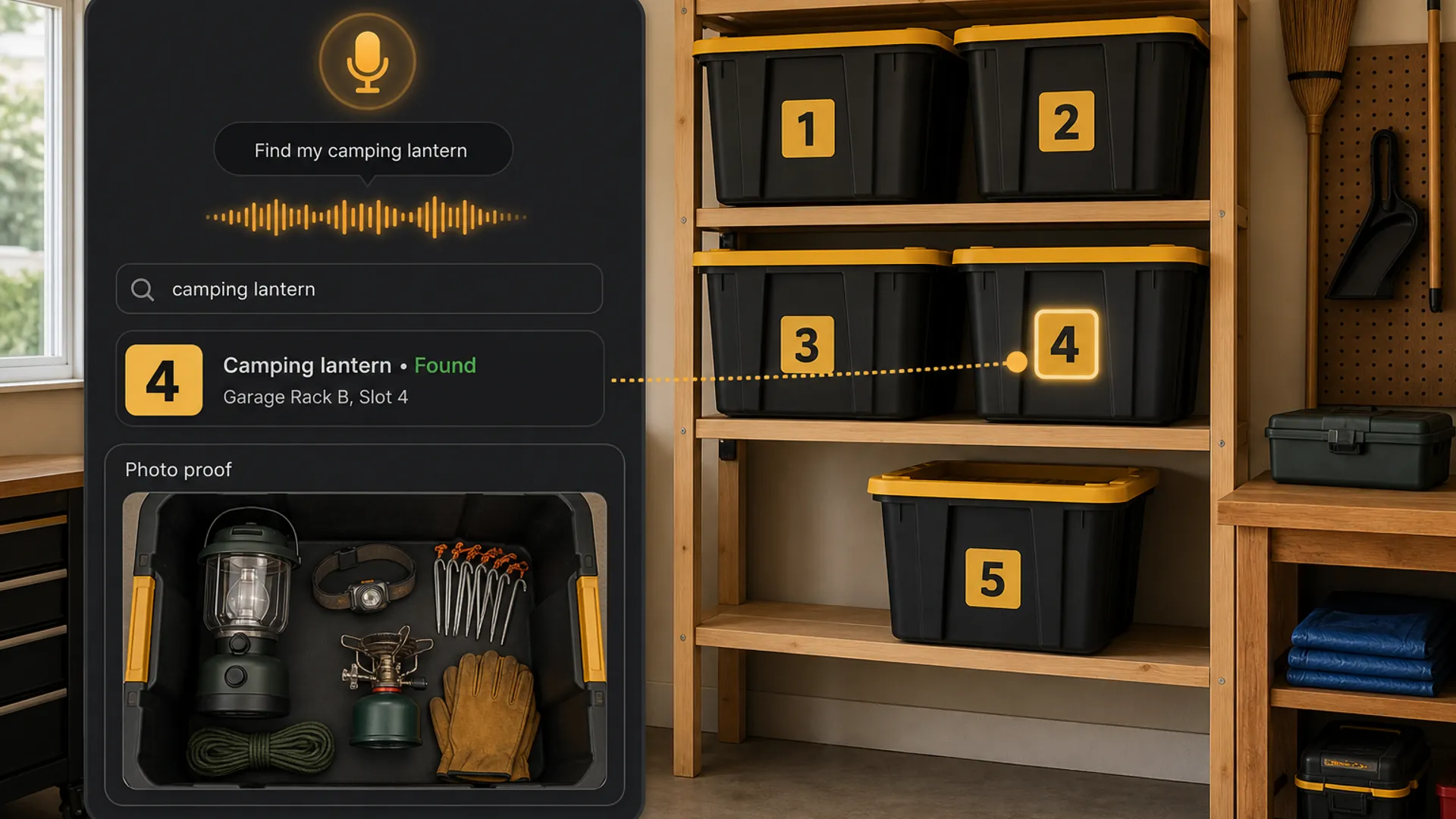
| Rack position | Bin | Best use | Example contents |
|---|---|---|---|
| Top Left | 1 | Rare seasonal | lightweight holiday decor, ribbon |
| Top Right | 2 | Seasonal | ornaments, tree skirt, garland hooks |
| Middle Left | 3 | Frequent access | extension cord, flashlight, spare batteries |
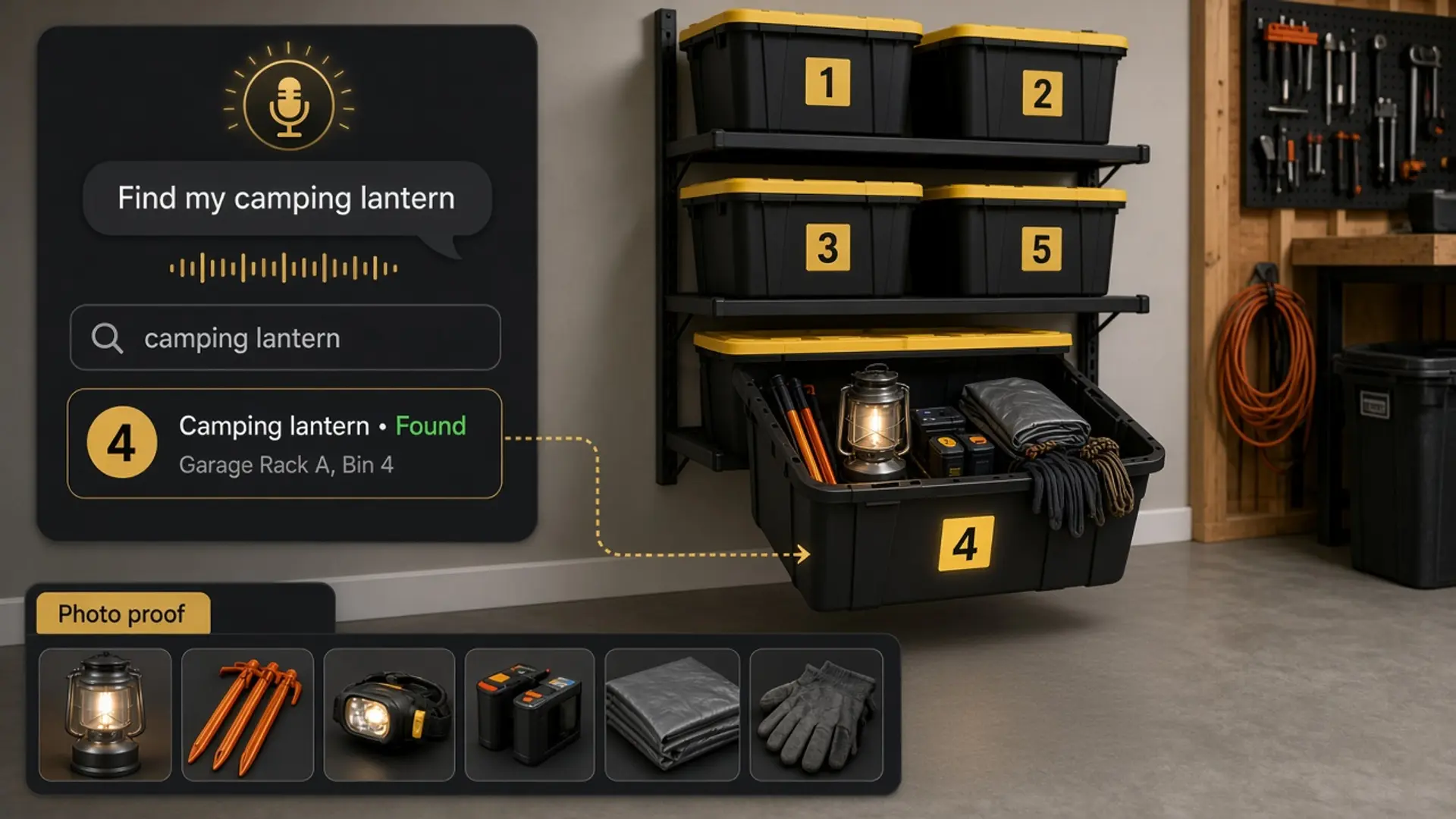
| Middle Right | 4 | Camping gear | camping lantern, headlamp, tent stakes |
| Bottom Left | 5 | Heavy | tools, work gloves, hardware |
| Bottom Right | 6 | Outdoor gear | tarp, rope, small pump, bungee cords |
This is not about making the rack look perfect.
It is about making retrieval easier.
The question is not:
Where can this tote fit?
The better question is:
How will I find this when I need it?
How to Make a Tote Rack Searchable
A rack becomes much stronger when every tote has a simple identity.
Here is the workflow.
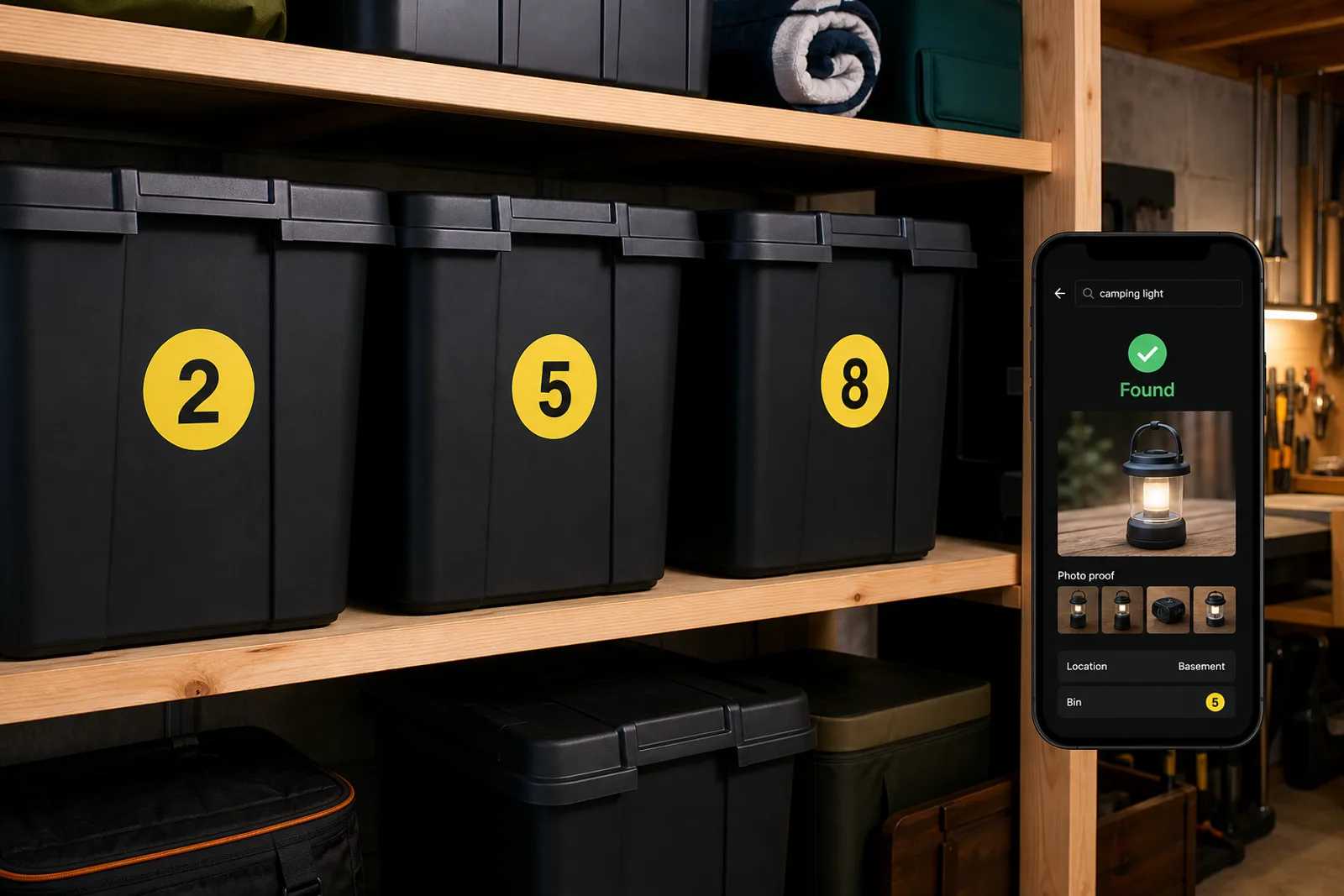
Step 1: Number Each Tote
Use simple visible numbers.
Examples:
- Bin 1
- Bin 2
- Bin 3
- Bin 4
- Bin 5
Do not rely only on long written labels.
Labels get vague.
Numbers stay stable.
The tote can stay Bin 4 even if the contents change from camping gear to winter gear later.
Step 2: Name the Rack
Give the rack a simple location name.
Examples:
- Garage Rack A
- Garage Rack B
- Basement Rack A
- Storage Unit Front Rack
- Workshop Rack
- Holiday Rack
This lets you save exact locations.
Garage Rack A, Bin 4 is much better than garage.
Step 3: Photograph the Contents
Before closing or sliding the tote into the rack, take a photo.
For a camping tote, photo proof might show:
- camping lantern
- headlamp
- spare batteries
- tent stakes
- small tarp
- paracord
- work gloves
The photo does not need to be pretty.
It needs to be useful.
Step 4: Add Searchable Item Names
Add the words you would actually search later.
Good search terms:
- camping lantern
- tent stakes
- headlamp
- spare batteries
- extension cord
- holiday lights
- winter gloves
- bike pump
- battery charger
- label rolls
Bad search terms:
- misc
- stuff
- garage
- random
- old things
- storage
Use real item names.
Step 5: Save the Location
Save the exact location.
Examples:
- Garage Rack A, Bin 4
- Basement Rack A, Bottom Left, Bin 5
- Storage Unit Front Rack, Bin 2
- Workshop Rack, Middle Shelf, Bin 3
The more specific the location, the less you have to remember later.
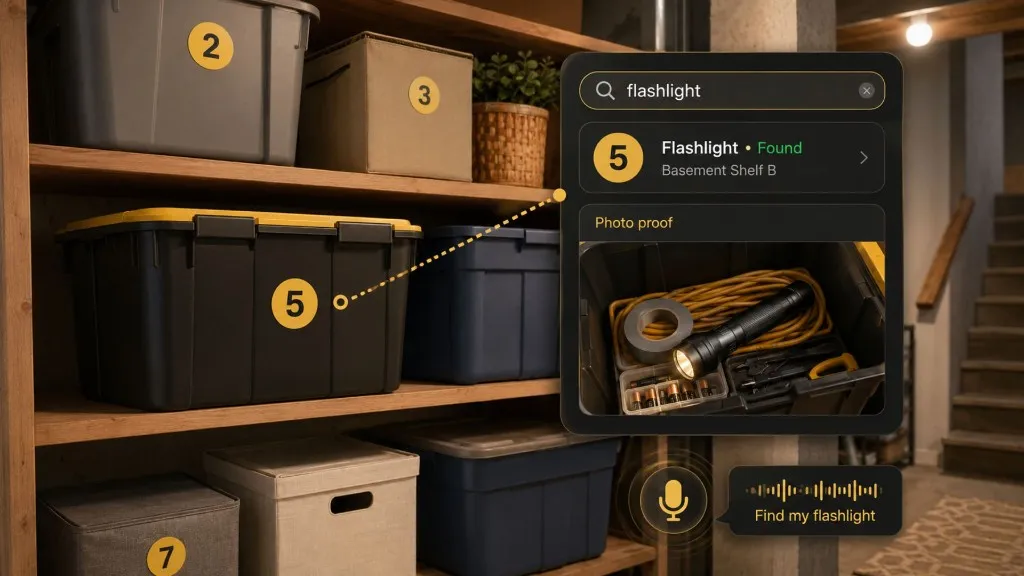
Step 6: Search Before Pulling
This is the moment the system pays off.
Instead of pulling three totes, search first.
Search:
camping lantern
Result:
Garage Rack A, Bin 4
Photo proof shows the lantern inside.
Now the rack is not just accessible.
It is searchable.
How Totely Fits
Totely is the digital memory layer for your tote rack.
It does not replace the rack.
It makes the rack work better.
A storage tote rack gives each tote a place.
Totely helps you know which tote matters.
The workflow is simple:
- Number the tote.
- Snap a photo before closing it.
- Let AI build the first item list from what it can see.
- Review or edit the record if needed.
- Save the exact location, such as
Garage Rack A, Bin 4. - Add notes for heavy, fragile, seasonal, front access, restock, or check-before-buying.
- Search naturally later.
- Use photo proof before opening everything.
Totely does not require QR codes, barcodes, or manual entry of every item to get started.
Start simple.
Visible number outside.
Photo and searchable details inside.
That is enough to turn a rack from “organized-looking” into actually useful.
Example: Finding the Camping Lantern
Physical setup:
- garage rack
- six numbered totes
- Bin 4 is a camping tote
- location saved as
Garage Rack A, Bin 4
Contents:
- camping lantern
- headlamp
- spare batteries
- tent stakes
- small tarp
- paracord
- work gloves
Later, you search:
camping lantern
Totely shows:
Garage Rack A, Bin 4
with photo proof.
You pull one tote.
Not four.
That is the difference.
Maintenance: Keep the Rack Working
Even the best tote rack can drift.
People add items.
People remove items.
A seasonal tote becomes a mixed tote.
A camping tote gets a random extension cord.
A holiday bin gets moved to a storage unit.
The fix is not a huge reorganization day.
The fix is small updates while the tote is already open.
Update when:
- you add an important item
- you remove something you will look for later
- you move the tote to a new rack
- you combine two totes
- you change a category
- you notice the photo is outdated
A good rack is physical.
A good memory system is current.
Storage Tote Rack FAQ
What is a storage tote rack?
A storage tote rack is a shelf, rail, cubby, or frame system designed to hold storage totes so they are easier to access without stacking and unstacking bins.
Are storage tote racks worth it?
Storage tote racks are worth it when stacked totes make it hard to reach what you need. They are especially useful in garages, basements, workshops, storage units, and seasonal storage areas.
Should I buy or build a storage tote rack?
Buy a storage tote rack if you want a faster setup and a finished system. Build one if you need custom dimensions, already own specific totes, or want to fit an odd garage wall or basement space.
Do most tote racks fit 27-gallon totes?
Many tote rack products and DIY plans are designed around common 27-gallon totes, but dimensions still vary by brand. Measure your actual totes before buying or building.
What should go on the bottom row of a tote rack?
Put heavier totes on the bottom row. Tools, files, hardware, books, car supplies, and dense camping gear are usually better lower than higher.
Are rolling storage tote racks a good idea?
Rolling storage tote racks can work well for lighter or medium-weight storage on smooth floors. Check caster quality, weight rating, locking brakes, floor slope, and tipping risk before relying on a rolling rack.
How do I organize totes on a rack?
Organize by retrieval frequency first. Put frequent-access totes where they are easiest to reach, seasonal totes together, heavy totes low, and rare-access totes higher or farther away.
How do I keep track of what is in each tote?
Use a simple system: number every tote, photograph the contents, save the exact rack location, and add the main item names you would search for later.
Does Totely work with tote racks?
Yes. Totely works with tote racks, garage shelves, storage bins, lidded boxes, under-bed bins, cube bins, storage units, and hidden storage spots. It helps you search by item and see photo proof before opening everything.
Do I need QR codes for a tote rack system?
No. QR codes can be useful for some setups, but you can start with simple visible numbers, photos, saved locations, and natural search.
Make the Totes Reachable. Make the Contents Findable.
A storage tote rack can make your garage, basement, workshop, or storage unit feel completely different.
No more trapped bottom tote.
No more unstable piles.
No more pulling half the stack apart.
But access is only half the system.
The real win is knowing which tote to pull.
So build or buy the rack.
Measure the totes.
Plan the zones.
Keep heavy bins low.
Put frequent-access items where they are easy to reach.
Then give every tote a memory.
Number it.
Photograph it.
Save the location.
Search before opening everything.
That is how a storage tote rack becomes more than a shelf.
It becomes a searchable storage system.
Stored, not lost.