Home Storage Totes: The Simple Number System That Keeps Them Searchable
Home storage totes work better when the outside stays simple and the inside becomes searchable. Learn the numbered tote system for finding things later.
By Steve Watts · Co-Founder, Totely
September 21, 2026 · Updated September 21, 2026 · 15 min read
You know the moment.
You need spare batteries.
Or the winter gloves.
Or the birthday candles.
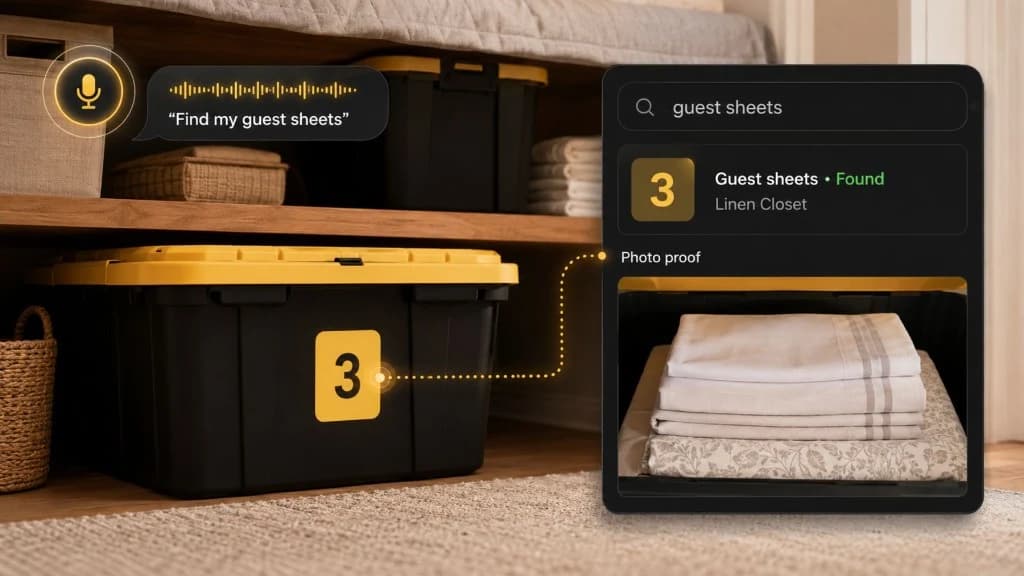
Or the guest sheets.
Or the little charger that only works with one old device in the house.
You know it is in one of the home storage totes.
The problem is that there are six of them.
Maybe ten.
Maybe a whole shelf.
Some are clear.
Some are opaque.
Some are labeled.
Some labels are old.
One says misc.
One says holiday.
One says garage.
One says nothing at all.
So you open the first tote.
Then the second.
Then the third.
By the time you find the thing, the shelf is a mess again.
That is the problem home storage totes are supposed to solve — but often create.
Totes give your stuff a place to go.
They do not automatically give your memory a place to go.
That is where a simple number system helps.
The outside stays simple.
The inside becomes searchable.
Quick Links
- Why Home Storage Totes Fail Over Time
- The Better System: Simple Outside, Specific Inside
- Step 1: Number Every Tote
- Step 2: Photograph What Is Inside
- Step 3: Save the Exact Location
- Step 4: Add Searchable Item Names
- How to Choose the Right Home Storage Totes
- Where to Use Numbered Storage Totes
- How Totely Fits
- Home Storage Totes FAQ
Why Home Storage Totes Fail Over Time
Home storage totes are useful.
They protect items.
They stack.
They make shelves look cleaner.
They work in closets, garages, attics, basements, storage units, under-bed spaces, laundry rooms, mudrooms, playrooms, and utility closets.
But most tote systems break down for one simple reason:
The outside does not keep up with the inside.
A tote might start with one clear purpose.
Holiday lights
Then later it gets:
- ornament hooks
- spare bulbs
- extension cords
- gift bags
- stocking holders
- outdoor clips
- a tree remote
- one random roll of tape
The label still says Holiday lights.
But the contents changed.
That happens all over the house.
A tote labeled Kids might hold:
- old school papers
- tiny sports gear
- train tracks
- extra puzzle pieces
- swim goggles
- birthday decorations
A tote labeled Tools might hold:
- batteries
- picture hangers
- outlet timers
- flashlights
- tape
- small chargers
- command hooks
The tote is doing its job.
The memory system is not.
The Better System: Simple Outside, Specific Inside
The best home storage tote system does not try to write every item on the outside.
That gets messy fast.
Instead, use this rule:
Simple outside. Specific inside.
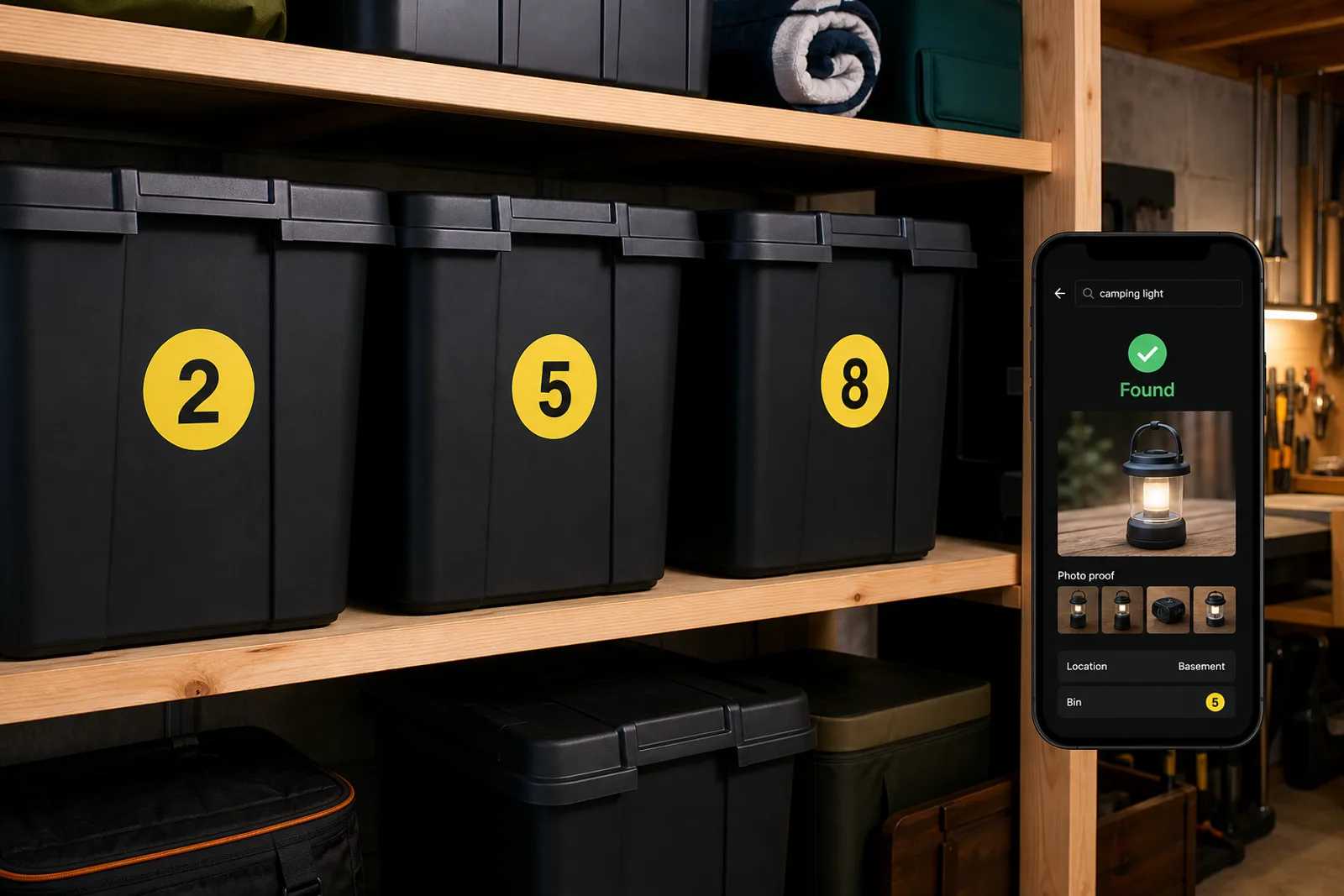
The outside gets a simple visible number.
The inside gets the details.
That way, Tote 2 can hold:
- AA batteries
- AAA batteries
- flashlight
- battery charger
- outlet timer
- spare remote
- small pack of bulbs
The tote itself only needs to say:
2
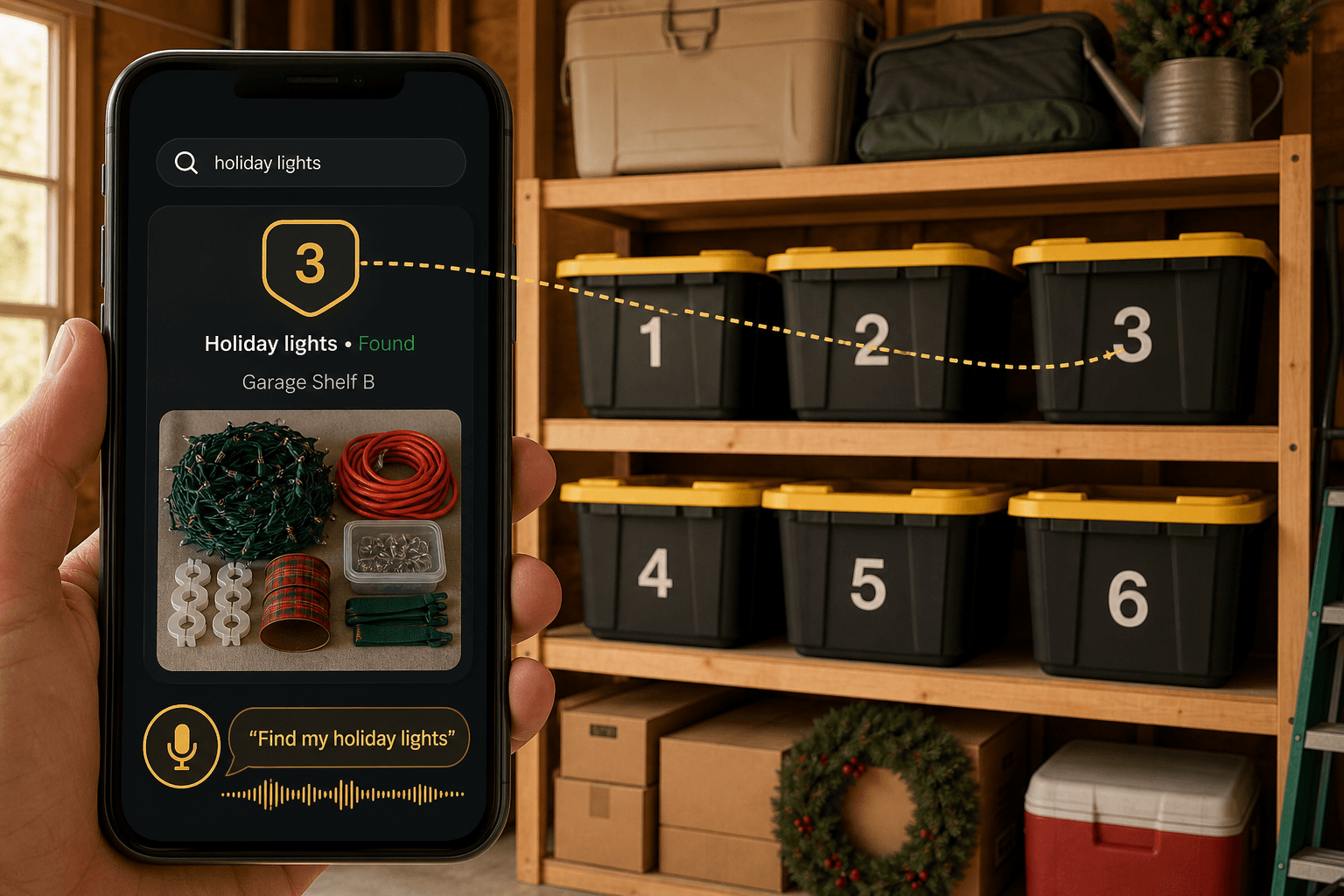
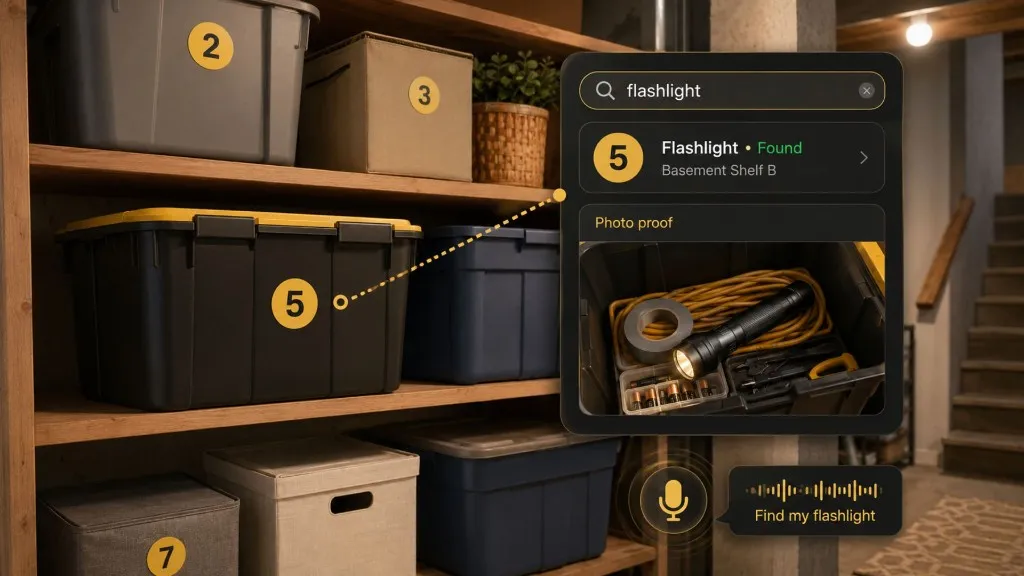
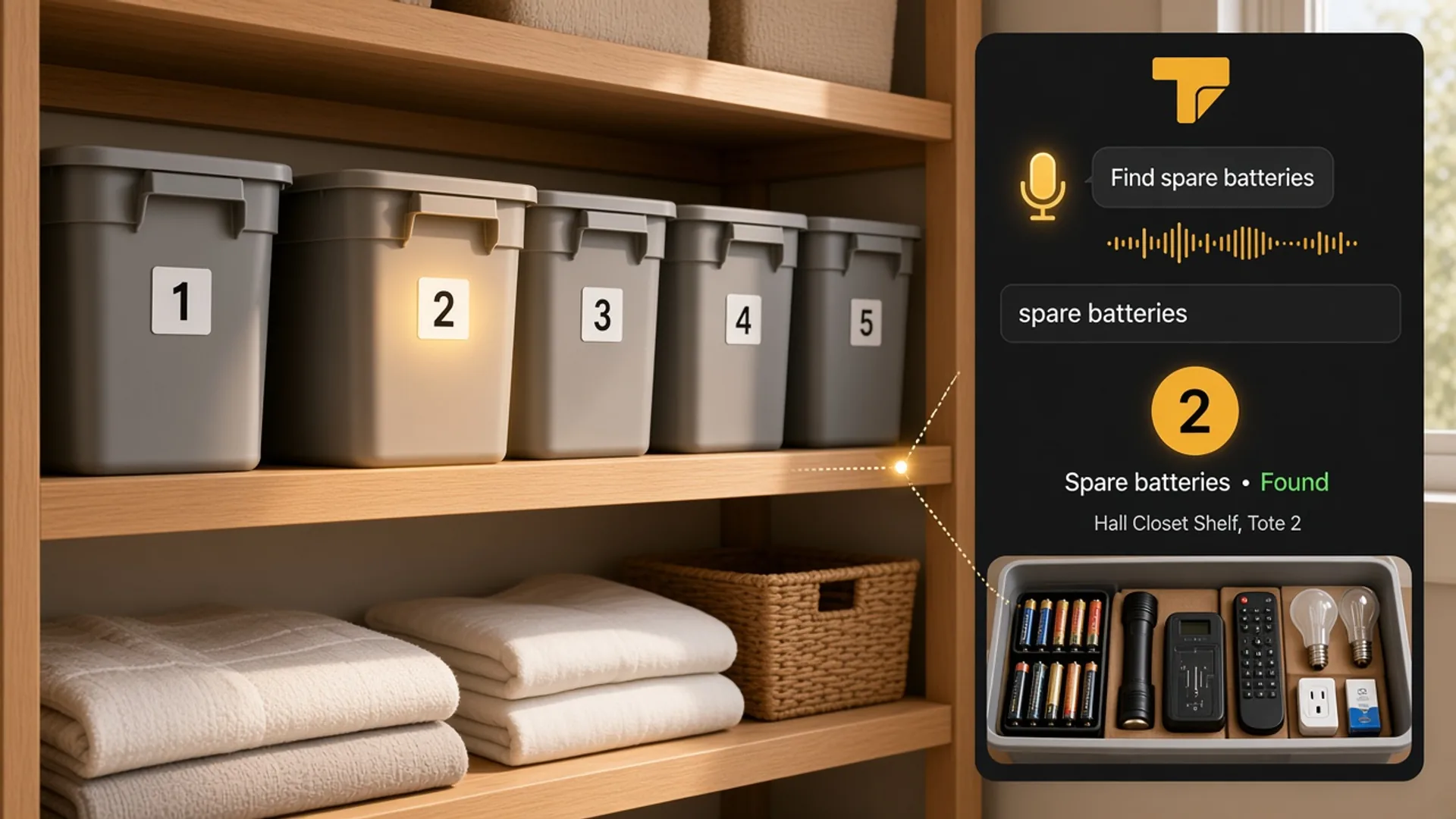
Later, when you search for spare batteries, the system tells you:
Hall Closet Shelf, Tote 2
That is cleaner than trying to make the outside label do everything.
Why Numbers Work Better Than Big Category Labels
Category labels sound helpful.
But they can become too broad.
Examples:
- holiday
- kids
- garage
- tools
- linens
- office
- camping
- decor
- memories
- extra
Those labels are not wrong.
They are just not specific enough when you need one item.
A number is different.
A number does not try to describe the whole tote.
It gives the tote an address.
Then the searchable record can hold the actual details.
That makes the system easier to maintain.
You do not have to reprint the outside label every time the contents change.
You just update the digital record.
Step 1: Number Every Tote
Start with simple visible numbers.
Use:
- 1
- 2
- 3
- 4
- 5
Keep going as needed.
Do not overcomplicate it.
Avoid:
- long category names
- tiny handwriting
- mystery abbreviations
- numbers that repeat
- codes nobody remembers
- complicated room/category systems
A simple number is enough when the record behind it is specific.
Good tote labels:
- Tote 1
- Tote 2
- Tote 3
- Tote 4
Even better if the location is also clear:
- Hall Closet Shelf, Tote 2
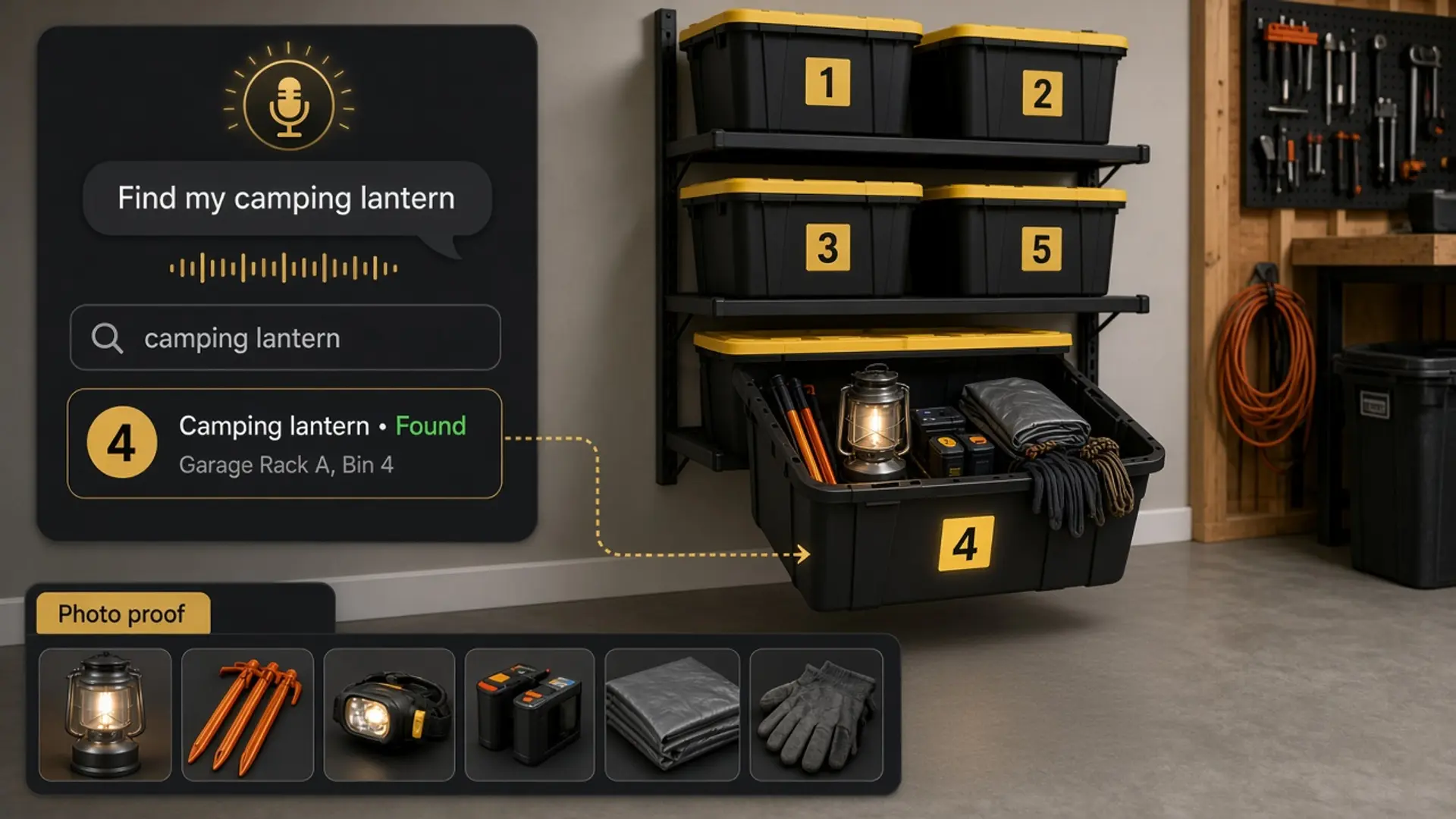
- Garage Rack A, Tote 4
- Under Bed, Tote 1
- Attic Shelf B, Tote 5
- Storage Unit Wall C, Tote 3
The number identifies the tote.
The location tells you where the tote lives.
Step 2: Photograph What Is Inside
Before closing the tote, take a photo.
This is the part most storage systems skip.
A photo gives you proof.
Not a perfect inventory.
Not a beautiful product shot.
Just proof.
A useful tote photo might show:
- spare batteries
- flashlight
- outlet timer
- charger
- extra remote
- small pack of bulbs
- tape
- hooks
That photo becomes much more useful than a label that says utility.
You can search later and confirm visually before pulling the tote down.
Step 3: Save the Exact Location
A home storage tote needs an address.
Not just:
closet
Use:
Hall Closet Shelf, Tote 2
Not just:
garage
Use:
Garage Rack A, Tote 4
Not just:
under bed
Use:
Guest Room Bed, Left Side, Tote 1
The more exact the location, the easier it is for someone else in the house to find it.
This matters because storage is rarely a solo system.
One person might organize it.
Everyone else has to use it.
Step 4: Add Searchable Item Names
The searchable list should use real words your household would actually search.
For example, for a utility tote:
- spare batteries
- AA batteries
- AAA batteries
- flashlight
- battery charger
- outlet timer
- remote
- small bulbs
- picture hooks
- tape
For a guest linen tote:
- guest sheets
- pillowcases
- spare blanket
- mattress protector
- towel set
For a holiday tote:
- holiday lights
- ornament hooks
- tree skirt
- stocking holders
- gift bags
- wreath hanger
For a kids’ rotation tote:
- train set
- wooden blocks
- puzzle pieces
- dress-up clothes
- toy cars
- art supplies
The search terms should match the way you speak.
If you would say “Find my spare batteries,” the record should include spare batteries.
Step 5: Update the Tote When It Changes
Home storage changes.
That is normal.
The goal is not to freeze every tote forever.
The goal is to keep the memory close enough to reality.
Update the tote record when:
- you add something important
- you remove something important
- you move the tote
- you combine two totes
- you split one tote into two
- you repack seasonal items
- the photo no longer matches what is inside
This should take seconds.
Not a full reorganization.
How to Choose the Right Home Storage Totes
The right tote depends on what you are storing and where it will live.
Here are the main choices.
Clear Totes
Clear totes are helpful when you want quick visual confirmation.
Best for:
- closets
- under-bed storage
- kids’ rotation bins
- craft supplies
- seasonal clothing
- guest linens
- frequently accessed items
Clear totes are not magic, though.
They can still become hard to read when stacked, crowded, turned sideways, or filled with mixed items.
Use clear totes when visibility helps.
Still give them a number.
Still photograph the contents.
Opaque Totes
Opaque totes are useful when you want a cleaner look or stronger visual calm.
Best for:
- open shelving
- utility closets
- garages
- basements
- attics
- storage units
- long-term storage
The downside is obvious:
You cannot see what is inside.
That makes the number system even more important.
Storage Totes With Lids
Lids help keep contents contained and stackable.
Best for:
- seasonal items
- linens
- holiday decor
- garage storage
- attic storage
- basement storage
- moving boxes
- under-bed storage
Look for lids that fit well and make sense for how often you need to open the tote.
A tote you open weekly should be easy to access.
A tote you open twice a year can be more secure.
Stackable Storage Totes
Stackable totes save space.
But stacking creates a new problem:
The bottom tote is harder to reach.
That means stacked totes need better searchability.
Before stacking, ask:
- Which tote will I need most often?
- Which tote can go on top?
- Which tote can go on the bottom?
- Is the stack safe and stable?
- Can the shelf support the weight?
- Can I lift the tote comfortably?
Use the number system so you know whether unstacking is worth it before you start.
Heavy-Duty Storage Totes
Heavy-duty totes are useful for:
- garage items
- tools
- camping gear
- car supplies
- sports gear
- long-term storage
- storage units
But heavy-duty does not mean you should overload them.
Heavy items are often better in smaller totes.
A huge tote full of books, tools, or hardware can become too heavy to move.
Keep heavy items low and easy to handle.
Under-Bed Storage Totes
Under-bed totes are great for hidden storage.
Best for:
- guest sheets
- off-season clothing
- extra blankets
- wrapping paper
- shoes
- kids’ keepsakes
- rarely used bedding
The problem with under-bed storage is that it disappears from sight.
That is exactly why it should be searchable.
Guest Room Bed, Left Side, Tote 1
is much better than:
somewhere under a bed
Where to Use Numbered Storage Totes
A numbered tote system works anywhere the contents can become hidden.
Hall Closet
Good for:
- spare batteries
- light bulbs
- candles
- first-aid overflow
- hardware
- tape
- chargers
- small household tools
Example:
Hall Closet Shelf, Tote 2
Garage
Good for:
- extension cords
- work gloves
- sprinkler parts
- car supplies
- camping gear
- sports gear
- outdoor toys
Example:
Garage Rack A, Tote 4
Linen Closet
Good for:
- guest sheets
- extra pillowcases
- blankets
- seasonal bedding
- beach towels
- table linens
Example:
Linen Closet Top Shelf, Tote 3
Kids’ Rooms and Playrooms
Good for:
- toy rotation
- puzzles
- train tracks
- art supplies
- dress-up clothes
- birthday decorations
- school keepsakes
Example:
Playroom Shelf, Tote 5
Attic or Basement
Good for:
- holiday decorations
- keepsakes
- off-season clothing
- memory boxes
- extra household items
- long-term storage
Example:
Basement Shelf B, Tote 1
Storage Unit
Good for:
- moving overflow
- seasonal items
- business inventory
- family keepsakes
- duplicate household items
- archived boxes
Example:
Storage Unit Wall C, Tote 6
Simple Home Storage Tote Map
Use a simple table like this when starting.
| Tote | Location | Main purpose | Important searchable items |
|---|---|---|---|
| 1 | Linen Closet Top Shelf | Guest linens | guest sheets, pillowcases, spare blanket |
| 2 | Hall Closet Shelf | Household utility | spare batteries, flashlight, outlet timer |
| 3 | Garage Rack A | Car and outdoor | tire gauge, work gloves, extension cord |
| 4 | Playroom Shelf | Toy rotation | train set, puzzle pieces, art supplies |
| 5 | Attic Shelf B | Holiday | tree skirt, ornament hooks, gift bags |
This does not need to be complicated.
The point is to give every tote a stable identity.
What Not to Do
Avoid these common tote mistakes.
Do Not Label Everything “Misc”
A misc tote becomes a place where items go missing.
Use specific searchable terms instead.
Do Not Make the Outside Label Too Detailed
If the outside label lists every item, it becomes outdated fast.
Keep the outside simple.
Put details in the record.
Do Not Use the Same Number Twice
If there are two Tote 3s, the system breaks.
Numbers need to be unique inside each location or household system.
Do Not Stack Important Items Too Deep
If you need batteries, flashlights, or chargers often, do not bury them under five other totes.
Searchability helps, but access still matters.
Do Not Trust Memory Alone
Memory works until it does not.
A quick photo and location record are easier than trying to remember every tote.
How Totely Fits
Totely is built for this exact problem.
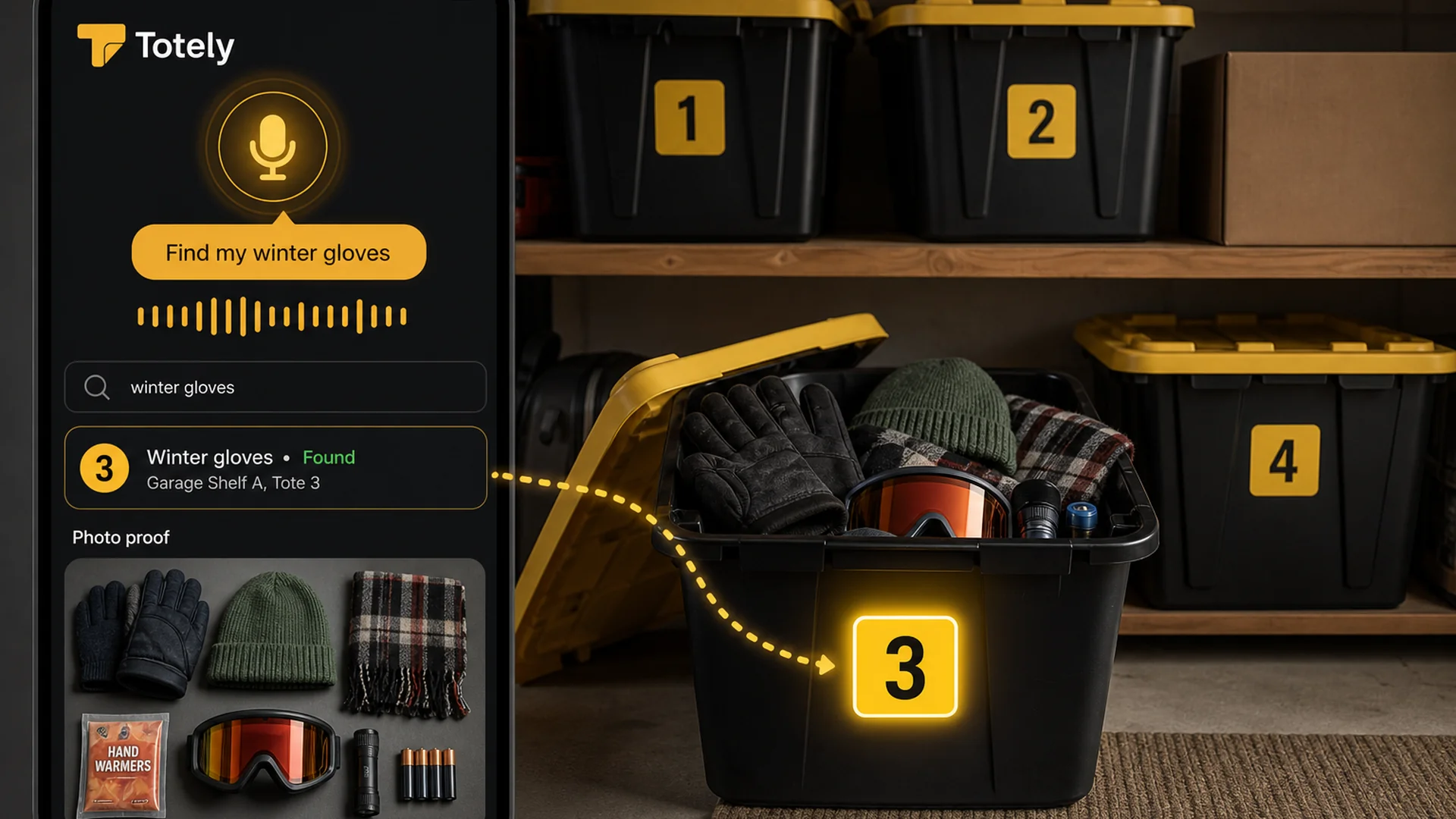
It turns home storage totes into searchable storage.
The workflow is simple:
- Number the tote.
- Snap a photo before closing it.
- Let AI build the first item list from what it can see.
- Review or edit the list if needed.
- Save the exact location.
- Add helpful notes for fragile, seasonal, sentimental, restock, or access details.
- Search naturally later.
- Use photo proof before opening everything.
You do not need to scan a QR code just to get started.
You do not need to manually type every object.
You do not need a complicated category system.
The tote gets a number.
Totely remembers the details.
Simple outside.
Specific inside.
Example: Finding Spare Batteries
Here is how it works.
You have five home storage totes on a hall closet shelf.
They are numbered:
1, 2, 3, 4, 5
Tote 2 holds:
- AA batteries
- AAA batteries
- flashlight
- small battery charger
- spare remote
- outlet timer
- small pack of bulbs
You save the location:
Hall Closet Shelf, Tote 2
Later, someone asks:
“Where are the spare batteries?”
Search:
spare batteries
Totely shows:
Hall Closet Shelf, Tote 2
with photo proof.
You open one tote.
Not five.
Why This Works Better for Families
Home storage is usually shared.
One person may know where everything is.
Everyone else may not.
A numbered tote system makes the knowledge easier to share.
Instead of saying:
“It is probably in the hall closet in one of those bins.”
you can say:
“Hall Closet Shelf, Tote 2.”
That helps kids.
That helps spouses.
That helps guests.
That helps future you.
The system does not depend on one person remembering everything.
A One-Tote Starter Workflow
You do not need to organize the whole house in one day.
Start with one tote.
Choose a tote that causes repeat searches.
Good starter totes:
- spare batteries and flashlights
- guest sheets
- holiday lights
- school keepsakes
- camping accessories
- craft supplies
- chargers and cables
- party supplies
Then:
- Put a simple number on the tote.
- Take a photo of the contents.
- Add the important item names.
- Save the exact location.
- Search for one item as a test.
If it works, do the next tote.
That is the whole system.
Home Storage Totes FAQ
What are home storage totes best for?
Home storage totes are best for items that need to be grouped, protected, stacked, moved, or stored out of sight. They work well for linens, holiday decor, kids’ toys, garage gear, seasonal clothing, keepsakes, tools, and household overflow.
Are clear storage totes better?
Clear storage totes help when you want to see contents quickly. They are useful for closets, under-bed storage, craft supplies, and frequently accessed items. But clear totes can still be hard to read when stacked or crowded, so a searchable record is still helpful.
Are opaque storage totes better?
Opaque totes can look cleaner and calmer on open shelves. They are also useful in garages, basements, attics, and storage units. Because you cannot see inside them, they work best with a number, photo, and saved location.
How should I label home storage totes?
Use a simple visible number on the outside, then store the specific contents in a searchable record. This keeps the outside clean and prevents labels from becoming outdated.
Should I use categories or numbers?
Use both, but let them do different jobs. The number identifies the tote. The category gives broad context. The searchable item list tells you what is actually inside.
How many home storage totes do I need?
Start with fewer than you think. Use one tote per real storage job, not one tote for every vague category. If a tote becomes too mixed, split it. If two totes are half empty and related, combine them.
What size storage tote is best?
The best size depends on the contents and location. Use smaller totes for heavy items and larger totes for lightweight bulky items. Make sure the tote fits the shelf, closet, bed clearance, or storage rack where it will live.
How do I keep storage totes from becoming mystery bins?
Number each tote, photograph the contents, save the exact location, add searchable item names, and update the record when contents change.
Does Totely require QR codes?
No. Totely can work with a simple visible number system. QR codes can be useful, but the core workflow is number, photo, saved location, and search.
Can Totely work for storage units too?
Yes. The same system works for storage units, garages, closets, attics, basements, and moving boxes. Save the location clearly so each tote has a real address.
The Tote Is Not the System
Home storage totes are helpful.
But the tote is not the whole system.
The tote holds the stuff.
The system tells you what is inside.
That is the part most homes are missing.
So do not try to make every tote label perfect.
Do not rely on memory.
Do not reopen five bins just to find one small thing.
Give each tote a simple number.
Take a photo.
Save the location.
Make the contents searchable.
That is how home storage totes keep working after the organizing day is over.
Stored, not lost.