How to Store Scarves Without Snags—and Find the One You Want
Learn how to store scarves by fabric, size, and season, then map each drawer or box so the exact scarf you want stays easy to find.
By Steve Watts · Co-Founder, Totely
October 25, 2026 · Updated October 25, 2026 · 13 min read
The navy silk scarf with the gold border should be easy to spot. Instead, three drawers and four closed boxes hold some combination of blue, patterned, lightweight, and special-occasion scarves. Finding the right one means disturbing nearly all of them.
Learning how to store scarves is partly about keeping fabric supported and free from snagging hardware. It is also about recognition. The best organizer is not useful if every scarf disappears into the same pile.
Start with the scarf: its material, weight, embellishments, condition, and how often you wear it. Then give the drawer, hanger position, or seasonal box a simple address you can find again.
Quick Links
Choose Storage by Scarf Type
Do not buy a 24-loop hanger and then make every scarf conform to it. A smooth everyday scarf, a thick blanket scarf, a loosely knitted wool scarf, and a beaded silk square create different storage problems.
Use this table as a practical starting point. The scarf's care label and maker instructions take priority when they are available.
| Scarf type or situation | Practical first choice | What to check |
|---|---|---|
| Lightweight everyday scarf | Smooth dedicated hanger, broad bar, or upright drawer compartment | It does not slide into a pile, drag on the floor, or rub against rough hardware |
| Bulky blanket scarf | Broad loose roll or individually folded shelf section | The scarf is not compressed under a stack and can be removed without pulling the pile apart |
| Knit, wool, or cashmere scarf | Supported drawer or shelf position, loosely folded or rolled as its care guidance allows | The knit is not stretched, snagged, or pressed against zippers and hooks |
| Silk scarf in regular rotation | Shallow drawer or suitable box with room to rest flat or loosely folded | The surface is protected from light, friction, sharp edges, and crowding |
| Embellished, fringed, vintage, or fragile scarf | Individual support with material-specific guidance | Beads, fringe, weak fabric, loose hems, and unstable decorations cannot catch or bear weight |
| Off-season group | Suitable closed box with a simple number and exact location | Every piece is appropriately clean and dry; the box is not overfilled or placed in a damp area |
Capacity is not the same as fit. A hanger may hold 20 scarves, but removing number 14 should not pull numbers 13 and 15 through tight rings. A drawer may close, but the drawer front should not scrape the tops of upright rolls.
Treat delicate pieces as individuals
The Canadian Conservation Institute's flat-storage guidance explains that supporting an entire textile relieves it from carrying its own weight. It also recommends minimizing folds and padding unavoidable folds for fragile collection pieces.
That is conservation guidance, not a requirement to house every winter scarf like a museum object. It is useful when you are deciding what to do with an inherited silk square, a scarf with weak fabric, or a heavily embellished piece. Everyday polyester or cotton scarves may tolerate a much simpler setup.
Manufacturer instructions can also be specific. For example, the current care guidance for one Hermès cashmere scarf says to store that product flat and untied. Follow the guidance for your actual scarf rather than applying one luxury product's instructions to the entire collection.
Prepare Scarves Before Storage
Storage begins with a short inspection, not a complicated cleaning routine.
Remove knots and hardware
Undo decorative knots rather than storing a scarf under tension. Remove scarf rings, brooches, pins, and clips unless the maker designed them to stay attached. Give the hardware its own small compartment so it cannot scratch, snag, or press against fabric.
If a matching ring lives elsewhere, record that second location: “Navy silk scarf in Box 3; gold scarf ring in Dresser Top Drawer, Left Tray.”
Check condition before doing anything else
Look for a stain, loose hem, pulled thread, missing bead, dampness, or an unfamiliar odor. Record the issue so it is not forgotten when the scarf goes out of sight.
Do not automatically wash, steam, iron, brush, freeze, or spot-treat a scarf because it is changing seasons. Fiber, dye, construction, and decoration matter. Follow the care label or maker, and seek material-appropriate professional advice for a valuable or deteriorating piece.
Only close a scarf inside a drawer or box when it is appropriately clean and fully dry.
Keep rough objects elsewhere
Belts, jewelry, handbags with exposed zippers, and metal hangers can turn one accessory drawer into a snagging surface. Separate scarves from hard or sharp items. You can connect the locations digitally without making the objects share physical space.
For the neighboring accessories, see how to store belts, store handbags, and store hats according to their own shapes.
How to Store Scarves in a Drawer
A shallow drawer works well when it lets you see the collection in one layer. Choose loose rolls, individual folds, or small compartments according to the scarf rather than forcing every piece into the same shape.
Use upright rolls for suitable everyday scarves
For a scarf whose care guidance allows rolling:
- Place it on a clean, dry surface.
- Fold only as needed to match the drawer depth.
- Form a broad, relaxed roll without pulling the fabric tight.
- Set the roll upright between smooth dividers.
- Close the drawer slowly and confirm nothing catches or flattens.
Keep the pattern or dominant color visible from above. The goal is not a perfectly tight row; it is to remove one scarf without the neighboring rolls collapsing.
Fold flat when the scarf needs support
A silk square or fragile scarf may be better in a shallow, supported position with as few folds as practical. Do not stack a heavy knit or a box of jewelry on top. If folds are unavoidable for an important older textile, use the CCI guidance or advice from a qualified conservator rather than improvising with household paper or foam and calling it archival.
The Institute's broader textile-care guidance notes that textile materials and structures vary and that creasing can become set, particularly in aged or weakened pieces. For ordinary wardrobe storage, the useful translation is simple: avoid hard, repeated folds and unnecessary compression.
Divide the drawer by use, not just color
Color sorting looks polished, but frequency often makes mornings easier. Give the front or most accessible section to scarves you wear now. Keep occasional silk squares or formal pieces in a protected section. Move out-of-season winter scarves to a numbered reserve box if they crowd the drawer.
A working drawer might use three sections:
| Drawer section | Contents | Return rule |
|---|---|---|
| Front | Current everyday scarves | Pattern remains visible from above |
| Middle | Lightweight occasion scarves | One scarf per smooth compartment |
| Back | Scarf rings and soft pouches | Hardware closed inside its own tray |
If the arrangement only looks good on the day you organize it, simplify it. Leave enough empty space to return a scarf without rebuilding the whole drawer.
When Hanging Scarves Makes Sense
Hanging can keep lightweight, frequently worn scarves visible and close to your clothes. Use a smooth broad bar, dedicated scarf hanger, or generously sized rings only when the scarf's construction suits that support.
Before committing, check four things:
- The contact point is smooth and will not snag the weave.
- The scarf does not need to be pulled through a tight opening.
- The fabric is not supporting more weight than its care guidance allows.
- The collection is not layered so densely that the back scarves disappear.
Keep hanging scarves clear of sunlight, rough coat zippers, hook-and-loop fasteners, and the closet floor. Do not use clips or clothespins that leave pressure marks unless the scarf maker approves that method.
Assign simple positions when a rack holds many similar pieces: Rack 1, Ring 1–6, or Left Bar. “On the scarf hanger” is not an exact location if the hanger is a thick wall of fabric.
Store Seasonal and Special Scarves
Seasonal storage should reduce handling, not create a forgotten fabric pile.
Build a front-row rotation and a protected reserve
Keep the current season's scarves where you can see and return them. Move the opposite season to a suitable closed box on a stable interior shelf. A box helps with dust and light, but it does not correct dampness, heat, leaks, or overpacking.
The reserve box should be small enough to lift comfortably and shallow enough that you do not have to dig. Several manageable boxes are often more useful than one deep container holding every scarf the household owns.
Give sentimental scarves a story note
An inherited scarf may look like several others in a folded photo. Record one accurate sentence: “Navy silk scarf with gold border, worn by Grandma Elena at holiday dinners.” If the date, maker, or fiber is uncertain, say so.
Avoid repeatedly unfolding a fragile piece just to create a better inventory image. Photograph its safe housing, use an existing picture, or capture one careful overview when the item is already out for use or inspection.
Do not mistake retail packaging for preservation material
An original box may help keep a scarf's history and accessories together, but branding does not prove that its tissue, board, lining, or adhesive is suitable for long-term textile contact. Keep valuable original packaging separately if needed, and get material-specific advice before replacing protective housing for an heirloom.
Build a Scarf Map
A label that says “scarves” identifies the category. It still leaves you opening every box to find one border, pattern, or fabric.
Give each closed scarf box a large, simple number and record its exact shelf. A small map can be enough:
| Number | Exact location | Main contents | Useful search words |
|---|---|---|---|
| 1 | Entry Closet, Door Rack | Everyday lightweight scarves | black striped scarf, red cotton scarf, daily scarves |
| 2 | Dresser, Second Drawer | Current-season knits | cream cable-knit scarf, green wool scarf, winter scarves |
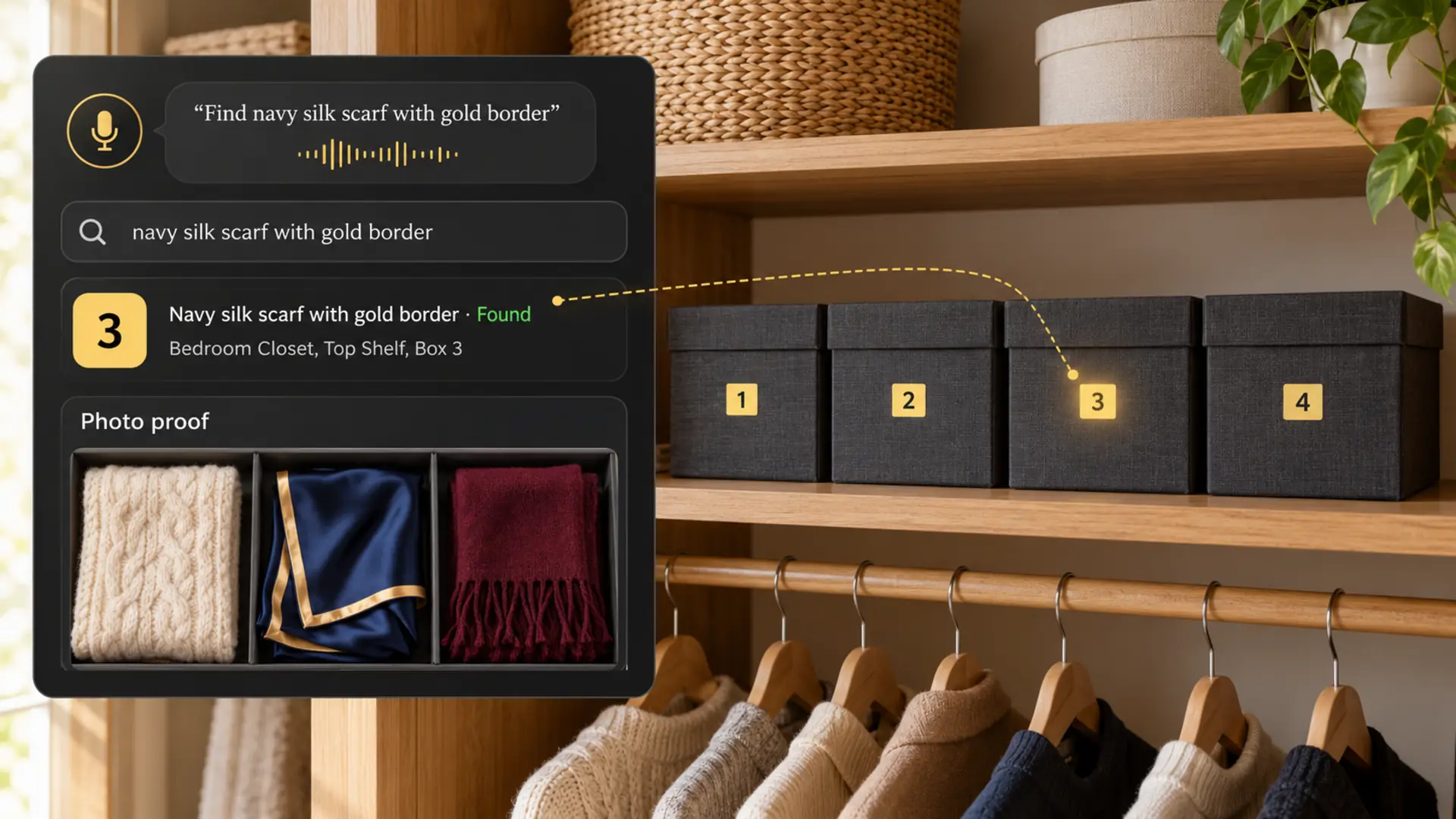
| 3 | Bedroom Closet, Top Shelf, Box 3 | Silk and special-occasion scarves | navy silk scarf, gold border, wedding scarf |
| 4 | Bedroom Closet, Top Shelf, Box 4 | Off-season blanket scarves | plaid blanket scarf, gray wrap, oversized scarves |
Now “Where is the navy silk scarf with the gold border?” has a usable answer: Bedroom Closet, Top Shelf, Box 3.
If Box 3 contains several protected pieces, add a simple internal map:
| Box 3 section | Contents | Note |
|---|---|---|
| A | Navy silk scarf with gold border | Special occasion; lift from support |
| B | Blue floral square | Matching soft pouch underneath |
| C | Burgundy evening scarf | Scarf ring stored in dresser tray |
The outside still needs only the number 3. Keep the descriptive detail in a paper index or searchable record. Update it when a scarf moves, goes to a cleaner, or returns to a different section.
For the same principle at a larger scale, see how to keep track of storage bins.
How Totely Helps
The hanger, drawer, or box supports the scarves physically. Totely adds the digital memory layer that keeps a particular pattern findable after the lid closes.
Use a simple workflow:
- Put a visible yellow number 3 on the outside of the closed scarf box.
- Take one safe overview photo while the contents are visible.
- Let the app suggest an initial list of visible items, then review and correct it.
- Add “navy silk scarf with gold border” and any story or condition note the photo cannot supply.
- Save Bedroom Closet, Top Shelf, Box 3 as the exact location.
- Search naturally for “navy silk scarf with gold border” later.
- Use the result number, location, and photo proof to confirm the box before opening it.
A photo cannot identify a scarf hidden under another piece, and AI cannot reliably determine fiber, care requirements, provenance, or condition from appearance alone. Human review matters. You do not need QR codes, barcodes, or an individual record for every inexpensive everyday scarf to make the system useful.
The One-Drawer Starter
Do not begin with every scarf in the house.
- Choose one drawer, hanger, or seasonal box.
- Remove knots and separate hardware.
- Check labels, construction, condition, and whether each scarf is appropriately clean and dry.
- Choose hanging, rolling, supported folding, or individual housing for each group.
- Give the drawer section, hanger position, or box a simple number.
- Take one safe overview photo and correct the visible item descriptions.
- Save the exact closet, shelf, or drawer location.
- Ask another person to find the navy scarf using the map alone.
If they can find it without unfolding the whole collection, the system already works. Stored, not lost.
Scarf Storage FAQs
Is it better to hang, roll, or fold scarves?
It depends on the scarf's material, weight, construction, condition, and use frequency. Smooth hanging can suit some lightweight everyday scarves; loose rolling can make suitable scarves visible in a drawer; flat or carefully supported storage may be better for fragile pieces. Follow the care label or maker when available.
How should I store silk scarves?
Keep them away from snagging hardware, crowding, unnecessary light, and hard repeated folds. A shallow drawer or suitable box can support silk scarves, but the maker's instructions should decide the exact method. Valuable, historic, embellished, or deteriorating silk may need conservation advice.
How do I store scarves in a drawer without losing them?
Use one visible layer, smooth dividers, and enough space to remove one scarf cleanly. Keep patterns or dominant colors visible from above, separate delicate pieces, and divide the drawer by current use or material.
Can I keep scarves in a plastic storage box?
A clean, suitable box can hold appropriately prepared off-season scarves if it provides enough room and sits in a dry, stable interior location. The box does not fix dampness, trapped moisture, crowding, heat, or unsuitable contact materials.
What is the best scarf storage idea for a small closet?
Use the empty vertical space on a closet door or wall for suitable everyday scarves, then move bulky or off-season pieces to a shallow numbered box. Avoid adding a high-capacity hanger if it will compress scarves or hide most of them.
Do I need to catalog every scarf individually?
No. Start with a box- or drawer-level photo, a few recognizable descriptions, and the exact location. Add individual notes for valuable, frequently requested, sentimental, or easily confused pieces.
Make the Collection Wearable Again
Good scarf storage protects the fabric without turning the collection into an untouchable archive. Keep daily scarves visible, give delicate pieces appropriate support, and move seasonal overflow into shallow boxes you can identify without searching every shelf.
Then add the small memory layer: one number, one reviewed photo, and one exact location. The right scarf becomes part of the outfit again instead of another thing you know you stored somewhere.