How to Store Sweaters: Protect the Knit, Find the One You Want
Learn how to store sweaters with supportive folds, sensible container choices and a clear location record, so the knit you want is easy to find.
By Steve Watts · Co-Founder, Totely
October 19, 2026 · Updated October 19, 2026 · 12 min read
The green crewneck is behind something bulky. You remember folding it, but the closet shelf now holds three similar containers and a stack that slides forward whenever you touch it. Finding one sweater means disturbing the whole arrangement.
Knowing how to store sweaters involves two separate decisions: how to support and protect the knit, and how to recognize the right garment after it disappears into storage.
For most everyday setups, start with a gentle fold rather than an ordinary shoulder hanger. Follow the garment's care label, finish drying before packing, and choose a suitable drawer, shelf or container without squeezing everything in. Keep frequently worn pieces accessible. For seasonal woolens, consider pest protection as well as fabric care, then record the exact home of the sweater you will want later.
Quick Links
How to Store Sweaters for the Way You Use Them
A sweater you wear this week should not require the same unpacking routine as one you put away for a season.
Before buying an organizer, decide which situation you are solving.
| Situation | What the storage needs to do | A useful first decision |
|---|---|---|
| Sweaters in regular use | Keep suitable folds supported and individual pieces accessible | Choose a reachable drawer section or shelf |
| Clean off-season sweaters | Protect the garments in appropriate conditions while keeping their identity clear | Check care instructions, packaging and the storage location together |
| A delicate or embellished knit | Avoid pressure, snagging and an unsuitable fold | Follow its specific care guidance rather than treating it like a sweatshirt |
| A sweater with a care problem | Keep an unresolved issue from disappearing into a ready-to-wear pile | Set it aside for appropriate assessment or care before packing |
Separating these jobs can solve a crowded closet without new furniture. Move the rarely requested pieces out of the everyday section, but do not simply push them into an anonymous bag.
A helpful test is physical: take the sweater you wear most often out of its proposed home, then return it. If that requires lifting a tower or holding a drawer shut, change the arrangement.
Prepare the Knit Before Packing
Read the actual care label. A fiber name is useful context, but it is not a complete washing instruction. Trims, construction and blends can change what a particular garment needs.
The American Cleaning Institute's sweater guidance distinguishes machine-washable, hand-wash-only and dry-clean-only sweaters. It recommends cleaning garments before seasonal storage and folding them for storage rather than hanging them in a way that stretches the knit.
This does not mean every briefly worn sweater needs washing after every outing. Keep the between-wears routine separate from preparing garments for a long period put away.
Finish drying before putting the sweater away
Follow the drying instructions too. Woolmark's wool-sweater drying guide recommends flat drying unless the garment's care claim permits tumble drying. Hanging a wet knit can let the weight pull it out of shape.
Do not make an all-sweaters dryer rule from one garment's label. Equally, do not assume that a machine-washable sweater can automatically be tumble dried.
Check thicker areas such as cuffs and collars before packing. Leave a garment that still needs drying out of the storage group. A sealed lid is not a solution to residual dampness.
Notice problems before they become hidden problems
Look for a loose seam, snag, stain or unexplained hole while the sweater is already in your hands. Record what you notice rather than attempting an unfamiliar repair simply to finish organizing.
If you suspect insects or damage that needs investigation, keep the affected garment separate from the clean storage group and seek garment-appropriate advice. Do not pack it among unaffected knits and assume a scented sachet will deal with it.
This guide covers storage choices, not treatment of an infestation or restoration of damaged clothing.
Fold for Support and Easy Removal
The goal is a supported, manageable shape. It is not the smallest possible parcel.
On a clean, dry surface, lay the sweater down without pulling its edges. Bring the sleeves inward and fold the body enough to fit the available space. Keep bulky collars, decorations or closures from being forced into an awkward bend. Adjust the arrangement for the actual garment.
For a very delicate or unusually constructed piece, follow its maker's instructions instead of trying to apply one fold to everything.
Keep the stack manageable
A short stack that you can handle comfortably is more useful than a tall column that looks tidy until someone wants the bottom sweater.
Place heavier knits where they will not crush delicate pieces. Give a special garment its own suitable section when necessary. Do not rely on the sweater underneath to act as a shelf support.
If a shelf is deep, avoid putting the most-used garment behind a second row. You may have room for the clothes, but no practical way to reach them.
Try a drawer arrangement without forcing a file fold
A side-by-side arrangement can help you see several folded sweaters at once. It works best when the garments sit comfortably in the drawer and remain supported.
If a thick sweater must be pressed into a tight packet to stand upright, use a flatter arrangement or a different home. File folding is one option, not a requirement for every knit.
Check the drawer's movement with the garments inside. Fabric should not catch at the back or be trapped along the closing edge.
Choose a Drawer, Shelf or Storage Container
Choose the housing for the garment and the purpose, then check it in the location where it will live.
| Storage choice | Where it can be useful | What to check |
|---|---|---|
| Drawer section | Regularly worn folded knits | Smooth surfaces, usable depth and easy opening without trapped fabric |
| Closet shelf with suitable separation | Accessible everyday stacks | Support, reach and whether one sweater can come out without bringing down the others |
| Cloth storage bag | Delicate garments when suitable care guidance supports it | Actual material, closure, room around the knit and the level of protection needed |
| Properly sealed container | Seasonal storage where an insect barrier is part of the plan | Garments must be clean, fully dry and pest-free; check fit and the surrounding conditions |
| Suitable under-bed housing | Off-season pieces in a home short on shelf space | Garment-appropriate packaging plus packed height, access and a dry storage area |
You will encounter both breathable-bag and airtight-container recommendations. They address different concerns; neither description makes unsuitable storage conditions disappear.
Woolmark's storage advice discusses cloth bags for delicate clothing and cautions that vacuum packing can restrict airflow, trap moisture and be unsuitable for delicate pieces. In contrast, UC's clothes-moth guidance recommends airtight housing for susceptible stored items that are already clean and pest-free.
A cloth bag is not equivalent to a sealed insect barrier. A sealed container does not clean the garment, remove insects already present or make it sensible to crush a delicate knit. For a valuable piece or a known pest issue, get advice that addresses both the garment and the problem.
Do not make cedar the whole plan
UC's pest specialists describe limits to cedar's effectiveness and uncertainty around herbal repellents. A pleasant smell is not proof that a stored sweater is protected.
Keep the storage area clean, inspect garments periodically and follow appropriate guidance if you find a problem. Do not improvise chemical, heat or freezing treatments from a general storage tip.
Check the location, not just the container
A dry interior closet may be more suitable than a storage area that becomes damp or experiences large environmental changes. Check for leaks, condensation and other signs that the proposed home is unsuitable.
For the container's physical fit under a bed, use the under-bed storage guide. For a small closet without a dresser, our renter-friendly storage guide covers other available spaces. Neither requires you to put delicate clothing wherever an empty gap happens to exist.
Make Similar Sweaters Easy to Tell Apart
“Winter clothes” may be enough to identify a season. It is rarely enough to identify one green crewneck.
Describe the features you actually use to recognize the garment: color, neckline, a stripe, a distinctive button or an owner when useful. Copy fiber and care information from the actual label rather than guessing from a photograph.
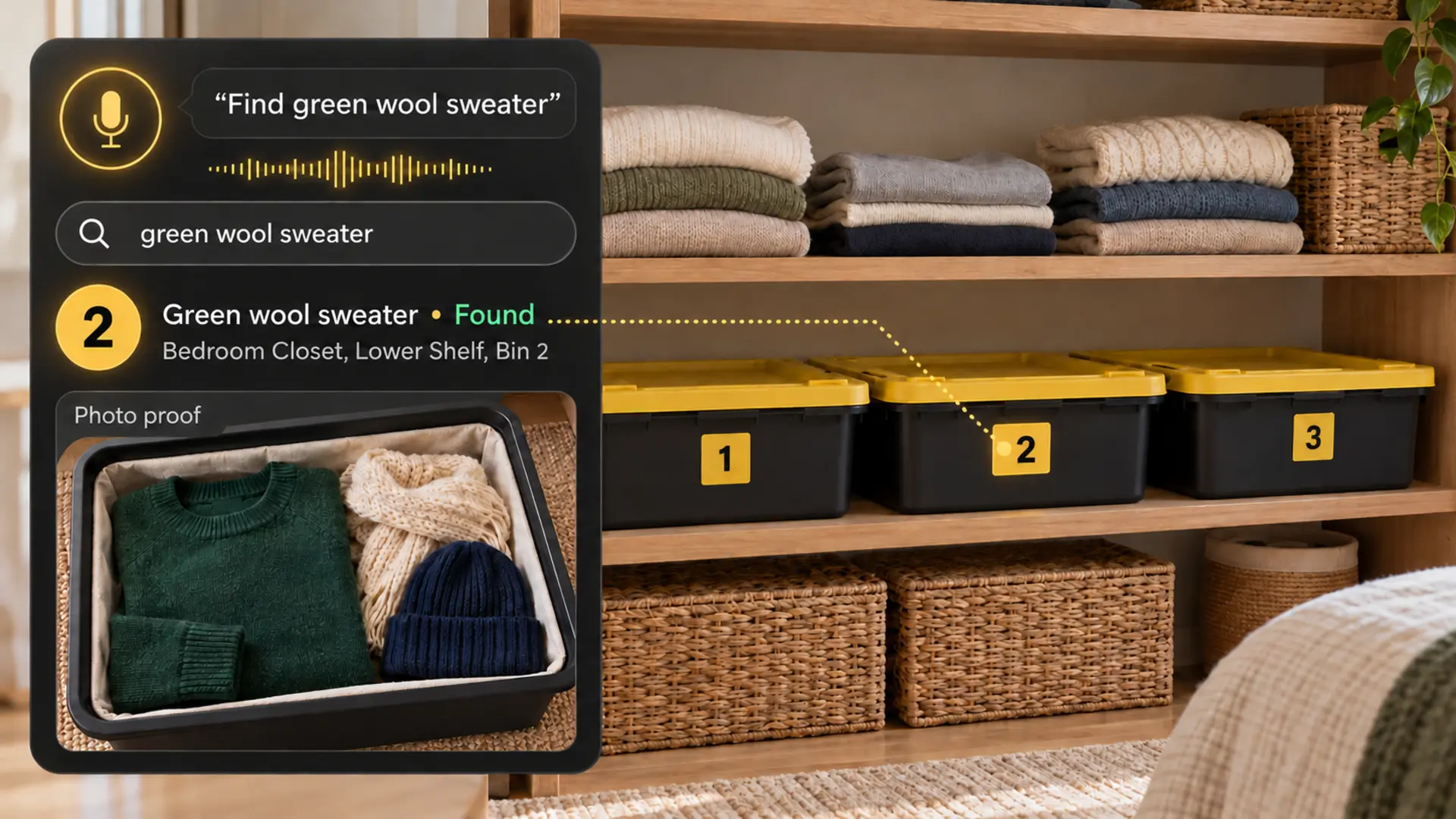
Here is an illustrative record for a three-bin closet setup:
| Container | Exact saved home | Useful description |
|---|---|---|
| 1 | Bedroom Closet, Lower Shelf, Bin 1 | Everyday cotton pullovers; descriptions checked from the actual garments |
| 2 | Bedroom Closet, Lower Shelf, Bin 2 | Green wool crewneck, cream knit scarf and navy beanie; each item's care instructions retained |
| 3 | Bedroom Closet, Lower Shelf, Bin 3 | Off-season cardigans; one cream cardigan needs a loose-button check before use |
These are examples, not care instructions inferred from the hero image. The wool description should come from a real label in your own setup.
Photograph the visible contents before closing the container. Keep the searched-for sweater recognizable without repeatedly unfolding everything just for a better inventory picture. If a garment is enclosed in inner packaging, add a description of what the photo cannot show.
A note can preserve a useful distinction: “green crewneck with ribbed collar” or “cream cardigan, button needs attention.” Avoid turning the record into a lengthy fashion catalog unless you want one.
When you move a bin or change its contents, update the location or item note. The storage-record maintenance guide explains that habit in more detail.
How Totely Helps
After the physical storage is suitable, Totely makes the record searchable.
Give the outer bin a simple visible number. Take a contents photo, let Totely suggest a first list from the visible items, then review and correct it. Add “green wool sweater,” its checked identifying details and an exact location such as “Bedroom Closet, Lower Shelf, Bin 2.”
Later, say or type “green wool sweater.” The saved description, number, location and photo proof help you identify the right container before opening similar bins.
AI cannot confirm the fiber, read a hidden label, diagnose damage or certify that the garment is pest-free from an ordinary storage photo. It also does not know about an unrecorded move or repair. Those details depend on your checks and updates.
No QR codes, barcodes or manual entry of every small item are needed to start with one useful container record.
The One-Sweater Reset
Choose the sweater you are most likely to want next. Leave the rest of the wardrobe for another time.
- Check its care label and any cleaning, drying or repair needs.
- Decide whether it belongs in everyday access or longer storage.
- Fold it gently for support and a suitable fit.
- Choose an appropriate drawer, shelf or container without forcing the closure.
- Check that the storage location is suitable and reachable.
- Give the outer container a simple number if that helps your system.
- Photograph the visible contents and save a recognizable description with the exact location.
- Find the sweater using that information, then update the record when something changes.
A system you can use on an ordinary morning is a better stopping point than an elaborate arrangement you cannot maintain.
Sweater Storage FAQs
Is folding better than hanging a sweater?
Folding is a sensible default for supporting knitted garments. Ordinary shoulder hanging can stretch some knits, especially when wet or heavy. Follow specific garment guidance if you use a different supported arrangement; do not assume a sweater stores like a woven shirt.
How can I store sweaters if I do not have a dresser?
Use a suitable closet shelf, separated shelf section or garment-appropriate container in another accessible indoor location. Test removing and returning one sweater. Avoid solving the missing-dresser problem with an unstable pile or an overfilled hanging organizer.
Is a cotton bag enough for storing wool sweaters?
It may suit some delicate garments in an appropriate setting, but it is not equivalent to an airtight insect barrier. Consider the garment's care instructions and the protection needed. Cleanliness, full drying, suitable conditions and periodic checks still matter.
Should I vacuum-pack bulky sweaters?
Do not assume compression is suitable just because it saves room. Woolmark notes limitations for delicate clothing and moisture in vacuum bags. Check the garment maker's storage guidance and choose a less compressed arrangement when appropriate.
How do I distinguish several dark sweaters in one bin?
Use specific descriptions such as “green crewneck with ribbed collar” or “navy cardigan with brown buttons,” checked against the garments. Take a useful reference photo and add notes for details it cannot establish. Keep the bin's exact location with the record.
How often should I check sweaters in seasonal storage?
Check periodically and whenever you have reason to suspect dampness, insects or a storage problem. There is no single interval in this guide for every home and garment. Inspect the contents as well as the container, and update any changed location or condition note.
Keep the Sweater, Not the Search
A good fold protects the garment's shape. A suitable home addresses its storage needs. A clear record helps you find the particular knit you meant.
Start with one sweater and one location you can describe. Keep its care information, give it room and make its description recognizable. Try the One-Tote Test with the container you already use.
Stored, not lost.