How to Store Handbags: Protected, Not Hidden
Learn how to store handbags with suitable support, room for handles and hardware, and dust covers that do not leave you guessing which bag is on the shelf.
By Steve Watts · Co-Founder, Totely
October 20, 2026 · Updated October 20, 2026 · 13 min read
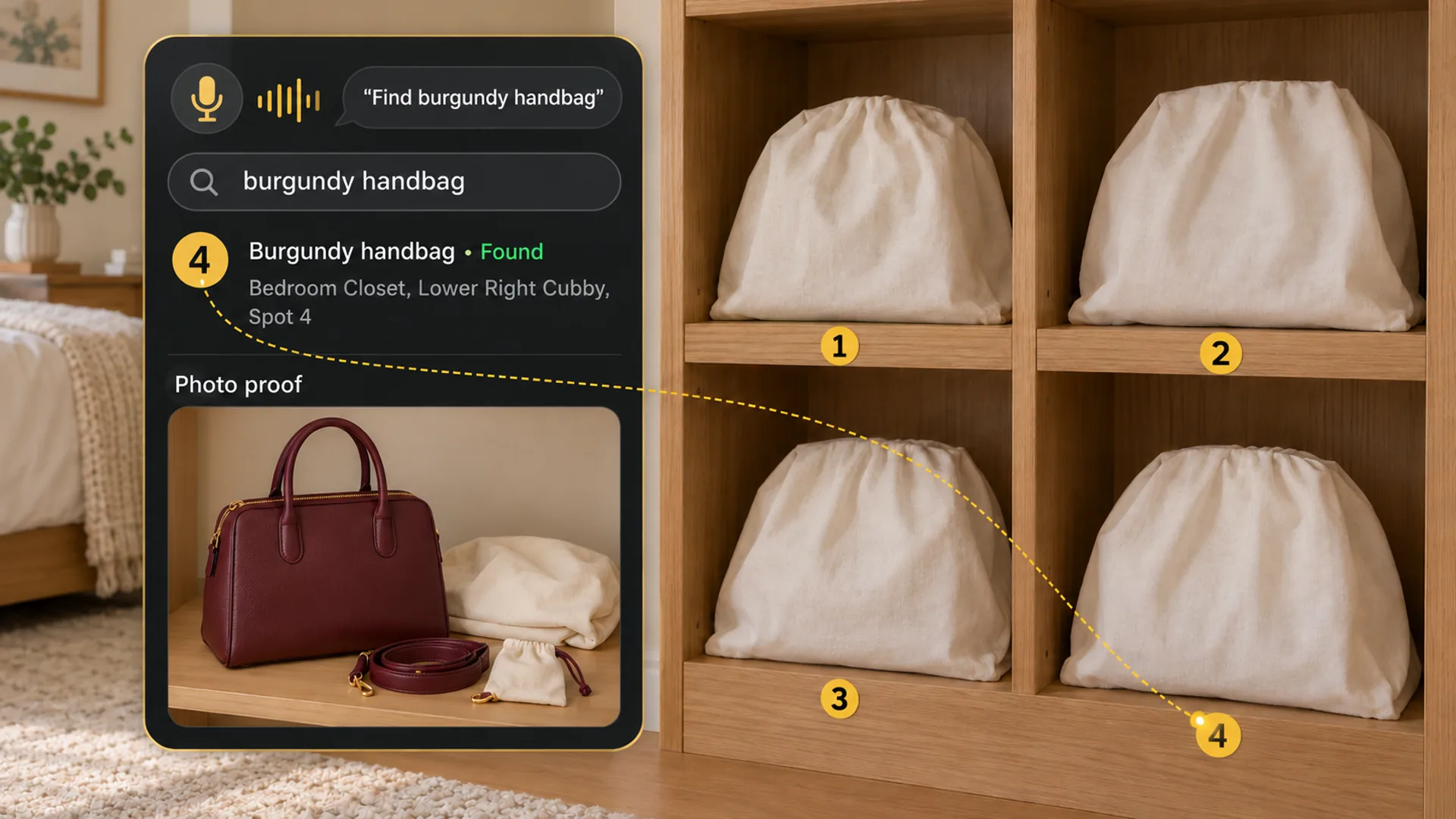
You remember the burgundy handbag. You remember putting it away carefully. But the closet now holds a row of similar cream dust covers, and the matching shoulder strap might be in a different drawer.
Good handbag storage should not make you choose between protecting a bag and recognizing it later.
To work out how to store handbags, start with the individual bag: its construction, condition and maker's instructions. Empty it, use suitable support without stretching it, keep straps and hardware from pressing against delicate surfaces, and give it enough room in a suitable interior location. Then record which covered bag lives where.
You may need a shelf, a drawer or individual housing. You do not necessarily need another storage tote.
Quick Links
Choose the Resting Position Before the Organizer
A structured satchel with a broad base and a fragile vintage purse do not necessarily belong in the same position. Neither should be forced into whatever shape a storage slot happens to provide.
Before choosing an organizer, find the care card or the maker's guidance for the actual bag. Look for instructions about its resting position, filling, cover and straps. If the material is uncertain, do not guess from a photograph or the word “leather” in an old listing.
A stable base can be useful, but upright is not universal
A shelf can give a sound, structured bag support under its base, provided that its care instructions suit upright storage. Leave room for the handles rather than folding them down simply to fit a lower shelf.
For its own handbags, CHANEL recommends upright storage in the original pouch and tissue protection around chains or straps. That is specific manufacturer guidance, not a rule for every purse ever made.
The Canadian Conservation Institute's guidance for collection accessories describes a different arrangement for purses: loose tissue support, flat storage, supported handles and separation from other objects. It also advises supporting the whole bag when moving it rather than relying on fragile handles.
Those instructions serve different objects and circumstances. Do not flatten a modern structured handbag to imitate a museum arrangement, or insist that a weakened heirloom stand unsupported. For a fragile or irreplaceable piece, seek advice suited to its materials and condition.
Check these constructions separately
- Structured handbag: Check that its base sits evenly, its panels are not pushed inward and its handles have clearance. Use the maker's intended shape as your reference.
- Soft or slouchy bag: Do not stuff it into an artificially rigid silhouette. Find out how its body should be supported without introducing sharp folds.
- Long-strap or chain bag: Allow space for the strap as well as the body. Avoid using the handle as the only support for an extended storage period unless the maker specifies that arrangement.
- Clutch or small occasion bag: A suitable drawer section or individual housing may fit better than a hanging organizer. Check that neighboring pieces cannot press on its clasp or embellishment.
- Vintage, beaded or damaged purse: Treat weak handles, loose decoration and unstable surfaces as separate care questions. A narrower organizer is not a solution to fragility.
The aim is a resting place you can use without pushing, bending or compressing the bag to get it in.
Prepare the Bag and Its Accessories
Work on one bag at a time. It is easier to keep the correct strap, care information and small accessories together when several similar pieces are not spread across the table.
Empty every pocket before adding support
Remove receipts, pens, cosmetics, coins, food and anything that can spill. Check small zip pockets and the space beneath a removable liner. Keep personal documents out of an inventory photograph.
Look at the base, corners, lining, handle attachments and closure. Notice problems such as a loose fitting or a surface that has started to change. Record them accurately; storing the bag is not the same as repairing it.
Use only cleaning and drying methods appropriate to the actual material. Do not automatically wash, spray or condition a bag because it is being put away for the season.
Hermès advises against commercial care products for its leather and directs owners to its specialists. Its storage guidance also favors a temperate, dry place away from light. That is a useful reminder to check original instructions before following a universal online conditioning schedule.
If the bag is damp, deal with that according to its care guidance before covering it. Do not make a radiator, hair dryer or sealed container part of an improvised drying treatment.
Add support only where it belongs
Use the filling or insert recommended for the bag. Support should help it rest in its intended shape, not make its panels taut or force the closure apart.
If the zipper becomes difficult to close after filling, or the corners bulge beyond their normal shape, stop and reassess the arrangement. More filling is not automatically more protection.
Do not use the handbag as a convenient container for heavy accessories or several smaller purses. The empty space is not spare household storage.
For old or delicate pieces, do not call ordinary tissue, foam or cardboard “archival” without knowing its specifications and suitability. Material touching an unstable finish may need specialist advice.
Give the matching strap a definite home
Follow the maker's instructions about detaching and arranging straps. Do not force a stiff clip or pull a chain through a fitting just to make the storage look tidier.
Where removal is appropriate, keep the strap with its own bag in suitable separate protection. Arrange it without a tight fold, and keep metal fittings from bearing against the bag's surface. Do not add adhesive directly to leather or fabric.
Record the arrangement in plain language: “Matching burgundy strap in cotton pouch beside the bag.” That is more useful than “strap somewhere in accessories.” If you must use a separate drawer, record that exact drawer instead.
Check Shelf Space with the Cover On
Fit the complete stored arrangement, not just the bare handbag. The body, handles, support, cover and associated pouch all need room.
Try removing and replacing the covered bag. Can you do it without catching a handle on the shelf above, dragging the cover against rough hardware or moving two neighboring bags first?
A roomy dust cover should not pull the handles together or compress decoration. Use the original cover when it remains suitable, or follow the maker's advice about a replacement. Do not assume a transparent plastic sleeve and a fabric dust cover are interchangeable for every finish.
Keep the bag separate from neighboring buckles, zippers and strongly colored materials. Leave enough space that a divider helps define a position rather than squeezing the bag into it.
An open shelf is not automatically suitable either. Check the actual location for direct light, heat, dampness and leaks. A covered shelf in an interior closet may be more practical than a sunny display. Closing a closet door does not solve an existing moisture problem.
Keep the arrangement accessible for inspection. When you next use or rotate the bag, check both the item and its housing for changes. Persistent dampness, suspected mold or a deteriorating finish calls for appropriate care advice, not another layer of packaging.
Make a Small Closet Work Without Squeezing
Start by measuring the space a properly supported bag actually occupies. An organizer advertised for six purses may not hold six of yours with their handles and covers clear.
Use these choices to guide the layout:
- Existing shelf: Give each bag a defined position, with enough height and width to remove it without scraping its neighbors. This can be enough without buying an organizer.
- Cubby: Check the whole opening and interior depth. Do not bend handles to pass through a smaller opening, even if the bag would fit farther inside.
- Drawer: Reserve it for bags whose recommended position and size suit the space. Check the drawer closed as well as open; the upper edge should not catch a clasp or handle.
- Hanging compartment organizer: Check the manufacturer's installation and load guidance, then whether each compartment supports the bag's body without sagging or compression. Suspending an organizer is different from suspending a handbag by its handles.
- Door storage: Check clearance when the door moves. Do not choose a hook or pocket merely because it adds capacity; the bag still needs an appropriate resting position and protection.
If none of the available compartments fit, change the allocation of closet space rather than forcing the bag into one. A smaller selection in the easy-access area can leave suitable room elsewhere for occasional bags.
For layout ideas using existing furniture, see our renter-friendly storage guide. For the wider wardrobe changeover, see seasonal storage in small homes.
Identify Handbags Under Their Dust Covers
Once the physical arrangement works, make it recognizable without uncovering every bag.
Give each storage position a simple visible number. On a cubby unit, place the number on an appropriate shelf-edge label or separate holder, not on the handbag. Use a labeling method suited to the furniture's finish.
Here is an illustrative four-spot record, all within one bedroom closet:
| Spot | Position | Bag and accessory note |
|---|---|---|
| 1 | Upper left | Black work bag; its matching strap kept with it |
| 2 | Upper right | Tan shoulder bag; care card in separate pouch |
| 3 | Lower left | Navy occasion bag; protected clasp |
| 4 | Lower right | Burgundy handbag; matching strap in cotton pouch beside it |
Save the complete address, not just “4”: Bedroom Closet, Lower Right Cubby, Spot 4.
Add a description you will remember: burgundy handbag, rounded top, two handles, matching removable shoulder strap. A maker name or material belongs in the record only when you have reliable information for it.
Take a reference photo while the bag is safely accessible, before replacing the cover. Include its strap pouch if that helps identify the setup. For a fragile piece, an existing photo or a picture of its housing with accurate notes may be more appropriate than extra handling.
A paper index can hold this information. The important part is keeping the bag, its description and its current address connected. Our storage tracking guide explains the same principle for closed containers.
How Totely Helps
Totely adds a searchable record to the storage you have already made suitable. It does not make an unsuitable shelf protective or decide how a particular leather should be treated.
The Totely storage workflow also works with shelves and closet zones. For the covered burgundy handbag example:
- Put a simple number 4 on the appropriate cubby marker.
- Photograph the safely accessible bag and its associated accessories before covering it.
- Review the app's suggested initial item list. Correct mistaken descriptions and add the matching strap's location yourself.
- Save Bedroom Closet, Lower Right Cubby, Spot 4 as the exact location.
- Later, say “Find burgundy handbag” or type “burgundy handbag.”
- Use the saved number, location and photo proof to identify the right spot before removing the cover.
The hero illustrates this saved-record idea; it is not a screenshot from an app test. A photo of a closed dust cover cannot reveal the bag inside. AI also cannot reliably establish a bag's material, authenticity, care requirements or a move you have not recorded.
Keep the human review. Add hidden accessories and personal identifiers yourself. When the bag changes position, update the saved location rather than expecting the old photo to know where it went.
Try One Complete Bag Changeover
Choose one sound handbag you regularly swap into or out of use. Complete the whole return routine before reorganizing the rest of the closet.
Empty it, check its care instructions, restore suitable support and arrange its accessories. Confirm that the covered setup fits its assigned space. Take one useful reference photo, add a number and save its description and address.
Then close the closet and try to answer two questions from the record: “Where is the burgundy handbag?” and “Where is its shoulder strap?”
If either answer is vague, improve the note. You do not need a detailed catalog of every stitch or pocket. You need enough information to retrieve the right bag and return it properly.
For a handbag with family significance, add a short, accurate story alongside its location. Our sentimental-item storage guide covers preserving that context without turning every keepsake into a large documentation project.
Handbag Storage FAQs
Is it better to store handbags upright or flat?
Follow the bag's construction, condition and original care instructions. Some makers recommend upright storage in a pouch, while conservation guidance for collection purses describes supported flat storage. Do not force a bag into either position merely to fit an organizer.
Can I hang handbags by their handles?
A hook puts the bag's weight through its handles and attachments. For extended storage, start with suitable support under the body unless the maker recommends otherwise. A fragile handle should not be treated as a carrying or hanging point.
Should I keep handbags in their dust bags?
Use the original dust cover when it is suitable and in sound condition, following the maker's guidance. It needs enough room for the whole bag and handles without squeezing them. A cover does not correct light, heat, dampness or pressure in the storage location.
What should I put inside a stored handbag?
Use support suited to the specific bag and its care instructions, adding only enough to maintain its intended shape. Do not overfill it or use heavy objects as stuffing. Fragile historic bags may need more specific advice about contact materials and support.
Do all leather handbags need conditioning before storage?
No universal conditioning schedule applies to every leather and finish. Check the exact maker's care instructions before using a product. Do not substitute a general storage article for advice about an unfamiliar, valuable or unstable surface.
How can I tell which handbag is under a dust cover?
Number its storage position, save a useful photo taken before covering it, and record a memorable description plus the exact location. Include where its matching strap is kept. Update the record when the bag or accessory moves.
Keep the Cover, Lose the Guesswork
The useful storage test is not how many bags fit on a shelf. It is whether each one has suitable support and room, can be retrieved without disturbing its neighbors, and goes back with the right accessories.
Make that physical setup work first. Then one number, an accurate photo and a clear address can keep a protected handbag from becoming an anonymous shape in the closet.
Start with one bag and try the One-Tote Test. Stored, not lost.