How to Store Sentimental Items Without Forgetting What You Kept
Store sentimental items by person, event, season, and story so keepsakes stay protected, remembered, and easy to find later.
By Steve Watts · Co-Founder, Totely
June 6, 2026 · Updated August 26, 2026 · 13 min read
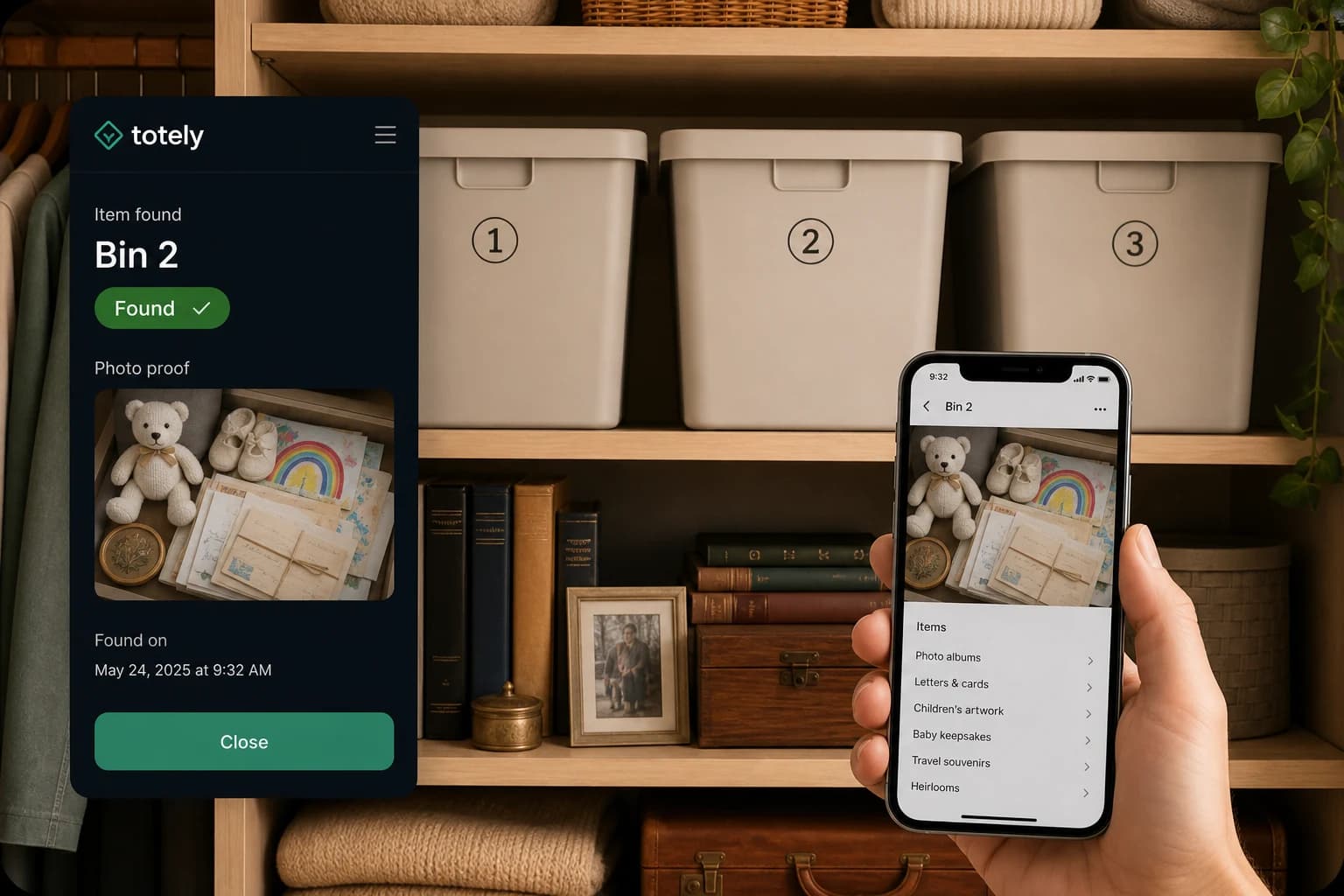
Sentimental items are not ordinary storage.
A box of old chargers is one thing. A box of photo albums, letters, children's artwork, baby keepsakes, school papers, graduation items, wedding keepsakes, travel souvenirs, inherited items, family recipes, handmade gifts, medals, concert tickets, heirlooms, and tiny objects with a story is something else entirely.
These items are not always useful in the everyday sense. But they hold memory, identity, family history, and little pieces of a life that mattered.
That is why sentimental item storage needs a gentler system than regular organizing advice usually gives.
The goal is not to pressure yourself to keep less. It is not to turn memories into a spreadsheet. And it is definitely not to toss meaningful things just because they do not have a daily purpose.
The goal is simpler: store sentimental items so they stay protected, remembered, searchable, and easy to find later.
Because a keepsake box that only says "memories" may feel organized today, but years from now it can become another mystery box. You may remember that you saved something important, but not which tote holds the wedding cards, where the school papers went, or why that small travel souvenir mattered so much.
Here is a warmer way to keep the memory without losing the story.
Quick Links
- Start With Why the Item Matters
- Sort Keepsakes by Person, Event, or Life Season
- Create a Small Number of Memory Categories
- Protect Fragile or Irreplaceable Items
- Write Down the Story Before You Forget It
- Use Numbered Keepsake Boxes Instead of Broad Labels
- How Totely Helps You Find Sentimental Items Later
- Sentimental Item Storage FAQs
Start With Why the Item Matters
Before you choose a box, label, shelf, or storage tote, pause for the most important question:
Why does this item matter?
That question is more useful than "Should I keep this?" because it removes the pressure. Some keepsakes matter because they are beautiful. Some matter because they belonged to someone you loved. Some mark a turning point: a graduation program, wedding invitation, baby bracelet, school award, concert ticket, travel souvenir, recipe card, or handmade gift.
Others matter in ways that are hard to explain quickly.
That is okay.
When you know why something matters, it becomes easier to decide how to store it. A child's artwork from preschool might belong in a school-years box. A wedding card might belong with marriage keepsakes. A handwritten recipe might belong in a family history folder rather than a random paper pile. A medal or award might belong with a life-season box, not loose in a drawer.
Try sorting sentimental items into three gentle groups:
Keep and revisit: items you want to see, share, or look through again. Keep and protect: items you may not open often, but want safely preserved. Keep for now: items you are not ready to decide on yet.
That last category matters. Sentimental storage does not have to force a final decision today.
Sometimes the kindest system is one that lets you keep something with context, then revisit it later with more clarity.
Sort Keepsakes by Person, Event, or Life Season
Most sentimental boxes become confusing because everything meaningful gets grouped under one broad label: "memories," "keepsakes," or "old stuff."
Those labels are not wrong. They are just not useful enough later.
A better system is to sort sentimental items by the way you are likely to remember them.
For many homes, that means sorting by person, event, or life season.
By person works well for family keepsakes. You might have one box for each child, one for a parent or grandparent, one for a partner, or one for inherited family items.
By event works well for weddings, graduations, big trips, moves, anniversaries, milestone birthdays, concerts, school performances, sports seasons, or family reunions.
By life season works well for broader chapters: childhood, school years, college, early career, new baby years, military service, family travel, home renovations, or caregiving years.
Examples:
Childhood Keepsakes
School papers, children's artwork, medals, report cards, favorite notes, class photos.
Wedding Keepsakes
Cards, invitation, program, dried ribbon, guest notes, small decor pieces, printed photos.
Family History
Letters, inherited items, family recipes, old photos, heirlooms, handwritten notes.
Travel Memories
Tickets, postcards, maps, small souvenirs, printed photos, travel journals.
Baby Keepsakes
Hospital bracelet, special coming-home outfit, first hat, baby cards, first artwork.
The goal is not perfect archival sorting. It is creating a system that your future self can understand.
For baby-specific keepsakes, see how to store baby clothes for the next child. For seasonal decor with sentimental value, see how to organize holiday decor by room, theme, and season.
Create a Small Number of Memory Categories
Too many categories can make sentimental storage feel impossible.
Too few categories make everything disappear into one box.
Aim for a small number of memory categories that match your life and household. This keeps the system gentle and easy to maintain.
A simple structure might include:
Memory Categories That Stay Manageable
Family History
Letters, old family photos, family recipes, inherited items, heirlooms, and stories passed down.
Children and School Years
Artwork, school papers, awards, class photos, handmade cards, sports medals, and special projects.
Milestone Events
Wedding keepsakes, graduation items, anniversaries, special birthdays, retirement notes, and celebration cards.
Travel and Experiences
Concert tickets, maps, postcards, small souvenirs, programs, wristbands, and printed trip photos.
Personal Memory Box
Notes, cards, journals, meaningful objects, handmade gifts, and small keepsakes that are deeply personal.
Protected Keepsakes
Fragile, irreplaceable, or high-value items that need extra care or a better storage environment.
This kind of category system gives each keepsake a home without making the process feel cold.
It also helps families later. If someone is looking for a family recipe, they know to look in Family History. If someone wants the wedding cards, they know to look in Milestone Events. If a child wants to see old artwork, they know where that story lives.
Protect Fragile or Irreplaceable Items
Some sentimental items need more than a regular plastic tote.
Printed photos, old letters, artwork, paper documents, fabric keepsakes, medals, heirlooms, and fragile objects can be damaged by moisture, light, pests, heat, pressure, or poor storage materials.
For photos and paper keepsakes, a few preservation basics go a long way. The Library of Congress recommends storing photographs with care around materials and environment, while the Northeast Document Conservation Center offers detailed guidance on photo-safe enclosures and storage materials.
For everyday home storage, that means:
Keep photos and paper away from damp areas. Basements, garages, attics, and storage units may be convenient, but they can expose keepsakes to temperature swings, moisture, pests, or light.
Use photo-safe or acid-free materials when possible. This is especially helpful for printed photos, letters, documents, family recipes, and paper keepsakes.
Do not overpack boxes. Overfilled boxes can bend photos, crush papers, crease artwork, and make items harder to retrieve safely.
Store fragile objects with support. Wrap delicate heirlooms, medals, ornaments, small ceramics, or handmade gifts so they do not shift or rub against harder items.
Separate high-value items from everyday keepsakes. Totely can help you remember where something is stored, but it does not replace proper archival storage, insurance documentation, appraisals, or estate records. A home inventory checklist can help document irreplaceable items separately.
The point is not to make your home feel like a museum.
The point is to give important items a little more care.
Write Down the Story Before You Forget It
The hardest part of sentimental storage is not always the item.
It is the story attached to the item.
A photo without names becomes harder to understand. A handwritten recipe without context may lose the memory of who made it. A small travel souvenir may look random if nobody remembers the trip. A medal or award may not explain what it meant at the time.
That is why one of the best things you can do is write down the story while you still remember it.
You do not need a long essay. A few words can be enough.
What to write down:
Who: Who gave it to you, made it, wore it, wrote it, or used it? When: What year, age, grade, season, trip, or event does it belong to? Where: Where did it come from? Why: Why did you keep it? What to remember: Is there a small story someone should know?
Examples:
Family recipe card
"Grandma's apple cake recipe. She made this every Thanksgiving."
Concert ticket
"First concert we went to together, summer after college."
Children's artwork
"Kindergarten self-portrait. She said the purple sky was 'because nighttime can be happy too.'"
Travel souvenir
"Tiny ceramic bird from our first trip to Portugal."
Inherited watch
"Grandad wore this to work for years. Not currently working, but important."
These notes turn storage into memory preservation.
They also make keepsakes easier to share. A future family member may not know why the item mattered unless you leave a small trail.
Use Numbered Keepsake Boxes Instead of Broad Labels
A broad label like "Memories" feels fine when you pack the box.
But later, it does not help much.
Which memories? Whose? From when? What is inside? Is it safe to open? Is it paper, fabric, photos, heirlooms, or tiny objects?
A numbered system keeps the outside simple while allowing the inside record to be specific.
Use simple numbers:
1 2 3 4
Then connect each number to a short description, photo, location, and story notes.
Box 1 Category: Family History Location: Hall closet, top shelf Contents: family recipes, letters, printed photos, inherited postcards Notes: includes Grandma's apple cake recipe and old holiday letters
Box 2 Category: Children's School Years Location: Bedroom closet, middle shelf Contents: school papers, children's artwork, medals, class photos Notes: sorted by child and school year
Box 3 Category: Wedding and Milestones Location: Under guest bed, right side Contents: wedding cards, invitation, graduation program, anniversary notes Notes: wedding cards are in the cream envelope
Box 4 Category: Travel Memories Location: Office closet Contents: concert tickets, maps, travel souvenirs, postcards Notes: Portugal souvenir is wrapped in blue tissue
The outside of the box does not need to carry the whole story.
The number simply points to the memory record.
That is the difference between a keepsake box and a mystery box.
See how to keep track of storage bins for more on numbered systems that stay trustworthy over time.
How Totely Helps You Find Sentimental Items Later
Totely is useful for sentimental storage because memory boxes often sit untouched for months or years.
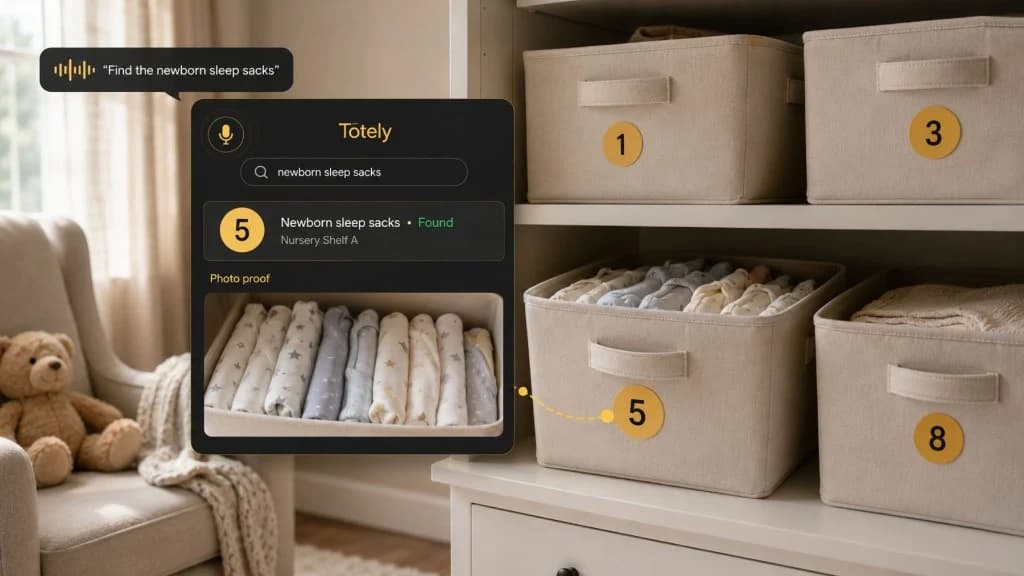
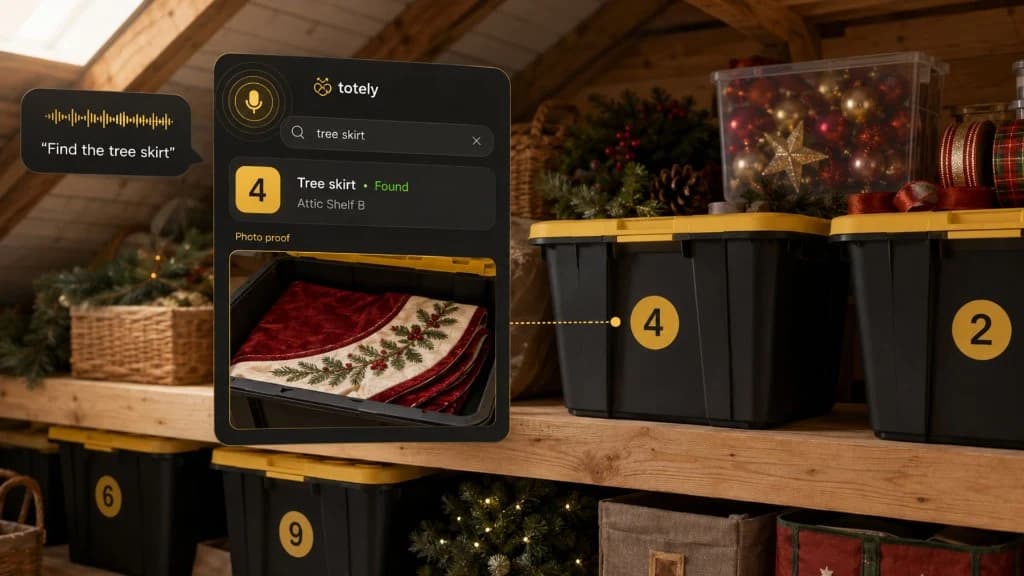
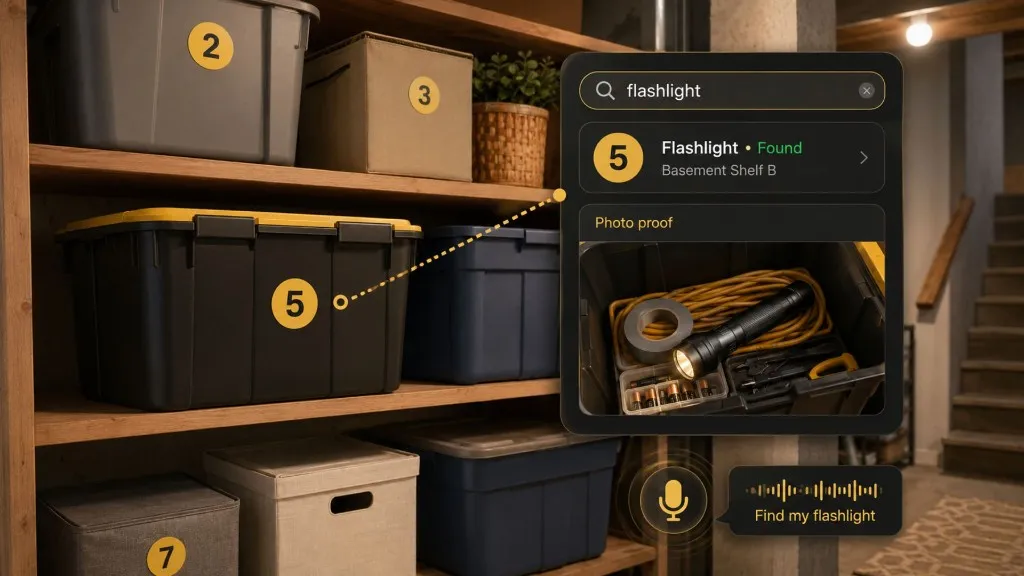
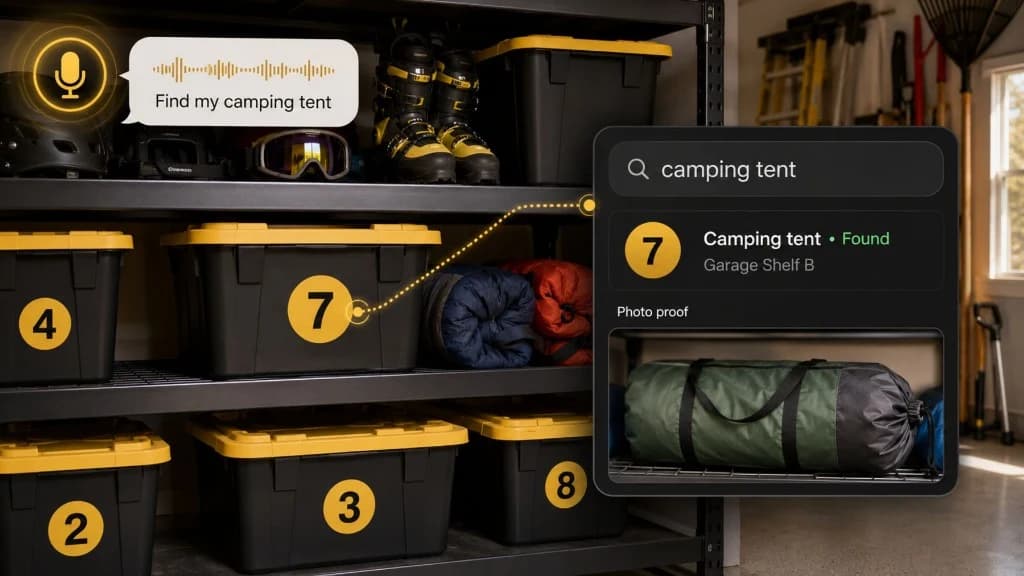
That is normal. But when you do want to find something — the family recipe, baby keepsake, wedding card, inherited item, graduation medal, school artwork, or old photo album — you should not have to open every box to find it. A household inventory with photos keeps keepsakes findable without turning memory boxes into spreadsheets.
With Totely, you can make sentimental storage searchable without manually typing every item into a cold, complicated spreadsheet.
Here is the simple flow:
Number the keepsake box, tote, bin, shelf, or storage zone
so it has a clear identity.
Snap a photo
of what is inside.
Let AI build the first item list
from what it can see.
Review or edit if needed
so the words match how you would search later.
Add a short note about why an item matters
when helpful.
Save the storage location
so you know where the box lives.
Search naturally later
for "family recipes," "wedding cards," "baby keepsakes," "graduation medal," "travel souvenirs," or "photo albums."
Use photo proof
to confirm what is inside before opening the box.
Totely does not replace archival storage, insurance documentation, appraisals, estate records, or professional preservation guidance for fragile or valuable items.
It simply helps you remember what you kept and where it lives.
Think of it as a digital memory layer for the keepsakes you do not want to lose inside storage.
Try the One-Tote Test on one keepsake box before you expand the system to every memory category.
A Sentimental Storage System You Can Copy
Here is a simple system you can adapt without overcomplicating the process.
A Sentimental Storage System You Can Copy
Box 1: Family History
Family recipes, inherited letters, old photos, postcards, family stories, small heirlooms.
Box 2: Children's Keepsakes
Children's artwork, school papers, medals, awards, handmade cards, special projects.
Box 3: Baby and Early Years
Baby keepsakes, hospital bracelet, first hat, special outfit, baby cards, first drawings.
Box 4: Milestone Events
Wedding keepsakes, graduation items, anniversary cards, retirement notes, event programs.
Box 5: Travel and Experiences
Travel souvenirs, concert tickets, maps, postcards, wristbands, printed trip photos.
Box 6: Fragile or Protected Keepsakes
Delicate letters, fragile heirlooms, special photos, handmade gifts, irreplaceable small objects.
Inside each box, use smaller envelopes, folders, pouches, or photo-safe sleeves when helpful. Keep similar items together. Add a note when the story matters. Take a photo before closing the box. Save the location.
The system should feel calm, not clinical.
You are not cataloging inventory in a warehouse.
You are making sure the things you chose to keep are not forgotten.
For a broader home framework, see the home storage organization guide.
Sentimental Item Storage FAQs
What is the best way to store sentimental items?
The best way to store sentimental items is to group them by person, event, life season, or story, then protect them based on material and fragility. Use numbered keepsake boxes, take photos of what is inside, add short notes about why items matter, and save the storage location so you can find them later.
How do I organize keepsakes without getting overwhelmed?
Start small. Choose one box, one person, one event, or one life season. Sort items into a few simple categories, such as family history, children's keepsakes, milestone events, travel memories, and fragile items. You do not have to decide everything at once.
Should I store sentimental items by person or by event?
Use the method that matches how you remember the item. Store by person when the keepsakes belong to one child, parent, grandparent, or family member. Store by event when the items belong to a wedding, graduation, trip, holiday, concert, or other specific memory.
How do I protect fragile keepsakes?
Protect fragile keepsakes by storing them in clean, dry, stable conditions, using photo-safe or acid-free materials when appropriate, and avoiding overpacked boxes. Keep delicate photos, letters, papers, fabrics, and heirlooms away from moisture, direct light, pests, and extreme temperature swings when possible.
How do I remember why I kept something?
Add a short note with the item or in your storage record. Write down who it belonged to, when it is from, where it came from, and why it matters. Even one sentence can preserve the story behind a letter, recipe, ticket, artwork, medal, or small keepsake.
How can Totely help with sentimental item storage?
Totely helps you number keepsake boxes, snap photos, let AI build the first item list, review or edit the record, add story notes, save the location, and search naturally later. Photo proof helps you confirm what is inside before opening every box.
Keep the Memory, Not the Mystery
Sentimental storage should feel kind.
You are not trying to erase the past or keep everything perfectly. You are simply giving meaningful items a place where they can be protected, remembered, and found again.
Start with one keepsake box. Give it a number. Group the items by person, event, season, or story. Add a short note when something matters. Take a photo. Save the location.
With Totely, your sentimental items can stay safely stored without disappearing from memory.
Because the point is not just to keep the thing.
It is to keep the meaning close enough to find.