Board Game Storage: Keep Games Together and Find the Right Box
Plan board game storage around box fit, secure pieces and easy access. Keep rules and expansions together, then record exactly where each game belongs.
By Steve Watts · Co-Founder, Totely
October 14, 2026 · Updated October 14, 2026 · 13 min read
The game is on the table, but the red dice pouch is somewhere in the family-room cabinet. You open one bin of boxed games, another of card decks, and a third holding the things nobody knew where to put. The shelves look orderly. Game night still starts with a search.
Useful board game storage keeps a game easy to retrieve, its pieces contained, and its instructions close enough to use. That starts with the actual board, box and components. A short location record helps once the physical setup works, especially when games share a larger bin or accessories move between rooms.
You can improve one game or one shelf without replacing every original box or cataloging every token.
Quick Links
Choose Board Game Storage by the Actual Game
Lay out the games you want to store and separate the awkward ones first. A long folding board, a tray full of shaped pieces and a small deck of cards need different support. A matched row of containers is useful only if the whole game fits inside each one.
| Storage format | Useful for | Check before choosing it |
|---|---|---|
| Original game box on a shelf | Games with useful inserts, fitted trays or recognizable box art | Box is sound, lid closes properly and the packed contents stay supported |
| Individual rigid case | Small card or dice games that can be rehoused together | Actual cards, sleeves, pieces and instructions fit without pressure |
| Zipped game pouch in a supported row | A suitable folded board and contained components | Board lies comfortably, seams close and the pouch does not bend the contents |
| Larger bin holding several game boxes | An occasional collection or overflow group | Inner boxes remain identifiable; filled bin is manageable and fits its shelf |
| Adjustable shelving or cabinet | A mix of game-box sizes used regularly | Shelf depth, opening, load guidance and retrieval space suit the real collection |
When to keep the original box
Keep it when its insert supports unusual pieces, the packaging forms part of play, or the box helps people recognize and put away the game. A sound original carton may already do the job well.
If you choose to rehouse a game, preserve its identity before separating anything. Record the publisher, title, edition or product number shown on the packaging. Keep the matching instructions and any information you may need for a specific part request. Decide whether you want to retain the original carton before discarding it; that decision is separate from making the shelf look uniform.
Try one replacement case with the actual contents before buying a set. If the folded board fits only when bent, or the lid presses on a miniature, choose a different container.
Where to put the collection
Start near the place where you play, with a shelf or cabinet you can reach and use comfortably. Keep frequently played games accessible and put occasional games in a clearly identified overflow spot.
Use a dry interior location away from likely spills and leaks. Follow care directions for the game's materials, especially for older or collectible pieces. Do not assume a lidded bin makes a damp garage or basement suitable, or describe ordinary packaging as archival without evidence.
For room-wide placement choices, the apartment storage guide covers limited space and renter constraints.
Check Box Fit and Shelf Access
Measure the largest packed game in the orientation you intend to use. Include the lid, projecting handles on a replacement case, and any expansion that will share its space. Compare those dimensions with the usable cabinet opening and shelf depth, rather than the furniture's overall measurements.
Then check the movement that happens during game night:
- Can you grip the box without scraping the shelf above it?
- Can you pull it out without moving an unstable pile?
- Is there room to carry it past the cabinet door or nearby chair?
- Can someone return it without forcing surrounding boxes aside?
A shelf that holds the collection but makes every game difficult to remove needs a different arrangement. Grouping boxes by size can help, but leave the titles recognizable and give the games you use most a convenient position.
Follow the furniture manufacturer's assembly, orientation and load instructions. The CPSC's Anchor It guidance explains choosing anchoring equipment for furniture. Follow the directions for your actual furniture and wall setup, and do not create an arrangement that encourages a child to climb for a game.
If you are using cubbies, cube storage bins explains how to check insert fit and removal clearance. If you are considering an under-bed overflow bin, check its full pull-out path as well as the gap beneath the bed; the under-bed storage guide covers that fit problem.
Choose Flat or Upright Storage Carefully
Standing boxes like books can make titles easy to scan and individual games easier to remove. It works when the packed game remains secure in that orientation. Check the inside before turning every box on its edge.
An open compartment may hold tokens neatly while the box lies flat, then release them when it stands upright. A loose lid or an unsupported board can create another problem. Secure the components in suitable inner containers and follow any packaging or insert instructions. If the arrangement still shifts or spills, keep that game flat.
For flat storage, use a manageable arrangement that lets you remove a game without wrestling with a tall pile. Do not place heavy unrelated objects on top of game boxes. A dedicated shelf space for an awkward game can be more practical than squeezing it into the same orientation as its neighbors.
Test retrieval and return with the filled box. The right orientation is the one that works for that game, its packaging and the people using the shelf.
Keep Pieces, Rules and Expansions Connected
Give loose components an inner home before putting the game back on the shelf. Suitable closed pouches, card cases or fitted trays can keep different groups from mixing. Check that the lid still closes without compressing the board, cards or pieces.
Component organizers vary too. Gamegenic's Token Silo uses removable trays in different sizes. That is a useful example of why an organizer needs to fit the actual components; it does not establish that one tray system fits every game. Measure your pieces and check the maker's compatibility guidance, including any difference caused by card sleeves.
Keep a game-specific component pouch with its game. Give shared accessories, such as the red dice pouch used for several game nights, their own consistent home so they do not drift into whichever box has space.
Keep the right instructions
Put the matching rulebook with the game, or record where it is kept if it needs a separate home. If it is missing, look for the publisher's instructions for the actual product and edition. Hasbro's instruction library supports searches by product details. CATAN's official rules page separates base games, expansions and an archive of earlier editions.
Save the correct source link in your notes. Similar artwork or a similar title is not enough to confirm that you have the right rulebook or compatible expansion.
If an expansion stays in a separate box, name both locations: “Base game on Cabinet, Left Shelf; expansion in Bin 3.” You do not need to combine them physically to keep the relationship clear.
Record what you actually checked
A full box is not evidence of a complete game. Use the publisher's component list for your edition when available, and separate three kinds of note:
- Checked: a specific component or group was physically confirmed.
- Not checked: you have not compared that group with the relevant list.
- Known missing: you looked for a particular part and have not found it.
Write the specific limit of a check. “Board and rulebook present; card deck not counted” is more useful than “all good.” A contents photo can help identify the box, but it cannot confirm pieces hidden beneath a tray or count every card in a closed case.
For a missing part, start with the publisher's current support guidance. Hasbro's replacement-parts help asks for the product name, UPC and needed part so availability can be checked. That is a contact process, not a promise that your part is available.
Keep small pieces and storage packaging appropriate to the household and follow the game's age guidance. The toy storage bins guide covers broader play-set storage and age suitability.
Build a Game-to-Container Map
Visible game titles may be enough for an open shelf. When several games or accessories share an outer bin, give that bin one clear number and record its exact location. Keep the inner game identity in the record so “Bin 2” does not become another version of “miscellaneous.”
This is a hypothetical household map to adapt, not a verified collection or a publisher's component list.
| Storage address | Contents to recognize | Useful record detail |
|---|---|---|
| Family Room Cabinet, Left Shelf | Frequently played games in original boxes | Actual titles and editions; which boxes remain flat |
| Family Room Cabinet, Middle Shelf, Bin 1 | Occasional boxed board games | Game titles; rulebook location; named unchecked components |
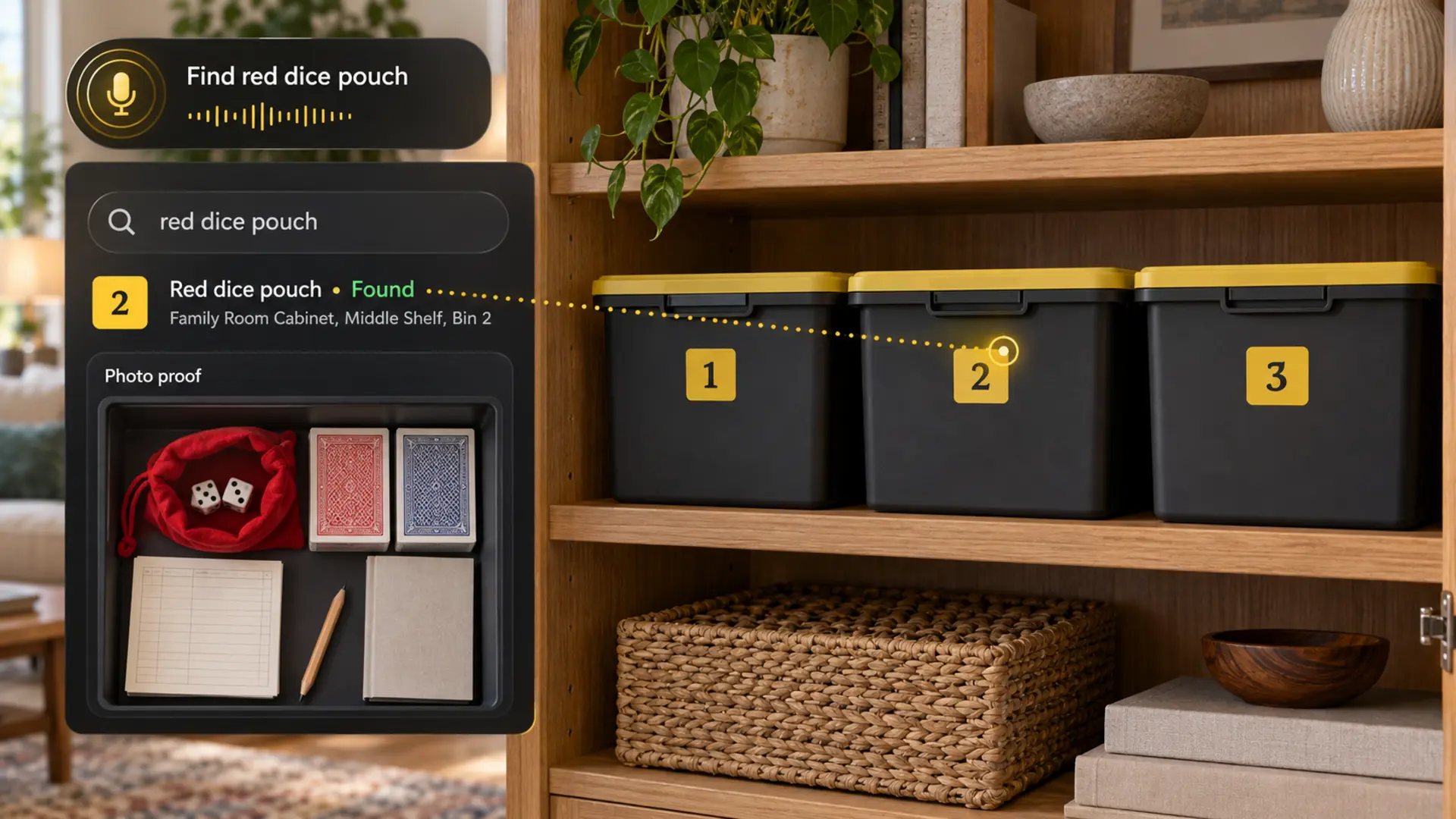
| Family Room Cabinet, Middle Shelf, Bin 2 | Red dice pouch, card decks in cases, score pad, pencil and rulebook | Shared accessories; add exact game names for the decks and booklet |
| Family Room Cabinet, Middle Shelf, Bin 3 | Less-used expansion boxes | Each expansion's title and the location of its base game |
The outside of Bin 2 needs a large, legible 2. Your paper index or searchable record can say “red drawstring dice pouch” and “Family Room Cabinet, Middle Shelf, Bin 2.” Use the phrases your household recognizes.
Photograph visible contents while the bin is open. If a card deck stays in its case, add its name manually. You do not need to unpack every piece just to make a better photo.
Update the map when a game or accessory moves
The record should describe the current location. Choose a simple update moment, such as putting the games away after play or handing a game to someone borrowing it.
| What changed | What to record |
|---|---|
| Red dice pouch moves to a desk drawer | Its current drawer; remove the implication that it remains in Bin 2 |
| A whole game is borrowed | Who has it, if appropriate, and that it is out of its stored location |
| Expansion moves to a separate box | New expansion location and the base game's location |
| Missing piece is found | Confirm it belongs to the right game, return it, then revise that specific note |
| Bin 2 moves shelves | Keep its number and replace the saved shelf address |
These are human updates. A saved photograph does not detect a move or prove that a borrowed game returned complete. For the household-wide habit, see how to keep track of storage bins.
The One-Game Starter Method
Choose a game people ask for, or the shared accessories that repeatedly go missing.
- Lay out the board, instructions and components on a suitable table.
- Check the packaging and decide which original supports should stay.
- Contain the loose groups without forcing the packed box shut.
- Test its shelf orientation, retrieval and return.
- Record the actual title and edition, plus any checked or missing-piece notes.
- If it shares an outer bin, put one clear number on that bin.
- Take one useful reference photo and save the exact location.
- Ask another person to find the game or accessory from the record, then agree when moves will be updated.
If another person can find the red dice pouch and put it back in the same place, you have a working start. Add the next game when the first record matches reality.
How Totely Helps
Totely adds a digital memory layer to the storage you have already made usable.
Number Bin 2 and take a clear contents photo before closing it. Let AI suggest the first item list from what is visible, then review and correct it. Add the game names hidden inside cases, the edition details you recorded, and any important component notes. Save Family Room Cabinet, Middle Shelf, Bin 2 as the exact location.
Later, a natural search for “red dice pouch” can point to the saved bin. The photo proof can help you recognize the pouch and its companions before opening other containers.
AI cannot establish a complete component count from one photo, identify every closed card deck or know that someone borrowed the pouch. Add those details yourself and update the record when something moves. You do not need QR codes, barcodes or manual entry of every piece to start with a useful bin-level record.
Board Game Storage FAQs
Should board games be stored flat or upright?
Choose by the packed game. Upright boxes can be easy to scan and remove, but check that the lid, insert and components remain secure. Keep a game flat if turning it on its edge causes shifting or spills.
Should I get rid of the original game boxes?
Keep boxes with useful supports, packaging used during play or identity details you want to retain. Rehousing can suit some games, but test the whole game in the replacement container and preserve its title, edition and instructions first.
Can I store board games in zipper pouches?
A suitable pouch can hold some folded boards and contained components. Check the board's actual fit, give loose pieces an inner container, and make sure the pouch closes without bending or pressing on the contents.
How do I keep game pieces from mixing together?
Use suitable separate pouches, cases or fitted compartments inside each game kit. Keep game-specific pieces with their game and give shared accessories a consistent home. Make the arrangement easy for another person to put away.
How should I store expansions and their instructions?
Keep each expansion identified and save the matching rules for its edition. If it lives separately from the base game, record both locations. Similar pieces or box art do not establish compatibility.
Can a photo tell me whether a game is complete?
No. A photo can identify visible contents, but hidden pieces and closed decks still need checking. Compare components with the correct publisher list when available, and record exactly what was checked, not checked or known missing.
Make the Game Easy to Retrieve and Return
Start with packaging that fits, components that stay contained and a shelf you can use comfortably. Keep the instructions and identity details connected to the game. Then add an accurate location and a few useful notes for anything stored out of sight.
Try it with one game bin through the One-Tote Test. Stored, not lost.