Cube Storage Bins: How to Organize Cubbies Without Mystery Bins
Choose cube storage bins that fit your cubbies, assign useful categories, and keep every removable bin searchable when its contents or position changes.
By Steve Watts · Co-Founder, Totely
October 12, 2026 · Updated October 12, 2026 · 13 min read
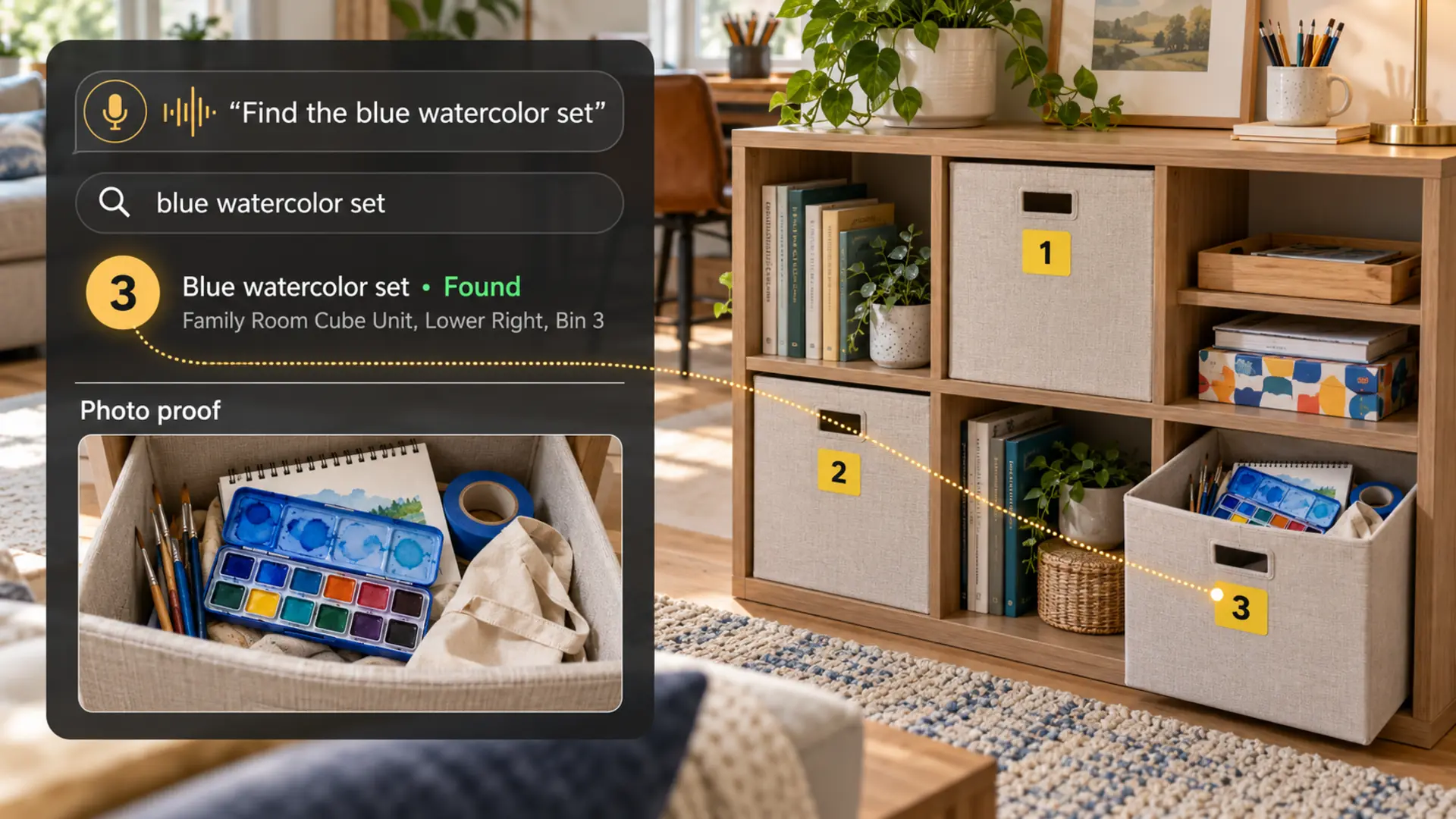
The blue watercolor set should be in the family room. You can see three matching fabric bins in the cube organizer, but each one hides a different project. Pulling all three onto the floor is the only way to discover whether the paint is with the paper, office supplies or a collection of unrelated odds and ends.
Useful cube storage bins solve more than the visual problem of an open cubby. They fit the actual furniture, give a manageable group of things one home and remain identifiable when someone swaps their positions. The physical setup comes first. A simple number and current cubby map make that setup easier to search later.
Start with one cube rather than reorganizing the whole wall. Measure it, decide what belongs there and test whether another person can find and return one requested item.
Quick Links
Choose Cube Storage Bins That Actually Fit
Measure the usable opening of one cubby: width, height and depth. Then compare those measurements with the bin's widest exterior points, including handles, seams, lid edges or a frame that holds its shape. Overall dimensions of the furniture do not tell you how much space is available inside each opening.
Leave enough clearance to grip and pull the filled bin without scraping the shelf above. If the cube organizer sits near a sofa or doorway, check the space in front of it too. A bin can fit inside a cubby and still be frustrating to remove.
Do not assume every product called a cube is equal on all sides. As one concrete example, IKEA lists its DRÖNA box at 13 inches wide, 15 inches deep and 13 inches high, with a stated minimum shelf depth of 13¾ inches. That is an example for one matched product, not a universal cube-bin size. Check the current specifications for your actual unit and insert.
| Bin or cubby format | A practical use | What to verify before committing |
|---|---|---|
| Open cubby | Books, a display object or a frequently used item that stores neatly on its own | Item height and depth, shelf load guidance and whether retrieval leaves the surrounding display stable |
| Soft-sided fabric bin | Light supplies, soft goods or mixed shapes that benefit from a visual boundary | Exterior seams and handles clear the opening; filled bin keeps a usable shape; care guidance suits the contents |
| Rigid open bin | Items that need more structure or a wipeable container | Lip and handle do not catch; actual filled weight remains manageable; material is suitable for the items |
| Lidded insert | Less-frequent contents that need enclosure | Lid can be opened in the available space; no essential item is crushed; enclosure suits the contents rather than hiding a mixed catch-all |
| Small trays inside a cube bin | Brushes, cables, game pieces or other small companions | Inner containers fit without preventing the outer bin from closing or sliding; people know which set they belong to |
Test one filled bin before buying a matched set. Put the intended contents inside, slide it fully into the cubby, remove it using the real handle and carry it the distance it will travel. Capacity on a label is less useful than that physical test.
Follow the furniture and bin manufacturers' assembly, orientation, care and load instructions. A cube unit shown horizontally in a room photo is not automatically approved for that orientation.
Decide Which Cubbies Stay Open
Cube organizers are good at mixing visible and hidden storage. Use that difference deliberately.
An open cubby suits an item you want to see, reach and return without another step. A removable bin suits a group that would otherwise look scattered or disappear behind other objects. The goal is not to cover every opening. It is to make each opening understandable.
Before adding a bin, ask:
- Does this group need to move to a table or another room?
- Are the contents visually noisy when left open?
- Would a shallow tray inside the open cubby be enough?
- Will a hidden group still have a clear name, or become “miscellaneous”?
- Can the person who uses it retrieve and return it appropriately?
Keep furniture safety separate from organization. The U.S. Consumer Product Safety Commission advises anchoring furniture such as bookcases and warns against placing tempting items where children may climb to reach them. Follow the current anchoring and installation instructions for the exact unit and wall conditions. Keep heavier contents lower when that placement complies with the manufacturer's directions, and do not treat a lower cubby or a fabric bin as proof that every item inside is suitable for a child.
If the unit is used for play materials, the toy storage bins guide covers set completeness, age guidance and changes when a piece leaves storage.
Give Each Cube One Useful Job
Choose categories around activities, not around vague container labels. “Watercolor supplies” tells someone what the bin supports. “Crafts” may combine paint, glue, yarn, clay and unfinished projects that are used and cleaned up differently.
An activity-sized group can still contain smaller companions. The watercolor bin might hold the blue paint set, brushes, a paper pad, painter's tape and an apron. A pouch or shallow tray can keep the brushes from spreading through the bin. If the paper bends when placed with the other supplies, it needs a better orientation or a separate home.
For a home office, one cube might hold mailing supplies while another holds reference notebooks. For linens, group by where or how they are used instead of forcing every textile into one deep bin. For games, keep the board or box with the pieces it identifies.
Separate “belongs together” from “happens to fit.” A spare charger does not become an art supply because there is room beside the brushes. Give uncertain items a temporary review spot outside the cube system rather than letting every bin acquire a layer of unrelated objects.
Do not overfill just to avoid an empty cubby. A little working room can make it easier to see, remove and return the intended group. The useful limit is the point at which the contents, bin, furniture guidance and household handling still work together—not a universal fill percentage.
Build a Cube and Bin Map
A label such as “art” describes a category. It does not identify which matching fabric bin holds the blue watercolor set after the bins change places.
Give each removable bin a stable, visible number. Keep that number with the physical bin even if it moves to another cubby. Then record its current location separately. This creates two distinct facts:
- Identity: Bin 3 remains Bin 3.
- Position: Bin 3 currently sits in the lower-right cubby.
Here is a hypothetical six-cube family-room and home-office map. Adapt the names to your own room; it is not a tested inventory or a recommendation to store these exact items together.
| Cube position | Current setup | Useful search terms | Handling note |
|---|---|---|---|
| Upper left | Open: reference books | project book, color guide, notebook | Keep within the shelf's stated load limit |
| Upper middle | Bin 1: mailing supplies | envelopes, stamps, packing tape | Small cutter stored separately as appropriate for the household |
| Upper right | Open: family game in its box | card game, score pad | Pieces stay with the named game |
| Lower left | Bin 2: soft accessories | spare blanket, cushion cover | Check actual fabric-care directions before storage |
| Lower middle | Open: current project tray | project in progress, sketchbook | Review before replacing the project with a different one |
| Lower right | Bin 3: watercolor supplies | blue watercolor paint set, brushes, paper pad, painter's tape, apron | Keep liquids closed and follow the supply makers' storage guidance |
On the outside of the bin, the large number 3 is enough. In your record, save Family Room Cube Unit, Lower Right, Bin 3. Add a reference photo while the bin is open and write the names your household actually uses.
If one item is hidden beneath the paper pad, add it manually instead of assuming a photo will reveal it. If you are unsure whether a particular brush is in the bin, record that uncertainty or check before claiming it is present.
The same method works if the unit contains home office supplies: keep the bin number stable, describe the current cubby precisely and name the specific item someone will search for.
Update the Map When Things Move
A removable cube bin is useful partly because it can move. The storage record needs to separate a moving bin from a moving item.
Suppose Bin 3 moves from the lower-right cubby to the upper-left cubby. The yellow number stays 3; only its current location changes. If the blue watercolor set leaves Bin 3 for the kitchen table while the bin remains in place, the item note changes instead.
| What changed | What remains stable | Record to update |
|---|---|---|
| Bin 3 moves to another cubby in the same unit | Physical number 3 and its contents | Replace “Lower Right” with the new exact cubby position |
| Bin 3 moves to another room | Physical number 3 | Update the room, unit and cubby; confirm its contents are still accurate |
| Watercolor set moves to the kitchen table | Bin 3's number and position | Note the set's current location; do not imply it is still visible in the old contents photo |
| Watercolor set returns | Bin 3's identity and current cubby | Confirm it is physically back, then remove the temporary-location note |
| Supplies are reorganized into another bin | Neither old contents list should be assumed correct | Review both bins, take useful new photos and update both records |
| Bin leaves the household | Other bins keep their own numbers | Retire Bin 3's record; do not silently reuse its history for a different container |
Choose a practical update moment: when a project is put away, when a whole bin changes cubbies or when a requested item will stay elsewhere. A current short record is more useful than a detailed inventory that still points to yesterday's shelf.
You do not need to record every pencil leaving the bin for ten minutes. Update the changes that would otherwise send someone to the wrong place. For a broader household method, see how to keep track of storage bins.
Try the One-Cube Starter Method
Pick the cubby that causes the most searching. Then work through one manageable test.
- Empty that cubby onto a suitable work surface and decide what genuinely belongs together.
- Measure the usable cubby opening and the proposed bin, including handles and clearance.
- Check the unit's current assembly, orientation, anchoring and load guidance.
- Fill the bin with the intended group and test removal, carrying and return.
- Put one clear, stable number on the removable bin.
- Take one reference photo and write two or three item names people will recognize.
- Save the room, unit, cubby position and bin number as the exact location.
- Ask another person to find one item from the record and agree when moves will be updated.
If they can find the blue watercolor set in Bin 3 without opening Bin 1 or Bin 2, the system is already useful. Expand to the next cube only when the first record matches reality.
How Totely Helps
Totely adds a searchable memory layer after you have chosen a bin that fits and a category that makes sense.
Place a simple number on Bin 3 and take a clear photo while its contents are visible. Totely can suggest an initial list from visible items in that photo. Review the suggestions, correct the names and add anything important that is hidden beneath the paper pad or inside a pouch.
Save the location as Family Room Cube Unit, Lower Right, Bin 3. Add recognizable phrases such as “blue watercolor paint set,” “brushes,” “watercolor paper pad” and “painter's tape.” Later, a natural search for the blue watercolor set can point to the saved bin, and the reference photo can help confirm the right contents.
The physical yellow 3 connects the record to the removable bin. It does not lock that bin to one square forever. If Bin 3 moves, keep the number and update the cubby address. If only the paint set moves to the kitchen table, update that item note.
Totely cannot see through an opaque bin, know a hidden item is present or detect a move you have not recorded. The first visible-item list needs human review, and the saved location needs a human update. That small check is what keeps the result trustworthy.
Start at bin level. You do not need QR codes, barcodes or a separate photo of every brush to make one cube easier to search.
Cube Storage Bins FAQs
What size cube storage bins should I buy?
Measure the inside width, height and depth of the actual cubby, then compare all exterior bin dimensions, handles, seams and lid projections. Leave room to grip and pull the filled bin. Do not assume “cube” means one universal size.
Are fabric or plastic cube bins better?
Neither material is best for every use. Fabric can suit light, dry contents and softer room finishes; a rigid bin can provide more structure or suit contents that need a different care surface. Check fit, filled weight, manufacturer care guidance and the actual items before choosing.
Should every cubby have a bin?
No. Open cubbies can work for books, display objects and current projects that store neatly. Use bins where a portable or visually contained group is helpful. A deliberate mix can be more usable than hiding every opening.
How do I organize cube bins without forgetting what is inside?
Give each removable bin a stable number, take a contents photo, record a few specific item names and save the exact room, unit and cubby. Update the contents or location when something moves.
Can I put a cube organizer on its side?
Only if the manufacturer approves that orientation and you follow its assembly, load and anchoring instructions. A room photo or a unit's rectangular shape does not establish that every orientation is supported.
Do I need to label every item in a cube bin?
No. Begin with the bin number, one overview photo, a useful activity name and a few memorable items. Add more detail only when it improves retrieval or records an item hidden from the photo.
Keep the Bin Identity, Update the Address
The best cube storage bins for your room are not simply the ones that match the furniture. They fit the real opening, hold one understandable group and remain easy to identify after the arrangement changes.
Measure one cubby, give one removable bin a stable number and save its current address. When the bin or the blue watercolor set moves, update the right fact. Stored, not lost.