How to Store Puzzles Without Losing Pieces—or the Box You Want
Learn how to store puzzles in progress, boxed sets, pouch-filed collections, and stray pieces—then make one specific puzzle easy to find.
By Steve Watts · Co-Founder, Totely
November 10, 2026 · Updated November 10, 2026 · 15 min read
Learning how to store puzzles starts with a distinction most storage advice skips: an unfinished puzzle on the dining table is not the same storage problem as a boxed collection in a closet. Neither is the same as a special puzzle you plan to display—or the mystery piece you just found under the sofa.
Give each situation its own physical route. Keep active work on a surface you can protect or move. Keep ready-to-build sets contained with a reference image. Decide deliberately which puzzles are archived, displayed, traded, or donated. Hold unidentified pieces in a dated quarantine instead of tossing them into the nearest box.
Only after that physical system works should you make hidden puzzles searchable. The goal is not to catalog every cardboard tab. It is to answer one practical question without opening six bins: Where is the blue lighthouse 1000-piece puzzle?
Quick Links
- Start With Four Puzzle States
- Store an Unfinished Puzzle Without Losing Progress
- Keep Ready Puzzles Complete and Identifiable
- Choose Boxes, Pouches, or Bins Deliberately
- Create a Stray-Piece Quarantine
- Protect Special and Display Puzzles
- Give Every Hidden Puzzle an Exact Address
- How Totely Helps
- Run a Ten-Minute Puzzle Reset
- Puzzle Storage FAQs
Start With Four Puzzle States
Do not begin by buying matching bins. Begin by deciding what each puzzle is doing now. A simple state system prevents an active project, a complete boxed set, a display piece, and an unidentified loose piece from competing for the same shelf.
| State | What belongs there | Physical home | Exit rule |
|---|---|---|---|
| Active | A puzzle currently being built, plus its loose pieces and reference image | Covered board, purpose-built mat, case, tray, or dedicated table | Move to Ready, Display, or Donate when the build is finished |
| Ready | A complete set available for another build | Sound original box or labeled pouch with a reference image | Return here only after pieces and identity are reviewed |
| Archive or display | Special editions, collector boxes, glued work, framed work, or low-frequency sets | Maker-appropriate enclosure, stable shelf, or finished display | Recheck condition and location on a planned review date |
| Quarantine | A piece whose puzzle is unknown, or a set with uncertain identity | Small dated envelope or divided tray | Reconcile with Active and Ready sets before discarding or donating |
This is the physical foundation. It solves the most common failure: everything being labeled “puzzles” while the actual decision—finish it, rebuild it, preserve it, identify it, or let it go—remains unclear.
Pull the whole collection into view
Bring boxes, pouches, boards, mats, trays, and known stray pieces to one review area. Do not dismantle an active project just to do this. Instead, add its name and location to the review list.
Sort by state first, then by practical use:
- adult or family jigsaws;
- children’s frame, floor, or wooden puzzles;
- active projects;
- special or collectible puzzles;
- incomplete or uncertain sets;
- puzzles ready to donate, trade, or recycle according to local options.
You may discover that shelf space is not the main problem. The problem may be that three unfinished puzzles share one table, six sets have damaged boxes, or nobody knows whether the loose blue piece belongs to the ocean puzzle or the lighthouse puzzle. Solve the actual failure before choosing containers.
Store an Unfinished Puzzle Without Losing Progress
An active puzzle needs a work surface, loose-piece containment, a reference image, and a safe place between sessions. Choose the method by asking what must happen to the room when puzzling stops.
| Method | Best when | Main tradeoff | Check before using |
|---|---|---|---|
| Rigid board with a cover | You want the layout to stay flat and have a level place to slide the board | Requires storage wider and deeper than the finished puzzle | Finished puzzle dimensions, usable board area, lifting path, and shelf clearance |
| Roll-up mat | Compact storage matters and some shifting is acceptable | Loose pieces or sections may move during rolling and unrolling | Puzzle material, maker instructions, tube length, and a clean rolling surface |
| Zippered case or portfolio | The project must move between rooms or homes | Bulkier and often more expensive than a mat | Interior dimensions, closure, support, and carrying orientation |
| Dedicated table or tray | The room can support a semi-permanent project | The surface remains occupied | Pets, children, spills, sunlight, traffic, and the ability to cover the work |
Use the finished dimensions printed on the exact puzzle box or product page. Piece count alone does not tell you whether a board, mat, or case will fit. A panoramic 1,000-piece puzzle and a conventional rectangular 1,000-piece puzzle may need different work areas.
Before moving an active puzzle:
- Take a straight-on photo of the whole layout.
- Put unconnected pieces into shallow trays or lidded compartments.
- Keep the reference image and puzzle name with the project.
- Cover the work without pressing a heavy object into the pieces.
- Clear the full path to the storage location before lifting anything.
- Store the board or case in the orientation its maker supports.
Ravensburger’s U.S. FAQ confirms that the manufacturer offers accessories specifically for storing and transporting puzzles in progress. That does not make one format universally best. Follow the instructions for the exact mat, board, case, puzzle material, and adhesive you use.
Keep Ready Puzzles Complete and Identifiable
A Ready puzzle should travel as one unit: pieces, identity, reference image, and any maker instructions that matter. The original box already does this when it is sound. Do not replace it simply because a storage trend says every collection should match.
If the original box works, keep the pieces contained inside it so a lifted lid or tipped box does not scatter the set. Add a short condition note only if you have personally reviewed the contents: built once; no missing pieces observed on Nov. 10 is honest. Complete is a stronger claim and should not be made from a photo or memory alone.
If the box is damaged or too bulky for the space, move the set to a durable pouch or shallow case. Keep these details with it:
- puzzle title or a plain-language description;
- piece count printed by the maker;
- clear reference image;
- brand or edition when that distinction matters;
- finished dimensions when available;
- personally reviewed condition note;
- original-box status if the box is stored elsewhere.
Do not cut up a box that matters to you as packaging, reference, gift presentation, trade value, or collection history. Photograph the front and side panels instead, then print or save a reference card for the pouch.
For children’s puzzles, make the cleanup path obvious. A photo label can connect a board and its pieces even when the child cannot read the title. Keep the container and shelf appropriate to the child and follow the manufacturer’s age label. The U.S. Consumer Product Safety Commission explains that small-parts rules and warnings are intended to reduce choking, inhalation, and swallowing hazards for young children. Keep small pieces away from children under three and do not override the age guidance on the puzzle.
Choose Boxes, Pouches, or Bins Deliberately
The right container protects identity first and saves space second. A beautiful row of identical pouches fails if the reference images are separated from the pieces. A stack of original boxes fails if the bottom box is damaged or the title you want is invisible.
Keep original boxes when they still earn their space
Original boxes are useful when they are sturdy, easy to browse, and part of the value or experience. Shelve them in a way the maker supports and that does not distort, crush, or spill the contents. Repair or replace an enclosure that no longer contains the pieces reliably.
Use pouches for a compact, browseable library
Pouches can reduce bulk and make a collection easy to file. Choose a closure that stays shut and a pouch large enough that the pieces and reference card are not forced or bent. File by a category you will actually use—piece count, family difficulty, theme, or last-reviewed date—not by an elaborate taxonomy nobody will maintain.
Use bins for groups, not for mixed loose pieces
A closed bin works well for several individually contained puzzles, boards, sorting trays, and accessories. It works poorly when pieces from multiple sets are loose inside. Every puzzle inside the bin should remain its own identifiable unit.
A Puzzle Bin You Can Copy
Inside the bin
Three or four individually closed puzzle pouches, each with its own title and reference image.
Accessories
Nested sorting trays, a clean cover, and one small envelope for pieces found during the current review.
Physical label
One unique yellow number on the outside of the bin—not a list of changing contents.
Shelf address
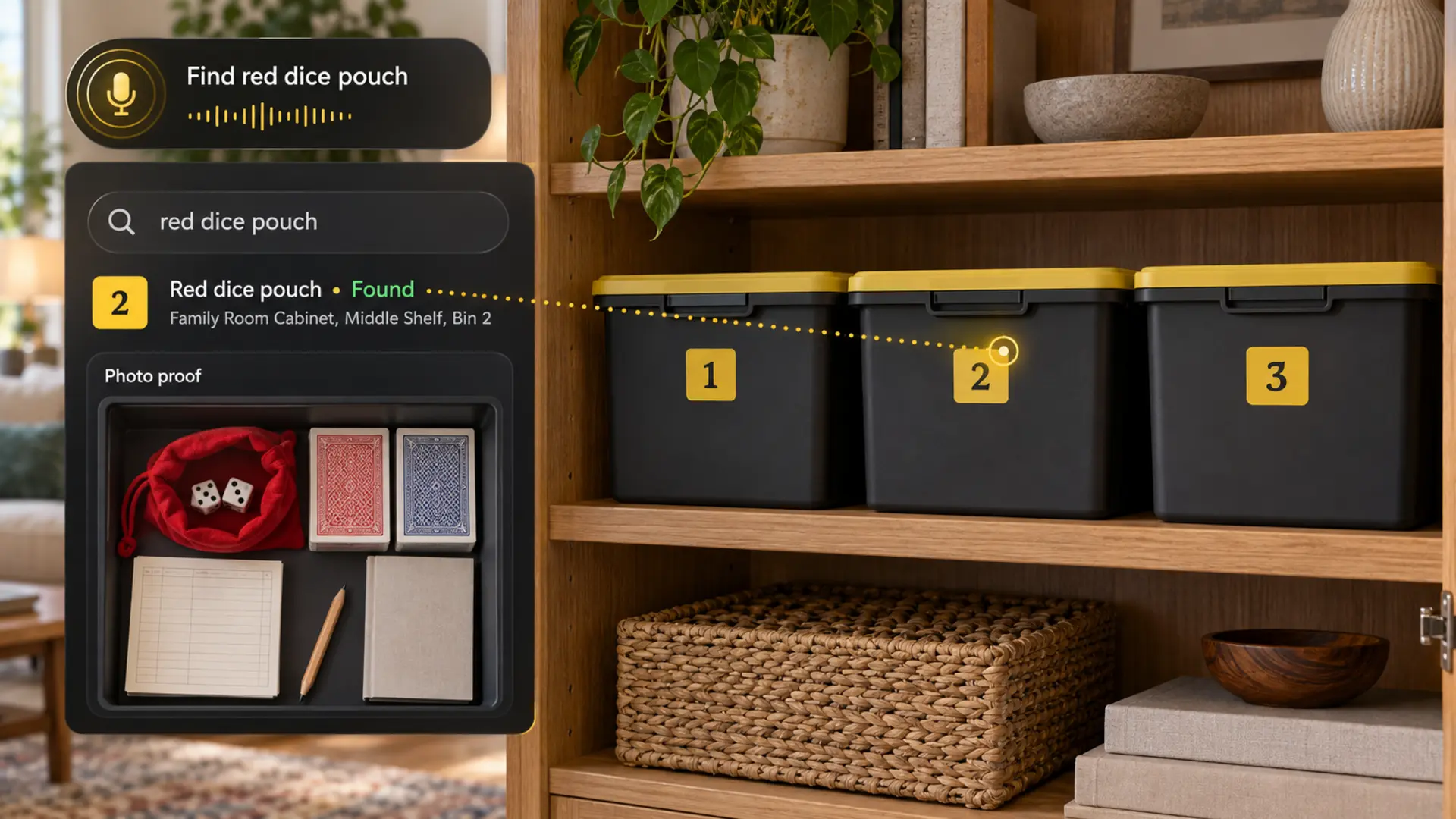
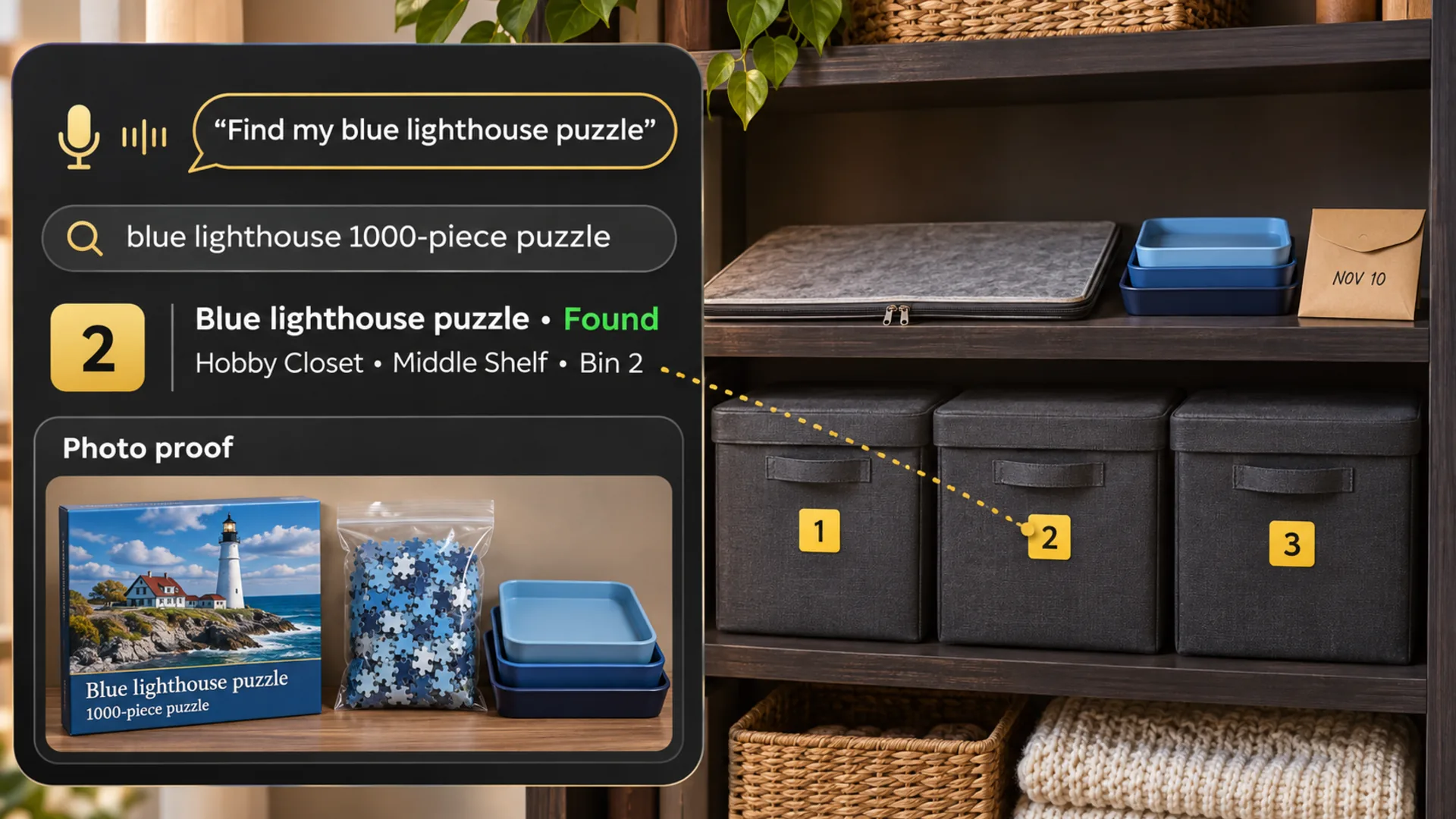
A stable path such as Hobby Closet / Middle Shelf / Bin 2.
For paper and cardboard items you want to keep, avoid obvious environmental risks. The U.S. National Archives’ family-paper guidance recommends avoiding damp basements, hot attics, leaks, and floor-level water risk, and using enclosures large enough to prevent bending. Ordinary puzzles do not automatically need archival materials, but those general storage boundaries are useful for paper-based collections.
Create a Stray-Piece Quarantine
A mystery piece should not be pushed into the nearest plausible box. That turns one unknown into a false inventory.
Create a small quarantine envelope or divided tray. For each piece, record:
- date found;
- room or furniture area where it was found;
- dominant color, pattern, or material;
- likely puzzle candidates;
- date checked against Active and Ready sets.
Review quarantine whenever an active puzzle is completed or a ready puzzle is rebuilt. Compare the piece with the actual cut, print, thickness, and backing—not just the color. If a match is confirmed, return it to that set and update the condition note.
Set a review rhythm that fits your household: after each completed build, at the end of a school term, or during a seasonal toy rotation. Do not invent a universal discard deadline. A rare puzzle, current active project, or special edition may justify a longer hold than an unknown mass-market set.
Quarantine is also where an honest record becomes useful. One unidentified blue edge piece found under sofa on Nov. 10 is better than pretending the lighthouse puzzle is complete.
Protect Special and Display Puzzles
Decide what “finished” means before you store a completed puzzle. Some will be dismantled and returned to Ready. Some will be glued and displayed. Some collector or wooden puzzles should remain unaltered. The material, maker instructions, and your intent determine the next step.
If you plan to glue or mount a puzzle, use a product and method approved for the exact puzzle material. Protect the work surface and follow the adhesive manufacturer’s instructions. Ravensburger publishes its own conserver process for its puzzles; that is manufacturer-specific guidance, not a universal instruction for every cardboard, wood, plastic, vintage, or collectible puzzle.
If you plan to preserve the set for rebuilding, keep the reference image, pieces, and original packaging together when practical. Avoid a location with repeated dampness, heat, leaks, or direct sun. Keep heavy objects from pressing unevenly on boxes, pouches, boards, or mounted work.
For a puzzle with financial, historical, or sentimental value, generic household advice may not be enough. Consult the maker or an appropriate conservator before cleaning, gluing, flattening, or replacing original packaging.
Give Every Hidden Puzzle an Exact Address
Once the four physical states work, give opaque bins and deep shelves addresses that another person can follow. “Puzzle closet” is a room description. “Hobby Closet / Middle Shelf / Bin 2” is a retrieval path.
| Record field | Example | Why it matters |
|---|---|---|
| Natural item name | Blue lighthouse 1000-piece puzzle | Matches the words a person will search |
| Physical number | 2 | Connects the result to one visible bin |
| Exact location | Hobby Closet / Middle Shelf / Bin 2 | Leads directly to the container |
| Companion items | Reference card, sealed piece pouch, sorting trays | Confirms the correct set and photo |
| Review note | Built once; no missing pieces observed Nov. 10 | Separates a human observation from an automatic claim |
| Photo proof | Puzzle box and pouch beside sticker 2 | Provides a visual match before opening other bins |
Use one unique physical number per container in the storage area. Keep that number stable even when the contents change. If Bin 2 moves, update the saved location. If the puzzle moves to another bin, update the record and photo rather than writing a crowded new list on the old label.
Test the address with a real retrieval. Ask someone who did not organize the closet to find the blue lighthouse puzzle. If they can reach Bin 2 without opening Bins 1 and 3, the physical system is doing its job.
The same principle helps with adjacent collections, but the contents and care rules stay distinct. Use board game storage for component-heavy games and expansions, toy storage bins for a broader parent-maintained rotation, and sentimental item storage when the decision is about memory and meaning rather than rebuilding the puzzle.
How Totely Helps
Totely belongs after Active, Ready, Archive/Display, and Quarantine have physical homes.
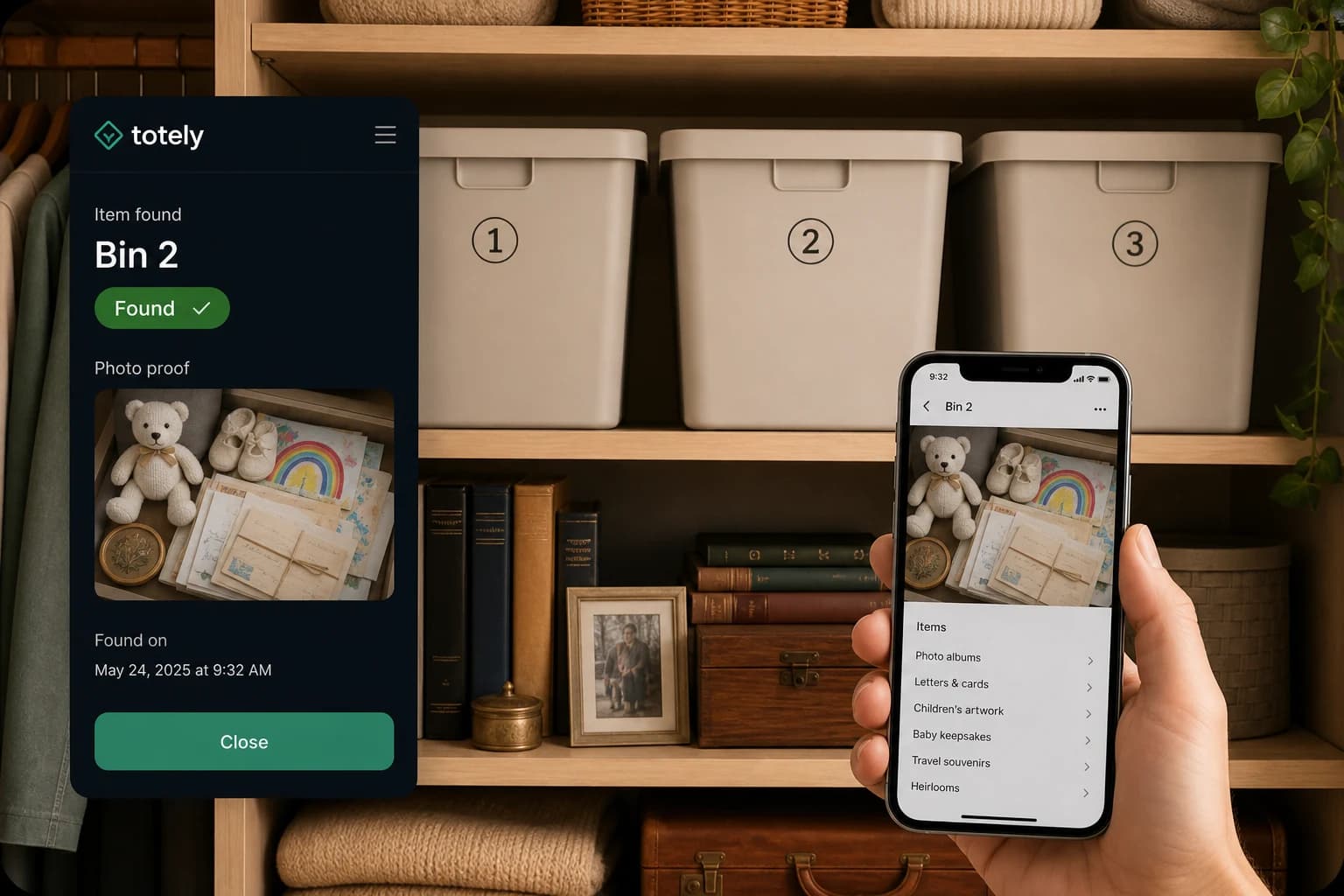
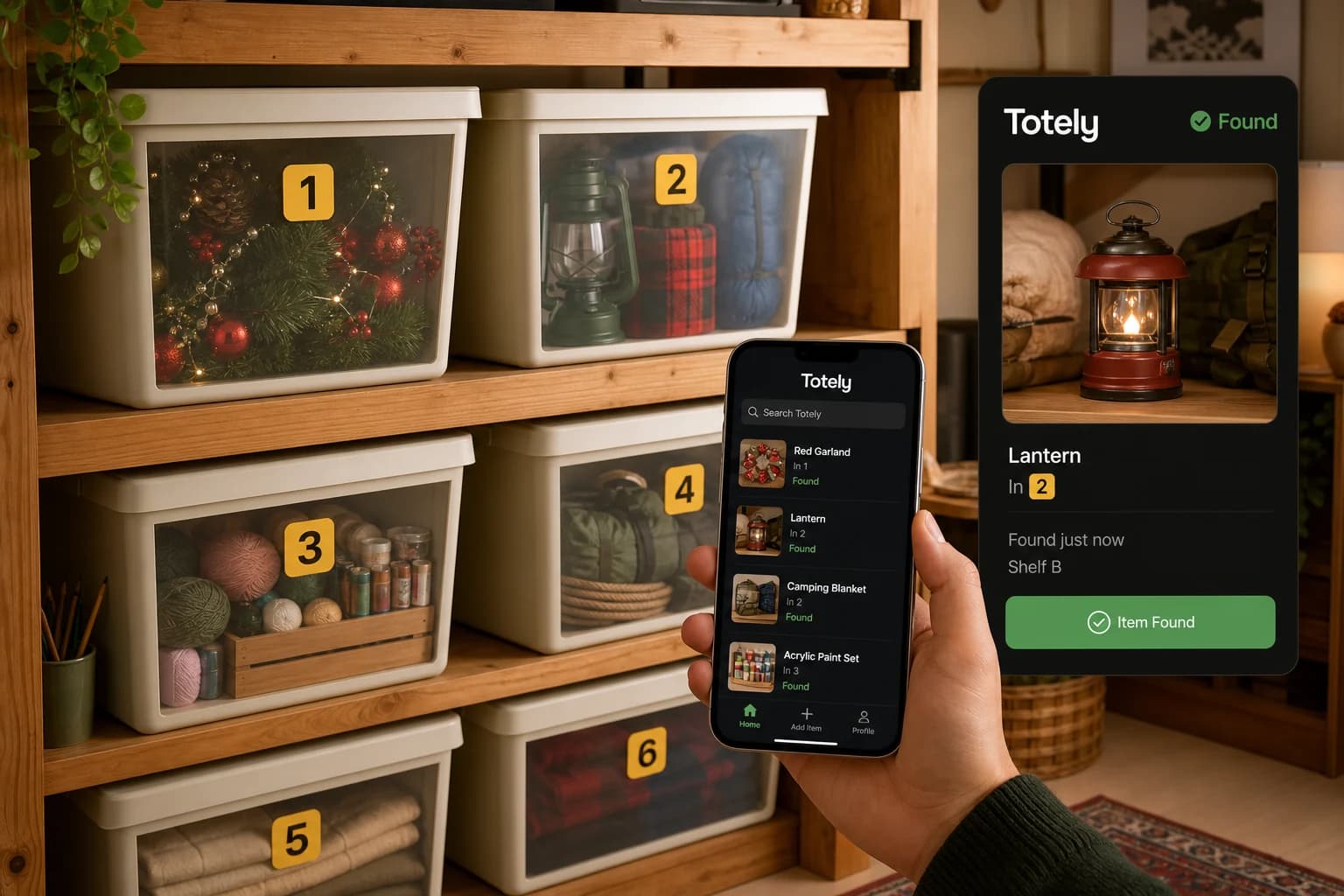
Put a unique yellow number on the physical puzzle bin. Photograph the reviewed puzzles and companion items in their actual container. Totely can create a first item list from what is visible; review and correct that list before saving it. Add the exact location—Hobby Closet / Middle Shelf / Bin 2—and use the words you will naturally remember later.
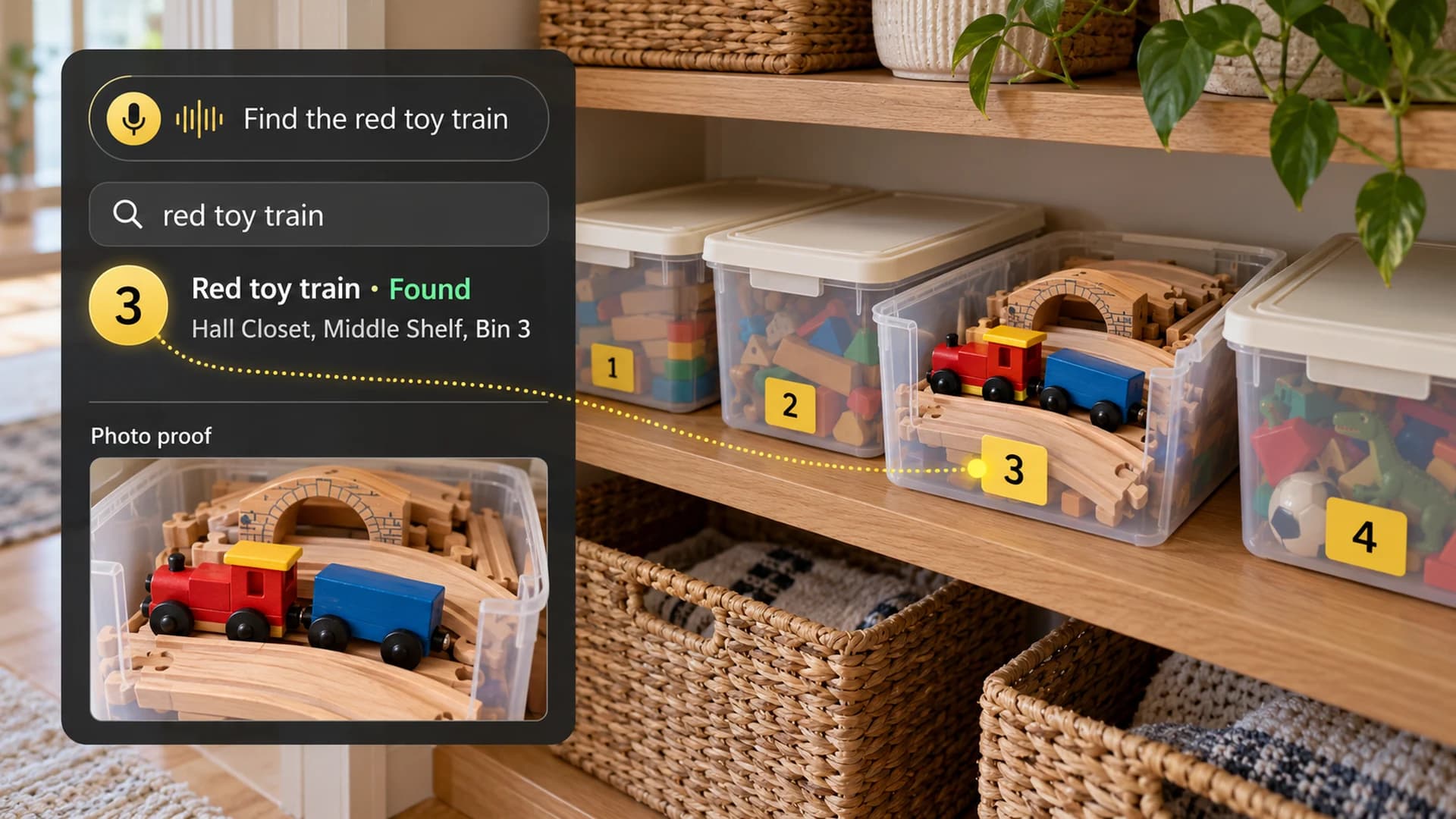
Search Find my blue lighthouse 1000-piece puzzle. The result connects the physical number, exact saved location, reviewed item details, and matching photo proof so you know where to look.
The useful chain is:
Number → photo → reviewed item list → exact location → natural search → photo proof
Number the physical bin
Give each closed puzzle container one unique visible number.
Photograph the reviewed set
Show the puzzle box or reference card, closed piece pouch, and believable companions.
Review the item list
Correct the title, piece count, edition, and condition notes using what you actually verified.
Save the exact location
Use a path such as Hobby Closet / Middle Shelf / Bin 2.
Test a natural search
Ask for the puzzle using the words you will remember later.
Totely helps with location and visible photo proof. It does not count every puzzle piece, confirm completeness, detect damage, certify condition, decide whether a puzzle is safe for a child, or replace maker care instructions.
Run a Ten-Minute Puzzle Reset
Use this reset whenever a build ends or the puzzle shelf becomes difficult to scan:
- Move the current project to Ready, Archive/Display, Donate, or keep it Active.
- Contain all loose pieces and keep the reference image with them.
- Put unknown pieces into the dated Quarantine envelope.
- Repair or replace any box, pouch, or closure that no longer holds the set.
- Return boards, mats, covers, and sorting trays to their assigned home.
- Check that bins are off the floor and away from obvious damp, heat, and leak risks.
- Update any changed condition note using only what you personally reviewed.
- Update the exact shelf/bin address and photo when a set moves.
- Test one search for a named puzzle before closing the closet.
The reset does not need to prove that every set is complete. It needs to leave each puzzle honest, contained, identifiable, and findable.
Puzzle Storage FAQs
What is the best way to store puzzles at home?
Separate them by state: Active, Ready, Archive/Display, and Quarantine. Keep an unfinished build on a supported surface or in a purpose-built system that fits its finished dimensions. Keep ready sets contained with a reference image and identity. Give any opaque bin an exact numbered shelf address.
How do I store an unfinished puzzle and free the table?
Use a rigid board with a cover, a roll-up mat, or a zippered case chosen for the exact puzzle material, finished dimensions, and available storage space. Contain loose pieces separately, photograph the layout before moving it, and follow the accessory maker’s instructions.
Should I keep puzzle boxes or use pouches?
Keep the original box when it is sound, easy to browse, or important for gifting, collecting, trading, or reference. Use a durable pouch when the box is damaged or space is limited, but keep the puzzle name, piece count, reference image, edition details, and reviewed condition with the pieces.
Can I store several puzzles in one bin?
Yes, if each puzzle remains individually closed and identifiable. Use separate boxes, pouches, or cases inside the bin. Do not mix pieces from multiple puzzles loose in one container, and give the outside bin one stable physical number and exact location.
What should I do with a puzzle piece I cannot identify?
Place it in a dated Quarantine envelope or divided tray. Record where it was found and check it against Active and Ready puzzles as those sets are completed or rebuilt. Do not add it to a plausible box until the match is actually confirmed.
Can Totely tell me whether a puzzle is complete?
No. Totely can help connect a numbered physical bin, reviewed item list, exact saved location, natural search, and matching photo proof. It cannot count every piece, certify completeness, detect hidden damage, or replace a person’s review and the maker’s care guidance.