How to Store Paint So Touch-Ups Stay Usable—and Findable
Learn how to store leftover paint upright, sealed and easy to identify, then build a simple system for finding the right room, color and finish later.
By Steve Watts · Co-Founder, Totely
November 15, 2026 · Updated November 15, 2026 · 11 min read
You spot a chip on a kitchen cabinet and remember saving the matching paint. The utility shelf holds six near-identical cans: two whites, a primer, a wall paint, a trim enamel and one mystery jar. The color you need may be there, but opening every container is not a good identification system.
Learning how to store paint starts with a physical decision: keep only paint that is still identifiable, sealed and useful for a real future job. Preserve the product label and formula, record the room and surface, close the container correctly, and store it upright in a suitable dry location. Only after that should you add a searchable record.
This guide focuses on ordinary leftover household architectural paint. Aerosol coatings, stains, varnishes, solvents, two-part products and specialty finishes can have different storage, ventilation, ignition and disposal requirements. The product label, safety data sheet and manufacturer guidance control whenever they differ from this general system.
Quick Links
Decide What Is Worth Keeping
Not every leftover ounce deserves permanent shelf space. Before cleaning lids or buying containers, sort each product into one of four outcomes.
| Decision | Keep it when | Next action |
|---|---|---|
| Keep for touch-ups | The product is identifiable, the room or surface still exists, the container can be sealed, and the paint appears suitable for later testing | Complete the paint passport and store it |
| Keep for a planned project | The product and intended job are known and the manufacturer still considers the product usable | Add the project and review date to the record |
| Offer for reuse | The paint is usable but no longer has a job in your home | Check a legitimate local reuse or paint-share program |
| Recycle or dispose | The product is unwanted, unidentifiable, spoiled, leaking or not worth storing | Follow the label and current local program instructions |
Do not use a fixed age alone as the verdict. Different products, containers and storage histories behave differently. Benjamin Moore tells users to check smell and consistency, while Sherwin-Williams gives its own product-specific guidance for identifying paint that is no longer usable. If the label or manufacturer offers a stricter limit, follow it.
Avoid opening or stirring a leaking, bulging, badly corroded or otherwise questionable container just to complete an inventory. Isolate access to the area and contact the manufacturer or an appropriate local household-hazardous-waste authority for instructions.
Build a Paint Passport
A color dab on the lid is useful, but it does not answer the questions that matter during a repair: Which room? Which surface? What finish? Was this the wall color or the trim?
Before the label fades, copy the details that would let you identify or replace the paint.
| Paint-passport field | Example | Why it matters |
|---|---|---|
| Room or area | Kitchen | Narrows the search |
| Exact surface | Upper cabinets and island end panel | Prevents a wall/trim/cabinet mix-up |
| Brand and product line | Copy from original label | Keeps product-specific instructions connected |
| Color name and formula/code | Copy every printed identifier | Helps distinguish similar whites and supports a future reorder |
| Finish or sheen | Satin | A color match with the wrong sheen can still stand out |
| Purchase or open date | November 2026 | Records age without pretending age alone proves usability |
| Remaining amount | About one quart | Helps plan whether a touch-up or larger repair is realistic |
| Original instructions | Label and safety data sheet retained | Keeps storage, use and disposal guidance available |
| Exact storage address | Utility Room • Upper Shelf • Bin 2 | Makes retrieval specific |
Photograph the front label, formula sticker and a representative dried swatch if one is already available. Do not cover required warnings, product identity or disposal information with an organizing label.
Seal the Container Without Losing Its Identity
If the original container is sound and the lid still fits, keeping the paint with its original label is the simplest way to preserve identity and instructions. PaintCare notes that its participating drop-off sites accept leftover paint in the original container with the original manufacturer label, so decanting can affect future recycling options.
Use this sequence:
- Read the label first. Confirm that the product has no special storage or container rule.
- Clean the rim. Remove wet residue with a method compatible with the product so the lid can seat evenly. Do not knock dried debris into the paint.
- Inspect the lid and can. A bent lid, damaged seam, severe rust or cracked plastic can prevent a reliable seal.
- Close around the edge. Follow the manufacturer’s closure directions. For a conventional can, a rubber mallet or a block of wood can help seat the lid without distorting its center.
- Keep it upright. PaintCare says turning a properly sealed can upside down is unnecessary and adds leak risk.
- Add the passport without hiding the original label. Record room, surface, color/formula, finish, date and storage address.
When the original container is damaged or much larger than the remaining amount, a manufacturer may allow transfer to a clean, compatible, tightly sealing container. Benjamin Moore advises that a replacement container should not be much larger than the paint left inside and names lined metal, glass or plastic options for many of its latex products. That is not permission to use any jar for every coating. Check the specific label or manufacturer, preserve the full product identity and understand that a recycling program may require the original container.
Never pour leftover material from a dirty tray or brush pot back into clean stock unless the product maker explicitly permits it. Contamination can turn a useful touch-up supply into an unreliable one.
Choose the Storage Location
The best shelf is not simply the nearest empty shelf. It has to fit the paint label and the household.
PaintCare advises keeping water-based paint from freezing and keeping cans dry so they do not rust or lose their labels. Its guidance also recommends retaining the original identity and marking when and where the paint was used.
Use this location screen:
| Location question | Better answer | Avoid |
|---|---|---|
| Does the area stay within the label’s storage conditions? | A suitable indoor utility or maintenance cupboard | A shed, vehicle or garage that crosses prohibited temperature limits |
| Is the shelf dry and stable? | A level shelf with a cleanable tray or bin | A damp floor, wobbly wire edge or shelf over food |
| Can children or pets reach the products? | Secured storage appropriate to the household and product | An open low shelf |
| Are ignition, heat and ventilation restrictions satisfied? | Follow the exact label and safety data sheet | A boiler, furnace, water heater, direct sun or improvised enclosed space |
| Can a leak be noticed and contained? | Upright cans in a shallow, compatible secondary tray | Stacked cans hidden behind unrelated supplies |
Do not treat “cool and dry” as permission to ignore the label. A water-based wall paint, an aerosol can and a solvent-based finish are not interchangeable storage problems.
Set Up One Paint Shelf
Now turn the suitable location into a small maintenance station.
- Group by room or project, not color alone. “Kitchen cabinets” is more useful than a row called “white.”
- Keep heavy cans low enough to handle safely. Do not create a stack that must be moved to reach the bottom.
- Use shallow secondary containment. A compatible tray or bin can keep cans upright and make a small leak easier to notice. It does not make an unsafe location safe.
- Give each shelf bin a simple number. Use
1,2,3—not a changing category label. - Keep the passport with the can. The physical record should still work if the phone is unavailable.
- Add a review trigger. Recheck the paint when a room is repainted, a can is opened, a product is moved or the storage conditions change.
- Identity check: Original label, formula or color code, product line, finish, room and surface are recorded.
- Container check: The can or compatible replacement container is sound, sealed and upright.
- Location check: The shelf satisfies the product label, safety data sheet and household-access requirements.
- Use check: The paint still has a real touch-up or project purpose.
- Exit check: A current local reuse, recycling or disposal route is known for paint that leaves the shelf.
At this point, the physical system is already useful. The paint is identified, sealed, upright and assigned to a real future job.
Add a Searchable Memory Layer
The remaining problem is retrieval. Six months after a shelf reset, can anyone find the exact kitchen-cabinet paint without opening the wall paint, primer and trim enamel?
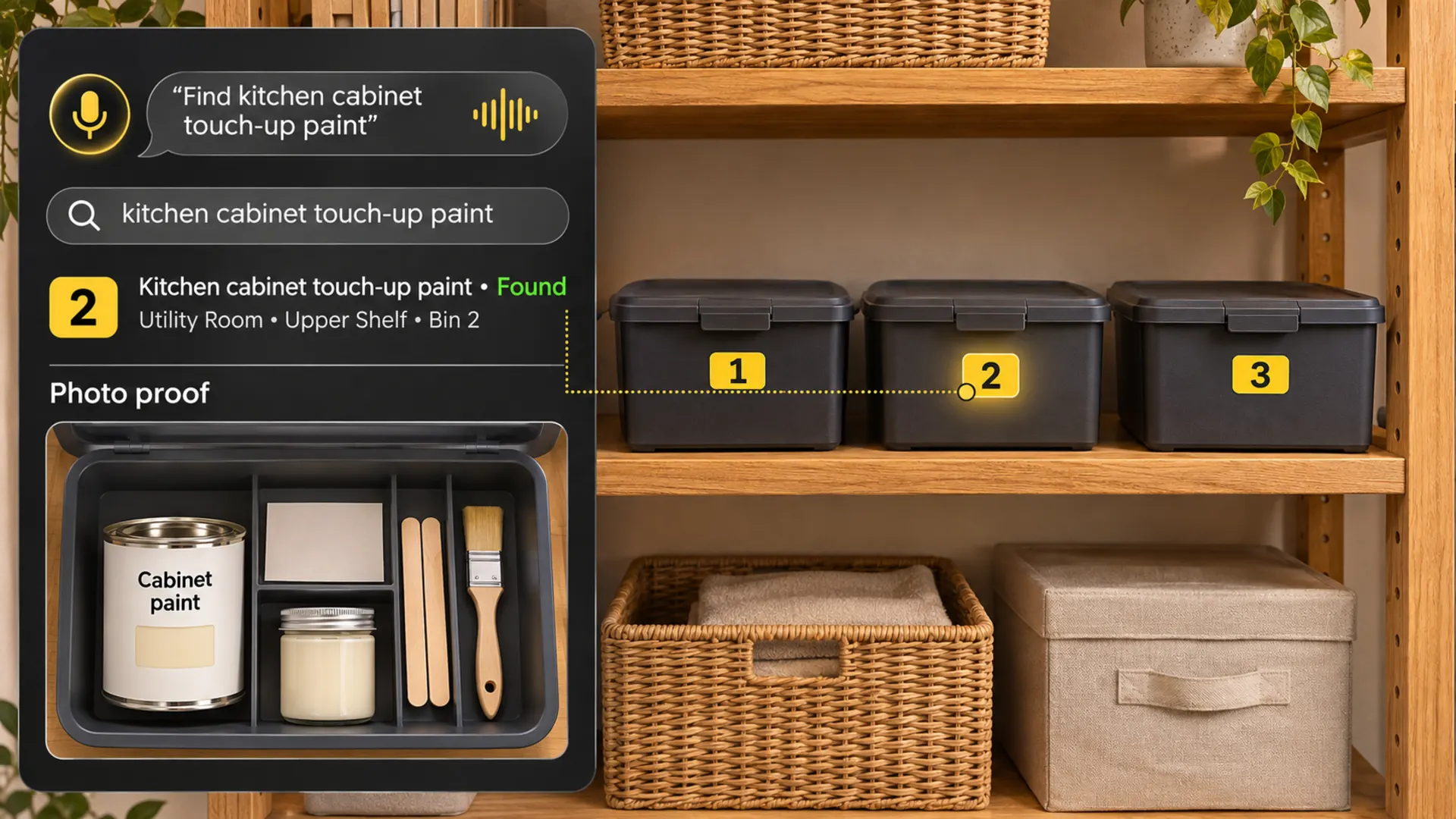
Totely can add a digital memory layer after the physical storage is correct:
- Put a simple visible number on the secondary shelf bin, such as
2. - Photograph the reviewed cans and their intact labels.
- Let Totely create the first item list from what it can see.
- Review and edit the list. Add the room, surface, product, color/formula, finish and remaining amount in ordinary language.
- Save the exact location:
Utility Room • Upper Shelf • Bin 2. - Search naturally later:
kitchen cabinet touch-up paint. - Confirm the number, saved location and photo proof before moving cans.
For example, a search for kitchen cabinet touch-up paint points to Bin 2 at Utility Room • Upper Shelf • Bin 2. The photo proof shows the small cabinet-paint can, its formula label, a plain swatch card, a sealed sample jar from the same project and a clean touch-up brush stored separately from the liquid.
Totely does not evaluate chemical compatibility, certify a container, read every obscured warning, decide whether paint is still usable or replace the product label, safety data sheet or local waste authority. It helps you find the reviewed record you created. See the current Totely features and FAQ for the supported number-photo-reviewed list-location-search-photo proof workflow.
If paint shares a maintenance area with tools, keep the paint rules primary and use the same exact-address principle in a broader garage tool inventory. If the whole space needs zones first, begin with the garage storage zones guide.
Know When to Reuse, Donate or Recycle
Paint should not become permanent clutter just because it was expensive or might be useful someday.
When a room is repainted, review its old touch-up paint immediately. If the product is still usable but no longer has a job, look for an established reuse program. If it is unwanted or unusable, use the product label and a current local paint-stewardship or household-hazardous-waste program to decide the next step.
Rules differ by product and location. Do not pour paint into a drain, combine products, assume every can belongs in household trash, or copy disposal instructions from another city. PaintCare’s drop-off guidance covers participating U.S. programs and accepted products by state; outside those programs, consult the appropriate local authority.
Paint Storage FAQs
What is the best way to store leftover paint?
Keep only identifiable, useful paint. Follow the product label and safety data sheet, preserve the original container and label when practical, clean the rim, close the lid correctly, store the can upright on a stable dry shelf within the specified conditions, and record the room, surface, color/formula, finish and date.
Can paint be stored in a garage?
Only if that garage reliably satisfies the specific product’s temperature, moisture, ventilation, access and ignition-source requirements. Many garages freeze, overheat or become damp, so an appropriate secured indoor utility or maintenance cupboard is often a better candidate. The label controls.
Should paint cans be stored upside down?
PaintCare says a tightly closed can does not need to be stored upside down and recommends checking the lid again rather than risking a shelf leak. Store cans upright unless the specific manufacturer directs otherwise.
Can I transfer leftover paint to a smaller container?
Sometimes, but use only a clean, compatible container permitted by the manufacturer, copy the complete product identity and warnings, and keep the replacement tightly sealed. First check whether a future recycling program requires the original container and label.
How can I tell whether old paint is still usable?
Start with the product maker’s guidance. Check the container and storage history before opening it, then evaluate the paint only as directed. Strong sour odor, contamination or a texture that will not return to a uniform consistency can be warning signs for some products. Test an acceptable paint in an inconspicuous area before a visible repair.
Can Totely tell me whether stored paint is safe or still good?
No. Totely can help you find the numbered shelf bin, reviewed item record, saved location and photo proof. It does not assess chemical condition, storage compliance, container compatibility, product age, color match or disposal requirements.
Start With One Touch-Up Job
Choose one room with a paint can you genuinely expect to use. Preserve the product identity, complete its passport, seal it correctly and assign it an exact upright shelf location. Once that physical system works, add the number-photo-location record that helps everyone find it again.