How to Store Kids’ Artwork Without Losing the Story—or the Piece
Learn how to store kids’ artwork with a simple dry, display, curate, and archive system—then find one specific drawing or painting years later.
By Steve Watts · Co-Founder, Totely
November 8, 2026 · Updated November 8, 2026 · 14 min read
Kids' artwork does not become a storage problem because one drawing is hard to keep. It becomes a problem because new pieces arrive faster than a family can decide what happens next. Wet paintings stack on the counter, school projects live in backpacks, and the pieces worth saving disappear into an unlabeled box.
The best way to store kids' artwork is to give every piece a short route: land and dry, display, curate, then archive or release. Keep a limited yearly collection flat in a labeled folder or box in a stable living-space closet. Photograph the oversized and three-dimensional pieces you cannot reasonably keep. Most importantly, save the child's words with the piece so the archive holds the story, not just the paper.
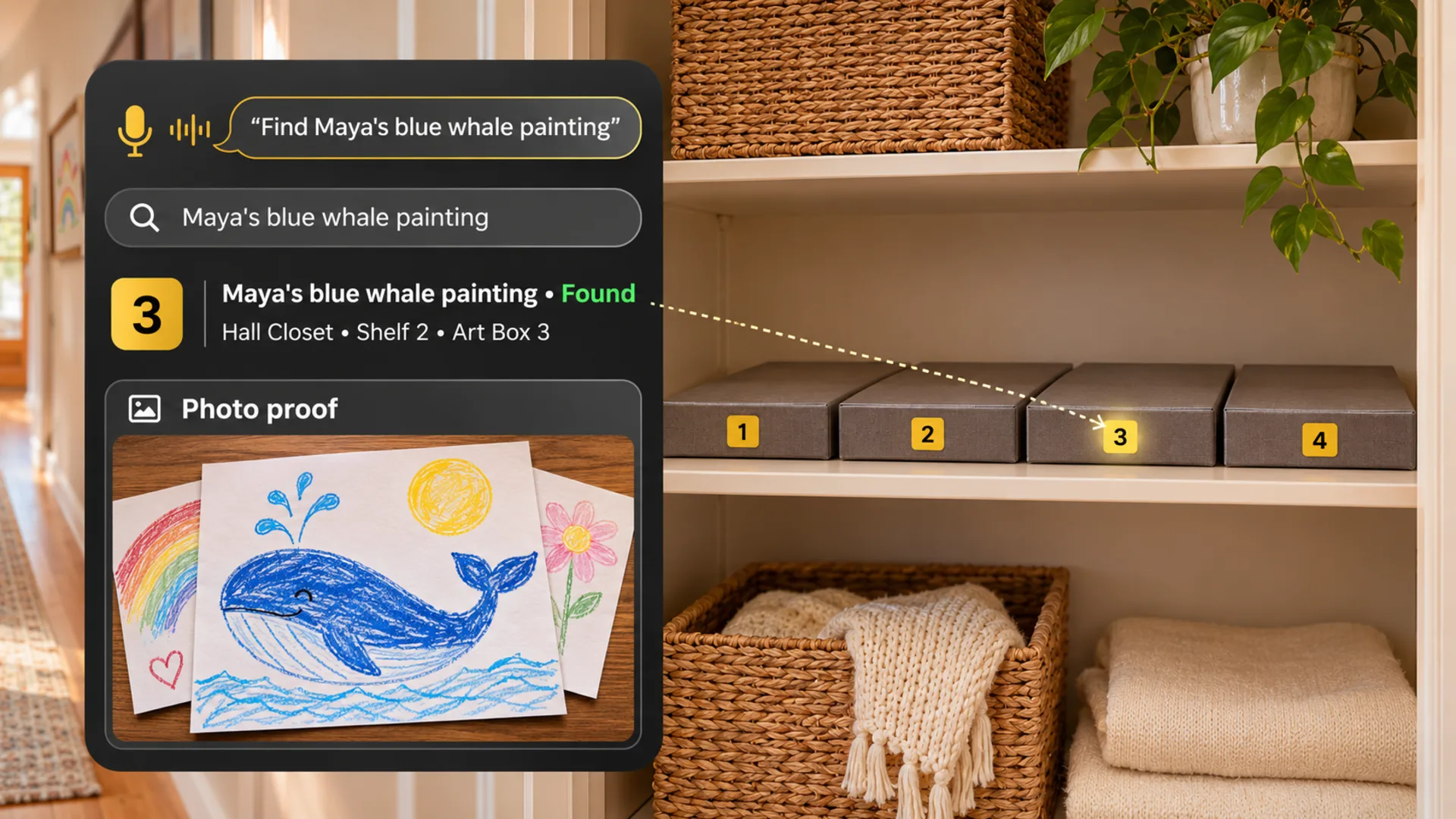
Build that physical system first. Once it works, a searchable record can answer the question a year label cannot: Where is Maya's blue whale painting?
Quick Links
- Build the Four-Stop Artwork Flow
- Choose What to Keep Without Making It a Test
- Match the Storage Method to the Artwork
- Create One Yearly Archive per Child
- Store Paper Artwork With Care
- Handle Oversized and 3D Art
- Make One Piece Findable Years Later
- How Totely Helps
- Run a Short Term-End Review
- Kids' Artwork Storage FAQs
Build the Four-Stop Artwork Flow
Do not start by buying a giant bin. Start by deciding what happens between the art table and the archive. Four small stops prevent one large pile.
| Stop | What belongs there | Capacity rule | What happens next |
|---|---|---|---|
| Land and dry | New, wet, glued, or unfinished work | One tray or drying surface per child | Finish, dry fully, or move to the review tray |
| Display | A small group the child wants to see | A fixed number of clips, frames, or board spaces | Rotate when a new favorite arrives |
| Curate | Dry pieces waiting for a keep/photo/release decision | One shallow tray | Review weekly, monthly, or at the end of a term |
| Archive | Chosen originals with names, dates, and stories | One folder or box per child per school year | Close and review at the end of the year |
1. Give new art a landing place
Put one shallow tray near the place artwork normally enters the home. School papers can land there after backpacks are emptied. Home projects can move there after they are dry. A shallow tray keeps the pile visible and makes its limit obvious.
Wet paint, glue, or clay should have a separate drying surface. Do not stack damp work directly into the review tray or archive. The point is not to impose a precise drying time on every medium; it is to wait until the piece is genuinely dry and stable before it touches another piece.
2. Limit the display on purpose
Choose a display with a natural boundary: six clips, three front-opening frames, one magnetic board, or one shelf. When it is full, rotate rather than expand.
This keeps current favorites visible without turning the whole house into permanent storage. Light can cause irreversible damage to paper, so avoid direct or intense light for pieces you hope to keep. The Library of Congress recommends minimal light exposure for works on paper.
3. Review before the pile becomes history
A review tray creates a pause between “made today” and “save forever.” It also prevents the archive box from becoming a second unsorted pile.
At each review, choose among five outcomes:
- display a current favorite;
- archive the original;
- photograph it and release the original;
- share or repurpose it as a card, gift, or collage material;
- release it without creating another obligation.
4. Archive only after the decision
The archive is for chosen originals, not undecided paper. Store each keeper with enough context to understand it later: child, date or school year, age or grade, title, and one sentence in the child's own words when the story matters.
If you already use keepsake boxes for sentimental items, keep the artwork archive separate. Flat paper needs a different shape, review rhythm, and handling method than mixed three-dimensional keepsakes.
Choose What to Keep Without Making It a Test
There is no correct annual number. A fixed container is usually more useful than a fixed quota: the family decides what deserves the available space.
Keep the pieces that carry information you cannot reconstruct later:
- an early self-portrait or family portrait;
- first writing, name attempts, or invented spelling;
- a piece the child explains with a memorable story;
- work that shows a new skill, fascination, or stage;
- a piece the child is especially proud of;
- a representative sample rather than ten near-duplicates.
Invite the child into the decision without asking them to judge whether their art is “good enough.” Try: Which one tells the best story? Which one would you like future-you to see? A child may choose a funny scrap that an adult would overlook. That choice is part of the record.
For a young child who wants to keep everything, make the physical boundary visible: “These are the pages that fit in this year's folder. Let's choose together.” Photographing a piece can preserve its appearance and story without pretending the digital copy is the original.
Match the Storage Method to the Artwork
The safest practical method depends on the material and shape. Children's art often combines inexpensive paper, paint, glue, tape, glitter, or objects with different aging behavior, so avoid one universal promise of preservation.
| Artwork type | Practical home | Record to keep | Watch for |
|---|---|---|---|
| Flat drawings and paintings | Acid- and lignin-free folder inside a flat document box | Child, date, title/story, medium | Folding, pressure, direct light, damp locations |
| Chalk, pastel, charcoal, or flaky paint | Supported folder or interleaving selected for the medium | Medium and handling note | Smudging; static from some plastic sleeves |
| Collage or thick paper | Shallow flat box with enough depth | Materials and fragile parts | Crushing, loose pieces, adhesive failure |
| Oversized paper | Large flat portfolio or a careful photo/scan | Original dimensions and whether it was retained | Folding just to fit a standard box |
| Clay, cardboard, or 3D work | Limited display shelf, sturdy object box, or photo record | Several views, scale, child/date/story | Breakage, dust, unstable materials |
| Digital-only record | Organized folder with a clear filename and backup copies | Child, year, title, original disposition | One phone or one cloud account as the only copy |
The Library of Congress notes that polyester film can build static that may lift powdery media such as pastel, charcoal, pencil, or flaking paint. If a piece is fragile, valuable, or already damaged, do not improvise a repair or sleeve choice; consult a qualified paper conservator.
Create One Yearly Archive per Child
A useful default is one flat archive box per child per school year. If your family creates less art, one box can span several years with one folder per year. If it creates more, keep the same structure and use more than one numbered box.
Give the archive a precise address:
Hall Closet / Shelf 2 / Art Box 3 / Maya / 2026–27
Inside the box, sort chronologically or by term. Use labeled folders rather than loose stacks. The physical label should stay short enough to read; the detailed record can hold the story.
| Field | Example | Why it helps later |
|---|---|---|
| Child and year | Maya / 2026–27 | Separates siblings and time periods |
| Piece | Blue whale painting | Uses the name the family remembers |
| Context | Age 6; “the whale is carrying the moon” | Preserves meaning beyond appearance |
| Physical address | Hall Closet / Shelf 2 / Art Box 3 / Fall folder | Leads to one exact place |
| Original status | Kept; photographed; released | Distinguishes a photo record from a stored original |
| Photo | Clear image of the piece and box number | Confirms the match before opening other boxes |
Number multiple boxes once and keep the number stable. A long handwritten contents label becomes inaccurate when art moves; a stable number can keep pointing to the current record. The storage-label guide explains the same principle for other household containers.
Store Paper Artwork With Care
For long-term favorites, use a cool, clean, relatively dry, stable location in the living area—not an attic, damp basement, or place exposed to leaks and temperature extremes. Keep paper flat and supported in appropriate folders or document boxes. Avoid rubber bands, self-adhesive tape, glue, paper clips, and dog-eared folds as organizing tools.
Those recommendations come from the Library of Congress guidance for care, handling, and storage of works on paper. Its paper preservation FAQ also emphasizes preventive storage and warns that even light behind UV-filtering glazing can damage paper over time.
For an ordinary family archive, translate that guidance conservatively:
- Wash and dry hands and clear the work surface.
- Make sure the art is dry before it enters the archive.
- Remove loose rubber bands or clips when doing so will not damage the piece.
- Store chosen pieces flat in supportive enclosures.
- Keep the box off the floor and away from direct sunlight, vents, and leak risks.
- Check it during the annual review for moisture, pests, stuck surfaces, or damage.
Do not use this family system as a treatment guide for mold, severe tears, flaking media, or valuable work. The Library of Congress recommends professional conservation help when basic preventive measures are not enough.
Handle Oversized and 3D Art
Not every creation should be forced into a box.
For oversized paper, either use a correctly sized flat portfolio or make a careful digital record. Do not fold a favorite poster just because the archive box is smaller. Photograph the whole piece square-on in even light, then capture a close-up of the child's name or signature and record its dimensions.
For sculptures, cardboard constructions, and mixed-media projects:
- display a small rotating selection;
- keep only what fits the family's defined object shelf or box;
- photograph from several angles;
- include the child in one image when scale and memory matter;
- record the materials, title, date, and story;
- mark clearly whether the original was kept or released.
If you keep a digital record, organize it and back it up. The Library of Congress advises selecting and organizing what to save, keeping copies on at least two different storage media in separate locations, and migrating saved copies periodically. See its reformatting and digital-preservation FAQ.
Make One Piece Findable Years Later
“Maya, first grade” narrows the search, but it may still leave dozens of pieces in one box. A retrieval-ready record ties the memory to the physical address.
For each keeper—or for the small group in one folder—record:
- the words someone will naturally search;
- the child and school year;
- a reviewed title and short description;
- whether the original is stored or only photographed;
- the numbered box and exact folder;
- one clear image of the art;
- one image that shows the box number when helpful.
Use honest item names. A photo may show a blue whale, but it cannot supply the child's date, intent, title, or story. Those details require a person to review and add them.
Test the address before closing the box. Ask another family member to retrieve “Maya's blue whale painting.” If they can reach the exact folder without opening unrelated boxes, the physical system works.
How Totely Helps
Totely fits after the landing tray, display limit, curation rule, and yearly archive are working.
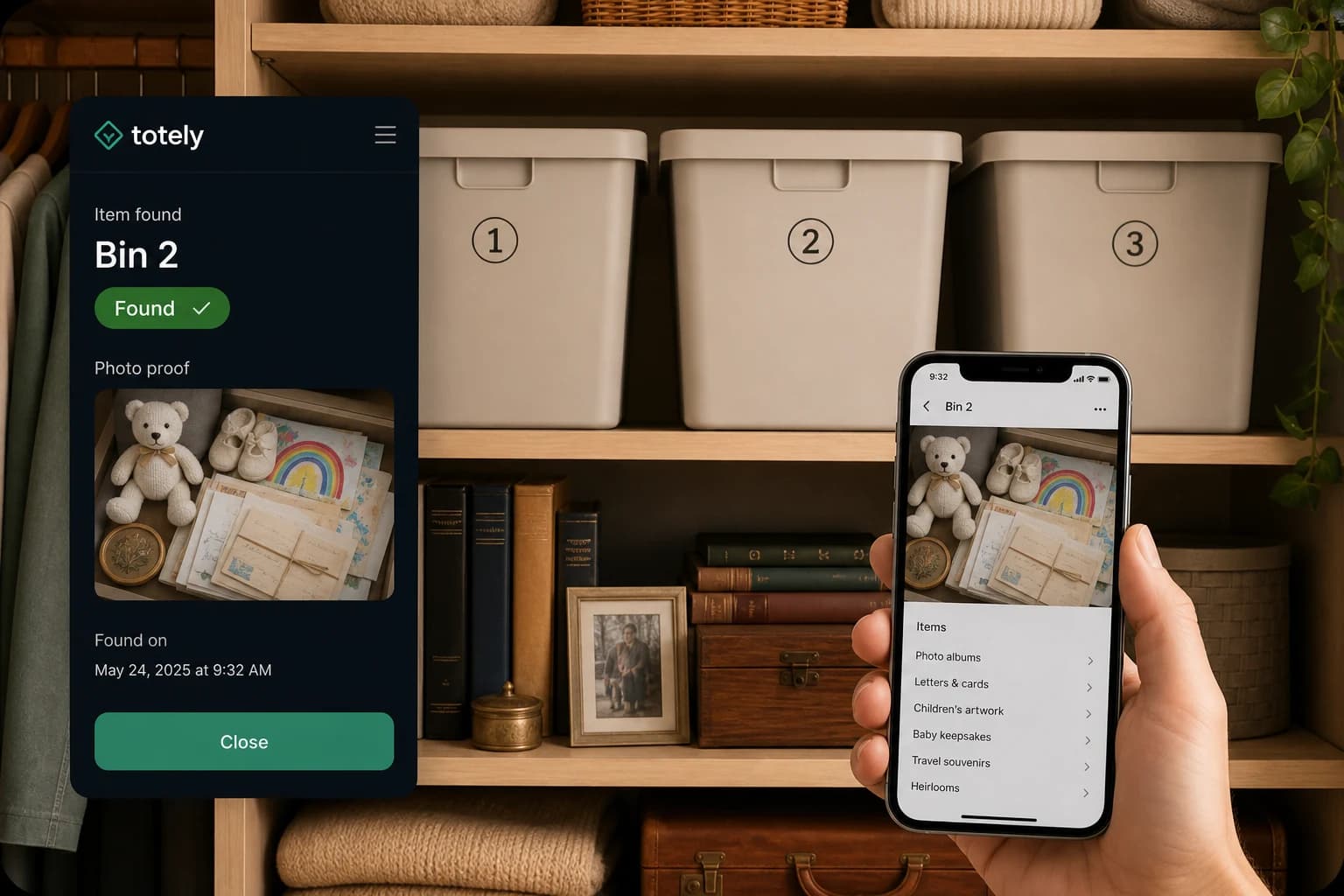
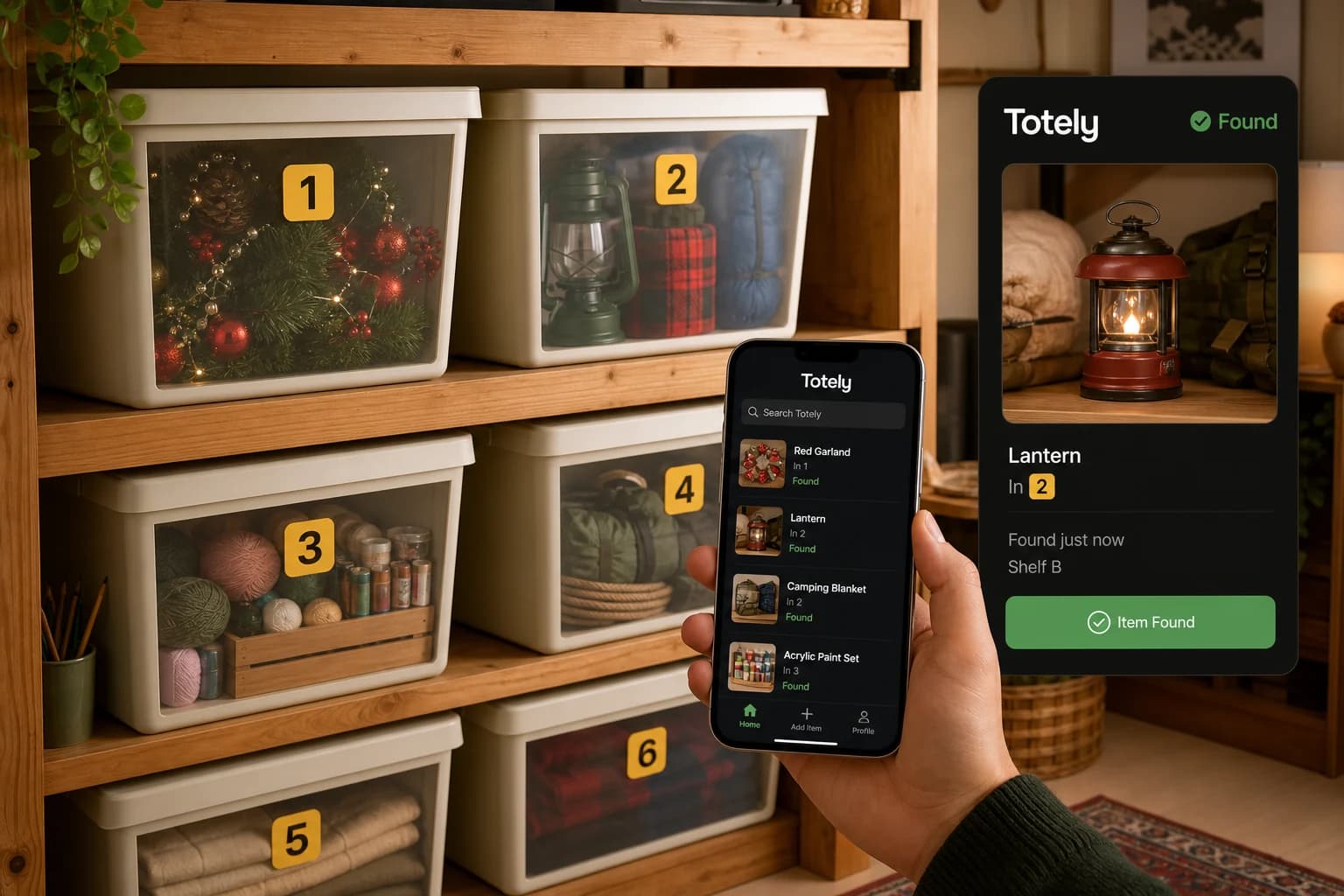
Put a unique visible number on the physical archive box. Photograph the selected pieces and the box in their real home. Totely can build a first item list from what is visible; review and edit that list before saving. Add the exact location—Hall Closet / Shelf 2 / Art Box 3—and use the words your family is likely to remember.
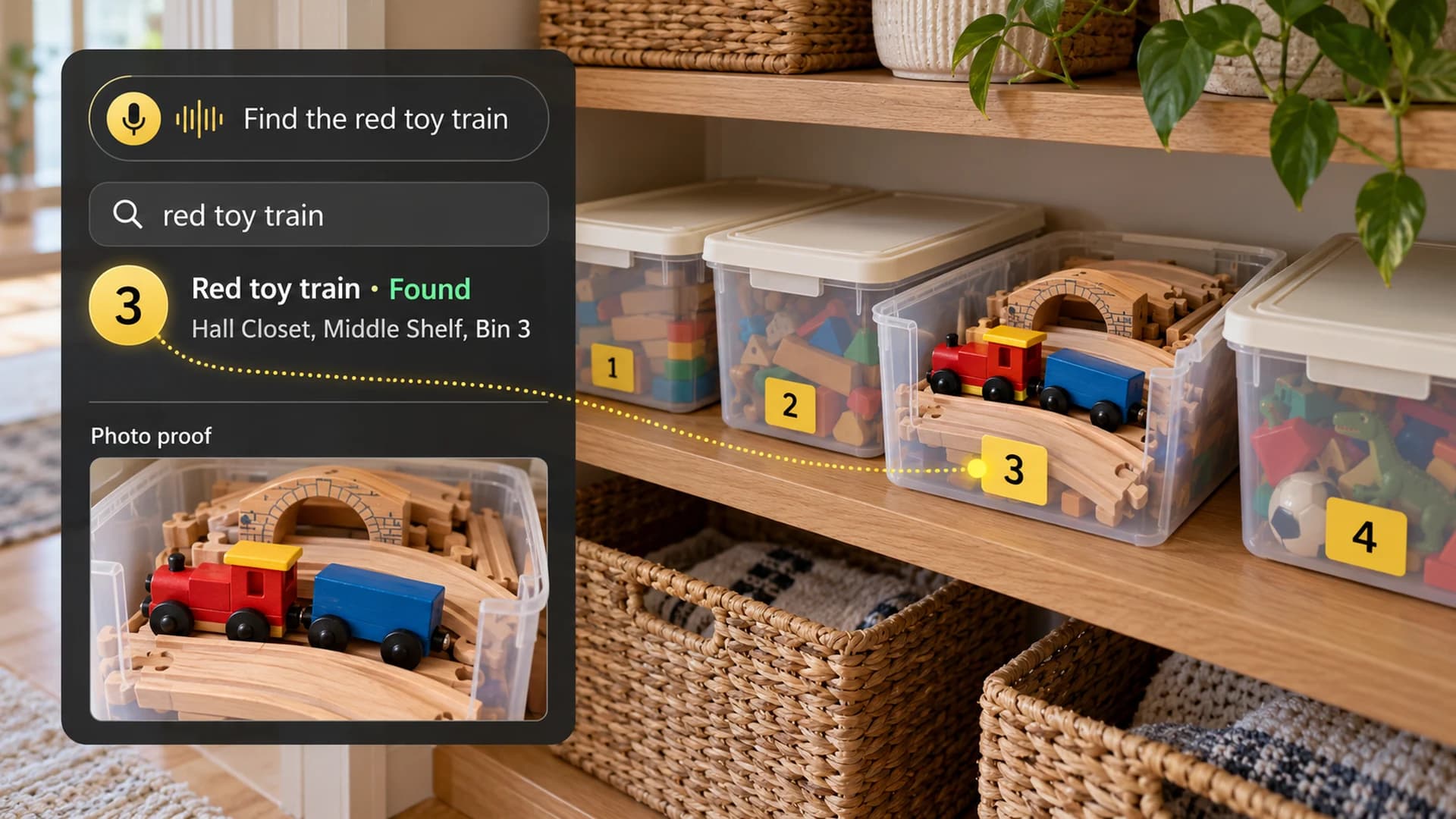
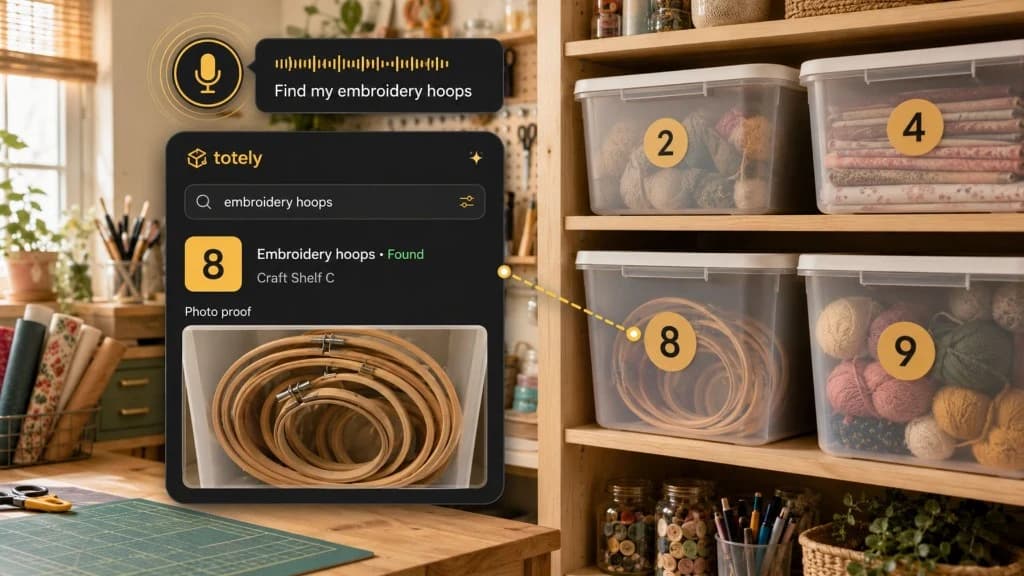
Later, search Maya's blue whale painting. The result connects the box number, saved location, reviewed item details, and matching photo proof so you know where to look.
The useful chain is:
Number → photo → reviewed item list → exact location → natural search → photo proof
Number the physical archive
Give each box or portfolio one unique visible number.
Photograph the keeper
Capture the artwork clearly, then show its numbered archive home.
Review the item list
Correct the title and add the child, year, story, and original status.
Save the exact location
Use a path such as Hall Closet / Shelf 2 / Art Box 3 / Fall folder.
Test a natural search
Ask for the piece using the words your family will remember.
Totely does not judge which art matters, determine conservation needs, or guarantee that a photograph identified every item correctly. The family's review and the physical archive still control.
Run a Short Term-End Review
Pick a predictable moment: the end of a school term, the first weekend of summer, or the child's birthday. Bring out only the review tray and current display—not every childhood box at once.
Use this 20-minute reset:
- Confirm every piece is dry.
- Let the child choose a favorite and tell its story.
- Select a balanced handful of originals for the year.
- Photograph oversized, bulky, or released pieces.
- Add child, date, title, and story to the keepers.
- File originals flat in the correct folder.
- Update the archive location and photo record.
- Rotate the display and clear the landing tray.
The goal is not a perfect retrospective. It is a small closed loop that the family can repeat.
Kids' Artwork Storage FAQs
What is the best way to store kids' artwork long term?
Store chosen originals flat in supportive acid- and lignin-free folders or document boxes in a cool, clean, relatively dry, stable living-space location. Avoid direct light, attics, damp basements, self-adhesive tape, rubber bands, and unnecessary folding. Use a conservator for fragile, valuable, moldy, or badly damaged work.
How do I organize children's artwork by year?
Use one folder per term inside one numbered archive box per child and school year. Label each keeper with the child, date or grade, title, and story. Record the exact box and folder so the year label does not become another unsorted pile.
How much kids' artwork should I keep?
Use the capacity of one chosen folder or box as the boundary rather than an arbitrary universal number. Keep representative pieces, firsts, writing, favorites, and work with memorable stories; photograph other pieces when the appearance or context is worth retaining.
Should I scan or photograph every piece of kids' art?
You do not have to. A photo is most useful for oversized or 3D work, pieces you release, and favorites you want to locate quickly. If the digital copy matters, organize it and keep redundant copies in separate locations rather than relying on one phone.
Can I store children's drawings in plastic sleeves?
Some sleeves may be appropriate for some media, but not every plastic or artwork behaves the same way. The Library of Congress warns that polyester film can create static that may lift powdery media such as pastel, charcoal, pencil, or flaking paint. Use suitable preservation materials and seek expert advice for fragile work.
How do I keep kids' artwork from taking over the house?
Limit each stage: one landing tray, one drying spot, a small rotating display, one review tray, and a defined yearly archive. When a stage is full, make the next decision instead of adding another pile or container.
Keep the Story and the Address
The most useful kids' art archive is not the biggest one. It is the one that preserves a meaningful sample, the child's own words, and a physical address another person can follow.
Start with today's pile. Give it a landing place, wait for the wet pieces to dry, choose one display boundary, and set up one folder for this school year. Then number the archive and test whether someone else can find one real piece.
That is enough to turn a paper pile into a family record you can actually use.