How to Store Extension Cords Without Tangles—or Losing the Right One
Learn how to inspect, coil, label, and store extension cords on hooks, reels, or shelves—then make the right cord easy to find by job and location.
By Steve Watts · Co-Founder, Totely
November 6, 2026 · Updated November 6, 2026 · 13 min read
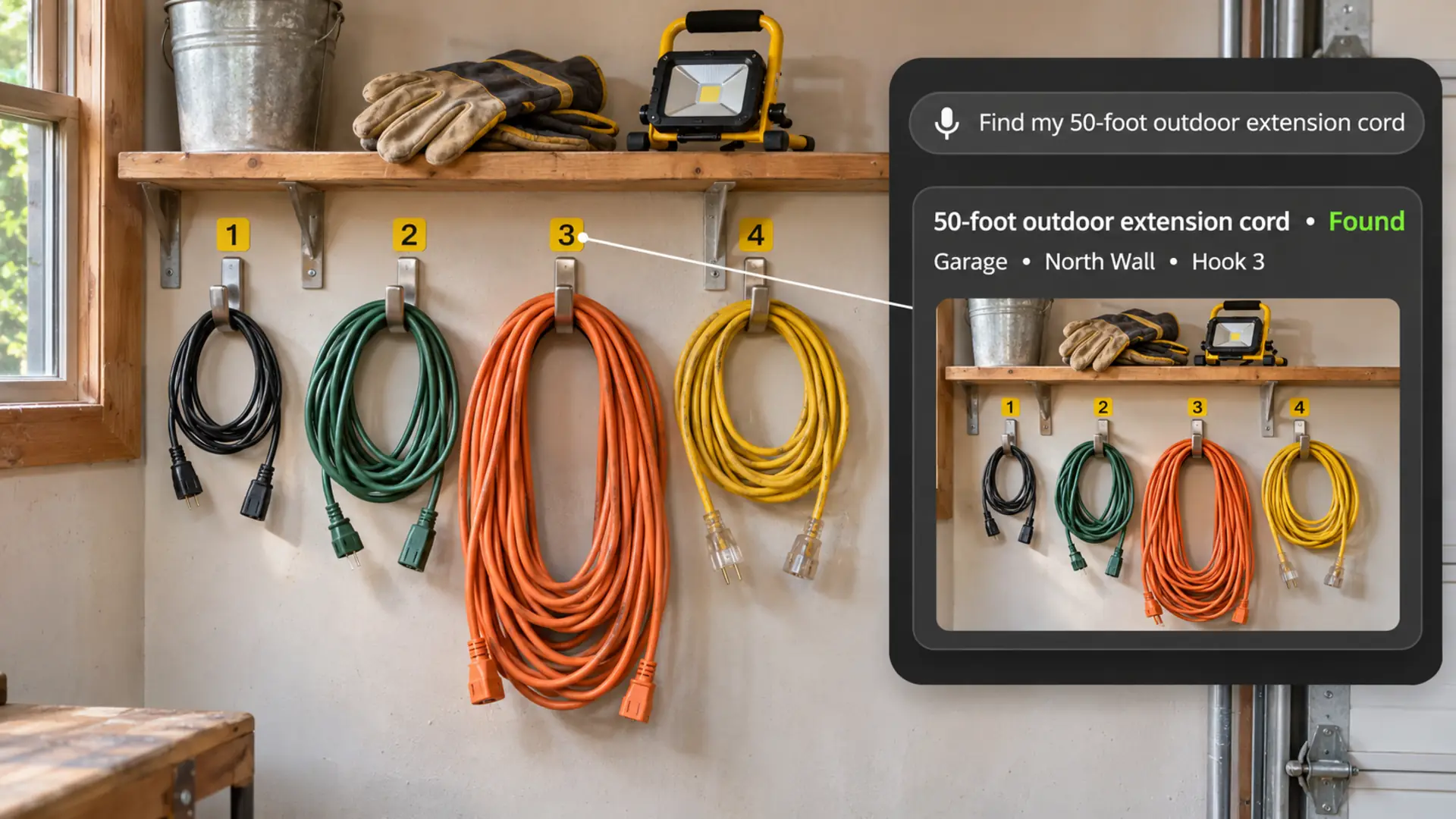
Extension cords have a habit of becoming one anonymous pile: three dark coils on a garage shelf, an orange cord under a workbench, and one short cord that is never where you expect it.
The answer is not a tighter knot. To store extension cords well, inspect each unplugged cord, make broad relaxed loops, secure the coil without pinching it, and give every cord its own supported, dry home. Then label the facts you will need later: the cord's length, the use it is actually rated for, and its home location.
That physical system comes first. Once it works, a searchable record can answer the harder question: Which cord do I need for this job, and exactly where is it?
Quick Links
Start With a Safe Storage Check
Storage begins when the cord is fully unplugged from both the outlet and the equipment. Grasp the plug rather than pulling on the cord, then lay the cord out where you can see it.
Look along the jacket and at both plug ends. If you see cracks, cuts, exposed wire, a loose plug, missing parts, scorching, or other damage, stop using the cord. The U.S. Fire Administration advises replacing worn, old, or damaged extension cords and keeping cords away from places where they can be pinched or damaged, such as under a rug.
Do not turn storage time into a repair project. Follow the manufacturer’s instructions and use qualified help when you are unsure whether a cord is safe. A tidy hook does not make a damaged or unsuitable cord safe to use.
Also read the markings already printed on the cord. Color is not a rating. An orange jacket does not, by itself, prove that a cord is intended for outdoor use. The Consumer Product Safety Commission distinguishes cords intended only for indoor use from cords intended for indoor and outdoor use and identifies jacketed construction as an applicable characteristic for outdoor cords.
Your storage label should preserve the manufacturer's facts, not replace them.
Coil the Cord Without Forcing It
The best coil is one the cord accepts without sharp bends or twists.
For most household cords, use this routine:
- Start at one unplugged end. Let the rest of the cord lie free so it can turn.
- Make a broad loop. Use a loop size that feels natural for the cord's thickness.
- Release twist as you go. If the cord starts corkscrewing, pause and let the free end rotate.
- Keep loops consistent. Do not pull them into a tight bundle just to make the cord look smaller.
- Secure the middle gently. Use a reusable cord strap or another organizer designed for the job; do not cinch hard enough to deform the jacket.
An over-under coil can help long cords lie flatter because alternating loops manage twist. If you already use that technique confidently, it is a good option. If not, a careful series of broad loops is better than a clever technique performed under tension.
The University of California, Riverside's extension-cord storage guide recommends storing cords indoors by coiling or hanging them to avoid tight kinks, cuts, and scrapes that could damage insulation or conductors. Its rules are written for a university workplace, but the storage principle is useful at home: support the cord without crushing or sharply bending it.
Do not plug the two ends together merely to lock a strained coil in place. A separate strap is easier to release and does not use the plug or receptacle as a fastener.
Choose the Right Storage Method
There is no single best extension cord organizer. Match the storage method to the cord, its frequency of use, and the space you actually have.
| Storage method | Best for | Set it up well | Watch for |
|---|---|---|---|
| Smooth wall hook | A few frequently used cords | Give each coil its own wide, rounded support | A sharp nail, crowded hooks, or a coil hanging by one small section |
| Manual reel | A long cord used regularly | Wind evenly and follow the reel and cord instructions | Tight winding, jammed layers, or treating the reel as permission to use the cord while tightly wound |
| Strap with handle | A cord that travels between garage, yard, or vehicle | Secure a relaxed coil and hang the handle | An overtight strap or a label that disappears behind it |
| Shelf cubby or open bin | Short cords and adapters kept as a small group | Keep each cord separately strapped and visible | A deep mixed pile that recreates the original problem |
| Portable bucket or bag | A job kit with one cord and its normal companions | Keep the cord dry, unplugged, and easy to inspect | Hiding a damp, dirty, warm, or damaged cord after use |
Hooks work well when you have open wall space and want to see every cord. A reel is useful for a long cord that is handled often. A labeled shelf position is better when drilling into the wall is not appropriate. A bag or bucket can support a real portable kit, but it should not become a place where several unidentified cords vanish together.
If cords share a garage wall, give each one enough space that you can remove it without dragging down its neighbors. Keep all coils off walkways, away from sharp edges, and in a location that stays appropriately dry for the equipment.
For the larger room plan around the cord wall, use the garage storage zones guide. This article stays focused on the cords themselves.
Label Facts, Not Guesses
A useful extension-cord label helps you select the right cord without pretending to certify it.
Record only what you can verify from the cord, packaging, or manufacturer instructions:
- Length: such as 25 feet or 50 feet.
- Intended environment: indoor-only or marked for outdoor use.
- Manufacturer rating details: copied accurately from the cord rather than inferred from color or thickness.
- Distinctive description: black, green, orange, or yellow can help identify the physical cord, but color is not a safety specification.
- Usual job: work light, holiday display, or driveway cleanup—only if the cord is appropriate for that use.
- Home location: Garage / North Wall / Hook 3.
A compact physical tag might read:
CORD 3 • 50 FT • OUTDOOR-MARKED • NORTH WALL / HOOK 3
Do not cover the cord's factory markings, warning labels, plug, receptacle, or strain-relief area. The number is an identity, not a rating. If the factory information is unreadable or you are uncertain about the cord's intended use, do not guess.
Give Every Cord a Permanent Home
Coiling fixes the tangle. A fixed address fixes the search.
Choose a location path that another person can follow without a tour:
Garage / North Wall / Hook 3
That is better than garage or on the wall. It identifies the room, the wall, and the exact support.
Number the storage positions from left to right or top to bottom. Use each number once. Put the number where it remains visible when the cord is hanging. If Hook 3 is the orange 50-foot outdoor-marked cord's home, do not let Hook 3 become the temporary home for three different items.
Then establish one return rule: the person who uses a cord inspects it, coils it, and returns it to its assigned location after use. If a cord is still deployed for a legitimate temporary task, its record should say so rather than claiming it is on the wall.
For a broader tool collection, the garage tool inventory system explains how to assign zones and searchable homes without turning the garage into a cataloging project.
Build a Cord Record You Can Search
Once the physical system works, create one short record per cord.
| Record field | Hook 3 example | Why it matters |
|---|---|---|
| Physical number | Cord 3 | Connects the record to the yellow number at the hook |
| Verified description | Orange 50-foot extension cord, marked for outdoor use | Identifies the cord without treating color as a rating |
| Photo | Cord coiled on Hook 3 with both ends visible | Provides visual confirmation before retrieval |
| Exact location | Garage / North Wall / Hook 3 | Gives a walkable address |
| Normal companions | Work gloves and portable work light | Helps you recognize the right job kit |
| Status | Stored, in use, or needs review | Prevents a false result |
| Notes | Factory markings photographed | Preserves evidence without retyping every line |
Take the photo after the final coil is on its hook. Make the cord, its physical number, and both ends visible when practical. If you also photograph the factory markings, keep that detail photo with the same cord record.
Review every proposed item name. A photo may show an orange cord, but a human must confirm the length, intended use, and other rating details from reliable markings. Do not let an image description promote a visual guess into a safety fact.
How Totely Helps
Totely fits after the hook, coil, and label are correct.
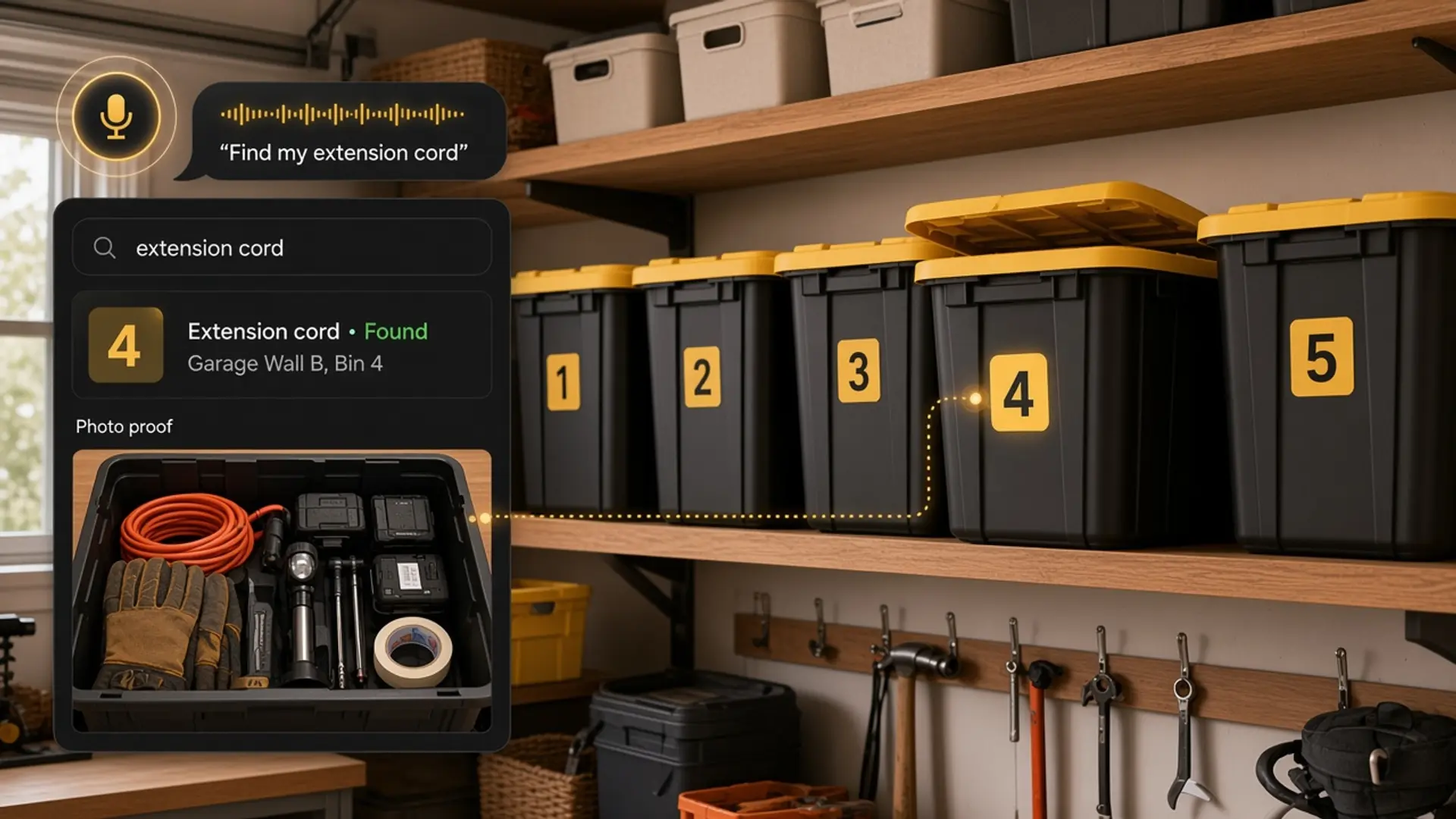
Place one unique yellow number at each cord's physical home. Photograph the cord in place. Review the proposed item list so it says what the cord actually is, based on details you verified. Save the exact location—Garage / North Wall / Hook 3—and add useful terms you would naturally search.
Later, search find my 50-foot outdoor extension cord. The result connects the physical number, saved location, reviewed item details, and matching photo. The photo provides a visual check before you take a cord off the wall.
The useful chain is:
Number → photo → reviewed item list → exact location → natural search → photo proof
Number the physical home
Give one hook or storage position a unique visible number.
Photograph the stored cord
Show the coil, number, and identifying details clearly.
Review the item record
Confirm length and intended use from reliable markings; never from color alone.
Save the exact location
Use a path such as Garage / North Wall / Hook 3.
Test a natural search
Ask for the cord by the job or verified detail you will remember.
Totely does not inspect electrical equipment, determine ratings from appearance, or decide whether a cord is safe for a particular load or environment. You still inspect the cord, read its markings and instructions, and use qualified guidance when needed.
Run the Hook 3 Retrieval Test
Before you call the system finished, test it with a real question.
- Stand outside the garage and search 50-foot outdoor extension cord.
- Confirm the result says Garage / North Wall / Hook 3.
- Check that the result photo shows the orange cord on the yellow number 3 position.
- Walk to the north wall and confirm the physical cord and record match.
- Read the cord's own markings before use; do not rely on the search description alone.
- After the job, inspect, coil, and return it to Hook 3—or update the status if it remains in use.
If the result points to Hook 3 but the hook is empty, the system has found a return-process problem. Fix the status or return habit instead of adding more labels.
Avoid These Extension-Cord Storage Mistakes
Making the coil as small as possible
Tight loops and sharp bends save a little wall space while placing more stress on the cord. Use broad loops and a support that fits the bundle.
Hanging several cords on one narrow nail
A crowded, sharp support makes cords harder to remove and easier to scrape or pinch. Use an appropriately installed smooth hook, reel, or shelf position and give each cord space.
Treating color as a rating
Color is useful for visual identification, not as proof of length, gauge, environment, or safe application. Copy verified facts from the cord and manufacturer information.
Keeping a damaged cord because it is organized
An attractive coil does not make damage disappear. Remove worn or damaged cords from use and follow appropriate replacement guidance.
Recording only “garage”
A room name is not an exact location. Add the wall, cabinet, shelf, hook, or bin position.
Trusting an unreviewed photo description
Image recognition can be wrong or incomplete. Review the item name and add verified details manually.
Using an extension cord as permanent wiring
This article is about storing portable cords between appropriate temporary uses. It is not a substitute for adding a properly located receptacle or following current electrical requirements. If equipment needs to remain in one place and the outlet is not suitable, consult a qualified electrician.
Extension Cord Storage FAQs
What is the best way to store extension cords?
Inspect the unplugged cord, make broad relaxed loops, secure the coil gently, and place it on its own smooth hook, suitable reel, shelf position, or portable organizer in an appropriately dry location. Label verified facts and give it one exact home.
Should extension cords be hung or stored on a reel?
Either can work. Individual hooks are simple and visible for a small collection. A manual reel can make a long frequently used cord easier to handle. Follow the product instructions, avoid tight winding or pinching, and inspect the cord before use.
How do I coil an extension cord so it does not tangle?
Use broad, consistent loops and allow the free end to rotate so twist can escape. An over-under coil is useful when you know the technique. Do not force a stiff or thick cord into small loops.
Can I identify an outdoor extension cord by its color?
No. Jacket color alone does not establish where or how a cord is rated for use. Read the cord's printed markings, packaging, and manufacturer instructions, and do not guess when information is missing.
What should I put on an extension-cord label?
Use a unique cord number, verified length, verified intended environment or use, a distinctive description, and the exact home location. Keep the label away from factory markings, plugs, receptacles, and strain-relief areas.
How can I find the right extension cord in a crowded garage?
Give each cord a unique number and dedicated physical home, then save a reviewed record with a clear photo, verified description, exact location, and status. Test the system by searching for one cord and confirming the result matches the physical hook and cord.