How to Store Comic Books Without Bends—or Losing an Issue
Learn how to store comic books with supportive enclosures, stable indoor storage, a practical box plan, and an exact location for every issue.
By Steve Watts · Co-Founder, Totely
October 29, 2026 · Updated October 29, 2026 · 15 min read
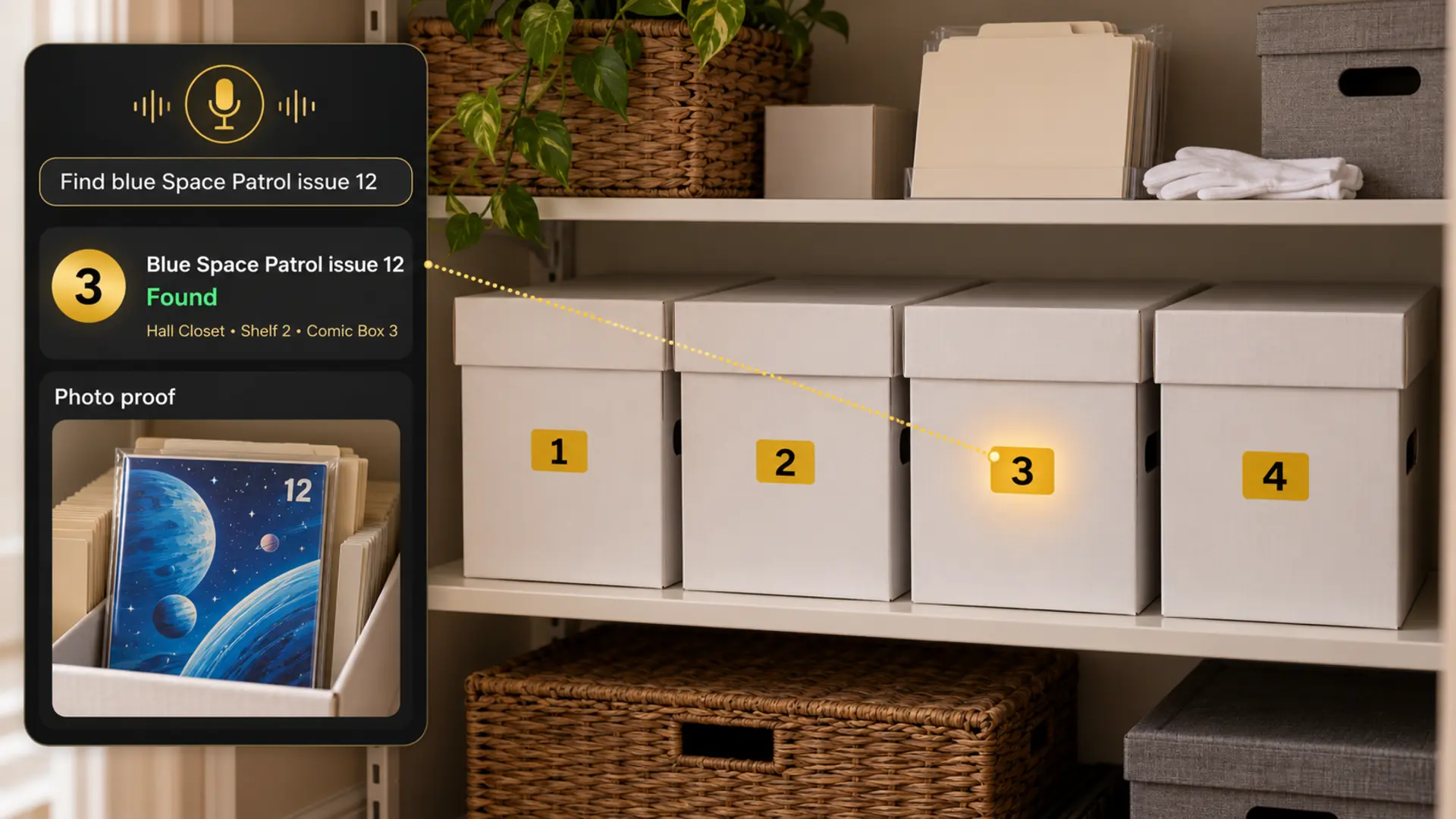
The comic you want is not missing. It is somewhere between three white boxes labeled “COMICS,” a stack of trades, and the short box you reorganized last year. You remember a blue space cover and the issue number, but not which run or box holds it.
The short answer is to protect each comic according to its condition, keep ordinary issues upright and supported in correctly sized enclosures, and store the boxes in a clean, stable indoor location away from direct light, heat, vents, leaks, and floor-level water risk. Do not overpack the box or let a partly filled row slump.
That physical system comes first. Once the comics are supported, give each closed box a simple number and exact shelf address. Add a reviewed issue list and overview photo so you can search for one cover, title, volume, or issue number without opening every box.
Quick Links
- Separate Ordinary Issues From Special Care
- Prepare a Clean Sorting Area
- Choose an Enclosure and Box
- Store Comics Upright and Supported
- Choose a Stable Indoor Location
- Pick a Sorting System You Can Maintain
- Build an Exact Comic Box Map
- How Totely Helps
- Use an Intake and Return Rule
- Comic Book Storage Mistakes to Avoid
- Comic Book Storage FAQs
Separate Ordinary Issues From Special Care
Do not start by buying matching boxes. Start by deciding which comics can join an ordinary household storage system and which ones need individual advice.
Make five groups:
- Current reading: issues or trades you are actively reading and will return soon.
- Ordinary collection: stable, dry issues that can be sorted and boxed together.
- Oversized or unusual formats: magazines, treasury editions, thick annuals, and books that do not fit the ordinary enclosure without pressure.
- Graded or encapsulated comics: rigid holders that need a box and support sized for the holder.
- Special care: brittle, torn, signed, unusually valuable, historically important, wet, mold-affected, or actively deteriorating material.
| Comic group | Practical starting point | What to verify first |
|---|---|---|
| Current reading | Supported shelf zone or clearly marked reading box | Clean surface, no leaning, and an easy return location |
| Ordinary single issues | Individually appropriate sleeve and support inside a fitted comic box | Correct fit, stable materials, no crowding, and no trapped moisture |
| Oversized formats | Separate enclosure and box sized to the item | Full support without bent corners or a lid pressing down |
| Graded holders | Purpose-fitted holder box, upright and supported | No loose movement, unstable stacking, or abrasion between cases |
| Special-care comics | Individual assessment before joining the main collection | Condition, material, value, water or mold exposure, and qualified advice |
An inventory can document a comic and its location. It cannot authenticate a signature, assign a grade, value a collection, replace an insurance schedule, or treat damaged paper. If an issue is valuable, brittle, wet, mold-affected, or irreplaceable, pause the household workflow and consult a qualified paper conservator or other appropriate specialist.
Prepare a Clean Sorting Area
The Library of Congress comic-care guide recommends clean hands and a clean work area, keeping food and drink away, and avoiding rubber bands, self-adhesive tape, glue, paper clips, dog-eared pages, and folding a comic back on itself.
Set up one clear table before opening a box:
- Wash and dry your hands, or follow the handling guidance appropriate to the item.
- Remove drinks, food, pens, tape, lotion, and household cleaners.
- Work with one comic at a time rather than building a tall loose stack.
- Keep a temporary divider for “needs a better fit” and another for “special care.”
- Write the proposed series and issue range on a removable working card, not on the comic or enclosure.
- Stop if you find moisture, active mold, insects, flaking paper, or a strong unexplained odor.
Do a rough sort before a detailed catalog. Group by series or title first, then put issues in a sequence you can verify. A perfect database does not help if the physical row remains loose, damp, or overfilled.
Choose an Enclosure and Box
The Library of Congress recommends supportive protective enclosures and cautions that storage materials need to be considered as a system. Its book-storage guidance also notes that the word “archival” by itself is not a meaningful material standard; look for specific information such as acid- and lignin-free paper-based housing and chemically stable plastics without additives.
For an ordinary comic, the enclosure has two jobs: reduce handling and dirt exposure, and support the flexible cover and pages. The surrounding box has to keep that enclosure upright without squeezing it.
Use this decision sequence:
- Identify the comic's size, format, and condition.
- Choose a sleeve or folder that fits without forcing corners or leaving the comic free to slide around.
- Add an appropriate supportive board or enclosure only when it suits the material and fit.
- Keep the comic and support smooth and aligned before closing the sleeve.
- Place like-sized enclosures in a fitted box with smooth dividers.
- Leave enough room to remove one comic without scraping or bending it.
Do not assume one bag, board, or buffered material is right for every ink, paper, signed item, or brittle issue. The Library of Congress notes that alkaline-buffered materials can help neutralize acids in paper but that some inks may be sensitive to alkaline pH. For valuable or unusual comics, ask a conservator or a reputable preservation supplier about the specific materials you own.
Short box or long box?
Both can organize a collection. The better box is the one that fully supports the enclosures, closes without pressing on them, sits squarely on the shelf, and remains safe for you to move.
Choose a shorter box when you want manageable shelf zones, frequent access, or simpler room-by-room moves. Choose a longer box only if the shelf, carrying route, and your lifting plan can handle it. Do not rely on a generic capacity number: enclosure thickness, dividers, graded holders, oversized issues, and safe handling all change what fits.
Inspect an empty box before use. Reject one that is damp, musty, dirty, crushed, splintered, or unable to sit flat. Follow the box and shelving maker's assembly, load, and stacking directions.
Store Comics Upright and Supported
For ordinary single issues in suitable enclosures, store the row upright with the covers vertical and fully supported. A partly filled box needs a smooth divider or approved filler so the comics do not lean. A full box still needs enough working room to remove and return an issue without force.
Check the row from the side:
- Covers and boards are vertical rather than fanned across a gap.
- Corners are not caught under a divider or neighboring enclosure.
- No comic is bowed by a box wall, lid, or tight sleeve.
- The divider stays square when one issue is removed.
- You can lift a single enclosure straight up without dragging it across the next one.
- Graded holders and oversized books have separate support suited to their dimensions.
The goal is supported, not compressed. Loose rows slump; crowded rows turn every retrieval into a tug. Adjust the divider as the collection grows instead of waiting for the box to become either half empty or jammed.
Do not use flat piles as a default fix for a box that does not fit. Large, unusual, or fragile formats may need horizontal storage designed for them, but that is a condition- and format-specific choice—not permission to stack an ordinary collection under heavy objects.
Choose a Stable Indoor Location
Paper preservation depends on the room as much as the box. The Library of Congress recommends a cool, relatively dry, clean, stable environment; minimal light; distance from radiators and vents; and avoidance of attics, basements, and other places at higher risk of leaks or environmental extremes.
The Henry Ford's conservators similarly emphasize limiting moisture, ultraviolet and visible light, and contact with unsuitable storage materials. Use those principles as a room-selection test rather than treating a box as a shield against every risk.
Look for an interior shelf or closet with these qualities:
- Stable: no routine hot/cold or damp/dry swings.
- Dark: no direct sun and no need to leave display lights on.
- Dry and clean: no condensation, musty wall, recurring leak, workshop dust, or smoke.
- Raised: boxes stay off the floor and away from likely water paths.
- Away from heat: no radiator, fireplace, vent, or hot appliance beside the collection.
- Structurally sound: shelving is level, anchored or installed as directed, and rated for the load.
- Reachable: a box can be removed without climbing, twisting, or pulling another box down first.
Do not turn a preservation guideline into a household guarantee. A single humidity reading does not prove that a room is safe year-round, and a plastic lid does not correct a damp basement or hot attic. Use monitoring to notice changes, and inspect the actual room and collection regularly.
Pick a Sorting System You Can Maintain
The best sorting system is not the most intricate one. It is the one another person—or future you—can use without reinterpreting every box.
Start with one primary order:
- Series title, then issue number: simple for most reading collections.
- Publisher, then series, then issue: helpful when publisher is how you browse.
- Character or story line: useful for a focused collection, but crossovers need clear decisions.
- Reading order: useful for events and collected runs, provided the order is documented.
- Special-care tier: a separate protected zone for items that should not be handled with ordinary readers.
Record enough identifying detail to avoid ambiguity. Comic numbering restarts, titles repeat, variants share issue numbers, and a remembered cover color is not a complete identifier. Depending on the collection, useful fields include series title, volume or start year, issue number, publisher, cover or variant description, format, and box location.
Use physical dividers for ranges that remain understandable when the app is closed: A–D, Series Name #1–25, or Independent / S–Z. Leave room for additions so one new issue does not force a full re-sort.
Build an Exact Comic Box Map
A label that says “COMICS” describes every box and locates none of them. A handwritten series range helps at the shelf, but it becomes wrong when a run moves and the label does not.
Build a small, verifiable map:
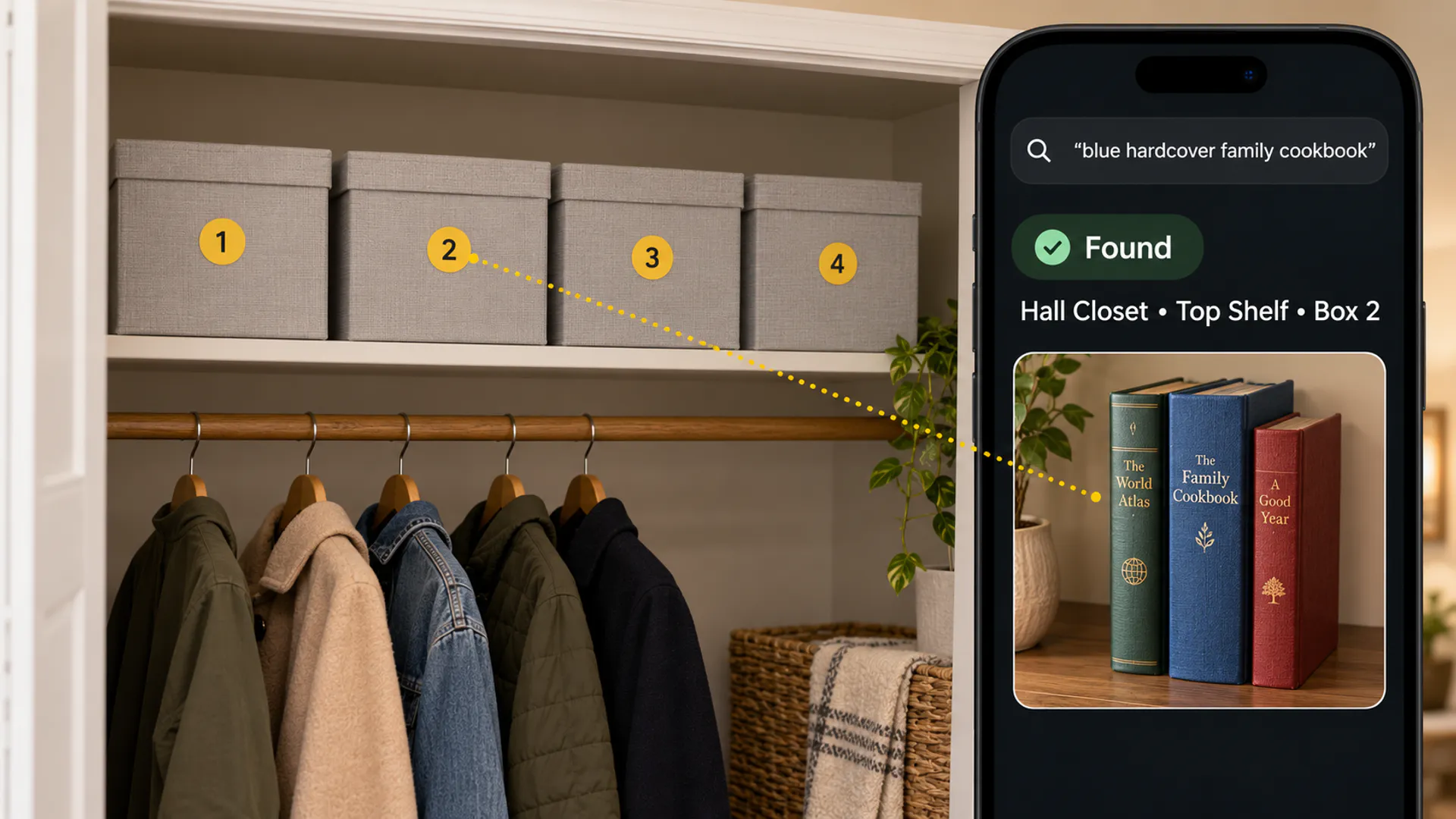
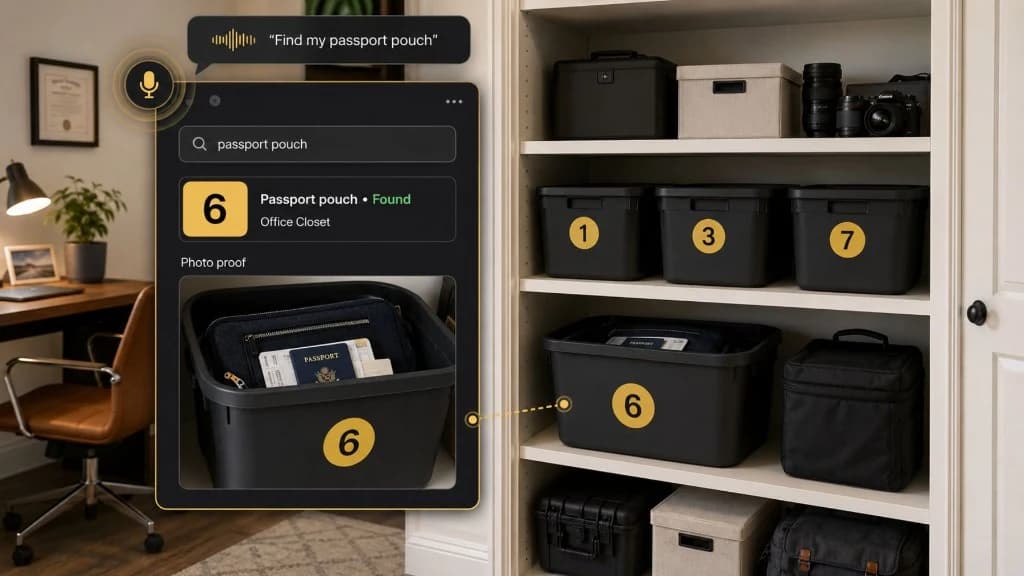
- Put one visible number on each closed box: 1, 2, 3, 4.
- Give the box an exact address, such as Hall Closet / Shelf 2 / Comic Box 3.
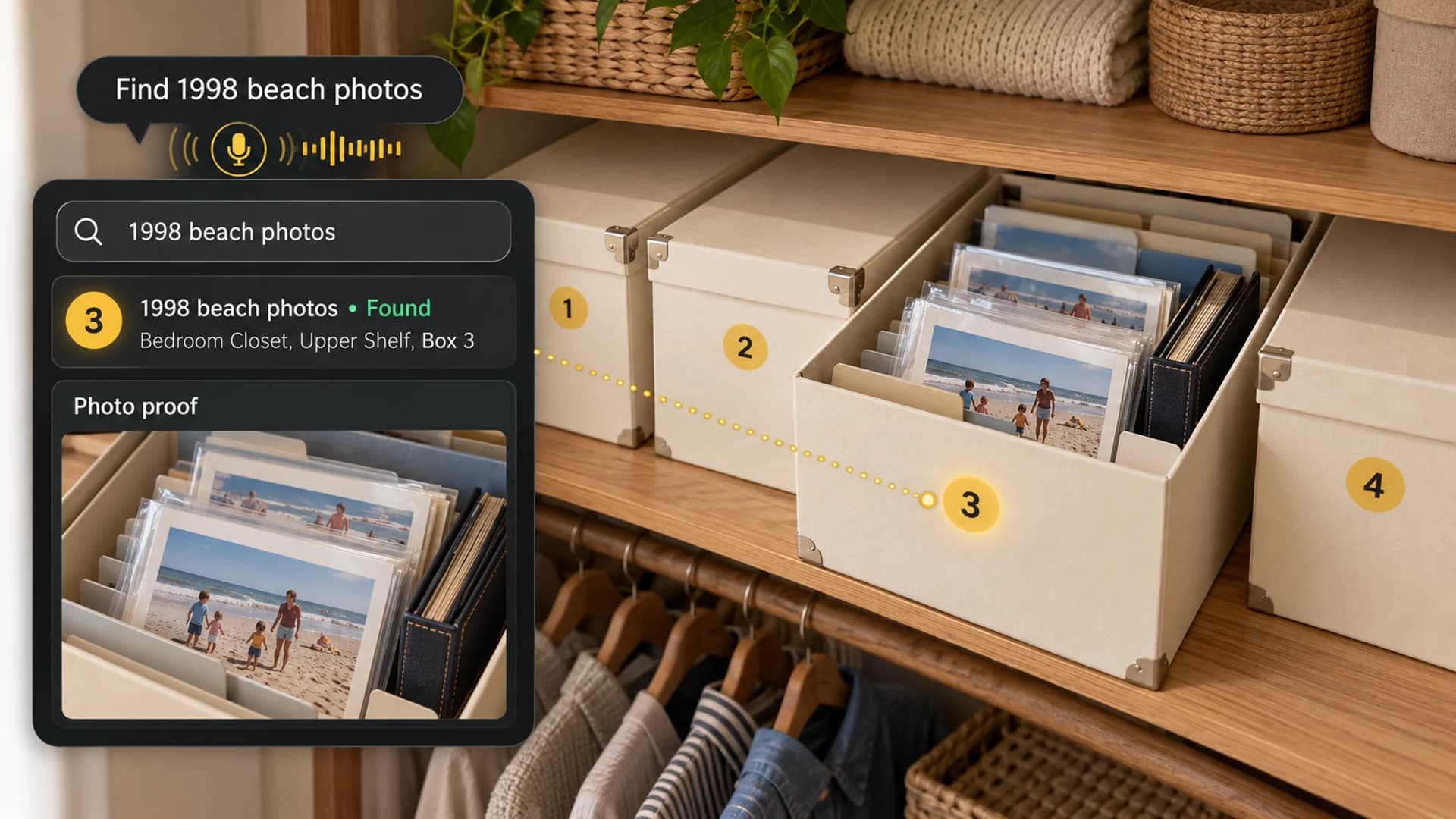
- Photograph the supported row before closing the lid.
- Record issue details you can verify from the comic or enclosure.
- Review the list against the physical row.
- Update the location when an issue, run, or entire box moves.
| What you remember | Reviewed item record | Saved location | Photo proof |
|---|---|---|---|
| blue space cover, issue 12 | Fictional example: Space Patrol, volume verified, issue 12, blue planet cover | Hall Closet / Shelf 2 / Comic Box 3 | Overview shows the blue issue between two cream divider tabs |
| signed issue from a convention | Title, volume, issue, signer note, and verification status recorded without guessing | Special-Care Shelf / Box 1 | Enclosure photo only; signature authentication is outside the storage record |
| first trade in a series | Exact title and volume number checked from the spine | Bookcase / Lower Cube / Zone 2 | Shelf photo shows the trade beside volumes 2 and 3 |
The first row is deliberately generic. Do not rely on cover recognition alone for a real comic. Verify the title, volume, issue, and variant details you need, then use the visual description as an extra search clue.
How Totely Helps
Totely adds search after the comics are physically protected, supported, sorted, and assigned a safe shelf.
For one ordinary box:
- Put a simple number on the outside.
- Photograph the supported row before closing the lid.
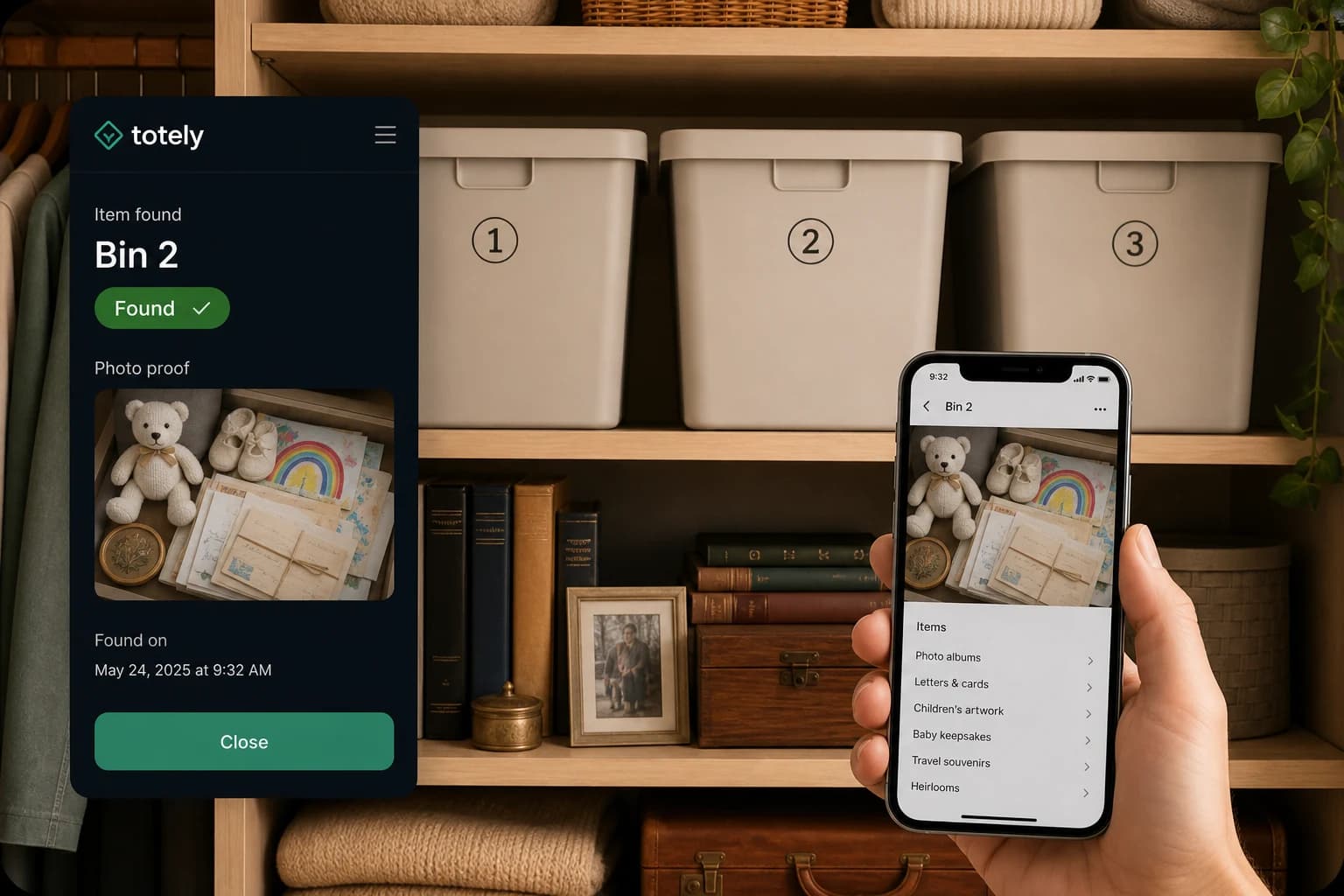
- Let Totely create a first item list from what the photo shows.
- Review and edit the list so series, volume, issue, and cover clues are accurate.
- Save the exact room, shelf, and box number.
- Search later in natural language, such as “blue Space Patrol issue 12.”
- Check the saved number, location, and photo proof before opening the box.
The review step matters. An overview photo may hide issue numbers, volumes, variants, signatures, inserts, damage, or comics behind a divider. Totely helps you locate the item record you saved; it does not grade, authenticate, value, preserve, insure, or certify the collection.
Start with one low-risk box of ordinary reading copies, not the most valuable part of the collection. The One-Tote Test works with a comic box too: one number, one photo, one exact location, and one real search.
Use an Intake and Return Rule
Collection maps fail when new issues join a pile beside the box or a reader never returns to its recorded slot. Use one small rule for every movement.
When a comic arrives
- Verify the title, volume, issue, and format.
- Check its condition before placing it with the collection.
- Choose an enclosure and support appropriate to the item.
- Add it to the correct physical sequence without crowding the row.
- Update the box photo or record if the change affects what you will search.
When a comic leaves the box
Leave a clean placeholder or note that does not contact the comic with adhesive. If the issue is loaned, graded, sold, moved to special care, or placed in the reading zone, update the saved location immediately.
When a comic returns
Return it to the verified series and issue position, check that the row remains upright, and remove the placeholder. If the old position no longer fits, move a logical range and update every affected location rather than wedging one more issue into a crowded box.
For a broader record of household collections, the home inventory app versus spreadsheet guide explains the tradeoff between flexible rows and photo-first search. If comics are only one part of a larger library, the book storage guide covers shelves, ordinary books, and moving boxes without replacing comic-specific care.
Comic Book Storage Mistakes to Avoid
- Sorting before checking condition: one damp or mold-affected item should not enter a clean box unnoticed.
- Treating “archival” as a complete specification: verify the actual material, fit, and suitability for the comic.
- Letting a short row lean: unsupported covers and pages take uneven pressure.
- Overpacking the box: forcing one issue out can bend corners or scrape neighboring enclosures.
- Mixing formats without support: oversized books, trades, and rigid slabs need space suited to their dimensions.
- Stacking heavy objects on comic boxes: lids and shelves can deform under loads they were not designed to carry.
- Storing on the floor: a minor leak can reach a collection before the room looks flooded.
- Trusting a lid to fix the room: closed plastic or cardboard does not correct heat, humidity swings, or a damp wall.
- Using tape, rubber bands, or clips on the comic: adhesives and pressure points can create permanent damage.
- Labeling every box only “COMICS”: the label does not locate a series or issue.
- Copying an app-generated list without review: an image may not reveal a volume, variant, signature, or hidden issue.
- Skipping the move update: the search result becomes wrong as soon as the comic or box changes location.
Comic Book Storage FAQs
What is the best way to store comic books?
For ordinary single issues, use correctly fitted supportive enclosures, keep the comics upright in a fitted box, and support the row so it does not lean or become compressed. Store the box in a clean, stable indoor location away from direct light, heat, vents, leaks, and the floor. Separate valuable, brittle, wet, mold-affected, signed, or unusual items for condition-specific advice.
Should comic books be stored flat or upright?
Ordinary bagged and supported single issues are commonly stored upright in a correctly sized comic box with a smooth divider keeping a partial row vertical. Do not let them slump or squeeze them tightly. Large, fragile, or unusual formats may need a different orientation and enclosure chosen for that specific item.
Do comic books need bags and boards?
Many ordinary collections use a correctly sized sleeve and supportive board to reduce handling and flexing, but one material or fit is not automatically right for every comic. Verify the sleeve, board, paper, ink, size, and condition. Seek preservation advice for valuable, brittle, signed, or unusual issues instead of relying only on retail “archival” wording.
Can comic books be stored in plastic bins?
A plastic bin may reduce incidental dust or water contact, but it is not automatically a safe comic enclosure. The comics still need correct individual support, an upright row, a fitted interior, and a stable room. A sealed bin can also trap moisture if the contents or environment are damp. Do not use the bin to justify a hot attic, wet basement, or floor-level location.
Where should comic book boxes be stored?
Choose a clean interior shelf or closet with stable conditions, minimal light, no nearby radiator or vent, and low leak risk. Keep boxes raised off the floor on level shelving installed and loaded according to the maker's guidance. Avoid unregulated attics, hot garages, damp basements, direct sunlight, and shelves beneath known plumbing problems.
How can I organize comic books so I can find one issue later?
Sort by a consistent primary order such as series title and issue number, use physical dividers, number each closed box, and save the exact room and shelf. Record the title, volume or start year, issue number, and cover or variant clue you can verify. Add an overview photo, review the list, and update the location whenever an issue or run moves.