How to Store Books Without Damaging—or Losing—the One You Want
Learn how to store books on shelves or in boxes, protect bindings and pages, and keep one specific title easy to find later.
By Steve Watts · Co-Founder, Totely
October 27, 2026 · Updated October 27, 2026 · 12 min read
The blue hardcover family cookbook is not on the kitchen shelf. It may be with the holiday books, inside a closet box, or tucked behind the novels that moved out of the living room. The book is stored, but until you know exactly where, it is not truly findable.
Learning how to store books starts with the physical collection. Paper, covers, and bindings need a clean, dry, stable place; ordinary books need enough support to avoid leaning or being crushed; large and fragile volumes may need a different position or enclosure. Only after those needs are solved does a label or app become useful.
The practical answer is to sort books by access, condition, and size. Keep frequently used titles supported on a shelf, place sound overflow books in small manageable boxes, and separate valuable, damaged, or mold-affected books for appropriate advice. Then give each closed box a number and exact location so you can retrieve one title without unpacking the rest.
Quick Links
Choose Storage by Access and Condition
Do not begin by buying matching bins. Begin by deciding which books need to remain visible, which can move into closed storage, and which should not be treated like ordinary household overflow.
Make four groups:
- Reading now: current reads, cookbooks in regular use, school books, and references you reach for often.
- Visible or occasional: books worth keeping accessible, but not necessarily within arm's reach every day.
- Boxed overflow: sound, ordinary books that can be stored for months without frequent access.
- Special care: rare, signed, fragile, damaged, wet, musty, mold-affected, or unusually valuable books.
The fourth group needs its own decision. General household advice is not a conservation assessment. The Institute of Conservation notes that book materials, construction, prior storage, and use all affect risk, and recommends qualified conservation help when treatment is needed.
| Book or situation | Practical first choice | Main check before storing |
|---|---|---|
| Current reads and frequently used references | Supported shelf, cart, or cabinet near the place of use | Easy removal without crowding or pulling on the top of the spine |
| Sound, ordinary hardcovers and paperbacks | Shelf or small sturdy closed box in a stable indoor location | Dryness, clean covers, similar sizes, and enough support |
| Oversized art books and atlases | Flat shelf space or a low, limited stack | Full support without a heavy pile pressing on the bottom volume |
| Children's books in active rotation | Low, stable shelf or basket that an adult has checked for safe placement | Reachability, tipped furniture, floor clutter, and damaged pages |
| Boxed overflow | Small manageable box with gaps filled and an exact shelf address | Avoid damp, heat, leaks, crushing, and floor-level water risk |
| Rare, signed, fragile, or damaged books | Individual assessment and suitable enclosure; professional advice when appropriate | Do not assume a generic bin or “archival” label is enough |
This split also prevents a common organizing mistake: hiding every book to make a room look clear, then opening six boxes to find the one volume you still use.
Prepare Books Before Storage
Work on a clean, dry surface. Remove bookmarks, loose receipts, rubber bands, sticky notes, and objects that could stain or distort pages. Dust only with a method appropriate to the book's condition; if a volume is fragile or has flaking material, stop and seek qualified advice instead of experimenting.
Edit before you pack
For each book, choose one action:
- Keep in active use
- Keep in visible or nearby storage
- Box as overflow
- Donate or sell if it is in acceptable condition
- Recycle where local rules allow
- Set aside for repair, valuation, or conservation advice
Boxing books you no longer want creates a future sorting project. An edited collection needs fewer boxes, produces less weight, and makes the retrieval map easier to trust.
Inspect for moisture, pests, and damage
Do not place a damp or mold-affected book into a box with clean books. The University of Illinois Preservation Services advises keeping books in a dry location and treats visible mold and insect activity as problems requiring careful handling. If you see active mold, extensive pest damage, wet pages, or a failing binding, isolate the item from the ordinary packing workflow and get appropriate guidance.
Record special books before they disappear
For a signed, sentimental, or potentially valuable book, take clear photos of the cover, title page, signature or inscription, and visible condition. Keep purchase records or appraisals separate from the physical book. A household inventory can document what you own and where it is; it does not establish value, authenticity, or insurability.
Store Books on a Shelf
For books you use, a shelf is usually easier than a box because you can see the spines and remove one title without disturbing the collection.
The Canadian Conservation Institute recommends storing books vertically with support, grouping similar sizes when feasible, avoiding tight packing, and storing large volumes flat with minimal stacking. The University of Chicago Library similarly recommends upright storage, bookends, a clean area, and protection from direct light.
Use these shelf rules:
- Keep ordinary books upright, with the spine perpendicular to the shelf.
- Use a bookend so the row stays vertical instead of slumping.
- Leave enough room to remove a book without dragging its cover or pulling on the headcap.
- Group similarly sized books so small volumes are not unsupported beside tall ones.
- Store oversized or very heavy volumes flat with full support and only a small stack above them.
- Keep books away from direct sunlight, radiators, plumbing, leaks, and obvious temperature or moisture swings.
- Keep shelves clean and inspect the collection periodically.
The Library of Congress preservation guide emphasizes a cool, relatively dry, clean, stable environment with limited light. It also warns against using poorly insulated attics, basements, and garages for valued materials. A lidded bin can reduce dust or provide secondary water protection, but it cannot make a hot, damp, or flood-prone room safe.
Store Books in Boxes
Boxes work best for sound overflow books that do not need weekly access. The goal is a container you can lift safely, a position that supports the books, and a location that does not expose them to avoidable hazards.
Use a small, sturdy box
Books become heavy quickly. Choose a container you can comfortably lift when full and that will not bow, split, or crush the books below it. Avoid reused food boxes, visibly damp cardboard, broken plastic, sharp edges, and containers that smell strongly.
Do a dry test before loading the whole collection. Put several representative books in the box, close the lid, lift it using safe technique, and confirm the shelf supports the load. If it feels awkward, use more smaller boxes.
Pack by size and support
Keep similarly sized books together. Ordinary hardcovers can stand upright as they would on a shelf when the box supports them; large volumes are generally better flat. Do not store a book resting on its fore edge with the spine up, and do not create a tall, heavy stack that presses on the bottom book.
Fill unused side space with clean, suitable packing material so books do not slide, but do not compress covers or force the lid down. Treat photo albums, scrapbooks, comics, and books with inserts according to their own materials and construction rather than assuming ordinary-book rules apply.
Choose the box location before sealing it
Use an interior living-space closet or another clean, stable area when possible. Keep boxes off the floor and away from plumbing, exterior walls, direct sun, heaters, and places with known leaks or pest activity. Do not rely on a plastic tote to cancel the risks of a damp basement, hot attic, or fluctuating garage.
For irreplaceable, rare, or fragile books, consult a conservator about a suitable enclosure and storage environment. “Acid-free” and “archival” are useful specifications only when the material and construction are appropriate for the item; they are not blanket guarantees.
Store Books Without a Bookshelf
A small home does not require one giant bookcase. It needs a clear distinction between books you browse and books you protect in overflow storage.
| Space problem | Practical option | Best for | Watch for |
|---|---|---|---|
| No floor space for a bookcase | Properly installed wall shelf or ledge | A small visible group | Hardware and wall must support the expected load; follow the maker's instructions |
| Rental or temporary room | Stable rolling cart | Current reads and light reference books | Wheel stability, overloading, and blocked walkways |
| Visual clutter | Cabinet or storage ottoman | A small group of frequently used books | Crowding, damp upholstery, and poor air movement |
| Shallow closet space | Small numbered boxes on a strong shelf | Sound overflow books | Weight, moisture, and losing title-level detail |
| Under-bed space | Shallow rigid container in a dry room | Low-access ordinary books | Dust, floor moisture, crushing, and difficult lifting |
| Growing collection | One visible zone plus boxed overflow | Separating browsing from preservation | Update the map whenever a book moves |
The Pottery Barn no-bookcase guide illustrates ledges, ottomans, and console storage; those ideas solve space, not preservation by themselves. Apply the same light, support, cleanliness, and moisture checks you would use on a regular shelf.
Make One Boxed Book Findable
A label such as “BOOKS” describes every book box and locates none of them. A handwritten genre label is better, but it still fails when a cookbook lands with family history or a child returns a title to the wrong box.
Use a simple box map:
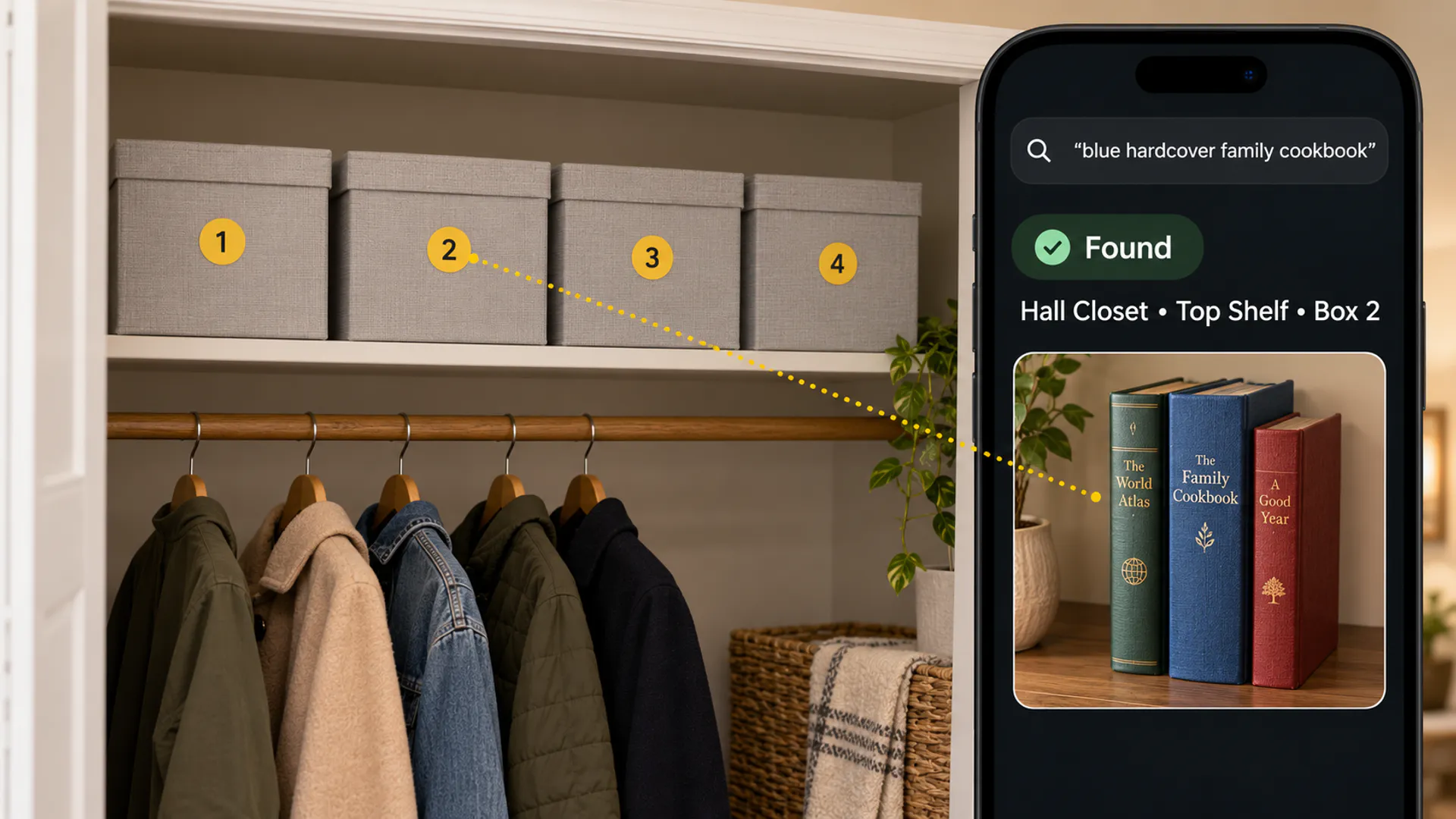
- Put one visible number on the outside of each closed box: 1, 2, 3, 4.
- Give the storage spot an exact address, such as Hall Closet / Top Shelf / Box 2.
- Take one overview photo before closing the box.
- Create a title-level list. Include identifying details only when useful: title, author, edition, color, signature, or family name.
- Review the list against the physical books before sealing the box.
- Update the record immediately when a book or box moves.
Example:
| Search | Result | Saved location | Photo proof |
|---|---|---|---|
| blue hardcover family cookbook | Family Cookbook, blue hardcover, handwritten notes inside | Hall Closet / Top Shelf / Box 2 | Overview shows the blue cookbook between a green atlas and red novel |
That is specific enough to retrieve one title without breaking the careful packing in every other box.
How Totely Helps
Totely adds a searchable memory to the physical storage system after the books are safely placed.
The workflow is intentionally small:
- Put a simple number on the book box.
- Photograph the overview.
- Let Totely suggest an item list from the photo.
- Review and edit that list so it reflects what is actually inside.
- Save the exact location.
- Search naturally later, such as “blue family cookbook.”
- Check the saved photo proof before opening the box.
The reviewed list matters. A photo may not show every title clearly, and AI cannot verify an edition, signature, condition, or hidden book without your input. Totely helps you find the box; it does not assess preservation needs or replace a conservator, appraiser, insurer, or the book's actual condition record.
If you want to test the system without cataloging an entire library, use the One-Tote Test on one overflow box first.
Book Storage Mistakes to Avoid
- Packing before editing: unwanted books consume the same space and lifting effort as keepers.
- Using one large box: books get heavy, the container becomes awkward, and the bottom is easier to overload.
- Storing books spine-up or on the fore edge: the text block and binding lose proper support.
- Letting shelf rows lean: unsupported books can distort over time.
- Sealing in moisture: a lid does not make a damp book dry.
- Trusting the room because the box is plastic: environmental extremes and leak risk still matter.
- Mixing active mold or pests into clean storage: isolate the affected item and seek appropriate guidance.
- Writing only “books” on the label: the label cannot answer where one specific title lives.
- Forgetting the move: a perfect inventory becomes wrong as soon as Box 2 changes shelves and the record does not.
Book Storage FAQs
What is the best way to store books?
Store frequently used books upright and supported on a clean shelf in a stable indoor location. Place sound overflow books in small sturdy boxes, grouped by size and supported so they do not shift. Store oversized volumes flat with limited stacking, and separate rare, fragile, wet, or mold-affected books for appropriate advice.
Should books be stored upright or flat?
Most ordinary books can stand upright like they do on a shelf, supported so they do not lean. Large, heavy, or oversized volumes are generally better stored flat with full support and a low stack. Avoid resting books on the fore edge with the spine up.
Can I store books in plastic bins?
A sound plastic bin can help with dust and minor water exposure, but every book and the container must be clean and dry before packing. The bin does not protect against a hot attic, damp basement, fluctuating garage, flood risk, or unsuitable pressure on the books.
How do I store books long term?
Edit and inspect the collection, choose a clean stable indoor location, group similar sizes, support each book correctly, use manageable boxes or suitable enclosures, keep containers off risky floors, and inspect periodically. Valuable or fragile books may need item-specific conservation guidance.
How do I store books without a bookshelf?
Keep a small active group on a stable cart, properly installed ledge, cabinet, or low basket, then place sound low-access overflow books in numbered boxes on a strong dry shelf. Match the option to access frequency rather than hiding the whole collection in one place.
How can I find one book after it goes into storage?
Number the closed box, save its exact room-and-shelf location, take an overview photo, and keep a reviewed title-level list. Search by a detail you remember—such as “blue hardcover family cookbook”—then confirm the location and photo proof before opening the box.