How to Store Luggage at Home and Find Your Travel Gear
Learn how to store luggage at home with careful cleaning, nesting-fit checks and an accessible travel kit. Keep bags and their contents easy to find.
By Steve Watts · Co-Founder, Totely
October 16, 2026 · Updated October 16, 2026 · 12 min read
The suitcase is easy to spot. The blue packing cubes are not. They might be inside the carry-on, inside the larger case, or in the box where someone put everything after the last trip.
Deciding how to store luggage at home means making two things work: the bulky bag needs a suitable place, and the belongings stored with it need a way back into use. Nesting can reduce the space occupied by several cases. It can also bury the bag or pouch you reach for most often.
The starting point is clean, completely dry luggage in a suitable location. Check the actual fit before nesting bags, keep frequent-use gear accessible, and record the contents you cannot see from outside. You can do this with the cases and containers you already own.
Quick Links
- Choose How to Store Luggage at Home
- Prepare the Bag Before Putting It Away
- Check Nesting Fit Without Forcing It
- Give Travel Accessories an Accessible Home
- Decide What Happens to Anything Stored Inside
- Make a Useful Luggage and Travel-Gear Record
- How Totely Helps
- The One-Case Starter Method
- Luggage Storage FAQs
Choose How to Store Luggage at Home
Start with the case you actually use most. If the carry-on leaves home regularly and the large suitcase rarely does, do not automatically make the carry-on the innermost part of a deep nest. A little more visible storage may be worth easier access.
Look for a dry, relatively stable interior location away from bedrooms. Check that you can retrieve the luggage without moving an unstable stack, blocking a doorway or lifting more than you can manage comfortably.
| Possible home | When it may work | What to check |
|---|---|---|
| Hall closet with a low, supported storage space | A regularly used case needs straightforward access | Whole bag fits; coats and doors do not catch on it; it can come out normally |
| Interior under-stairs closet | Occasional luggage needs a defined out-of-the-way home | Space stays dry; sloping ceiling and narrow opening leave room to retrieve the case |
| Utility or storage-room shelving | Several bags can have separate supported positions | Shelf dimensions, load guidance and safe lifting suit the actual bags |
| Suitable low cabinet or storage bench compartment | You want luggage hidden without nesting every bag | Clear interior and opening fit the case, including wheels and handles |
| A separate accessible spot plus a nested occasional set | Household members travel at different frequencies | The everyday bag stays available and the occasional set has a clear record |
Why under-bed storage is not the default here
Under-bed suitcase storage appears in many idea guides. However, the U.S. EPA's travel guidance recommends keeping stored luggage away from bedrooms and not under beds as part of bed-bug prevention. It also advises careful luggage inspection when returning home.
That does not make every garage or basement a suitable alternative. Samsonite's care guidance cautions about temperature and humidity extremes. Choose a location that addresses both concerns, such as a suitable dry hall closet, rather than treating either “hidden” or “out of the bedroom” as the whole decision.
For room-wide tradeoffs and renter restrictions, see the apartment storage guide. You do not need to install new shelving to improve one bag's home.
Prepare the Bag Before Putting It Away
Unpack the suitcase fully, including exterior pockets, lining pockets and any smaller bags inside. Return everyday belongings to their normal homes. Remove food, rubbish, damp clothing and anything that does not belong in long-term luggage storage.
Inspect the lining, seams, wheels, handles and closures. Record a loose wheel or damaged zip as something needing attention; a note that says “ready” is not useful if nobody checked the bag. If you suspect pest exposure, follow the EPA's guidance and seek appropriate pest advice before placing the case among clean household belongings. A storage photograph cannot certify it pest-free.
Use the luggage maker's cleaning instructions for that material and model. Do not apply a general spray, soak a structured bag or wash a lining merely because it looks removable. Care for separate packing cubes and pouches according to their own instructions too.
Travelpro's storage guide recommends letting luggage dry completely before storing it. Allow the interior, pockets and any cleaned accessories to finish drying before rebuilding a nest or putting the kit away. Fragrance is not a substitute for addressing moisture or a persistent problem.
Follow the maker on orientation and closure
Advice about standing a bag on its wheels, laying it flat or leaving a zip slightly open is not identical across manufacturers and materials. Follow the guidance for your luggage, with suitable support and no pressure from heavy objects above it.
Do not turn an empty suitcase into a shelf for a heavy tote. Travelpro specifically warns against loading weight onto empty luggage. A bag designed to travel is not automatically a storage bench, plant stand or permanent load-bearing platform.
Check Nesting Fit Without Forcing It
Nesting means placing a smaller bag inside a larger one. It is useful only when the real shapes fit and you are comfortable with the retrieval work.
Samsonite notes that some of its collections are designed to nest. That is different from a promise that any carry-on will fit inside any checked bag, even if their advertised size names sound compatible.
Try the empty bags first. Retract handles, close unnecessary expansion sections where appropriate, and check the manufacturer's nesting instructions. Protect the lining from contact with dirty wheels before putting one bag into another.
| Check | Try it with your actual bags | Stop and change the arrangement if |
|---|---|---|
| Opening and interior fit | Compare the inner case's full shape with the outer opening and clear interior | Wheels, handles or shell press against the lining or closures |
| Normal closure | Close the outer case without leaning or pulling hard | You need pressure to make the zip or latches meet |
| Retrieval | Remove the bag you expect to use next | The arrangement is awkward to handle or requires clearing an impractical area |
| Filled weight and support | Move and return the stored group comfortably | The nest becomes too heavy or its shelf position is unsuitable |
You do not need a tight sequence of every bag you own. Two compatible occasional cases can nest while a weekend bag stays separate. A soft duffel should only be folded as its construction and care instructions allow; forcing a structured base flat is not the same as using a purpose-made packable bag.
Before choosing a shelf or cupboard, measure the outside of the stored group, including wheels, fixed handles and any cover. Check the doorway and retrieval space as well as its parking space. A case that fits at the back of a cupboard may still be difficult to turn and remove.
Give Travel Accessories an Accessible Home
You may use the same packing cubes with several different bags. If so, storing them inside the least-used suitcase makes an ordinary packing job depend on opening that case first.
Try a small travel bin or drawer near the luggage. Keep clean, dry packing cubes, spare luggage straps, blank tags, empty toiletry pouches and packable bags together where practical. Leave enough room to take out one item without emptying the group.
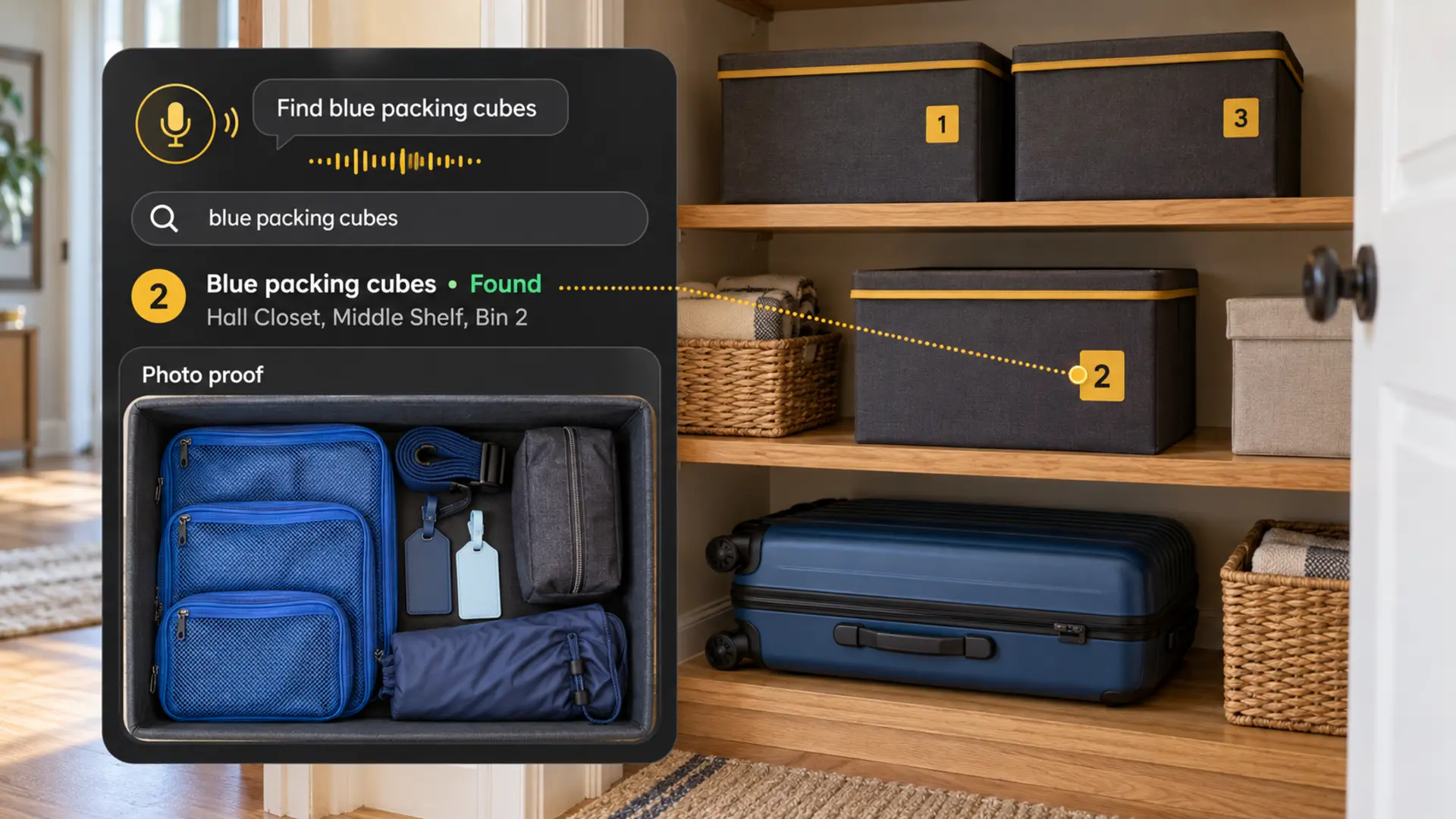
In the example used here, the blue packing cubes live in Bin 2 on the hall closet's middle shelf. The blue carry-on has its own supported place below. Someone taking an overnight bag can get the cubes without opening a suitcase they are not taking.
If you have no separate shelf space, an accessible pouch inside a frequently used bag may suit you better. Record which bag and which pocket holds it. The point is not to create another container; it is to avoid hiding shared gear somewhere inconvenient.
Keep passports, personal documents, medication, valuables and items with special storage needs out of this ordinary supply-bin example. Do not photograph readable identity details just to make a travel inventory more complete.
Decide What Happens to Anything Stored Inside
Some households use occasional suitcases for suitable clean, dry belongings between trips. Before doing that, ask where those belongings will go when the suitcase needs to leave.
If your answer is “on the bed until we return,” the arrangement needs another decision. Choose an appropriate temporary home before packing day, and make sure it does not create an awkward pile or block access to something else.
Keep any contents supported without overstuffing the bag. Luggage is not automatically appropriate for fragile, valuable or moisture-sensitive long-term storage. A fitted case and a clear record do not replace suitable care for the objects inside.
If the spare storage role creates more work than it saves, leave that suitcase empty apart from its own appropriate accessories. Empty space can be useful when the next trip comes around.
Make a Useful Luggage and Travel-Gear Record
A useful record distinguishes the bag's home from anything hidden inside it. Describe the actual case by a recognizable detail, and give accessory containers simple visible numbers.
Here is an illustrative arrangement, not a shopping list or a requirement to make three bins:
| Stored group | Exact home | Detail worth recording |
|---|---|---|
| Blue carry-on | Hall Closet, Lower Shelf | Stored separately; no inner bag to remove before packing |
| Occasional large suitcase | Under-Stairs Closet, Rear Low Shelf | Smaller soft bag inside; remove it before using the outer case |
| Travel accessories, Bin 2 | Hall Closet, Middle Shelf, Bin 2 | Blue packing cubes, luggage strap, blank tags, empty toiletry pouch and packable bag |
Use a removable tag or a number on the surrounding storage area where appropriate. Avoid adhesive that could damage the luggage finish. A bin number belongs on the bin, not on the packing cubes.
Photograph visible contents while the bag or bin is already open. Add a written note for anything hidden in an inner pocket or another bag. A closed suitcase photograph can identify the exterior; it does not reveal the contents.
When a bag leaves for a trip, update the note if its saved storage description would otherwise mislead someone. When it returns, record what actually goes back. A simple note is enough; you do not need a special automatic trip-status feature.
The storage-bin tracking guide covers keeping these records current. If you are about to replace a missing pouch or strap, the duplicate-purchase guide explains how a useful search can help you check what you already own first.
How Totely Helps
Totely adds the digital memory layer after you have chosen suitable physical storage.
Number the travel bin, take a clear photo of its visible contents, and let Totely suggest an initial item list. Review and correct it. Add details the photo cannot show, then save the exact location: “Hall Closet, Middle Shelf, Bin 2.”
Later, search naturally by voice or typing for “blue packing cubes.” The saved location and photo proof can point you to the accessory bin without opening the suitcases first.
For nested bags, describe the arrangement in your notes; do not assume a photo sees through cases or automatically understands every hidden layer. You still update the record when gear moves. Totely does not inspect luggage for pests, assess repairs or verify packing readiness. No QR codes, barcodes or manual entry of every small accessory are needed to start.
The One-Case Starter Method
Choose the bag you expect to use next, then improve its storage before reorganizing the entire collection.
- Empty and inspect it after the trip; address any care or pest concerns appropriately.
- Follow its cleaning instructions and let it dry completely.
- Choose a suitable, accessible non-bedroom storage location.
- Trial the actual fit, including any proposed nested bag.
- Decide whether shared travel accessories belong elsewhere.
- Photograph the visible contents and note anything hidden or needing attention.
- Save the exact home and try retrieving one item from the record.
- After the next trip, return the gear and update what changed.
If you are starting with the accessory bin, use the One-Tote Test. One useful record is a manageable beginning.
Luggage Storage FAQs
Where is a good place to store luggage at home?
A suitable dry interior hall closet, under-stairs closet or storage-room shelf may work. Check the whole case, support, retrieval space and your maker's care guidance. Keep pest-prevention advice in mind as well as the room's temperature and humidity.
Can I store luggage under the bed?
It is not the default recommended here. The EPA's travel guidance advises storing luggage away from bedrooms and not under beds for bed-bug prevention. Look for suitable non-bedroom storage without assuming a damp garage or basement is a good alternative.
Is it okay to store smaller suitcases inside larger ones?
Yes, when the actual bags are compatible and the maker's instructions allow it. Check wheels, handles, lining clearance and normal closure. Do not force a fit, and keep frequently used bags separate if the nest is awkward to unpack.
Should I store my suitcase open or closed?
Follow the luggage maker's guidance for your model and material; recommendations differ. Empty and dry the bag fully before storage, avoid compression, and do not assume leaving it open can make an unsuitable damp location acceptable.
Can I keep other belongings in unused luggage?
Suitable clean, dry items may fit, but consider their care needs, the bag's support and where the contents will go when you travel. Avoid turning frequently used luggage into inconvenient household overflow. A record helps you remember contents, not certify storage conditions.
How do I stop losing packing cubes and travel pouches?
Choose one accessible bin, drawer or named bag pocket and return them there after care and drying. Save a clear photo, a few recognizable descriptions and the exact location. Update the record when you move the supplies.
Put the Bag Away With the Next Trip in Mind
Start with the suitcase you use, not the most compact-looking arrangement. Give it a suitable home, make sure any nesting works in practice, and keep the blue packing cubes somewhere you can find without dismantling the closet.
The storage is doing its job when putting a bag away does not make the next packing session harder. Stored, not lost.