How to Store Jewelry Without Tangles—or Losing the Right Piece
Learn how to store jewelry by piece type, prevent tangles and scratches, choose a stable location, and find the right necklace, ring or earring later.
By Steve Watts · Co-Founder, Totely
November 16, 2026 · Updated November 16, 2026 · 13 min read
The blue pendant necklace is not lost. You remember putting it somewhere sensible after the last time you wore it. But the dresser has two pouches, a travel roll, a small box and a drawer tray—and opening all of them turns a quick choice into a hunt.
Learning how to store jewelry starts with the physical pieces, not an organizer shopping list. Give each necklace, ring, earring pair and delicate item a resting place that suits its materials and construction. Separate pieces that can scratch, snag or tangle. Then give every tray, box or compartment a stable address so you can find the right piece without disturbing the entire collection.
This guide covers ordinary at-home organization. The maker, jeweler or conservator who knows the actual piece should control care for treated gems, antique or damaged jewelry, pearls, opals and other material-sensitive pieces. Storage is not repair, appraisal, insurance documentation or security advice.
Quick Links
Decide What You Wear and What You Protect
A jewelry collection usually contains several different storage jobs. Treating them as one pile is what creates the tangle.
Start with four working groups:
- Everyday pieces: the small set you reach for most weeks.
- Occasion pieces: jewelry you use less often but still want accessible.
- Material-sensitive or fragile pieces: items that need their own maker- or jeweler-directed conditions.
- Irreplaceable or high-value pieces: items that may need a more secure location and separate records.
This is not a ranking of what matters. A modest inherited ring may be more meaningful than a newer expensive piece. The groups simply tell you how much access, separation, care and security each item needs.
A two-layer setup
Daily tray
A small divided tray for the pieces you actually reach for, with one slot or compartment per item.
Protected collection
Separate boxes, pouches or padded compartments for less-used, delicate or sentimental pieces.
If a piece is damaged, has a loose stone, broken clasp, kinked chain or weakened setting, take it out of normal rotation. A narrower compartment does not fix a structural problem.
Prepare One Piece at a Time
Work with one item before opening the next pouch or box. This keeps earring pairs, detachable pendants, spare links, care cards and provenance information from being mixed.
For each piece:
- Identify what it is and who made it, if known.
- Find the maker's care instructions or ask a qualified jeweler about the actual materials and treatments.
- Check the clasp, posts, chain, setting and surface for a change that deserves professional attention.
- Remove personal papers, receipts or identifying documents from any photograph you plan to use for ordinary household retrieval.
- Keep an earring pair together and store detachable components with the correct piece.
- Record uncertainty instead of guessing. “Blue stone pendant” is safer than naming a gemstone you have not verified.
The Gemological Institute of America notes that light, heat and chemicals affect jewelry materials differently, and that treated gems may need special care. Its guidance also warns that pearls and opals do not necessarily belong in an extremely dry location. That is why “cool and dry” should not be treated as a universal rule for every piece.
Do not clean the whole collection with one method before storage. A method that is acceptable for one metal or gem may be unsuitable for a delicate, treated, organic or vintage piece. Storage preparation should follow the instructions for the item in your hand.
Choose a Resting Place by Jewelry Type
The goal is not to make every piece fit the same insert. It is to prevent unnecessary contact, movement, pressure and tangling while keeping the piece retrievable.
| Jewelry type | Practical starting point | Check before committing |
|---|---|---|
| Necklaces and chains | One necklace per hook, channel, roll section or flat padded compartment | The chain is supported without a tight bend; the clasp and pendant do not press on another piece |
| Rings | Individual padded slots or separate small compartments | The slot does not force an oversized setting or rub neighboring stones and metals |
| Earrings | Keep each pair together in its own small compartment or appropriate holder | Posts, hooks and stones cannot scratch the next pair; backs stay with the correct earrings |
| Bracelets and watches | Separate padded compartments with enough room for clasps and faces | The piece is not tightly coiled, crushed or resting hardware-first on another item |
| Pearls, opals and treated gems | An individual container and conditions confirmed for the actual piece | Maker or jeweler guidance covers moisture, light, heat and cleaning; do not assume a dry safe is ideal |
| Antique, damaged or sentimental pieces | Individual housing with handling kept to a minimum | Fragile surfaces and weak components are supported; specialist advice is used when needed |
Tiffany & Co.'s general storage FAQ recommends keeping pieces separated in individual spaces to reduce tangling and disorder. GIA's care guidance likewise advises against tossing jewelry loose into a drawer and describes padded slots, necklace posts and separate travel protection.
For necklaces, a visible hanging system can be useful when it supports the chain and keeps each piece separate. A flat divided tray can also work when the chain lies in its own channel without tight turns. The important part is one controlled resting path per necklace—not whether the organizer hangs or lies flat.
Choose the Location Before the Organizer
A beautiful organizer in the wrong place is still the wrong system. Choose the location by access, conditions, privacy and the actual collection.
| Location question | What to check |
|---|---|
| Is it stable? | The drawer, shelf or cabinet does not shake, tip or force trays to slide when opened |
| Is it suitable for the materials? | Light, heat, moisture and nearby products match the maker or jeweler's guidance for the pieces stored there |
| Is it away from routine chemicals? | Perfume, hairspray, lotion and household cleaners are not being applied or stored where they can contact the jewelry |
| Is access appropriate? | Children, guests and household members do not have unintended access to sensitive or valuable items |
| Is it easy to return pieces? | Everyday jewelry can go back to its assigned compartment without moving the protected collection |
| Is the collection obvious from outside? | If discretion matters, avoid a display that advertises valuables to every visitor |
GIA says chemicals in cosmetics and household products can damage or discolor some metals and gems. A jewelry tray should not share the same landing zone where perfume, lotion or cleaning spray is routinely used.
For fine jewelry, Jewelers of America recommends a clean, organized, fabric-lined box with many compartments and notes that irreplaceable pieces may need secure storage. Use that as a decision prompt, not a promise that one box or safe is suitable for every material or household.
Build a Small-Space Jewelry System
Small spaces reward shallow layers and strict limits more than oversized cases.
- Measure the closed space. Record usable drawer width, depth and height, including handles, hinges and the clearance needed to close it.
- Choose one daily tray. Size it for the real everyday set, not the entire collection.
- Use stackable layers only when each layer lifts out easily. If reaching the bottom tray requires unloading the dresser, the address will not stay dependable.
- Keep one open return compartment. A piece worn today needs a safe temporary landing place if you cannot put it away immediately.
- Separate travel storage. Empty the travel roll after the trip so it does not become a second hidden collection.
- Leave breathing room. A crowded compartment hides broken backs, catches chains and makes the return step harder.
A drawer insert does not have to fill the drawer. A smaller divided tray plus an individual pouch or box for a special piece can be more useful than a full-width organizer with too few suitable compartments.
If accessories beyond jewelry share the area, give them their own zones. The same principle appears in our guide to storing handbags without hiding the bag or its strap: protection works better when the item and its companions have a known home.
Give Every Tray or Box an Address
Once the physical care and location decisions are complete, make the arrangement repeatable.
Use a simple hierarchy:
- Room or zone: Bedroom
- Furniture: Dresser
- Position: Top Drawer
- Container: Tray 2
- Compartment: Left necklace section
You do not need to label every ring slot. Number the meaningful container or tray, then describe the individual piece inside it. Physical numbers should help with return and retrieval without advertising the contents.
For example:
| Piece | Stable address | Useful companions to note |
|---|---|---|
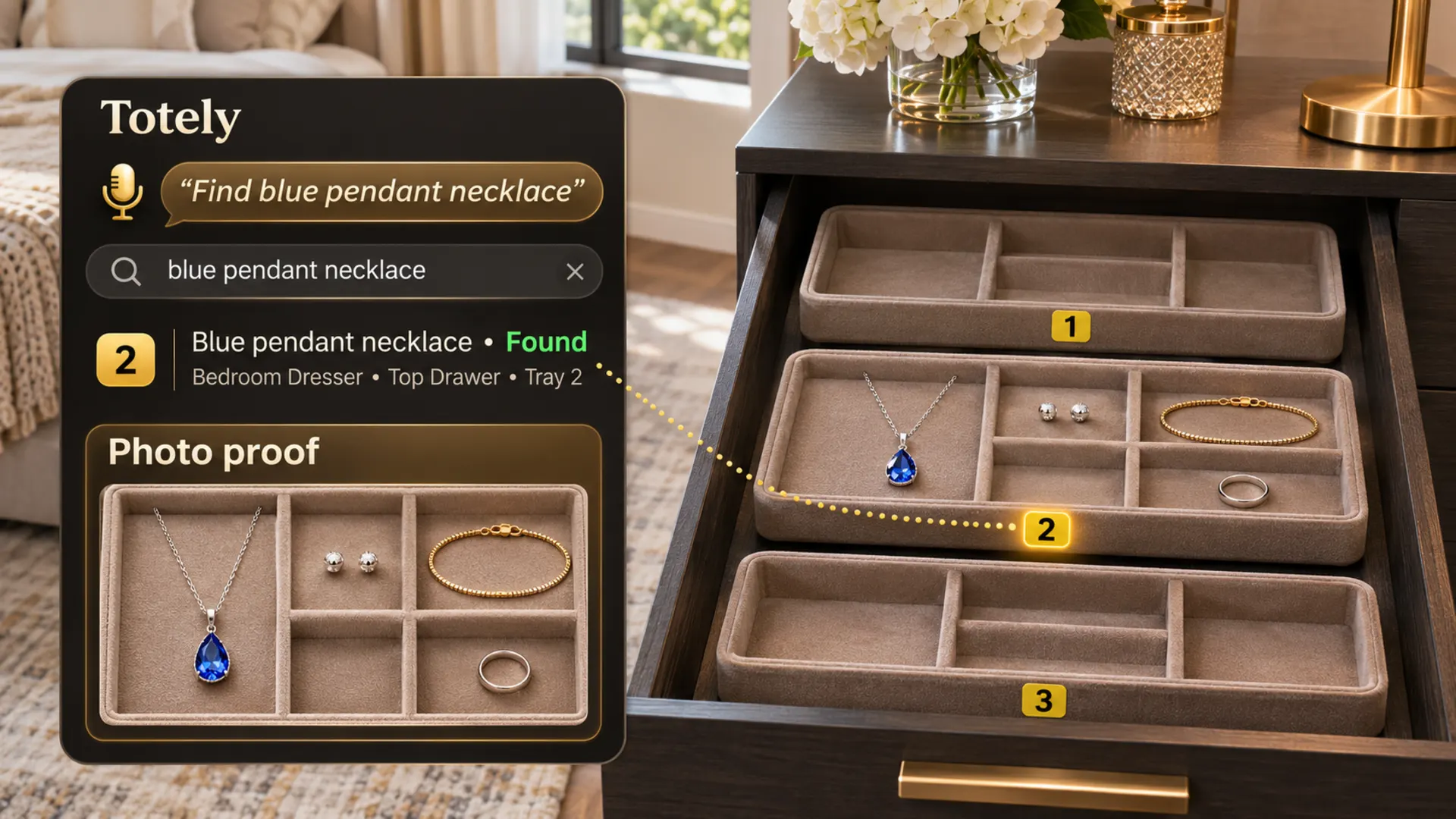
| Blue pendant necklace | Bedroom Dresser • Top Drawer • Tray 2 | Silver stud earrings, slim gold bracelet |
| Pearl earrings | Bedroom Dresser • Top Drawer • Pearl Box | Care card and matching backs |
| Inherited ring | Secured location • Ring Case • Slot 1 | Appraisal or insurance records stored separately |
Keep sensitive documents and security details out of ordinary household photos and casual shared notes. A retrieval record can tell you which approved container holds the piece without becoming a public map of valuables.
Make the Collection Searchable
At this point, the physical storage problem is solved: each piece has an appropriate resting place, incompatible or delicate items are separated, the location suits the collection and the return path is clear.
Totely can add a memory layer to that system:
- Put one simple visible number on each approved tray, box or storage spot.
- Photograph the pieces in their assigned compartments.
- Let Totely create the first item list from what it can see.
- Review and edit the list so names are accurate and pairs or companions are clear.
- Save the exact location, such as
Bedroom Dresser • Top Drawer • Tray 2. - Search naturally later:
blue pendant necklace. - Confirm the number, location and photo proof before opening other boxes.
In this example, the search result points to Tray 2 and the photo proof shows the same blue pendant necklace beside its silver stud earrings, slim gold bracelet and ring. The photo confirms the tray before you move the other layers.
Totely does not identify gemstones, assess damage, choose safe material conditions, appraise jewelry, replace insurance records or make a storage location secure. It helps you find the reviewed record you created. See the current Totely features for the supported number, photo, reviewed-item-list, location and search workflow.
If a piece moves, update its saved location immediately. If it is sold, gifted, repaired or removed for travel, update the list rather than leaving an old photo as false proof.
Run a Five-Minute Jewelry Reset
Use the return path instead of reorganizing the entire collection.
- Close every clasp that should be closed for storage.
- Return each piece to its assigned compartment.
- Reunite earring pairs and their backs.
- Move damaged pieces out of rotation.
- Empty the travel roll or temporary landing compartment.
- Update the saved location for anything that changed trays.
- Check whether the organizer still closes without pressure.
For sentimental pieces, record the story separately from the storage address. Our sentimental-item storage guide explains how to keep meaning attached to a keepsake without turning one container into a mystery box.
Avoid Common Jewelry Storage Mistakes
Buying the case before sorting the collection
A case designed around rings may be poor storage for long chains, watches or large earrings. Count the actual piece types first.
Letting necklaces share one compartment
Several chains in one open section can cross, snag and hide the piece underneath. Assign one supported path or compartment to each necklace.
Treating every material the same
Heat, light, humidity, cleaners and storage fabrics do not affect every piece equally. Follow instructions for the actual materials and treatments.
Hiding everyday pieces behind the protected collection
Frequent access should not require handling fragile or irreplaceable pieces. Keep the daily layer separate.
Photographing sensitive records with the jewelry
Ordinary retrieval photos do not need addresses, receipts, appraisal details or identifying documents in the frame.
Forgetting the return rule
A perfect inventory becomes inaccurate when a necklace moves from Tray 2 to a travel pouch and the record does not change.
Jewelry Storage FAQs
What is the best way to store jewelry at home?
Give each piece a clean, stable, separate resting place suited to its materials and construction. Keep everyday jewelry accessible, protect delicate or irreplaceable pieces appropriately, and use a consistent drawer, tray, box and compartment address.
How do I store necklaces without tangling?
Use one supported path per necklace: an individual hook, channel, roll section or padded compartment. Avoid tight bends and do not layer several chains together. Check the maker or jeweler's guidance for fragile, antique or unusual chains.
Should jewelry be stored in plastic bags?
Do not assume one bag material is suitable for every piece. Use the original box or pouch when its guidance supports that choice, or ask the maker or a qualified jeweler about an appropriate individual container. Sterling silver, pearls, opals and treated gems can have different storage needs.
Can I keep all my jewelry in one drawer?
One drawer can work when it is stable, appropriately located and divided into enough suitable compartments. The drawer should not become one shared pile, and high-value, fragile or material-sensitive pieces may need a different approved location.
How should I store earrings so pairs stay together?
Keep each pair in its own small compartment or suitable holder, with the correct backs attached or contained beside it. Prevent posts, hooks and stones from rubbing neighboring pieces.
How do I keep track of jewelry stored in several boxes?
Give each tray, box or spot a simple number, photograph the reviewed contents and save the exact room, furniture and container location. Update the record whenever a piece moves. A small free home inventory test can help you prove the workflow on one tray before expanding it.
Start With One Tray
Choose the tray that causes the most searching. Separate the pieces, give each one a suitable resting place, number the tray and save its exact address.
Then search for one real item—such as the blue pendant necklace—before opening another box.
That single successful retrieval tells you whether the system is useful. Try the One-Tote Test with a tray, drawer or box you already own.