How to Store Cleaning Supplies Safely—and Find the Right One
Learn how to store cleaning supplies in original containers, separate active caddies from secured backstock, and find the right cleaner later.
By Steve Watts · Co-Founder, Totely
November 16, 2026 · Updated November 16, 2026 · 12 min read
The glass cleaner is not under the kitchen sink. It is not in the bathroom caddy, either. After checking both places, you find two nearly empty all-purpose sprays, three packs of sponges and a floor cleaner you forgot buying—but not the bottle you need.
Learning how to store cleaning supplies is not mainly about squeezing more bottles into a cabinet. First, keep products in their original labeled containers, follow each product’s storage directions and control who can reach them. Then separate the small set you actively carry for cleaning from secured backstock and dry tools. Only after that should you build a searchable location system.
This guide covers ordinary household cleaning supplies. A product label, manufacturer instructions and safety data sheet control whenever they differ from general organizing advice. Unknown, damaged, leaking or specialty products need product-specific and local guidance rather than an improvised storage fix.
Quick Links
Start With the Safety Gate
An organizing bin cannot make an unsuitable product location safe. Before choosing a caddy, shelf or turntable, check every item against four questions.
| Safety gate | What to verify | What the answer changes |
|---|---|---|
| Product identity | The original label is present and readable | If you cannot confidently identify a product, restrict access and seek manufacturer or local hazardous-waste guidance |
| Product directions | Storage, temperature, ventilation, separation and disposal instructions are available | Those directions override a generic room or organizer recommendation |
| Household access | Children, pets or other vulnerable household members cannot reach the product | The storage area may need a lock, latch or a different location |
| Storage conditions | The area is dry, stable and away from prohibited heat, sun, flames, sparks, food and medicine | An under-sink cabinet, garage or shed may be unsuitable even when it has spare space |
The City of San Diego’s household hazardous-material guidance recommends keeping these products in their original containers, tightly sealed and upright, away from food and out of children’s reach. It also directs people to keep combustible and flammable materials away from pilot lights and water heaters.
Indiana’s Department of Environmental Management likewise says to follow the container directions, retain original containers, keep hazardous products away from food and never mix household chemicals. Its guidance is general; the individual product label remains the place to check the rules for that product.
Do not decant a cleaner into a decorative jar, drink bottle or mystery spray bottle to make the cabinet look coordinated. The original package keeps the identity, directions, warnings and first-aid information together. FamilyDoctor.org makes the same original-container and intact-label point in its household injury-prevention guidance.
Decide What Belongs in Each Storage Layer
A useful system separates supplies by how they are used without pretending every product can share one tray.
1. The active cleaning caddy
The caddy holds the small set you intentionally carry for one cleaning session: perhaps a manufacturer-labeled surface cleaner, glass cleaner, gloves, microfiber cloths, a squeegee and a brush.
Treat the caddy as transport, not unattended permanent storage. Return the products to their approved secured location after use. Keep wet cloths and brushes out of the chemical-storage tray until they are cleaned and fully dry.
2. Secured product backstock
Backstock includes refills, specialized products and bottles used less often. Keep them in original containers with labels visible. Use separate wipe-clean trays only when they do not conflict with the product directions, and do not combine leftovers or group products merely because their bottles fit together.
The safest grouping rule is not “bathroom” or “blue bottles.” It is: follow the product label and keep products apart wherever their directions require it.
3. Dry tools and consumables
Sponges, dry brushes, cloths, gloves, trash bags and paper goods do not need to disappear behind bottles. Give them a separate dry bin, drawer or door pocket. This makes the chemical trays easier to inspect and stops a damp cloth from hiding a small leak.
| Layer | Good candidates | Storage priority |
|---|---|---|
| Active caddy | The limited set for the current cleaning job | Controlled while in use; returned immediately afterward |
| Secured backstock | Original labeled bottles and refills approved for that location | Access control, label visibility, stable upright storage and product-directed separation |
| Dry tools | Clean cloths, brushes, gloves, squeegees and spare sponges | Dryness, visibility and quick access without blocking bottles |
This three-layer split also exposes duplicates. If three half-used glass cleaners appear during the sort, you can stop buying another one—but do not pour them together.
Choose a Storage Location
There is no universally correct cleaning-supply room. Choose the location by the products, household and conditions rather than by whichever cabinet is empty.
| Possible location | It may work when | Reconsider it when |
|---|---|---|
| Secured utility cabinet | It is dry, stable, accessible to the intended adult and compatible with every product label | It also stores food, medicine, clean linens or items that could be contaminated by a leak |
| Under-sink cabinet | The plumbing is sound, the shelf stays dry, the door can be secured and the stored products permit the conditions | Children or pets can access it, pipes leak, labels become damp or products crowd shutoff valves |
| Laundry-room cabinet | It is secured, dry and separated according to product directions | Heat, humidity, laundry access or mixed product types make the setup hard to control |
| Garage or shed | Each label permits the temperature and ventilation conditions, and the cabinet is secured away from ignition sources | Temperatures swing, containers freeze or overheat, sunlight reaches the shelf, or fuels and tools share the area |
An under-sink cabinet deserves extra scrutiny. Empty it and check the cabinet floor, pipes, shutoff valves and back wall before returning anything. A wipe-clean liner or shallow tray may make a leak easier to notice, but it does not repair plumbing or satisfy a product’s storage requirements.
Keep frequently used items reachable only within the safe storage area. “Front access” should mean you do not have to move five bottles to reach one—not that the bottle sits on an open floor-level shelf.
Set Up the Cabinet Before Buying Organizers
Once the location passes the safety gate, build the physical system in this order.
- Remove one item at a time. Keep caps closed and labels facing you. Do not sniff or test an unknown product to identify it.
- Inspect the empty space. Look for moisture, cabinet damage, unstable shelving, heat sources and blocked plumbing access.
- Measure the cabinet. Record usable width, depth and height, plus doors, hinges, pipes and the tallest bottle with its trigger attached.
- Edit the collection. Set aside empty, unwanted, damaged, leaking or unidentified products for directions from the manufacturer or the current local household-hazardous-waste or solid-waste program.
- Create the three layers. Limit the active caddy, secure the backstock and separate dry tools.
- Use shallow, wipe-clean containment where appropriate. Keep bottles upright and labels visible. Avoid deep bins that require blind digging.
- Assign stable addresses. Number the cabinet or shelf trays—
1,2,3—without covering or replacing any original product label. - Test the return path. Carry the caddy out, use the tools, then return every product to its approved address.
- Identity: Every stored product is identifiable in its original labeled container.
- Access: The cabinet or storage area matches the household’s child, pet and vulnerable-person controls.
- Conditions: Product directions allow the temperature, ventilation, light and location.
- Containment: Bottles are stable, upright and visible; separate trays do not override compatibility directions.
- Tools: Damp cloths and brushes stay out of chemical backstock until cleaned and dry.
- Exit plan: Unwanted, damaged or unknown products have a current manufacturer or local-program handoff.
At this point, the physical storage problem is solved: the products are identifiable, access is controlled, conditions are checked and the caddy has a return address.
Make the System Searchable
The remaining problem is memory. A household may have glass cleaner in the utility cabinet, a bathroom squeegee in a dry-tools bin and spare microfiber cloths in the laundry room. A category label on one cabinet door cannot tell you all three locations.
Totely can add a digital memory layer after the physical safety system is in place:
- Give each approved cabinet, shelf tray or dry-tools bin one simple visible number.
- Photograph the reviewed supplies without hiding their original labels.
- Let Totely create the first item list from what it can see.
- Review and edit the list. Record the product name, tool companions and any non-safety note that helps retrieval.
- Save the exact location:
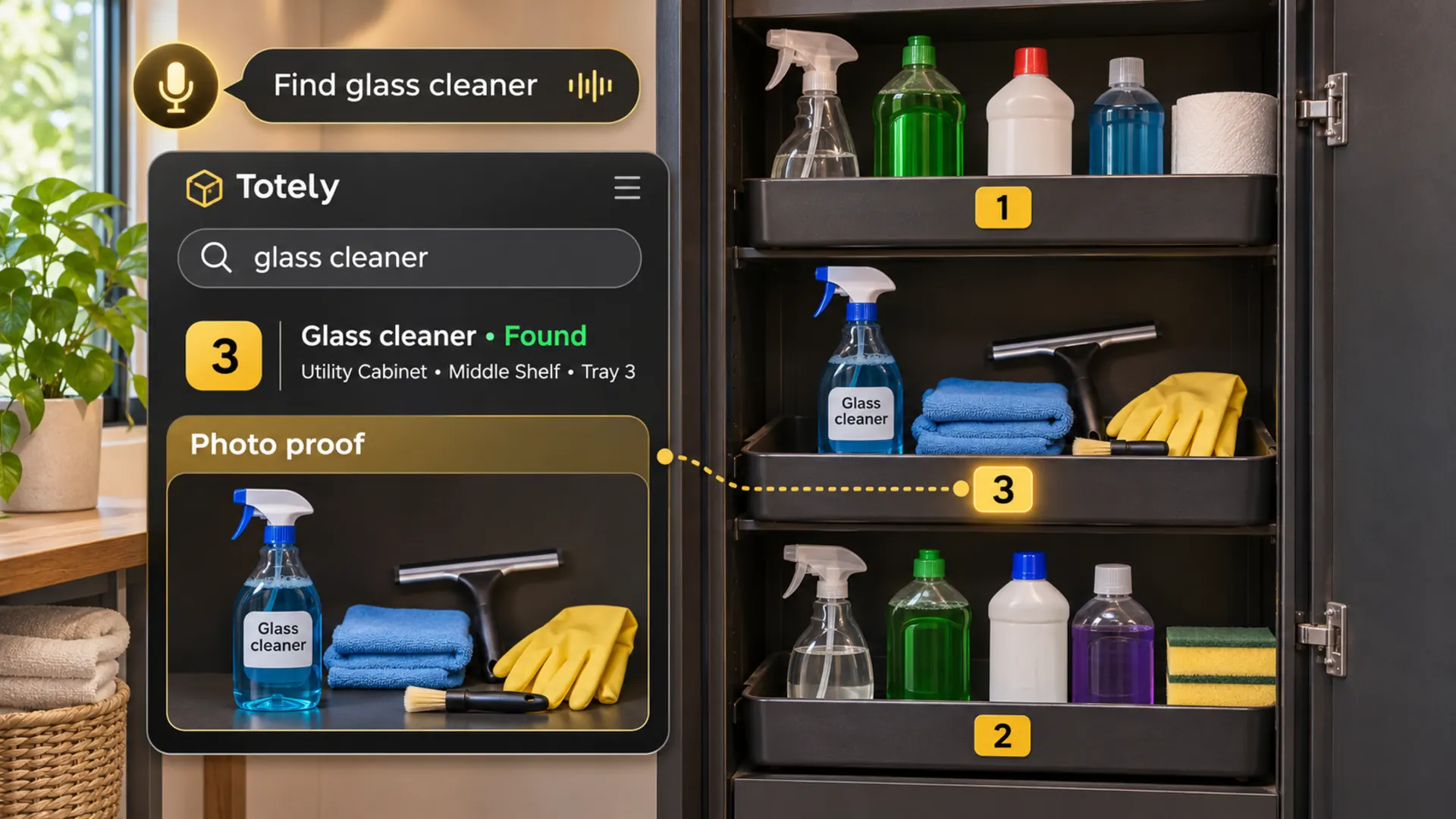
Utility Cabinet • Middle Shelf • Tray 3. - Search naturally later:
glass cleaner. - Confirm the number, location and photo proof before opening the cabinet or moving other products.
For example, a search for glass cleaner points to Tray 3 at Utility Cabinet • Middle Shelf • Tray 3. The photo proof shows the original glass-cleaner bottle with microfiber cloths, a squeegee, gloves and a small detail brush.
If the bottle moves to a different approved cabinet, update the saved location immediately. If it leaves the home, remove it from the reviewed item list. The number can stay on the tray while the searchable details change.
Totely does not determine whether two products are compatible, make an accessible cabinet safe, read an obscured warning, manage an exposure or replace labels, safety data sheets, manufacturer instructions or local disposal rules. It helps you retrieve the reviewed record you created. See the current Totely features for the verified number-photo-list-location-search workflow.
Avoid Common Cleaning-Supply Storage Mistakes
Buying organizers before checking the location
A turntable that fits around the pipe does not answer whether the products belong under the sink. Check access, moisture and label directions first; measure second; shop last.
Making products look alike
Matching decorative bottles erase the most important information. Keep original packages and labels. Number the shelf tray, not the chemical bottle.
Leaving the active caddy out
A portable caddy is convenient during a cleaning session. It should not remain accessible on the floor, counter or open shelf afterward. Return every product to its approved secured address.
Stacking deep bins
If reaching the lower bin requires lifting a chemical-filled bin overhead, redesign the shelf. Use shallow trays, pull-outs or front-access zones that keep containers visible and stable.
Combining duplicates
Two bottles that appear similar may not have the same formula, age or instructions. Never mix or combine products to save space. Use the inventory to prevent another purchase, not to improvise a new mixture.
Treating the digital record as the safety system
The record remembers what and where. The original container, label, closure, cabinet, household access control and product directions do the safety work.
Run a Simple Reset
A system stays useful when there is a clear reason to update it. Reset the cabinet when:
- a product moves to another approved location;
- the active caddy changes;
- a bottle becomes empty, damaged or unreadable;
- plumbing leaks or storage conditions change;
- a new child, pet, caregiver or housemate changes who can access the space;
- the product label or manufacturer guidance changes how it should be stored; or
- you keep buying a supply that is already in backstock.
During the reset, do not open every product. Check identity, closure, cabinet conditions, visible damage and the accuracy of the location record. Use current local guidance for anything leaving the system.
If utility storage shares space with paint or maintenance supplies, keep each product’s own rules in control. The paint storage guide shows the same physical-first principle for touch-up paint, while the garage tool inventory guide focuses on dry tools and hardware rather than household chemicals.
Cleaning Supply Storage FAQs
What is the best way to store cleaning supplies?
Keep each product in its original labeled container and follow its storage directions. Choose a dry, stable area with the access control your household needs, keep products away from food and medicine, separate them as directed, and return the active caddy after use.
Is it safe to store cleaning supplies under the sink?
It depends on the product directions and the cabinet. Check child and pet access, plumbing leaks, moisture, heat, usable space and the ability to secure the door. If the area does not pass those checks, choose another approved location.
Should cleaning products stay in their original containers?
Yes, unless the manufacturer explicitly directs otherwise. The original container keeps the product identity, warnings, use directions, storage instructions and first-aid information together. Never transfer a cleaner to a food or drink container or an unmarked decorative bottle.
Can different cleaning products share one cabinet?
Do not assume they can. Follow every product label and manufacturer instruction for separation, temperature and ventilation, and never mix products. Use separate containment only when it is compatible with those directions; ask the manufacturer when the guidance is unclear.
What belongs in a cleaning caddy?
Use a caddy for the limited products and dry tools needed for the current cleaning job. Keep products in original labeled containers, control the caddy while it is in use, and return every product to its secured storage address afterward.
What should I do with a leaking, damaged or unknown cleaner?
Restrict access to the area and follow the product label, manufacturer and current local household-hazardous-waste or solid-waste guidance. Do not identify it by smelling it, mix it with another product, pour it down a drain or invent a universal disposal method.
Start With One Cabinet
You do not need to reorganize every cleaner in the house today. Choose one approved cabinet. Keep the original labels, split the active caddy from secured backstock, separate the dry tools, number one tray and save its exact location.
When the glass cleaner goes back to Tray 3, update the record if anything changed. That small return step is what turns an attractive cabinet into a storage system that keeps working.