How to Store Camping Chairs Without a Garage Pileup
Learn how to store camping chairs by folded shape, prepare them for storage, choose a safe garage or closet setup, and find the right chair later.
By Steve Watts · Co-Founder, Totely
November 18, 2026 · Updated November 18, 2026 · 13 min read
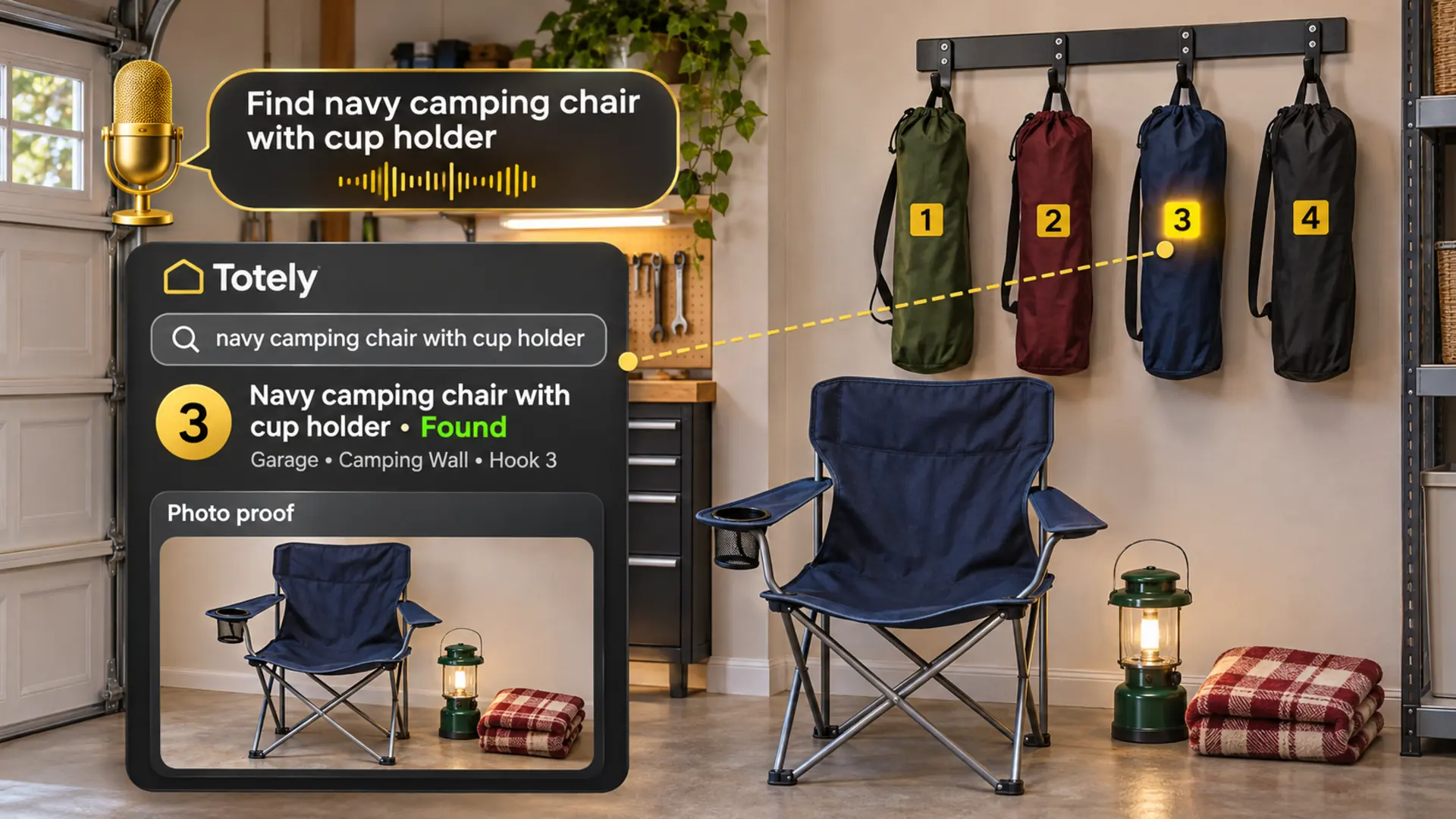
Four camping chairs are leaning in the same garage corner. Two are in black sleeves, one is in a navy bag, and the last is hiding behind a tent. You need the wide navy chair with the cup holder, but every bag looks almost the same.
Learning how to store camping chairs starts with the chairs themselves: identify the folding shape, follow each maker's care instructions, clean and dry the chair, fold it correctly, and choose a support method that fits its weight and frame. A wall rack, shelf, upright divider or closet can all work when the chair is stable, accessible and protected from heavier items.
Only after that physical setup works should you add a number, photo and exact location. The goal is not a wall that looks organized. It is a storage system that lets you retrieve the right chair without opening every sleeve.
Quick Links
The Quick Answer: What Is the Best Way to Store Camping Chairs?
Check the chair's label or manual first. Remove loose dirt, clean only with a method approved for that chair, and let the chair and carry bag dry completely. Fold and secure the chair as its maker directs.
Then choose a clean, dry location where the folded chair will not tip, bow, carry heavy boxes or block a walkway. Tube-folding chairs often fit an upright divider, deep shelf or appropriately rated wall rack. Flat-folding chairs may work against a secured wall stop, beneath a suitable shelf or on hooks approved for the chair and installation surface.
Do not assume every chair can hang from any convenient frame bar. The chair's manual and the mounting hardware should control where and how much weight the support can carry.
Sort Chairs by Folded Shape and Use
Do not buy a rack before you know what it must hold. Open every chair, identify it, and sort the collection in three ways.
Folded shape
- Tube-folding chairs collapse into a long narrow bundle, usually with a carry sleeve.
- Flat-folding chairs close into a wider flat profile.
- Director-style or rigid compact chairs may fold but keep a boxier shape.
- Low, rocking, loveseat or oversized chairs can have unusual frames and higher stored weight.
A narrow vertical slot that holds four tube bags may not fit one flat-folding chair. A hook that works for a light chair may be wrong for a heavy loveseat. Measure the chair when folded, including the carry bag, rather than relying on the open dimensions.
How often you use it
Keep the chairs used for weekly games, beach days or backyard gatherings near the front of the zone. Seasonal or guest chairs can sit higher or farther back, provided they remain safely accessible.
What you would search for later
Write the description you would naturally use: navy chair with cup holder, two kids' red chairs, low beach chair or double camp loveseat. Brand and model can help, but visible details are often easier to remember.
This inventory also reveals chairs that should not return to storage. Set aside any chair with a damaged frame, loose connection, torn seat or missing locking part. Follow its maker's guidance for inspection, repair or retirement.
Prepare Each Chair for Storage
Storage cannot fix a chair that went away damp or gritty. Give every chair a short post-trip reset before assigning its location.
Follow the chair's care instructions
Cleaning materials and frame construction vary. Start with the label, manual or maker's support page. Decathlon's camping-chair support guidance, for example, specifies simple soap, a brush and clean water for its chairs and recommends folded storage in a clean, dry place without weight on top.
A camping-chair use and care manual hosted by Home Depot likewise directs owners to clean regularly, inspect components and store that chair in a dry, ventilated location away from direct sunlight and humidity. These are useful examples, but your own chair's instructions take precedence.
Clean the parts that bring the campsite home
Open the chair fully. Remove loose sand, leaves and dirt from the feet, joints, seams, pockets and cup holder. Use only an approved cleaning method. Do not experiment with bleach, solvents, lubricants or rust treatments on an unknown fabric or finish.
Clean the carry sleeve too. Putting a clean chair into a dirty or damp bag simply brings the problem back inside the system.
Let the chair and bag dry completely
Keep the chair open until the fabric, padding, seams, frame joints and storage sleeve are dry. CORE Equipment's first-party chair care guide specifically warns against folding and storing a damp chair in its carry bag.
There is no reliable universal drying time for every chair, climate and fabric. Check the actual chair instead of following an arbitrary number of hours.
Fold, secure and inspect
Fold the chair according to its instructions. Use the supplied strap or carry bag when the maker calls for it. Confirm that no fabric is pinched, no joint is forced and no loose strap can snag a neighboring chair.
Before the chair disappears into storage, photograph it open. Include the identifying details you would want to confirm later: color, cup holder, headrest, side table, footrest or matching carry sleeve.
Choose the Right Camping Chair Storage Method
The best method is the one that supports the actual chair, fits the available space and keeps the next retrieval simple.
| Chair and space | Practical starting point | Verify before using it | Avoid |
|---|---|---|---|
| Tube-folding chairs in a garage | Deep shelf, upright divider or purpose-built rack | Folded length, bag diameter, stability and rack rating | A loose bundle that can roll or fall |
| Flat-folding chairs | Secured wall position, suitable hooks or a supported shelf | Approved hanging point, hardware rating and wall attachment | Hanging from an unapproved moving part |
| Heavy or oversized chair | Low shelf or individually supported position | Chair weight, shelf/rack capacity and safe lifting route | Storing high where retrieval is awkward |
| Apartment or small closet | Upright slot, under-bed position or deep upper shelf | Clearance, tipping control and dry conditions | Blocking an exit or crushing the frame |
| Mixed chair collection | Separate zones by folded shape | Enough space to remove one chair independently | Forcing every shape into one narrow rack |
Wall rack or hooks
Wall storage can free floor space, but it requires the most careful verification. Use a support designed for the chair's stored shape and weight. Mount it according to the hardware manufacturer's instructions and the actual wall construction. Keep chairs within a comfortable retrieval height and leave enough clearance to lift one without dragging across the others.
Shelf or cubby
A deep shelf works well when the chair can rest without bending, rolling off or carrying boxes. Add dividers for long tube-style bags so each chair has its own slot. Put heavier chairs lower and keep the chair ends inside the shelf footprint.
Upright floor divider
An upright corral or divider can turn an awkward corner into usable storage. It should prevent tipping and keep chair feet or bags off any area that gets wet. Do not let the divider become a leaning tower that spills into a walkway.
Closet or under-bed storage
These options are useful for renters and small homes. Choose a dry interior location and contain straps so they do not catch on clothing or bedding. A flat chair under a bed needs full clearance; do not wedge it beneath a frame that presses on the chair.
Vehicle storage
Keeping a frequently used chair in a vehicle sounds convenient, but it also exposes the chair to the vehicle's actual heat, moisture, security and cargo conditions. Follow the chair and vehicle guidance rather than treating the trunk as universal long-term storage.
Set Up a Camping Chair Zone in the Garage
Build the zone around retrieval, not maximum density.
- Measure the folded chairs and available wall, shelf and floor clearance.
- Choose a method for each folded shape.
- Install and test the support according to its instructions before loading all chairs.
- Put heavy or frequent-use chairs at an accessible height.
- Leave enough room to remove one chair without shifting the whole collection.
- Give every position a short address.
Use location names that remain clear when you are standing in the garage:
Garage • Camping Wall • Hook 1Garage • Camping Wall • Hook 3Garage • West Shelf • Chair Slot 2Hall Closet • Upper Shelf • Left
Avoid vague locations such as garage, camping area or back wall. They describe a room, not a retrieval point.
| Physical number | Chair description | Exact location | Review note |
|---|---|---|---|
| Chair 1 | Gray low chair | Garage • Camping Wall • Hook 1 | Carry bag dry; frequent use |
| Chair 2 | Red kids' chair | Garage • Camping Wall • Hook 2 | Matching red sleeve |
| Chair 3 | Navy wide chair with cup holder | Garage • Camping Wall • Hook 3 | Photo shows cup holder and green lantern |
| Chair 4 | Tan director chair with side table | Garage • West Shelf • Chair Slot 1 | Heavy; keep low |
If a chair moves, update the location while you are holding it. A neat map from last season is not a current map.
Keep compact gear in a separate physical system. The camping gear storage totes guide covers small equipment such as lights, stakes and camp-kitchen pieces; this guide keeps bulky seating from swallowing that tote space.
Store Camping Chairs in a Closet or Small Home
Small-space storage works best when every chair earns its footprint.
First, decide how many chairs the household actually uses. Donate or retire extras that are safe to release instead of building an elaborate rack for forgotten seating.
Next, use one vertical slice of a closet, one supported upper shelf or one under-bed position. Keep daily household items separate so taking out a chair does not collapse a stack of coats, luggage or linens. If the chair has a sleeve, turn the handle toward the access side.
For several similar tube bags, add a physical number near the handle and preserve one slot per chair. That small distinction prevents a closet from becoming the indoor version of the garage pile.
The same zone-and-position logic works in a storage unit. Preserve a clear route and put likely first-use chairs near the front; the garage storage zones guide offers a useful model for separating access levels.
Make Similar Chair Bags Searchable
At this point, the physical storage problem is solved. Each chair is clean and dry, folded according to its instructions, supported in a suitable location and assigned a stable position.
Totely can add the searchable memory layer:
- Add one simple visible number to the chair bag or approved storage tag.
- Photograph the open chair with its visible identifying details.
- Let Totely build the first item list from what it can see.
- Review and edit the record so the chair type, color and useful features are accurate.
- Save the exact location, such as
Garage • Camping Wall • Hook 3. - Search later in everyday words:
navy camping chair,chair with cup holderorwide camp chair. - Confirm the number, saved location and photo proof before removing the other chairs.
In this setup, navy camping chair with cup holder returns Chair 3 at Hook 3. The photo proof shows the open navy chair beside the same green lantern and plaid blanket photographed during storage. The result tells you which black-and-navy sleeve to grab without opening Chairs 1, 2 and 4.
Totely does not clean a chair, verify dryness, certify wall hardware, assess damage or replace the manufacturer's instructions. It helps you find the reviewed record you created. The current Totely features document the supported number, photo, reviewed-item-list, exact-location, natural-search and photo-proof workflow.
If the chair moves to a closet or vehicle, update the saved location immediately. Search is only as reliable as the record behind it.
Avoid Common Camping Chair Storage Mistakes
Buying a rack before measuring the folded chairs
Open dimensions do not tell you the stored length, width or bag diameter. Measure every chair in its real folded state.
Hanging a chair from the wrong point
A convenient bar may be a moving joint, handle or unsupported frame member. Follow the chair and hardware instructions; do not invent a hanging point or load limit.
Closing a damp chair inside its sleeve
Dry the fabric, seams, frame and bag before enclosure. Do not let a tidy sleeve hide moisture you have not checked.
Stacking heavy boxes on chairs
Stored chairs should not become a shelf. Decathlon and POLYWOOD both caution against putting weight or heavy items on stored folding furniture within their respective guidance.
Using one label for the whole category
Camping chairs identifies a pile, not a specific chair. Give each chair a number, useful description and exact position.
Forgetting to update a moved chair
When Chair 3 moves from Hook 3 to the hall closet, change the record during the move. Otherwise, photo proof confirms the right chair but the saved address sends you to the wrong wall.
Camping Chair Storage FAQs
Can camping chairs be stored in a garage?
They can be stored in a garage when the chair maker permits the conditions and the location stays clean, dry, stable and protected from direct sunlight, moisture, pests and heavy items. Garages vary widely, so check the actual seasonal conditions rather than assuming every garage is suitable.
Is it better to hang camping chairs or put them on a shelf?
It depends on the folded shape, weight, approved support points and available space. Hanging can free floor area, while a shelf may better support a heavy or unusually shaped chair. Follow the chair and hardware instructions and keep retrieval safe.
Should camping chairs stay in their carry bags?
Use the supplied carry bag when the chair's instructions call for it, but only after both chair and bag are clean and fully dry. A bag can contain straps and protect against dust; it should not conceal moisture or damage.
How do you store camping chairs in a small apartment?
Use one measured interior location such as a closet slot, supported upper shelf or under-bed position. Prevent tipping or crushing, keep exits clear and give each similar bag a visible number and fixed position.
How do I keep track of several similar camping chairs?
Number each chair or sleeve, photograph the chair open, record a short description, and save the exact hook, shelf or closet position. A home inventory app can connect those details so a natural search returns the matching number and photo proof.
Build the System Around the Next Retrieval
Good camping chair storage is not the densest rack or the prettiest garage wall. It is a setup that keeps each chair dry, supported, identifiable and easy to retrieve.
Sort by folded shape. Follow the maker's care instructions. Choose a support method that fits the actual chair. Name every position. Then add a reviewed photo record so the right sleeve is findable even when all four bags look alike.
Start with the chair you use most. If you can search for it, confirm the photo and walk directly to its exact position, the system is doing its job.