How to Store Blankets So They Stay Clean, Dry, and Easy to Find
Learn how to store blankets by use, material, and space—then map each basket, bench, or box so the exact blanket stays easy to find.
By Steve Watts · Co-Founder, Totely
October 26, 2026 · Updated October 26, 2026 · 15 min read
The cream wool throw with navy stripes is somewhere in the house. It might be under the window bench, on the top closet shelf, or packed with winter bedding. Until you know which container holds it, “put away” can feel a lot like “lost.”
Learning how to store blankets starts with the physical problem: keep frequently used throws accessible, protect seasonal blankets from dust and dampness, and give delicate pieces enough support. Only then should you add labels or an inventory.
The simplest useful plan is this: sort blankets by use and material, follow each care label, store only fully dry blankets in a suitable interior location, and avoid crushing anything that depends on loft or has fragile fibers. For closed storage, give each container a number and record the exact place it lives.
Quick Links
Choose the Right Storage Method
Do not start by buying the largest bag or basket you can find. Start with four questions:
- How often is this blanket used? Daily throws belong near the sofa or bed. Seasonal blankets can move farther away.
- What is it made of? A washable fleece throw, a lofty down blanket, a wool blanket, and an heirloom quilt may need different handling.
- What can the storage location do to it? Check for dampness, leaks, sunlight, dust, pests, heat, and sharp hardware.
- Can you remove one blanket without disturbing everything else? If not, the container is too deep, crowded, or poorly placed.
Use this table as a practical starting point. The sewn-in care label and maker instructions take priority when available.
| Blanket or situation | Practical first choice | Main risk to check |
|---|---|---|
| Everyday sofa throw | Open basket, smooth rack, cabinet, or storage ottoman near the sofa | Dust, pet hair, snagging, and a walkway blocked by the container |
| Current-season bed blanket | Linen-closet shelf, wide drawer, or bench near the bedroom | A heavy stack that makes the lower blanket difficult to remove |
| Off-season cotton or synthetic blanket | Clean fabric bag or suitable lidded container on a dry interior shelf or under the bed | Trapped dampness, crowding, and a container that is hard to inspect |
| Lofted comforter or puffy blanket | Roomy breathable bag or dedicated shelf, folded only as its care guidance allows | Long compression that flattens or shifts the fill |
| Wool blanket | Material-appropriate clean storage with room, in a dry, stable location | Food, body oils, lint, and pest activity; direct contact with unverified repellents |
| Weighted blanket | Strong low shelf or drawer rated for the load, following maker guidance | Unsafe lifting, overstressed furniture, and a wash method beyond machine capacity |
| Heirloom, antique, or fragile quilt | Flat, supported, or conservator-recommended storage with archival-quality materials | Light, weak folds, unstable dyes, rough handling, and unsuitable paper or board |
Capacity is not the same as fit. A bench may close with six blankets inside, but it is not working if the cream throw is crushed under five heavier pieces. A basket may look inviting, but it is not long-term protection from light or dust.
Prepare Blankets Before Storage
Storage begins with an inspection. Spread each blanket on a clean, dry surface and look at the care label, seams, edges, filling, decorations, and any stains or odors.
Edit the collection before you compress it
Separate blankets into four groups:
- Used now
- Used seasonally
- Sentimental or delicate
- Repair, donate, repurpose, or responsibly discard
This is not a rule about how many blankets a household should own. The goal is to avoid paying for containers, shelf space, and repeated handling for pieces nobody wants to use.
Keep a practical spare where it will actually help: a guest-room blanket near the guest bed, an outdoor throw near the patio door, or a washable pet blanket near the pet's favorite chair.
Clean according to the actual blanket
Food residue, body oils, hair, and dust do not improve in a closed container. Utah State University Extension notes that clothes-moth larvae—not the adult moths—damage textiles and that soiled fibers can be especially attractive. Its guidance also emphasizes housekeeping and vacuuming as part of prevention.
That does not mean every blanket belongs in a washing machine. Read the label and follow the maker's directions. Wool, silk, handmade, down-filled, weighted, embellished, painted, antique, or structurally weak blankets may need special handling or professional advice.
For ordinary washable blankets:
- Treat stains as the care instructions allow.
- Wash or clean using the approved method.
- Dry completely, including thick seams, corners, and filling.
- Inspect again before closing the container.
Do not use a fragrance to cover an unresolved musty odor. Find the moisture source, dry the textile and space appropriately, and get qualified help when mold or deterioration is suspected.
Repair small problems before they disappear
Record a loose seam, pulled thread, broken binding, or missing button while the blanket is visible. If you cannot repair it immediately, keep it out of the ready-to-use stack and add a plain note such as “cream throw—repair corner seam.”
Store Everyday Throws Within Reach
The best everyday storage reduces the number of steps between using a blanket and returning it.
Use a basket for washable, frequently used throws
A smooth, stable basket beside the sofa works when the blankets tolerate loose rolling or folding. Keep it out of the walking path and away from fireplaces, heaters, vents, damp exterior walls, and direct sun.
Do not pack the basket until the sides bow. Each throw should lift out without dragging the rest onto the floor. A washable liner can make a rough woven basket friendlier to soft fabric.
Use a bench or ottoman for hidden storage
A storage bench solves two problems at once: it hides visual clutter and keeps blankets near the room where they are used. Before filling it, check that the inside is clean, dry, smooth, and ventilated as the furniture design intends.
Put the most-used throw on top. If the lid is heavy, pinching, or difficult for someone in the household to lift, the bench is not a convenient daily home.
Use a rack only for suitable blankets
A blanket ladder or broad rack can display lightweight throws and use vertical space. It also exposes them to light, dust, pets, and passing contact. Avoid hanging heavy, stretchy, fragile, or snag-prone pieces unless their maker says the support is appropriate.
Display storage is access, not preservation. Rotate or clean exposed throws as their actual use and care guidance require.
Store Seasonal Blankets Safely
Seasonal storage works best as a repeatable changeover rather than a once-a-year stuffing session.
Choose the location before the container
Favor a clean, dry, stable interior part of the home that you can inspect. A hallway closet, bedroom closet, wide drawer, under-bed space, or interior cabinet is usually easier to monitor than an attic, damp basement, exterior shed, or garage with large temperature swings.
A sealed box cannot make a wet blanket dry. It also cannot protect against a leak you never notice. Keep containers off a floor that could flood, do not block ventilation equipment, and leave enough access to check the area.
Fold with room instead of force
For an ordinary blanket whose care instructions permit folding:
- Lay it flat without stretching.
- Smooth it gently; do not pull corners into alignment under tension.
- Fold only enough to fit the container.
- Keep hard objects, zippers, buckles, and sharp-edged decorations elsewhere.
- Leave enough room to close the container without pushing down on the contents.
If a blanket relies on lofty filling, follow its maker before using a compression or vacuum bag. Saving shelf space is not worth permanently changing a blanket that should not remain compressed.
Keep the stack shallow
Several smaller groups are easier to retrieve than one deep pile. Divide by room, season, or use:
| Group | Example contents | Return rule |
|---|---|---|
| Living room winter | Cream wool throw, rust cotton throw, sage fleece blanket | Box 3; clean and dry; cream throw stays on top |
| Guest bedding | Two guest blankets and one mattress pad | Hall Closet, Shelf 3; sized for guest bed |
| Summer lightweight | Cotton coverlets and picnic throw | Under Bed, Left Side, Bag 2 |
Avoid vague labels such as “miscellaneous linens.” A useful label or record tells you enough to choose the right container before opening it.
Handle Wool, Weighted Blankets, and Quilts
Special blankets deserve individual decisions, not a household-wide shortcut.
Wool blankets
Follow the care label for cleaning and drying. Before storage, inspect the blanket and the storage area for pest evidence, remove lint and nearby food debris, and clean the surrounding shelf or drawer. Do not assume cedar, lavender, or another scented product guarantees protection, and do not place an unverified material directly against the wool.
If you find webbing, larvae, shed skins, new holes, or widespread pest activity, isolate the affected item and seek appropriate pest-management or textile-care guidance rather than moving it into the main blanket box.
Weighted blankets
Weight changes both care and storage. Check the manufacturer's washing instructions, the capacity of any appliance, and the blanket's current condition. Store it on a low, structurally suitable shelf or in a strong drawer so nobody has to lift a dense bundle from overhead.
Do not hang a weighted blanket from a narrow rail or place it in a flimsy basket. Record its weight if that helps the household choose a safe person or method for moving it.
Quilts and heirloom textiles
The Canadian Conservation Institute's flat-storage guidance explains that flat support relieves textiles from carrying their own weight and recommends minimizing folds for fragile pieces. The Institute's basic quilt-care guidance is a better starting point for collectible or inherited quilts than a general decor article.
For a significant family quilt, painted textile, unstable dye, brittle fabric, elaborate embroidery, or damaged piece, avoid improvising with household cardboard, tissue, plastic, or adhesives and calling the result archival. Ask a qualified textile conservator for material-specific advice.
Record the story separately: who made it, when it was used, what is known, and what remains uncertain. Documentation can travel with the quilt without pins, tape, or labels attached to the fabric.
Store Blankets Without a Closet
No linen closet does not mean every blanket has to live on the sofa.
Use the space under the bed
A shallow container can hold suitable seasonal blankets while staying accessible. Measure the clearance before buying anything, choose a container you can slide out without straining, and keep it away from damp flooring or blocked vents.
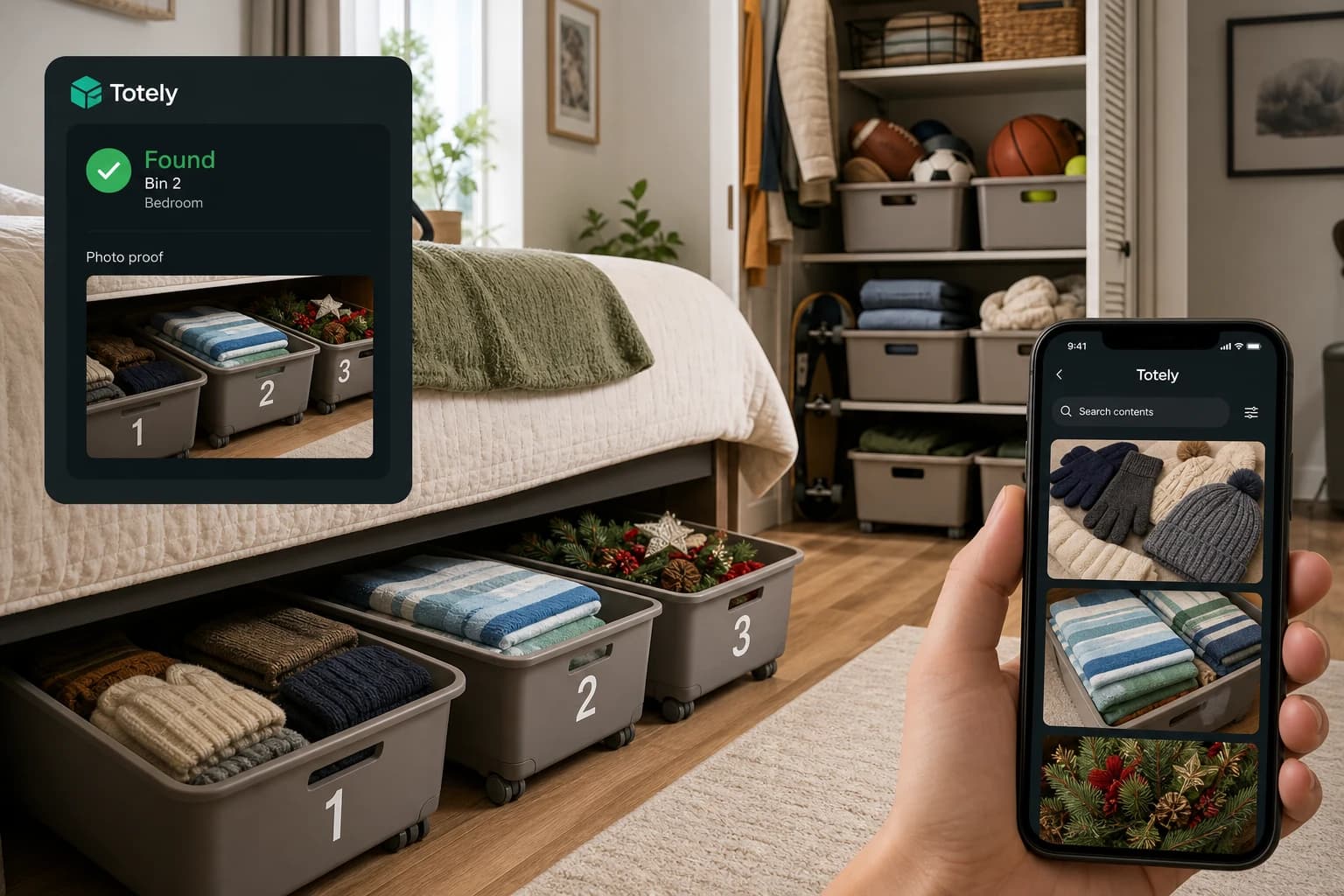
If you use several under-bed containers, give each one a side and number: Bedroom, Under Bed, Left Side, Box 2 is more useful than “under the bed.”
Let furniture do two jobs
A storage ottoman, window bench, trunk, or drawer-base bed can hold blankets without adding a separate cabinet. Check the interior surface and hardware. Exposed staples, rough wood, rust, or a lid that drops suddenly are reasons to choose another home or add appropriate protection.
Reserve open display for the active layer
Keep one or two attractive everyday throws in a basket or on a suitable rack. Move the rest to protected storage. When every blanket becomes decor, the room gains dust-catching surfaces and the seasonal pieces still have no real home.
For more small-home tradeoffs, see seasonal storage ideas for small homes. If you are separating other linens at the same time, use the dedicated guide to storing bed sheets.
Make Every Blanket Findable
A box labeled blankets tells you the category, not whether it contains the cream wool throw, the guest blanket, or the picnic cover.
Use a large simple number on each closed container and save its exact location. A small map can be enough:
| Number | Exact location | Main contents | Useful search words |
|---|---|---|---|
| 1 | Living Room, Cabinet, Lower Shelf | Everyday washable throws | gray fleece, kids movie blanket, sofa throws |
| 2 | Bedroom, Under Bed, Left Side | Lightweight summer blankets | blue cotton coverlet, picnic throw, summer bedding |
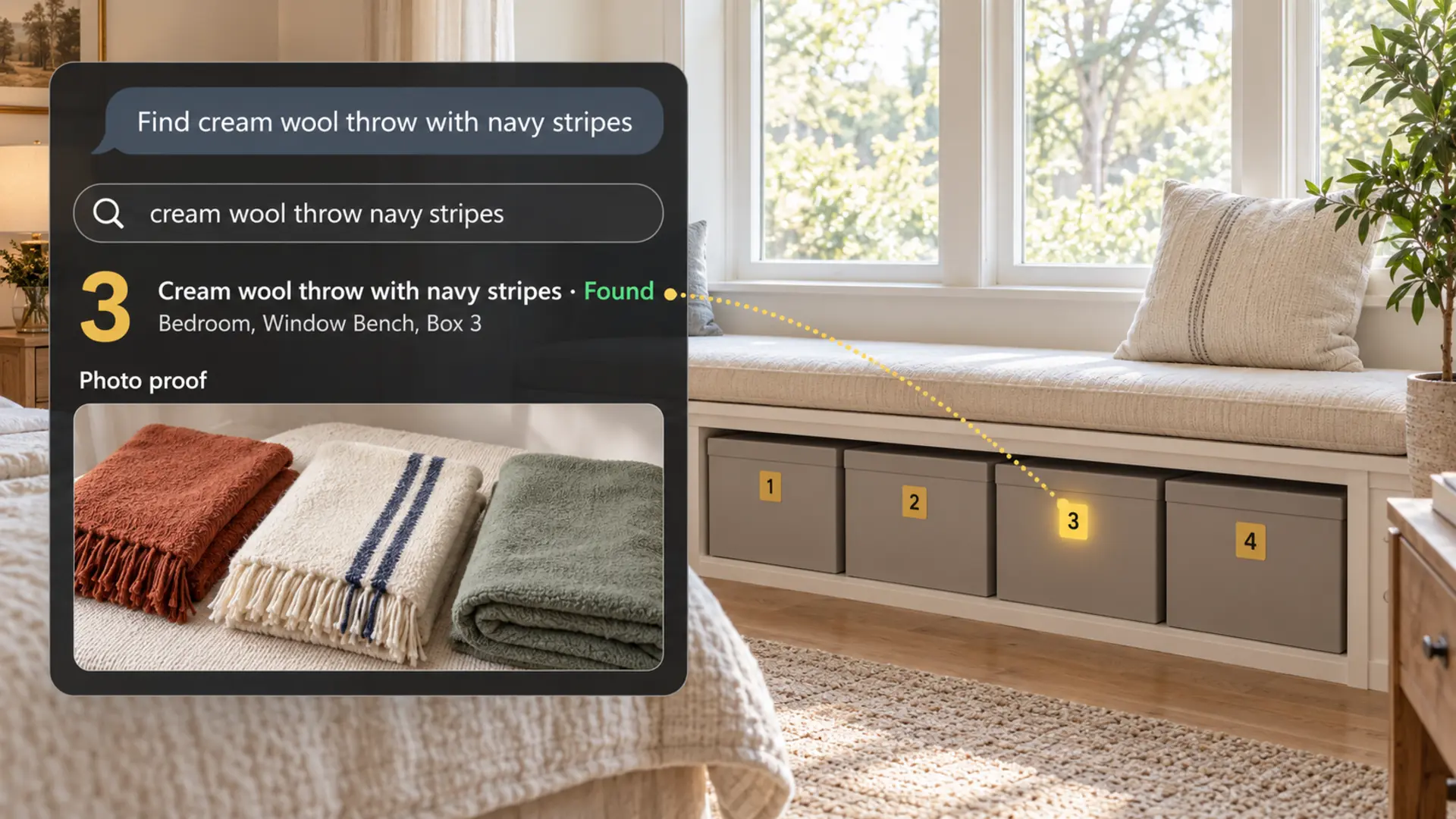
| 3 | Bedroom, Window Bench, Box 3 | Winter living-room throws | cream wool throw with navy stripes, rust throw, sage fleece |
| 4 | Hall Closet, Top Shelf | Guest and spare blankets | queen guest blanket, spare fleece, guest bedding |
Now “Where is the cream wool throw with navy stripes?” has a usable answer: Bedroom, Window Bench, Box 3.
When the blanket moves, update the location. When it goes out for cleaning or repair, record that temporary status instead of leaving an empty box to tell the wrong story.
For the same method across a larger storage system, see how to keep track of storage bins.
How Totely Helps
The shelf, basket, bench, or box protects blankets physically. Totely adds the memory layer that helps the household find one after it disappears from view.
Use a simple workflow:
- Put a visible yellow number 3 on the outside of the closed blanket box.
- Take one overview photo while the contents are visible and safely arranged.
- Let the app suggest an initial list of visible items, then review and correct it.
- Add “cream wool throw with navy stripes” and any material or condition note the photo cannot confirm.
- Save Bedroom, Window Bench, Box 3 as the exact location.
- Search naturally for “cream wool throw with navy stripes” later.
- Use the result number, location, and photo proof to confirm the box before opening it.
A photo cannot identify a blanket hidden under another item, confirm fiber content, read every care label, detect internal dampness, or judge whether a textile is historically significant. Human review still matters.
You also do not need to create a museum catalog for every inexpensive throw. Start at the container level, name the blankets people actually search for, and add detail only where it earns its place.
The One-Box Starter
Do not begin with every blanket in the house.
- Choose one crowded basket, bench, or seasonal box.
- Sort the blankets by use, material, and condition.
- Check each care label and make sure every stored piece is fully dry.
- Choose a safe interior location and a container with enough room.
- Place the most-used blanket where it is easiest to remove.
- Add one visible number to the closed container.
- Take one photo and correct the visible item descriptions.
- Save the exact room, furniture piece, position, and box number.
- Ask someone else to find the cream throw using the map alone.
If they can retrieve it without opening every blanket box, the system already works. Stored, not lost.
Blanket Storage FAQs
What is the best way to store blankets?
Store blankets according to how often they are used, what they are made of, and what their care labels require. Everyday throws can stay accessible in a suitable basket, cabinet, or bench. Seasonal blankets need to be appropriately clean, fully dry, uncrowded, and kept in a clean, dry, stable location.
Is it better to roll or fold blankets?
Neither method is universal. Loose folding fits shelves and boxes; rolling can make suitable everyday throws visible in a basket. Fragile quilts may need supported flat or conservator-guided storage, while lofted or weighted blankets require their own maker guidance.
Can I store blankets in plastic containers?
A clean, suitable lidded container can protect ordinary, fully dry blankets from dust and handling. It does not fix trapped moisture, a damp room, heat, crowding, or an unsuitable blanket. Follow the blanket maker's guidance, especially for wool, down, heirloom, or delicate textiles.
How do I keep stored blankets from smelling musty?
Resolve moisture first. Store only blankets that are appropriately clean and completely dry, choose a dry location you can inspect, and do not overfill the container. A fragrance can mask odor but cannot remove moisture or deterioration.
How should I store wool blankets?
Follow the care label, remove lint and nearby food debris, inspect for pest evidence, and use a dry, stable storage area with enough room. Do not rely on a scented product as a guarantee, and avoid placing unverified repellents directly against the wool.
How do I store blankets without a linen closet?
Use a measured under-bed container, a clean storage bench or ottoman, a drawer-base bed, or an interior cabinet. Keep only active throws in open baskets or on suitable racks. Number closed containers and record the exact room and position so the right blanket remains findable.
Give Every Blanket a Real Home
Good blanket storage is not one perfect basket. It is a series of small decisions: which blankets stay within reach, which move out of season, which need special care, and which exact space can keep them dry and supported.
Solve those decisions first. Then add the memory layer—one number, one reviewed photo, and one exact location. The cream wool throw becomes something you can use again, not something you vaguely remember putting away.