How to Store Bed Sheets: Keep the Right Set Together
Learn how to store bed sheets in complete, easy-to-find sets. Choose suitable storage, record the right size, and keep missing pieces out of the ready pile.
By Steve Watts · Co-Founder, Totely
October 18, 2026 · Updated October 18, 2026 · 12 min read
The blue striped sheets look right until you stretch the fitted sheet across the mattress. Wrong bed. Back in the closet, another blue bundle is missing a pillowcase, and the set you actually wanted is behind the towels.
Knowing how to store bed sheets is partly about folding. Mostly, it is about keeping a usable set together and recognizing it before you unfold it.
Start with clean, completely dry sheets. Group the pieces you use together, choose a suitable shelf, drawer or breathable storage bag, and keep the bed size identifiable. Add a note for anything missing or temporarily in the laundry. A neat bundle should not look ready when it is not.
Quick Links
How to Store Bed Sheets as Usable Sets
Think about what you reach for when changing a particular bed. That is your storage group.
For one household, it is a fitted sheet, flat sheet and two pillowcases. Another uses no flat sheet. A child's bed may need one pillowcase; a guest bed may need a different arrangement. Your set does not have to match a package photograph. It needs to contain the pieces you expect.
Before rearranging the cupboard, sort the sheets into three groups:
- Sets that are complete for the way you use them.
- Sets with a known piece elsewhere, such as a pillowcase in the wash.
- Uncertain pieces whose size, partner or purpose needs checking.
Do not hide the third group inside the first. Give uncertain pieces a temporary place while you check them, rather than letting every white fitted sheet join the same pile.
You also do not need a prescribed number of sets per bed. Your laundry routine, available space and actual use matter. First make the sets you keep understandable.
Check fit before creating the bundle
A color is not a size label, and a size name does not describe every aspect of fit.
The Company Store's fitted-sheet information distinguishes mattress size from pocket depth. When two sets look alike, check the actual label, retained product information or the bed you already know they fit. Keep that information with the storage record.
If you cannot establish a loose sheet's size, mark it as unconfirmed until you check. Do not promote a guess into a permanent label.
Make Sure the Sheets Are Ready for Storage
Follow the care instructions on the particular sheets. Cotton, linen, blends and embellished pieces do not all need the same treatment.
There is an easy point to miss in laundering advice: removing sheets from the dryer slightly damp is not the same as putting them away damp. SFERRA's care guide describes removing its bed linens while slightly damp, then smoothing and air-drying before storage, or pressing while damp. Finish the appropriate care process before enclosing a set.
When putting sheets away, unfold any bunched sections enough to check them. Do not assume a warm outer layer means everything inside is dry. If a set needs more drying, keep it out of the ready-to-use storage group.
The container and its home need attention too. Empty out lint and debris, check for dampness, and avoid placing clean sheets beside leaking toiletries or household chemicals. A storage bag cannot make a damp cupboard suitable.
If stored sheets smell musty, take them out and inspect both the textiles and their storage space. Follow appropriate care guidance before returning them. Adding a fragrance is not a substitute for finding out why a set no longer seems ready to use.
Choose a Home for Each Set
Choose the location before buying an organizer. Put one folded set in the space and test the ordinary action: can you take it out and put it back without dismantling everything around it?
| Storage home | A useful arrangement | Check before committing |
|---|---|---|
| Linen closet shelf | Keep complete bundles in a short, accessible row or stack | Can you remove the needed set without pulling down the rest? |
| Bedroom drawer | Give the bed's spare set its own section | Does the drawer close without trapping fabric or crushing an overfilled bundle? |
| Cotton storage bag on a shelf | Keep less frequently used sets contained and recognizable | Is the bag suitable for the textiles, with room to close it normally? |
| Suitable under-bed bag or container | Use a clean, accessible space for spare sets | Check the packed height, opening clearance, dust protection and the actual storage conditions |
| Existing bedroom cabinet | Reserve a clear section rather than mixing bedding with unrelated supplies | Can you describe the exact shelf and reach it easily? |
A closed fabric container can make a shelf look calmer, but it also hides the set. A transparent window may show blue stripes without telling you whether they belong to a queen or twin bed. Keep a short description as well as a photo.
For under-bed dimensions and access, use the under-bed storage guide. This article is about the sheet set; that guide helps you decide whether its container will fit the frame and slide out properly.
No linen closet does not mean no system
A drawer near the bed may be more practical than a distant cupboard. If different sets live in different rooms, give each one a clear home. You can keep a useful record without concentrating all the household linen in one place.
Our renter-friendly storage guide covers other small-space choices. Start with furniture you already use before adding another storage unit.
For longer storage, check the bedding maker's recommendations for the material and packaging. Do not assume that an airtight or vacuum-compressed bag is the best default merely because it makes the smallest parcel.
Bundle the Pieces Without Forcing Them
A matching pillowcase is a convenient wrapper when the pieces fit comfortably. The Company Store's folding and storage guide includes this approach, along with cotton bags and other suitable storage options.
Set aside one pillowcase. Fold the remaining pieces into a manageable shape, gather them together, and slide them inside it. Fold the spare fabric over the opening so the bundle stays recognizable when you move it.
If the set is too bulky, stop. A pillowcase is not a compression sack. Use a suitably sized cotton bag or keep the complete group together in its own drawer section or bin instead.
Fold for the space, not for a display
A fitted sheet can have an imperfect corner and still be easy to store. Aim for a repeatable bundle that fits the shelf or drawer, rather than repeatedly refolding until it resembles a shop display.
On a clean surface, bring the gathered edges inward and fold the fabric into a shape the chosen space can accommodate. Keep the other pieces with it. If you prefer a detailed fitted-corner method, the manufacturer's guide above includes instructions and a video.
Avoid a deep pile that requires you to pull the bottom set out while holding everything else up. Fewer sets in an accessible section can be easier to manage than one tightly packed tower.
Keep a set distinct inside a larger bin
One outer bin can hold more than one set. The important thing is that each group stays recognizable.
Use separate pillowcase bundles, suitable inner bags or clearly separated sections. Do not pour all the fitted sheets into one bin and put every pillowcase somewhere else unless that arrangement genuinely suits your household.
A mixed-size bin needs more detail than “spare sheets.” That detail can live in an index or searchable record while the outside stays simple.
Make the Right Size and Missing Pieces Obvious
A useful description answers a small number of practical questions: which bed, which pieces, and where?
Here are illustrative entries—not measurements inferred from the hero photograph:
| Set description | Pieces checked by the person packing | Fit note |
|---|---|---|
| Blue striped queen sheets | Fitted sheet, flat sheet, two matching pillowcases | Guest queen bed; label and known fit checked |
| White twin sheets | Fitted sheet and one pillowcase | Twin bed; no flat sheet used |
| Ivory queen sheets | Fitted sheet and flat sheet; pillowcases elsewhere | Keep out of the complete-set group until reunited |
Copy a useful pocket-depth specification from the actual label or product information if you have it. If the only verified fact is “fits the guest mattress,” that is more honest than inventing a number.
You can put a readable size note on a suitable removable container tag or paper index. There is no need to write on the sheets themselves.
Keep the record true through laundry day
Storage changes after the photograph. Pieces leave for washing, move to a different bed or return to a different shelf.
| What changes | Practical action | Record to update |
|---|---|---|
| The whole set goes into use or laundry | Leave its usual home available for its return | Note that the set is temporarily out if someone else may look for it |
| One pillowcase is elsewhere | Keep the incomplete bundle separate from ready sets | Name the missing piece and where it is, if known |
| The complete set comes back | Check the pieces and return them to their home | Remove the temporary note |
| A bin moves rooms | Keep its number if that still suits the system | Replace the old saved location with the new one |
A paper note can do this. A digital record can do it too. The useful habit is updating the information when the physical situation changes.
For a broader maintenance routine, see keeping storage records accurate.
How Totely Helps
Once the sheets are stored suitably, Totely makes the container's record searchable.
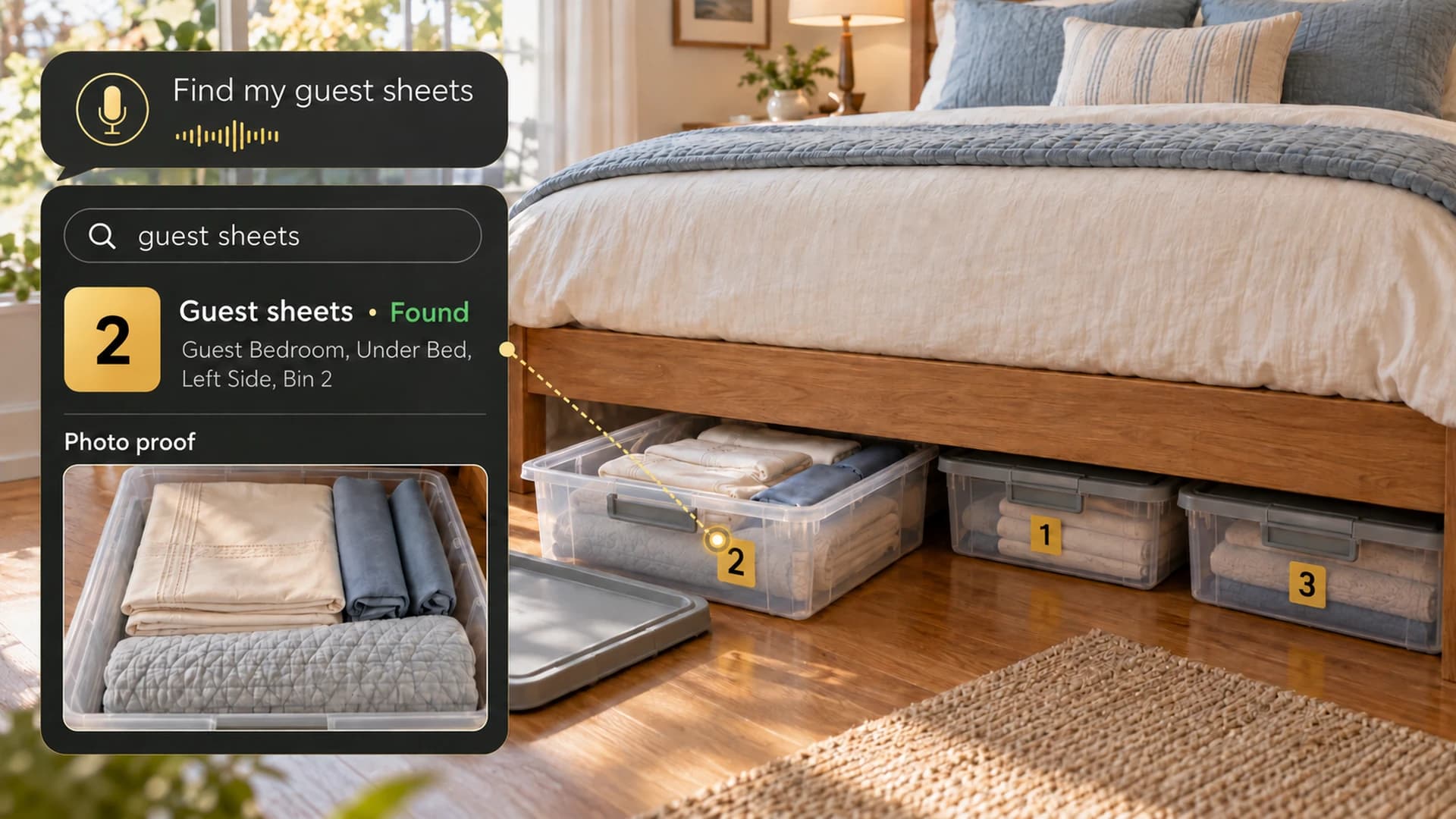
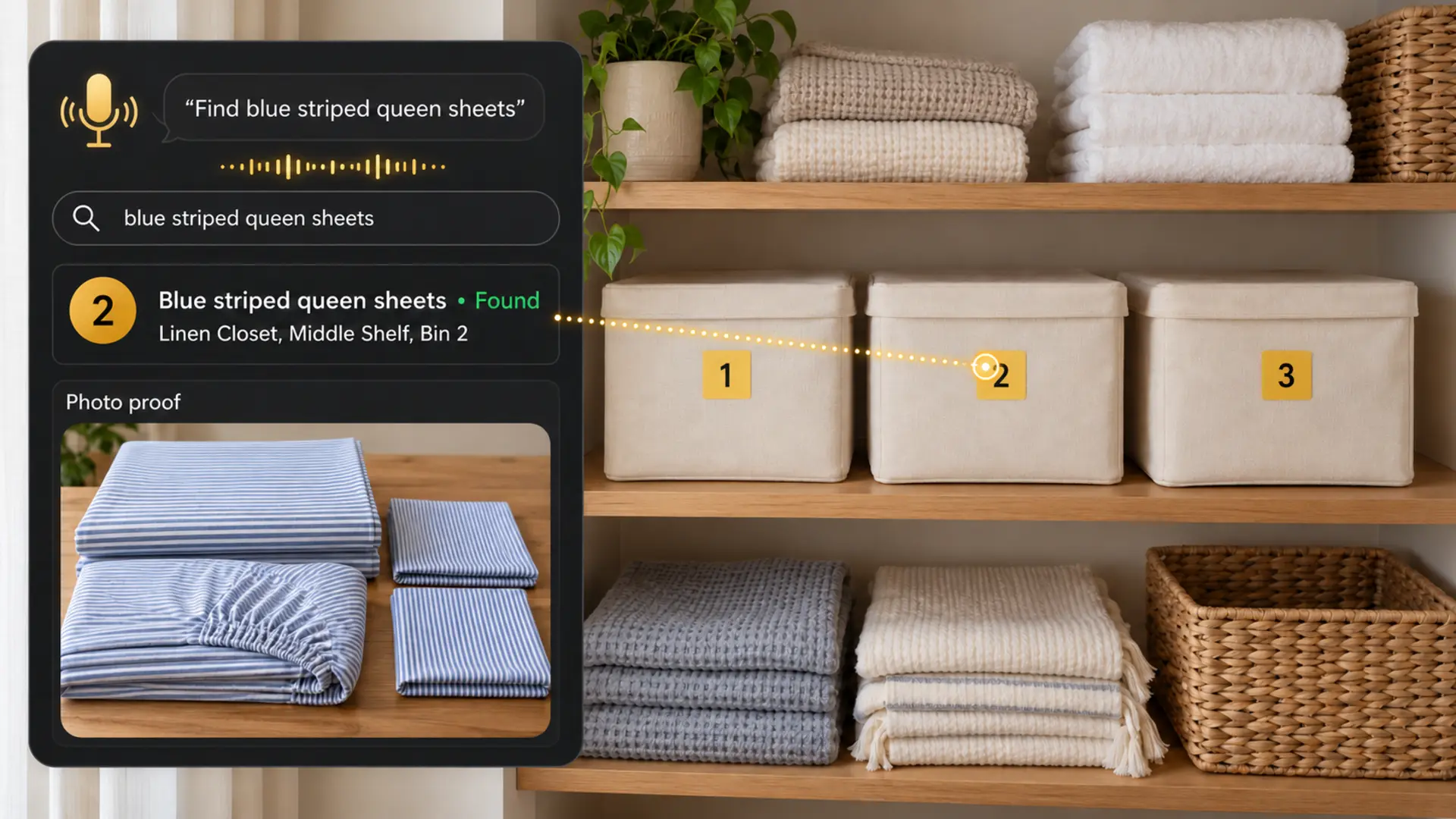
Give the outer container a simple visible number, such as 2. Take a reference photo while the pieces are visible, let Totely suggest an initial item list, and review it. Add the details the photo cannot establish: “blue striped queen sheets,” the pieces you checked, the bed they fit and any missing-item note.
Save an exact location such as “Linen Closet, Middle Shelf, Bin 2.” Later, type or say “blue striped queen sheets.” The saved number, location and photo proof help you identify the right bin before opening similar containers.
A photo of a closed pillowcase bundle cannot prove what is inside. Even an open-set photo does not establish mattress fit, fabric condition or current availability. Those details come from your checks and notes. Totely does not automatically know that a pillowcase went into the wash or that someone moved the bin.
You do not need QR codes, barcodes or manual entry of every linen item to start. One reviewed container record can be useful.
The One-Set Reset
Leave the rest of the cupboard alone for now.
- Choose one set you actually use.
- Check its size or known bed fit.
- Gather the pieces you expect, noting anything missing.
- Finish cleaning and drying as its care instructions require.
- Bundle it without forcing the fabric into a small wrapper.
- Put it in a suitable, accessible home.
- Number the outer container if needed, photograph the visible pieces and record the exact location.
- Find the set using that information, then update the record when it leaves or returns.
That is a reasonable place to stop. The next set can wait until the routine is working.
Bed Sheet Storage FAQs
What if the whole set will not fit inside a pillowcase?
Use a suitably sized cotton bag, a separate drawer section or another arrangement appropriate to the sheets. Keep the pieces grouped without forcing the closure. The pillowcase method is an option, not a requirement.
Do I need a flat sheet to make a complete stored set?
No. Define a complete set by what you actually use on that bed. If your household uses a fitted sheet and pillowcases without a flat sheet, record those pieces rather than treating the missing flat sheet as a problem.
How can I tell similar white sheet sets apart?
Check the actual size label, retained product details or known mattress fit, then keep a clear description with the bundle or its container record. Add a verified pocket-depth note when useful. Do not rely on color or a folded photograph to establish size.
Are sealed plastic bins or vacuum bags the best choice for sheets?
Not automatically. Follow the bedding maker's storage guidance and consider the material, dryness, location and how often you need access. A suitable breathable cotton bag is one alternative. Do not apply advice for ordinary sheets to every duvet, filled pillow or specialty textile.
What should I do if stored sheets smell musty?
Remove them and inspect the sheets, container and storage space. Follow the textiles' care instructions and address dampness or other storage problems before putting them back. Do not mark the set ready merely because a scent has been added.
How do I track sheets that are temporarily in the laundry?
Keep their usual home identifiable and add a temporary note to your paper index or digital record when that would help. If only one piece is out, name it. Check the set when it returns, then remove the note yourself.
Put Away a Set You Can Recognize
The useful result is not a flawless fold. It is opening the right place and finding the pieces that fit the bed.
Start with one clean, dry set. Keep it together, preserve the size information you actually know, and give it a home you can describe. A short note about the missing pillowcase is worth more than a beautiful but misleading stack.
Try the One-Tote Test with one linen bin. Stored, not lost.