How to Store Batteries Safely—and Find the Right Type
Learn how to store batteries in a dry indoor spot, separate ready, used and damaged cells, protect terminals, and find the right type later.
By Steve Watts · Co-Founder, Totely
November 14, 2026 · Updated November 14, 2026 · 9 min read
The smoke alarm starts chirping at bedtime. You know there is a new 9V battery somewhere, but the “battery drawer” contains loose AAs, expired packaging, a few used cells and three things that might be rechargeable. Finding the right battery has become a guessing game—and the drawer is not a safe storage plan.
Learning how to store batteries starts with physical separation, not labels or an app. Ready-to-use batteries need a dry indoor home. Used batteries need a route to a local collection program. A damaged or swollen rechargeable battery needs manufacturer or local-authority guidance, not a spot beside the good stock.
This guide covers ordinary household cells and small removable rechargeable packs. It does not cover vehicle batteries, e-bike batteries, whole-home energy systems, industrial battery rooms or shipping rules. Follow the instructions for the specific battery and device whenever they differ from general advice.
Quick Links
Start With Four Battery States
Do not pour every cell into one organizer. First decide what state it is in and what should happen next.
| State | What belongs here | Physical rule |
|---|---|---|
| Ready to use | Unopened household batteries or known-good spares | Keep the original packaging when practical, or use a purpose-made nonconductive holder that keeps cells controlled |
| Rechargeable set | Matched rechargeable cells or a removable pack with its instructions | Keep the set together and follow the battery or device maker's storage and charger guidance |
| Used for drop-off | Spent cells waiting for a local recycling or hazardous-waste route | Keep them separate from ready stock and prepare them as the local program directs |
| Damaged or stop-use | Swollen, leaking, cracked, unusually hot, discolored, odorous or noisy lithium-ion cells or packs | Stop using them; keep people away and contact the manufacturer, local fire authority or local waste program for situation-specific instructions |
The fourth state is not an organizing project. The U.S. Fire Administration says to stop using lithium-ion batteries that show warning signs such as unusual heat, shape changes, leakage, odor or odd noises. Do not put a questionable pack into the ready-stock case while you decide what to do.
For ordinary packaged cells, preserve the information that helps you use them correctly: size, chemistry, expiration or best-before date if shown, and any manufacturer instructions. A tidy tray is not an improvement if it removes the details you need.
Choose a Safer Storage Location
Health Canada’s household battery guidance recommends original packaging and a dry, secure, well-ventilated place at room temperature, away from heat, direct sunlight, household chemicals, food and medicine. Batteries should also stay out of children's sight and reach.
That makes an indoor utility closet, high hall-closet shelf or secured cabinet a better starting point than a hot garage, damp basement floor, sunny windowsill, shed or vehicle. The exact location still has to fit the product instructions and the people in the home.
| Location question | Better answer | Avoid |
|---|---|---|
| Is it dry and temperature-stable? | Interior shelf or cabinet at ordinary room temperature | Damp, freezing or high-heat storage |
| Can metal objects reach the terminals? | Packaging or a dedicated nonconductive holder | A loose junk drawer with keys, coins, paper clips or tools |
| Can a child or pet access it? | Secured, out-of-sight storage appropriate for the household | Open baskets, low drawers or food-storage areas |
| Does the battery need a specific charge state or inspection cycle? | Follow the battery or device maker's instructions | One universal percentage or schedule for every rechargeable product |
The refrigerator is not a universal battery-storage upgrade. Energizer's battery-care guidance recommends a cool, dry place at normal room temperature and says refrigeration is unnecessary.
Keep Terminals and Types Under Control
A battery case is useful only when it controls contact and preserves identity. Original retail packaging is a strong default because it keeps matched cells together and reduces accidental contact with metal. If the package is already open, use a holder designed for that battery size rather than a loose bag or mixed jar.
Give 9V batteries their own attention
A 9V battery has both terminals on the same end. A conductive object can bridge them. The Idaho Department of Insurance advises keeping 9V batteries in their original packaging until use; if one is loose, cover the posts with suitable tape and prevent contact with metal. Store 9V batteries apart from the junk-drawer objects that create the problem.
Keep coin and button cells inaccessible
Small batteries are not just miniature versions of an AA. Keep them in secure packaging, out of children's sight and reach, and follow the maker's instructions. If ingestion is suspected, treat it as an emergency and seek immediate medical help.
Follow the product for rechargeable packs
Power-tool, camera and other removable rechargeable packs can have different storage and charging requirements. Use the specified charger, keep the pack protected from crushing and heat, and follow the device or battery maker's long-term storage guidance. Do not invent one charge percentage for every product.
Build One Battery Station
Start with the batteries you actually use. This should take one small shelf or cabinet—not a whole-home overhaul.
- Gather only the ready-to-use stock. Leave used and questionable batteries out of the setup.
- Keep packages intact when practical. Group unopened AA, AAA, C, D, 9V and coin-cell packages without stripping away instructions.
- Give loose spares controlled slots. Use a nonconductive battery holder sized for the cell. Keep 9V terminals protected as the manufacturer or local authority directs.
- Separate rechargeable sets. Keep matched cells and compatible charger information together without storing everything on a live charger.
- Choose the indoor location. Save a precise address such as “Utility Closet • Upper Shelf,” not just “closet.”
- Add one maintenance trigger. Review the station when you open a new pack, retire a set, move the case or take used batteries to a collection point.
- Ready-stock check: Packaging or controlled slots are intact, types remain identifiable, and no used or damaged cell is mixed into the case.
- Location check: The case is dry, indoors, away from heat, direct sun, loose metal, chemicals, food and medicine, and inaccessible to children.
- Rechargeable check: Each pack or matched set follows its own maker instructions and stays with the correct charger information.
- Exit-route check: Used batteries have a separate, secure collection path and a known local drop-off destination.
This setup solves the immediate physical problem. The right batteries are protected, the wrong states are separated, and the storage location is deliberate.
Create a Used-Battery Exit Route
Used batteries should not drift back into the ready case. Give them a separate, secure collection point and decide where they will go before the container fills.
Disposal and recycling rules vary by battery chemistry and location. Check your municipality, retailer take-back program or approved battery-recycling service. Follow the program's instructions for terminal protection and transport. Do not assume that every battery belongs in household trash or curbside recycling.
If a battery is leaking, swollen, hot or otherwise damaged, do not treat it like an ordinary spent cell. Avoid handling it unnecessarily and contact the manufacturer, local fire authority or local hazardous-waste program for instructions that fit the condition.
Add a Searchable Memory Layer
Once the physical station is sound, the remaining problem is memory: which case holds the unopened 9V pack, and where did that case move after the last closet reorganization?
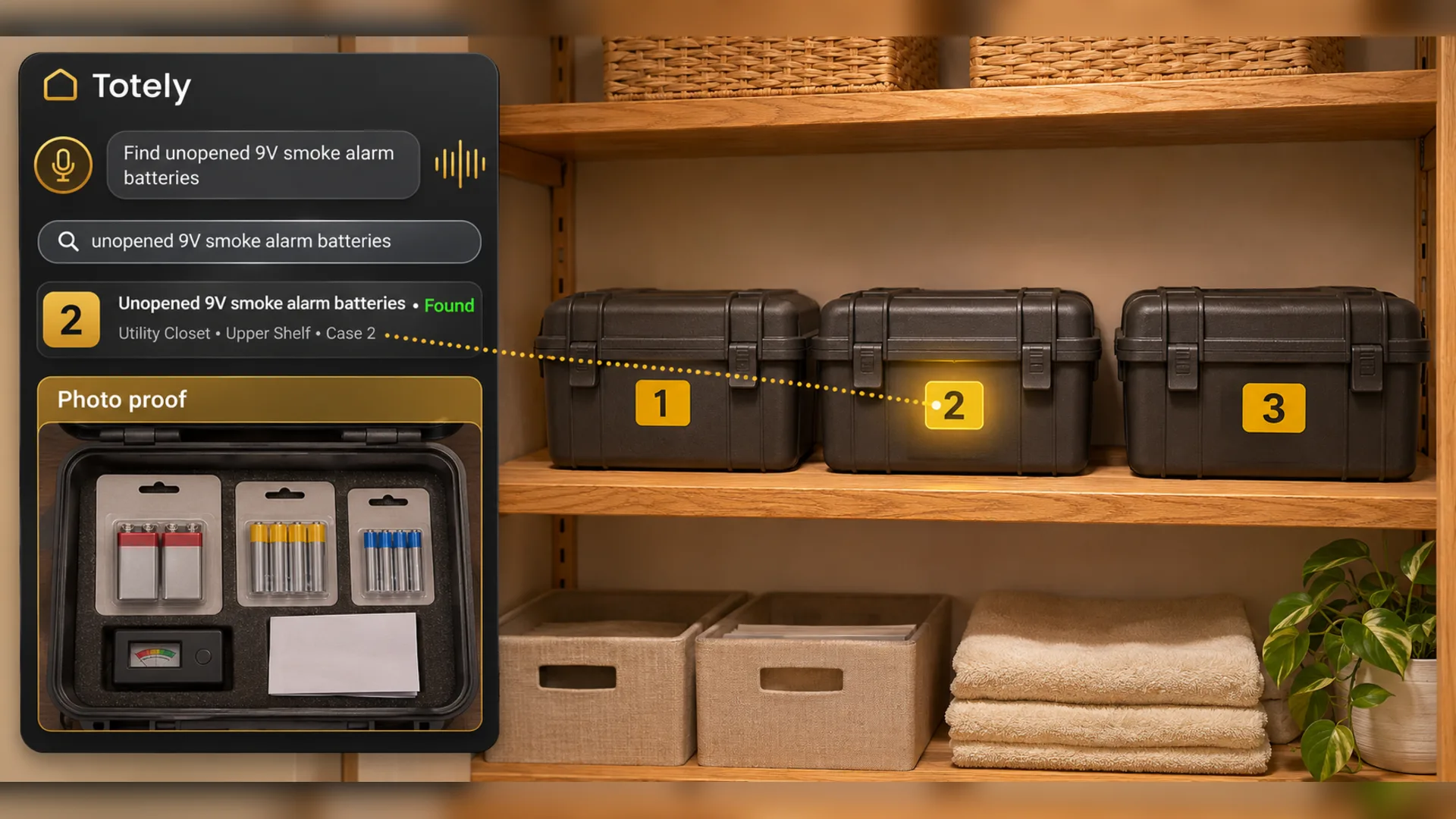
Totely can connect the physical station to a searchable record:
- Put a simple visible number on the ready-stock case, such as
2. - Photograph the safe, reviewed contents before closing it.
- Let Totely create a first item list from what it can see.
- Review and edit that list. Add the exact battery type in ordinary words if the photo is not specific enough.
- Save the exact location:
Utility Closet • Upper Shelf • Case 2. - Search naturally later:
unopened 9V smoke alarm batteries. - Confirm the case number, location and photo proof before opening storage.
For example, a search for unopened 9V smoke alarm batteries points to Case 2 at Utility Closet • Upper Shelf • Case 2. The photo proof shows the unopened 9V two-pack, unopened AA and AAA packages, and maker instruction card, so you can confirm the ready-stock case before opening it.
Totely is the memory layer, not the safety authority. It does not test charge, confirm chemistry, verify device compatibility, detect damage, certify storage conditions or decide how a battery must be recycled. The product's instructions and current local guidance still control those decisions. See the current Totely features and FAQ for the supported number-photo-review-location-search workflow.
If you already keep batteries with office or shipping backstock, the same exact-address idea can complement a broader home-office storage system. Tool batteries and accessories may fit a separate garage tool inventory, provided their manufacturer storage requirements come first.
Battery Storage FAQs
What is the best place to store household batteries?
Choose a dry, secure indoor location at ordinary room temperature, away from heat, direct sunlight, moisture, loose metal, household chemicals, food and medicine. Keep batteries out of children's sight and reach, and follow the battery maker's instructions.
Can I store batteries in a plastic container?
Use original packaging when practical. If packaging is no longer usable, choose a purpose-made nonconductive holder with controlled slots for the specific battery size. A loose plastic tub or bag can still allow batteries and terminals to contact one another.
Should batteries be stored in the refrigerator?
No universal guidance requires that. Major manufacturer guidance recommends a cool, dry place at normal room temperature and says refrigeration is unnecessary. Condensation can create another problem when cold batteries return to a warm room.
How should I store 9V batteries?
Keep 9V batteries in original packaging until use. If a 9V battery is loose, follow manufacturer or local fire-safety guidance for covering its adjacent terminals and keep it away from metal objects and other loose batteries.
Where should I keep used batteries before recycling?
Use a separate, secure collection point away from ready stock and children. Check the local collection program for chemistry-specific terminal, container and transport instructions. A damaged, leaking, swollen or hot battery needs situation-specific guidance rather than the ordinary used-battery bin.
Can Totely tell whether a battery is charged or safe?
No. Totely can help you find the numbered case, reviewed item record, saved location and photo proof. It does not test charge, identify every chemistry, confirm compatibility, assess damage or certify safe storage.
Start With One Safe Case
Choose one ready-stock case today. Remove used and questionable batteries, preserve the packaging and instructions, pick a dry indoor location, and write down the exact shelf. When the physical system is safe and clear, add the number-photo-location record that helps everyone find it again.