How to Fold an Air Mattress for Storage Without Damage
Learn how to deflate, fold or roll, bag, and store an air mattress with its pump, nozzles, patch kit, and exact shelf location.
By Steve Watts · Co-Founder, Totely
November 21, 2026 · Updated November 21, 2026 · 16 min read
An air mattress is easy to remember as one object. In storage, it is a small system: the mattress, its correct pump, the power cord or batteries, the nozzles, the repair patch, the storage bag, and the instructions that explain how this particular model should be packed.
That is why learning how to fold an air mattress is not about copying one universal rectangle. Some manufacturers show a specific fold sequence. Others direct owners to make loose folds or roll from a particular end. Built-in pumps and valve positions change where the bulky sections sit. The right method is the one in the instructions for the mattress you own.
Start with the physical job: clean and dry the mattress as directed, remove all the air, follow the model's fold-or-roll pattern, and store the complete set in a suitable location. Only then add a searchable record so the guest bed does not become a mystery bag with a missing pump.
Quick Links
- Read the Mattress Instructions First
- Prepare a Clean, Dry Work Area
- Deflate the Air Mattress Completely
- Choose the Correct Fold or Roll
- Fold or Roll Without Forcing the Material
- Build One Complete Guest-Bed Storage Station
- Choose the Storage Location
- Make the Air Mattress Searchable
- Air Mattress Storage FAQs
The Quick Answer: How Should You Fold an Air Mattress?
Remove the bedding, place the mattress on a clean surface, and deflate it using the valve or pump setting specified by its manufacturer. Gently move remaining air toward the open valve or approved deflation point without jumping, kneeling, or putting concentrated force on the mattress.
When the mattress lies flat, use its original creases, printed diagram, manual, or storage bag as your guide. Keep a built-in pump, valve housing, and cord compartment where the instructions place them. Make loose, even folds—or roll the mattress—without creating sharp creases or trapping pockets of air. Close the valve when directed, return the mattress to its bag, and store it in the dry, protected location its manufacturer specifies.
If the bag will not close with light, even pressure, stop. Do not solve a bad fold by cinching a strap harder, standing on the bag, or forcing the zipper. Reopen the mattress, check for trapped air, and compare the shape with the manual.
Read the Mattress Instructions First
Air mattresses can look interchangeable while using different valves, pumps, cord compartments, seams, and pack-away shapes. That makes the manual the first tool in the folding process.
Find the model name or number before the mattress disappears into a plain storage bag. Look for:
- the approved deflate setting or valve position
- whether the pump must stay connected, be removed, or be turned to a particular mode
- the end from which folding or rolling should begin
- the position of a built-in pump or cord compartment
- the specified cleaning and drying method
- the storage bag and location guidance
- warnings about heat, cold, sunlight, weight, sharp objects, or chemicals
The differences are visible in current first-party instructions. Decathlon's support guide gives a named-model sequence that folds the mattress to a chosen width and then rolls it toward the valve. A YAWN air-mattress manual uses a diagrammed series of folds. A separate airbed storage manual emphasizes clean, dry material and loose folds without sharp creases.
Those sources agree on careful deflation and protected storage, but not on one universal geometry. This guide therefore gives you a decision process, not a made-up fold count.
If the original instructions are missing, search the manufacturer's official support site using the exact model number. Do not assume a video for a similar-looking mattress uses the same pump or valve.
Prepare a Clean, Dry Work Area
Take off sheets, blankets, mattress pads, and fitted protectors. Store linens separately once they are clean and dry; the bed-sheet storage guide shows how to keep complete sets together.
Move the mattress to an open floor area large enough for it to lie flat. Before opening the valve:
- Sweep or vacuum grit from the surface.
- Remove toys, pet items, tools, jewelry, and anything with a sharp edge.
- Check that the route to the storage bag is clear.
- Put the pump, cord, nozzles, patch kit, and instructions in one temporary tray.
- Clean and dry the mattress only as its care instructions direct.
Do not fold a mattress simply because its surface feels dry. Seams, flocked surfaces, valves, and the underside can hold moisture. Use the manufacturer's drying guidance and inspect the full mattress before packing it.
This is also the easiest moment to notice a problem. Look over the seams, valve, pump housing, cord, plug, and surface. If the mattress leaks, the pump behaves abnormally, or electrical parts appear damaged, stop using it and follow the manufacturer's service guidance. Folding is not a repair.
Deflate the Air Mattress Completely
An air mattress cannot fold evenly while air is trapped between the layers. It also should not be emptied by methods the manufacturer does not approve.
For a mattress with a built-in pump
Set the control to the specified deflate position and connect power only as the instructions require. Stay with the mattress while it deflates. When the process is complete, return the control, plug, cord, and compartment cover to the positions shown in the manual.
For example, the Tzumi Cozi Air Mattress manual provides model-specific built-in-pump and cord-storage steps. Use that sequence only for the covered product, not as a substitute for another manufacturer's controls.
For a separate pump or manual valve
Open the correct deflation valve or connect the compatible pump to its approved deflate port. Keep the correct nozzle with the pump; a similar nozzle that does not seat properly is not a useful spare.
As the mattress settles, smooth broad sections toward the outlet with open hands. Work slowly across the surface rather than pressing hard at one seam or pump housing. Do not jump on the mattress, walk across it, or place a heavy object on top to force air out.
When the mattress lies flat, listen and feel for a remaining air pocket. If one section keeps rising, stop and confirm that the valve is fully open, the pump is in the correct mode, and the mattress is positioned as directed. A little patience now is easier than reopening a strained storage bag later.
Choose the Correct Fold or Roll
Use this table to identify the decision you need to make. The manual still controls the final method.
| What you have | First check | Pack-away approach | Keep with it |
|---|---|---|---|
| Built-in electric pump | Deflate setting, cord compartment, pump-side fold diagram | Place the pump housing where the diagram shows; do not force it into a sharp bend | Cord, model note, manual, repair patch |
| Detachable electric pump | Approved nozzle and deflate port | Remove the pump when directed, then fold or roll from the specified end | Pump, cord, every matching nozzle, patch kit |
| Rechargeable or battery pump | Battery and charging guidance | Store the mattress by its instructions and handle the pump separately as directed | Pump, charging cable or specified batteries, nozzles |
| Manual valve only | Valve position and closing step | Fold or roll toward the valve if the model instructions specify it | Cap or plug, patch kit, manual |
| Original bag or box still fits | Diagram, original creases, bag dimensions | Recreate the approved pack shape with light, even pressure | Complete accessory pouch and model note |
| Original bag is missing | Manufacturer replacement guidance and finished packed size | Use a suitable protective bag without compressing the mattress beyond its instructions | All companions in a secured pouch |
Do not use the storage bag as evidence that the fold is correct. A stretchy bag can hide trapped air, and an oversized container can hide a sharp crease. The packed mattress should reach its final shape without extreme compression.
Fold or Roll Without Forcing the Material
Once the mattress is fully deflated and positioned according to its instructions, work in broad sections.
If the manual shows folds
Smooth the mattress flat. Bring the specified side or end inward, keeping the edges aligned and the pump or valve in its shown position. Pause after each fold to move any remaining air toward the open outlet. Keep the fold relaxed rather than pinching it into a hard line.
Use original creases only when they match the current model instructions and are still easy to identify. Do not create a new accordion fold merely to make the package smaller.
If the manual shows a roll
Start at the end the manufacturer names and form a broad, even roll. Keep the sides aligned and let air escape through the open valve as you move. Do not tighten the center while leaving loose, ballooned edges.
The Decathlon guide linked above is a useful example of why direction matters: for the named Air Basic and Air Comfort models, the roll progresses toward the valve after the width is set. That is a model-specific instruction, not a rule for every air mattress.
If the packed shape looks wrong
Unfold it and diagnose the problem:
- A raised section: trapped air or a closed/blocked outlet
- A hard lump: pump housing, valve, cord, or folded accessory in the wrong place
- Edges that will not align: wrong starting direction or an uneven first fold
- A bag that will not close: trapped air, wrong geometry, or missing model guidance
- A cord caught in the fold: stop and return it to the approved compartment or companion pouch
Never hide the pump, nozzles, or repair tools inside an arbitrary fold unless the manufacturer designed a compartment for them. Loose hard objects can press against the mattress during storage.
Build One Complete Guest-Bed Storage Station
The physical system is not complete when the mattress fits in its bag. It is complete when someone can set up the bed without hunting for a pump or discovering that the only nozzle belongs to a pool float.
Keep the following pieces together:
Air mattress storage station
- Folded or rolled air mattress in its approved bag
- Correct pump for that exact mattress
- Power cord, charging cable, or batteries handled as directed
- Every matching nozzle adapter
- Manufacturer-supplied repair patch or approved repair kit
- Model name or number and official instructions
- Short condition note if the set needs service before the next use
Use a small zip pouch for the nozzles and repair patch. Attach or secure that pouch to the storage bag in a way that does not press hard components into the mattress. If the pump is too large for the bag, place it beside the mattress in the same shelf zone rather than in an unrelated utility bin.
Do not mix pumps because two nozzle tips look similar. Keep the pump and accessories that are approved for the actual mattress.
Name the station with a physical address another person can follow:
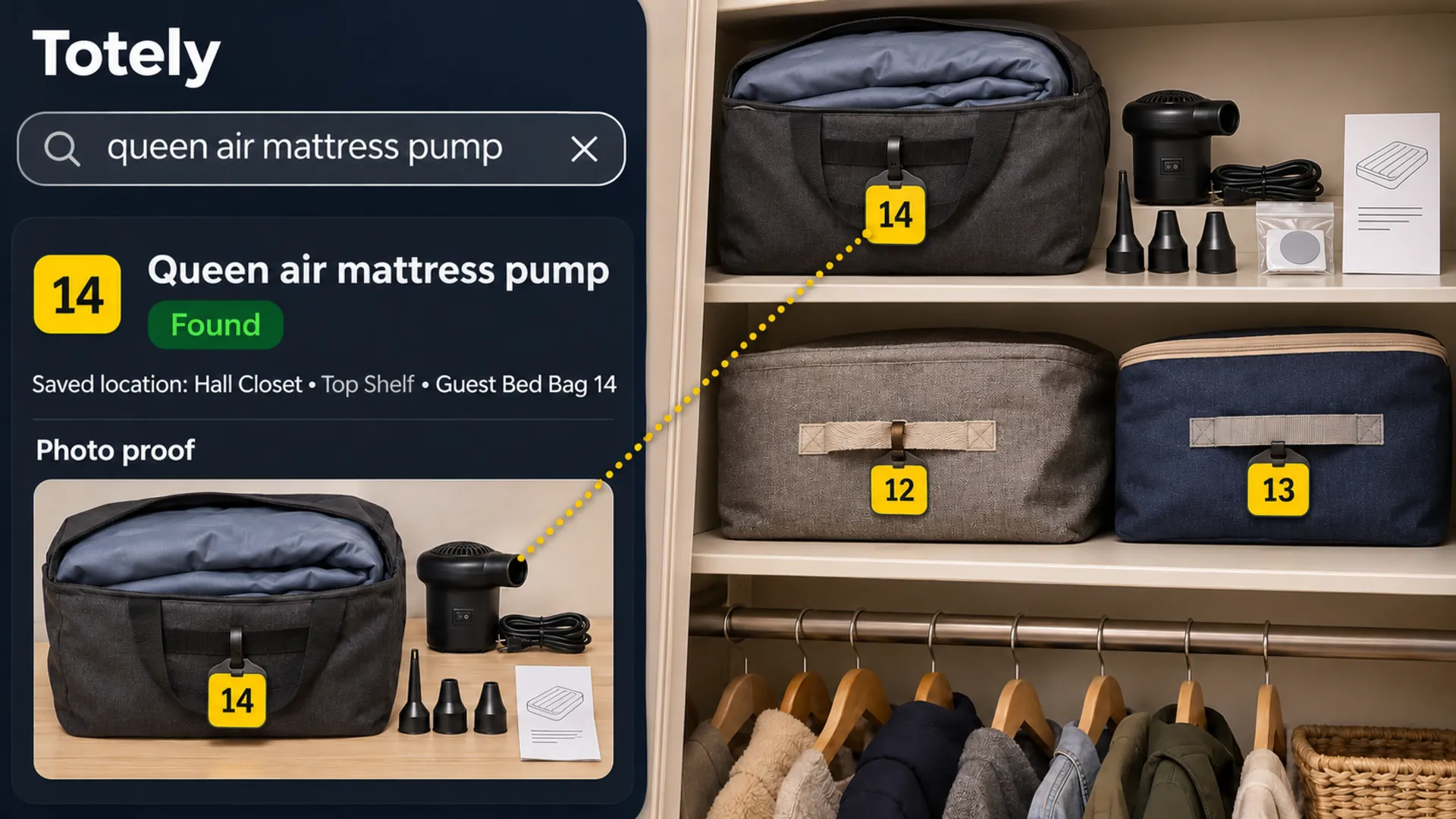
Hall Closet • Top Shelf • Guest Bed Bag 14
That is clearer than air mattress in closet. It tells a helper which closet, which shelf, and which bag.
Choose the Storage Location
Use the location guidance for the mattress you own. Current manufacturer manuals commonly call for a dry, protected place and warn against sharp objects, excessive weight, sunlight, or temperature extremes, but the exact limits and wording vary by product.
A useful storage location should be:
- indoors or otherwise protected as the manufacturer specifies
- clean and dry
- away from sharp shelf hardware and protruding fasteners
- free from heavy items that could compress or deform the packed mattress
- easy to reach without pulling down unrelated bins
- large enough for the approved bag without crushing it
- near enough to the guest linens that setup is straightforward
Do not invent a universal temperature range. A finished attic, unconditioned garage, basement, or outdoor shed can experience heat, cold, moisture, or pests that conflict with a particular manual. Choose the shelf after checking the actual space and instructions.
If closet space is limited, use the seasonal-storage guide for small homes to decide what deserves the easiest access. The apartment storage guide for renters can help identify reversible shelf and closet zones without adding permanent hardware.
Before walking away, lift the bag once. If the handle strains, the accessories shift, or retrieving it requires moving heavy objects overhead, revise the station.
Make the Air Mattress Searchable
At this point, the physical problem is solved. The mattress is packed by its own instructions, the correct pump and companions are together, and the bag has a safe shelf address.
Now remove the memory problem.
Place one visible yellow number on a stable part of the station, such as a rigid bag tag or shelf label. Do not cover a model number, warning, valve, vent, or zipper. Photograph the stored mattress, pump, cord, nozzles, patch pouch, and model card together.
In Totely's searchable storage system, that photo can become a first item list for you to review before saving. A useful record might include:
- queen air mattress in charcoal storage bag
- black electric pump
- coiled power cord
- three matching nozzle adapters
- repair patch in clear pouch
- model and instruction card
- exact location: Hall Closet • Top Shelf • Guest Bed Bag 14
Then search the words you naturally remember: queen air mattress pump, guest bed, air mattress nozzles, or repair patch. The result can point to number 14, the exact shelf address, and photo proof of the set you recorded.
Review the item list before saving. A photo may not reveal a model number, a patch hidden behind the pump, or whether a cable belongs to the mattress. Add only details you can verify. If the bag moves, update the location and photo.
Totely does not deflate the mattress, choose a safe fold, judge damage, pair an unverified pump, or track physical moves automatically. The numbered-photo record supports a working storage station; it does not replace the manual or your inspection.
Run the next-guest test
Ask another person to prepare the bed without coaching:
- Search for
queen air mattress pump. - Confirm the result shows number 14.
- Follow
Hall Closet • Top Shelf • Guest Bed Bag 14. - Match the physical bag and companions to the photo proof.
- Confirm the pump, cord, nozzles, and repair patch are present.
- Lift the bag safely without moving heavy neighboring items.
If they can retrieve the full set, the system works. If they find the mattress but not the pump, fix the physical station before editing the digital record.
Avoid These Air Mattress Storage Mistakes
- Copying a universal fold count. Use the model's diagram or instructions.
- Folding while air remains trapped. Reopen the valve or use the approved deflate mode, then work gently toward the outlet.
- Standing, jumping, or piling weight on the mattress. Do not force deflation or compression with concentrated weight.
- Packing damp material. Clean and dry the mattress only as directed before it enters the bag.
- Pinching the built-in pump or valve into a hard fold. Position bulky components exactly as the manual shows.
- Throwing loose nozzles into the mattress bag. Keep hard companions in a secured pouch or beside the bag.
- Using any pump that happens to fit. Store the approved pump and correct nozzle set with the mattress.
- Forcing the zipper or using a tight strap. Recheck trapped air and fold direction.
- Putting a heavy bin on top. Choose a dedicated shelf position without compressive loads.
- Saving a vague location.
Closetis not enough when the home has several closets and bags. - Treating number 14 as a care label. It identifies the station; it does not replace model, warning, or electrical information.
- Moving the bag without updating the record. The photo and address should match the physical setup you can retrieve today.
Air Mattress Storage FAQs
Should you fold or roll an air mattress?
Use the method in the instructions for your exact mattress. Some manuals show a multi-step fold, while others tell owners to fold to a set width and roll toward a valve. Pump and valve placement matter, so there is no safe universal answer based only on mattress size.
How do you get all the air out before folding?
Use the approved deflate setting, pump connection, or valve position. Let the mattress settle on a clean surface, then gently smooth broad sections toward the outlet. Do not jump on it, walk across it, or place heavy objects on top to force the air out.
Can you store an air mattress in a plastic tote?
Only if the mattress instructions allow the location and container conditions, the mattress is clean and dry, the tote is large enough for the approved packed shape, and nothing heavy or sharp presses against it. A tote does not make a damp, overheated, freezing, or pest-prone space suitable.
Where should an air mattress pump and nozzles be stored?
Keep the approved pump, cord or charging cable, and matching nozzles in the same physical station as the mattress. Use a secured accessory pouch or a clearly paired space beside the bag so hard pieces do not press into the mattress.
Can an air mattress be stored in a garage or attic?
Do not assume so. Garages and attics vary widely in temperature, moisture, sunlight, pests, and stored loads. Compare the actual space with the manufacturer's storage instructions. Choose a protected indoor shelf when the product guidance or local conditions make the garage or attic unsuitable.
What should you check before using a stored air mattress again?
Confirm that the mattress, correct pump, cord, nozzles, and repair materials are present. Inspect the surface, seams, valve, pump housing, cable, plug, and storage bag according to the manufacturer's guidance. If anything appears damaged or behaves abnormally, stop and use the official service or replacement guidance before setup.
A Fold Is Only the Middle of the System
The best air-mattress storage routine does three jobs in order. It protects the physical set by following the model's deflate and pack-away instructions. It keeps the pump and small companions with the mattress. Then it gives the complete station an exact address that someone else can search and verify.
Before the next guest arrives, run the retrieval test once. The goal is not the smallest possible bundle. It is a guest bed that comes out of storage complete, identifiable, and ready for the next manufacturer-approved setup.