How to Store Rugs Without Creases—or Losing Track of the Right One
Learn how to store rugs by construction, roll and support them safely, choose a suitable location, and find the exact wrapped rug later.
By Steve Watts · Co-Founder, Totely
November 17, 2026 · Updated November 17, 2026 · 16 min read
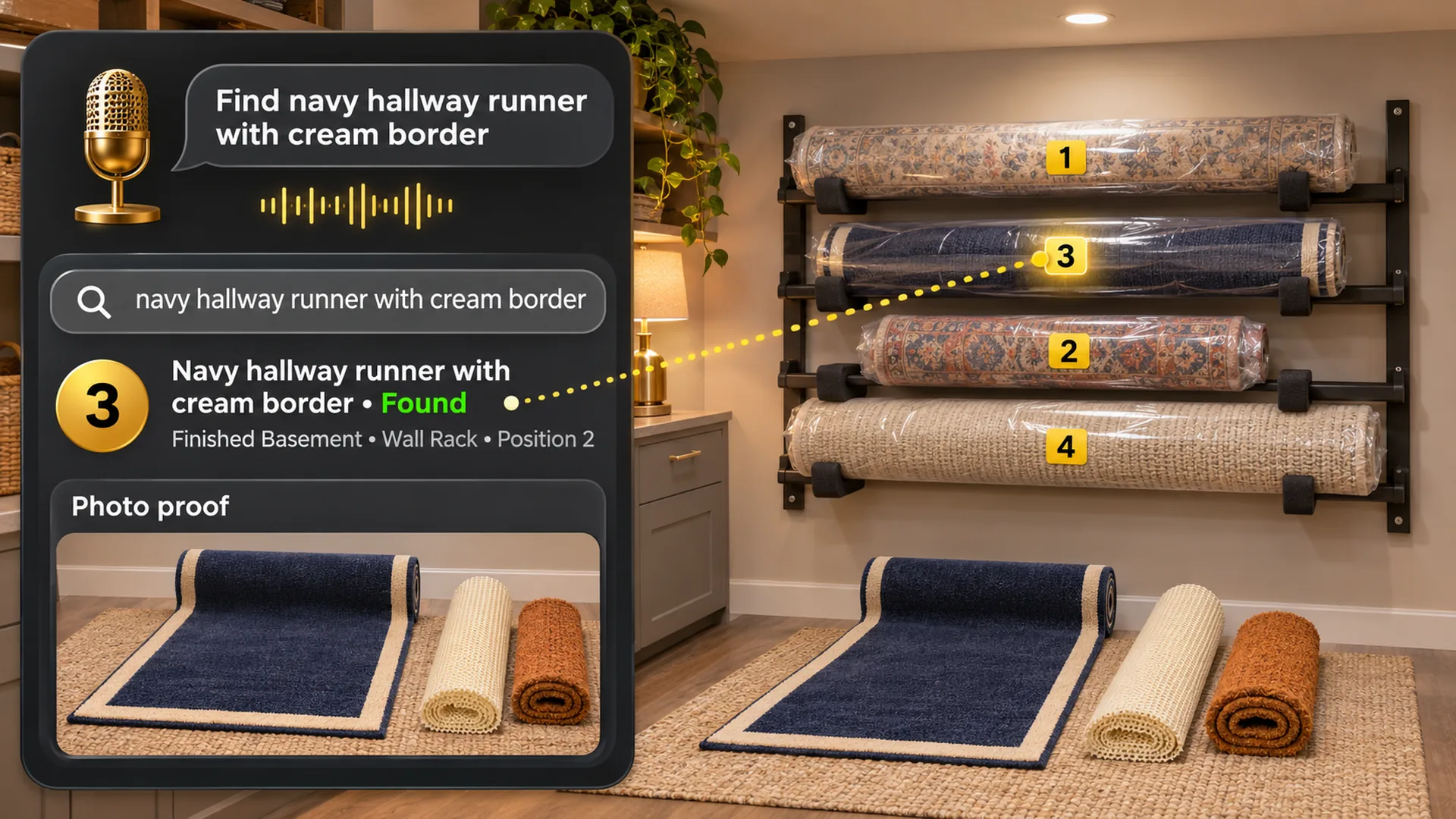
The navy hallway runner is somewhere in storage. Three long wrapped rolls are resting on the same rack, and the pattern that would identify it is hidden under the cover. Pulling each rug out to check feels like the only option.
Learning how to store rugs starts well before wrapping. Identify the rug's construction and condition, follow its care instructions, make sure it is clean and fully dry, then roll or support it in the way that suits that specific rug. Choose a stable location where the roll will not sit on the floor, bend under its own weight or disappear beneath heavier belongings.
Only after that physical setup works should you add a number, photo and exact location. The goal is not merely to put the rug away. It is to protect the rug and know which covered roll to retrieve later.
This guide is for ordinary household area rugs and runners. Valuable, antique, silk, damaged, unusually stiff or hand-made rugs may need advice from the manufacturer, a qualified rug specialist or a textile conservator. Generic storage advice does not override a care label or a professional assessment of the actual piece.
Quick Links
The Quick Answer: How Should You Store Rugs?
Check the rug's label or maker first. Clean it using the method approved for its material, allow it to dry completely, and inspect the backing, edges and pile before storage. Most flexible household rugs are better stored as an even roll than with a sharp fold, but roll direction, core, cover and orientation can vary by construction.
Support the entire length of the roll, keep it off the floor, protect it from dust and direct light, and avoid putting boxes or furniture on top. Choose a dry, stable indoor space rather than assuming a garage, attic or unfinished basement will be suitable.
For long-term or preservation-minded storage, the Winterthur Museum's 2024 handling guidance recommends rolling a rug evenly—not too tightly—separating the pad, supporting large rugs with several people and using an acid-free tube for long-term support. That is a useful high-care benchmark, not a requirement that every inexpensive household rug needs museum materials.
Decide How This Rug Should Be Stored
Do not begin with a roll of plastic or an empty corner. Answer four questions first.
- What is the rug made from, and how is it constructed? Check the label, receipt, maker's care page or other reliable product record. A flexible flatweave, a tufted rug with adhesive backing and a hand-knotted wool rug may not respond to bending or wrapping in the same way.
- What condition is it in now? Look for weak edges, loose backing, stiff areas, active staining, dampness, pest evidence or repairs. Stop if rolling could worsen damage.
- How long will it be stored? Moving a rug out of a room for a week is a different job from storing an heirloom for years.
- Where can the full roll be supported? Measure the available length, depth and clearance. A location is not suitable if the rug must bend around a corner, lean unstably or carry the weight of other belongings.
Use those answers to choose a starting point.
| Rug situation | Physical storage starting point | When to get specific advice | Record before covering |
|---|---|---|---|
| Flexible modern area rug with clear maker instructions | Follow the maker's roll direction, cover and location guidance | If the backing is cracked, unusually stiff or separating | Dimensions, material, pattern, room and condition photo |
| Thick-pile rug | Use an even, supported roll without crushing the pile | If the maker's direction is unclear | Pile direction, roll direction and core used |
| Rug with a separate pad | Roll and store the pad separately unless the maker says otherwise | If the pad is sticky, brittle or bonded to the rug | Rug number, pad number and pairing note |
| Large or heavy rug | Clear the route first and use enough people to support the full length | If the move cannot be made without dragging or sharp bends | Weight estimate if known, doorway route and final position |
| Antique, valuable, silk, damaged or unknown rug | Pause before cleaning, folding or tightly rolling | Manufacturer, qualified rug specialist or textile conservator | Condition photos, provenance kept elsewhere and professional instructions |
This decision is more important than copying a universal tutorial. Even first-party directions differ. For example, Shaw Floors' rug storage guidance says to roll its rugs with the backing side out, while Winterthur notes that some extra-thick pile may need the pile facing out. Those differences are exactly why the specific rug should control the method.
Prepare the Rug Before You Roll It
Identify the rug and its instructions
Before cleaning, save or photograph the care label and maker information. Record the rug's length and width, dominant colors, pattern, room and any matching pad. If several rugs are similar, add one detail you would actually remember: navy runner with cream border, rust living-room rug or round jute rug.
Do not rely on the wrapped roll to preserve this identity. Once covered, a 2-by-8 runner and a narrow bath rug can look surprisingly alike.
Clean only by an approved method
Remove loose surface soil using the maker's instructions. Do not invent a wet-cleaning recipe for an unknown rug. The Institute of Conservation's carpet and rug guidance warns that cleaning methods suitable for modern machine-made carpet may not be appropriate for hand-made rugs, and that wet cleaning depends on condition, composition and dye stability.
If the rug is fragile, stained, very valuable or outside your experience, ask a qualified specialist before cleaning. Storage is not the moment to test an unverified product on the full surface.
Let the rug dry completely
Do not wrap a damp rug. Confirm that the surface, backing and any thick pile are dry according to the maker's directions before moving on. If you cannot tell whether moisture remains after cleaning, get professional guidance rather than sealing the uncertainty inside a cover.
Photograph the rug while it is visible
Take one overview photo in even light and one closer image of the pattern or identifying edge. Add a condition note if there is an existing stain, worn corner or repaired fringe. These photos are not an appraisal and do not replace insurance documentation. They are practical proof of which rug is inside the eventual roll.
Roll and Support the Rug Without Forcing It
Roll rather than make a sharp fold—unless the rug requires an exception
For many flexible rugs, an even roll spreads stress more gently than a hard fold. The Institute of Conservation says folds can create weak areas and recommends a wide-diameter acid-free tube for preservation storage. Winterthur likewise recommends an acid-free tube for long-term support.
But not every rug should be forced around a core. A stiff backing can crack or distort if bent. Some rugs may be folded temporarily for transport under professional direction, then rolled for storage. If the rug resists, stop. Resistance is information, not an invitation to pull harder.
Use a clean core when the rug needs one
A core helps keep a long roll even and prevents the center from collapsing. For valuable or long-term storage, use the material and diameter recommended by the maker or conservator. Do not assume a random cardboard tube is chemically or structurally suitable for a delicate rug.
For ordinary short-term household storage, the rug's own instructions may permit a simpler supported roll. The essential point is to avoid a bent, tapered or over-tight cylinder.
Keep the roll straight and evenly supported
Clear enough floor space to lay the rug flat. Align the edges and roll slowly, correcting any sideways drift before it becomes a corkscrew. Do not cinch the roll so tightly that the backing or pile is compressed.
Large rugs need more than one person. Winterthur specifically advises several people to support the length and weight of a large rug. Plan the path, doorway turns and final rack position before lifting. Do not drag the rug by one end or let the center sag between two handlers.
Store the pad separately
If the rug has a removable pad, roll it separately unless its maker directs otherwise. Give the pad its own number or a clear pairing note such as Pad for Rug 3. Keeping the pair linked in the record prevents the pad from becoming an anonymous roll six months later.
Cover the Rug and Choose a Suitable Location
The cover should protect against dust, light and handling without becoming a source of dye transfer, abrasion or trapped moisture. Follow the maker's instructions for the covering material. Clean undyed cloth or a purpose-made cover is a common starting point; delicate or valuable rugs may require conservation-grade materials.
Do not wrap the roll so tightly that air cannot move where the maker expects it, and do not let tape or adhesive touch the rug. If pests, mold or active damage are suspected, isolate the item only under professional direction—the correct response can be different from ordinary storage.
Give the full roll stable support
Choose a rack, shelf or suspended support that carries the roll evenly. Keep it off concrete, tile or any floor where a leak, condensation or dirt could reach it. Never use the rug as a shelf for boxes.
For a heavy rug, horizontal support along the length is usually easier to stabilize than balancing it on one end. A manufacturer or conservator may approve another orientation for a particular construction. Whatever the orientation, the roll should not bow, slide or fall.
Prefer stable indoor conditions
A finished interior closet, spare room or other dry, stable space is usually a better starting point than an attic, shed, unfinished basement or garage with temperature and humidity swings. Avoid direct sunlight, exterior-wall dampness and heat sources.
If home conditions are unsuitable, compare professional or climate-controlled storage options. Ask what the facility actually controls, how the rug will be supported, whether the cover is included and how you can inspect or retrieve it. Climate controlled is not a substitute for understanding the facility's real conditions and rules.
| Location | What to verify | Main risk to avoid |
|---|---|---|
| Interior closet or spare room | Full-length clearance, dry floor, stable rack and no heat vent | Bending the roll to make it fit |
| Finished basement room | No dampness, leaks or direct floor contact; stable conditions | Assuming “finished” guarantees dryness |
| Garage, shed or attic | Maker approval, actual seasonal conditions and off-floor support | Heat, moisture or wide environmental swings |
| Storage unit | Facility conditions, rack dimensions, access order and inspection rules | Leaving the rug on concrete behind heavy furniture |
| Professional rug storage | Cleaning, cover, support, inspection, retrieval and documentation | Assuming every service uses the same preservation method |
Plan Storage for More Than One Rug
Four protected rolls can still become a retrieval problem. Build the rack around access, not just capacity.
- Measure the longest roll and the available support length.
- Give every rug and separate pad a unique simple number.
- Record the pattern, dimensions and former room before covering.
- Assign a stable position from left to right or top to bottom.
- Keep the next likely rug accessible without moving the heaviest roll first.
- Leave enough clearance to lift one roll without scraping its neighbor.
Use a short storage address:
- Room or zone: Finished Basement
- Rack: Wall Rack
- Position: 2
- Physical number: Rug 3
Then keep a small map.
| Physical number | Identifying description | Exact location | Pairing or handling note |
|---|---|---|---|
| Rug 1 | Rust 8 × 10 living-room rug | Finished Basement • Wall Rack • Position 1 | Heavy; use two people |
| Rug 2 | Round natural-fiber rug | Finished Basement • Wall Rack • Position 3 | Maker instructions saved |
| Rug 3 | Navy runner with cream border | Finished Basement • Wall Rack • Position 2 | Pad 3A stored directly above |
| Pad 3A | Cream non-slip pad for navy runner | Finished Basement • Wall Rack • Upper Position 2 | Pair with Rug 3 |
If a rug moves, update the location during the move. A perfect map from last season is not a current map.
For an off-site setup, the storage unit organization guide can help you preserve an aisle and retrieval order before the unit fills up.
Make Every Wrapped Rug Searchable
At this point, the physical storage problem is solved. Each rug has been identified, prepared according to its care needs, rolled or supported without forcing, covered appropriately and assigned a stable position.
Totely can add the digital memory layer:
- Put one simple visible number on each wrapped rug or approved storage cover.
- Photograph the rug before covering it, along with the matching pad and useful companions.
- Let Totely create the first item list from what it can see.
- Review and edit the record so color, pattern, dimensions, room and pad pairing are accurate.
- Save the exact location, such as
Finished Basement • Wall Rack • Position 2. - Search naturally later:
navy runner,cream border rugorhallway rug. - Confirm the number, saved location and photo proof before moving the other rolls.
In this example, navy hallway runner with cream border returns Rug 3 at Position 2. The photo proof shows the unwrapped runner beside its cream pad and the small rust doormat that was stored with it. You can identify the right roll without opening Rugs 1, 2 and 4.
Totely does not determine material, choose a cleaning method, verify dryness, appraise a rug, assess damage or replace maker and conservator guidance. It helps you find the reviewed record you created. See the current Totely features for the supported number, photo, reviewed-item-list, saved-location, natural-search and photo-proof workflow.
If a rug moves or the pad pairing changes, update the record immediately. Photo proof is useful only when it describes what is actually stored.
Retrieve and Inspect Without Undoing the System
Before taking a rug down, read its handling note and clear enough floor space to unroll it. Move neighboring rolls only when necessary and put them back in their recorded positions.
Use this return checklist:
- Confirm the physical number and photo proof before unwrapping.
- Check the cover and surrounding area for dampness, pests or damage.
- Use enough people to support the roll.
- Remove the cover without cutting toward the rug.
- Unroll on a clean surface and follow the maker's instructions before use.
- Inspect the backing, edges, pile and pad.
- Update the record if the rug returns to a room, moves to a new position or is no longer stored.
For valuable or damaged rugs, stop if you notice a new odor, staining, pest evidence, cracking, delamination or other change. A qualified specialist can advise on the next step.
Avoid Common Rug Storage Mistakes
Copying one roll direction for every rug
Pile, backing, construction and maker guidance vary. Record the direction chosen for the actual rug rather than turning a general rule into a universal one.
Cleaning with an unverified method
A cleaning recipe can damage a rug before storage begins. Follow the label or maker and get specialist advice for delicate, damaged or unknown pieces.
Wrapping before the rug is fully dry
A cover hides uncertainty. Confirm the rug is dry according to its care instructions before it disappears inside the roll.
Making a sharp fold to fit a short shelf
The shelf is the wrong size if the rug must be forced into it. Find full-length support or ask a specialist about the specific construction.
Standing a heavy roll without support
An unstable roll can fall, bend or become distorted. Use a support system designed for the rug's size and weight.
Stacking boxes on top
A wrapped rug is not a shelf. Keep weight and point pressure off the roll.
Writing only “Rugs” on every cover
Once the pattern is hidden, the label does not identify the piece. Use a simple number and keep the detailed description in a reviewed record.
Rug Storage FAQs
Is it better to roll or fold a rug for storage?
Rolling is generally the safer starting point for a flexible rug because a sharp fold can concentrate stress and create a crease. The rug's construction, condition and maker guidance still control. Do not force a stiff or damaged rug around a core; ask a qualified specialist when the correct method is unclear.
Which way should I roll an area rug?
There is no single direction for every rug. First-party and conservation guidance varies by pile thickness, backing and construction. Check the maker's instructions. For a valuable, antique, silk, damaged or unknown rug, get rug-specific professional advice and record the chosen direction in the storage note.
Can I store a rug in plastic?
Use the cover material specified by the maker or a qualified conservator. Tightly sealed plastic can trap moisture when the rug or environment is not completely dry, but some manufacturers may permit a loose plastic cover for particular products. Do not let the cover's dye, adhesive or tape contact the rug.
Can rugs be stored in a garage or attic?
Only if the rug's maker approves the conditions and you have verified that the space stays suitable. Garages and attics often experience heat, moisture or temperature swings. A dry, stable indoor space with full-length support is usually a better starting point.
Should a rug be stored horizontally or vertically?
The answer depends on weight, backing, support and manufacturer guidance. A heavy roll often benefits from even horizontal support along its length. Do not balance it unsupported on one end. Whatever orientation you use, keep it stable, off the floor and free from pressure.
How do I keep track of several wrapped rugs?
Give each rug and separate pad a unique number, photograph the rug while visible, record dimensions and pattern, and save an exact rack position. Search by a description you remember, such as navy runner with cream border, then confirm the number and photo proof before unwrapping. A one-container test is enough to prove the workflow with one rug before mapping the whole rack.
Start With One Rug
Choose the wrapped roll that would be hardest to identify later. Confirm its care instructions, photograph it while visible, record its dimensions and pad, and give the finished roll a simple number.
Then save one exact location and run one real search. That small retrieval test is more useful than building an elaborate rug catalog you will not maintain.
If the rug is part of a broader textile rotation, the blanket storage guide can help you keep folded soft goods separate from long supported rolls. For a wider household record, see how a photo-based home inventory app can start with one hidden storage problem at a time.