How to Store LEGO Sets Without Losing the Pieces—or the Build
Learn how to store LEGO sets by build state, keep manuals and known missing pieces connected, and save the exact bin and shelf for each set.
By Steve Watts · Co-Founder, Totely
November 13, 2026 · Updated November 13, 2026 · 13 min read
A LEGO model is finished on Saturday, partly dismantled on Tuesday and mixed into a deep toy bin by the weekend. The room may look tidier, but the set is no longer ready to rebuild. Its instructions are on another shelf, one wheel may be missing, and nobody can say which box holds the rest.
Useful LEGO set storage starts by deciding what state each build is in. An active build needs a work surface. A display model needs a stable home. A dismantled set needs its pieces kept together. Loose bricks need a sorting system that matches how people build. Only after those physical decisions work should you add a searchable record.
You do not need to count every brick in the house or buy a wall of matching drawers. Start with one set people want to find and rebuild.
Quick Links
Store LEGO by Build State
Do not force every brick, model and booklet into the same kind of container. Separate the collection by what should happen next.
| Current state | Storage goal | Practical starting point |
|---|---|---|
| Active build | Pause without losing the current step | Rimmed tray or project box with the loose pieces and instructions together |
| Finished display model | Keep the build recognizable and supported | Stable shelf or suitable enclosure with enough clearance for the model |
| Dismantled set to rebuild | Keep that set separate from other sets | One closed inner bag or pouch per set, inside a rigid outer bin if needed |
| Loose creative-building bricks | Make commonly used shapes easier to browse | Broad categories in shallow bins or drawers that suit the collection |
| Instruction booklets | Preserve the relationship to the right set | Sleeve, folder or file labeled with the set identity and stored location |
| Unmatched pieces | Stop guesses from contaminating reviewed sets | A small “to match” tray or bag for later identification |
This is usually a hybrid system. Rebuildable sets can stay together while general bricks are organized by type, size, color or a combination that works for the builder. LEGO's own guidance lists color, set, size and type as common sorting methods, and notes that the right storage depends on the chosen sort and the size of the collection.
The important boundary is simple: do not borrow from a set you intend to keep rebuildable without updating its status.
Build the Physical Storage System
Start on a clear table with one set. Have its booklet or identifying information nearby, plus a tray for pieces that do not belong.
1. Decide whether the set stays built
If it is on display, check the actual footprint, height and fragile projections before choosing a shelf. Leave enough room to lift the model without catching it on the shelf above. Follow the shelving or display product's assembly and load instructions.
If it will be dismantled, decide whether it should remain a complete set or become part of the loose-brick library. Both choices are valid. Trouble starts when the household assumes a mixed bin still contains a complete set.
2. Keep an active build on a contained surface
Use a tray, shallow project box or other rimmed surface large enough for the current model and the pieces for the next steps. Keep the matching instructions with it or record where they are. A lid can help when the project needs to move, but test the real model and pieces before relying on one.
Give abandoned builds a decision date. When that date arrives, either return the project to active status, display it, dismantle it as a set or move its pieces to the loose-brick collection. “Half built forever” is a storage state, but it is rarely a useful one.
3. Give every rebuildable set an inner container
Place the dismantled pieces for one set in one closed bag, pouch or small box. If the set needs more than one inner bag, mark them as a group: “Blue space rover, bag 1 of 2” and “bag 2 of 2.” The numbers describe your storage bags; they do not claim to reproduce the original factory bag sequence.
Add the set name or number shown on the instructions or packaging. Include the manual in a protected pocket only if it fits without bending. Otherwise, save the manual's separate location.
Several set bags can share a rigid outer bin. The inner separation is what keeps one set from becoming part of a mixed pile again.
4. Sort loose bricks for the way people build
Begin with broad groups that a person will actually return: bricks, plates, wheels, figures and accessories, or another small set of familiar categories. Split a category only when it becomes difficult to browse.
Sorting by color can be intuitive for some builders. Sorting by part type can make a specific shape easier to find in a larger collection. Sorting by set serves a different goal: keeping an official build together. There is no reason one household cannot use all three methods in different zones.
For the wider room, the toy storage bins guide covers broad play categories and maintainable cleanup. This article stays focused on LEGO set identity, build state and rebuildability.
5. Create a “to match” zone
Put unidentified bricks, figures and accessories in one temporary tray rather than guessing which set they belong to. Match them later using the correct instructions, packaging or another reliable reference.
Do not quietly drop an uncertain piece into a reviewed set bag. That turns an honest unknown into a false claim of completeness.
6. Label the outer container with one simple number
If several set bags share an opaque or crowded outer bin, give the outer bin one large visible number. Keep the number unique within the storage system. Avoid squeezing a complete inventory onto the outside label; it will go stale as sets move.
The storage-bin labeling guide explains placement and legibility for numbered containers.
7. Save the full storage address
“Playroom” is a room, not an address. Record enough detail for another person to go to the correct spot without asking what you meant.
| Too broad | More useful |
|---|---|
| Playroom | Playroom, Build Shelf, Bin 3 |
| Closet | Hall Closet, Upper Shelf, Bin 6 |
| Basement | Basement, Hobby Rack, Middle Shelf, Bin 12 |
If the inner set bag moves to a different numbered bin, update the address. A correct container number with an old room or shelf still sends someone to the wrong place.
Choose Containers That Fit the Job
Buy for the contents, not for the photograph on the package. Test one container with the actual set before buying multiples.
| Container | Useful for | Check before committing |
|---|---|---|
| Rimmed tray | Active builds and sorting sessions | Model and loose pieces remain inside when carried |
| Closed bag or pouch | One dismantled set or a group of related inner bags | Closure works; pieces do not press against the manual |
| Small rigid project box | Frequently used set or small active build | Lid clears the build and the filled box fits its shelf |
| Shallow drawer | Loose bricks sorted into broad groups | Hands can browse the layer and drawers open fully |
| Larger numbered bin | Several identified set bags or occasional builds | Inner groups stay separate; filled bin remains manageable |
| Shelf or enclosure | Finished display model | Footprint, height, retrieval clearance and support suit the model |
Clear containers can provide a useful preview, but visibility is not the same as an accurate inventory. Opaque containers can work well when their numbers and records are current.
Avoid treating ordinary bags or household bins as archival protection unless the manufacturer makes a supported claim for the exact product and use. For built models, avoid improvised hanging or unstable high placement. The physical setup should be easy to retrieve without moving a precarious stack.
Record What You Actually Checked
A bag labeled with a set name is not proof that every piece is present. Use notes that distinguish knowledge from assumption.
- Reviewed: you compared the visible set contents with the reference you chose on a specific date.
- Known missing: you identified a particular absent piece or group.
- Not checked: the set was stored together, but no complete comparison was performed.
- To match: pieces or a manual may belong to the set, but the relationship is not confirmed.
Write the limit of the review. “Four wheels, figure and instruction booklet seen; small parts not counted” is more useful than “complete.” A photograph can show the blue rover sections and its companions, but it cannot count hidden pieces or inspect closed inner bags.
If someone borrows a wheel or figure for another build, revise the note. Totely or any other inventory record can only reflect the information the household saves.
| Change | Honest update |
|---|---|
| One wheel is borrowed | “Known missing: one wheel moved to active vehicle build” |
| Set is dismantled but not counted | “Stored together; completeness not checked” |
| Unmatched figure is confirmed | Add the figure to the set record and update the review date |
| Entire set bag moves | Replace the saved bin and shelf address |
Store Instructions Without Losing the Connection
Instructions can live with the pieces when they fit safely, or in a separate file when they do not. LEGO's official storage guide suggests file storage, plastic wallets, folders and binders, and points to its building-instructions app.
If manuals are stored separately, use the same set name or number on both records:
- Set bag: “Blue space rover — Playroom, Build Shelf, Bin 3.”
- Manual: “Blue space rover instructions — Desk Cabinet, Manual File A.”
Do not depend on a theme name alone when several sets share similar artwork. Use the identifying number printed on the actual manual or box when available.
If the paper booklet is missing, start with LEGO's official building instructions search for the set you have. Confirm the set identity before saving a digital link. Do not assume a similar model uses the same steps or pieces.
Choose a Safe Storage Location
LEGO's official care guidance says to store bricks somewhere dry and away from heat sources, direct sunlight and temperatures above 104°F (40°C), because excessive heat may make bricks brittle or cause discoloration.
Use that as a product-specific boundary, not a guarantee that any closet, attic, garage or basement is suitable. Check the actual space for leaks, heat sources and direct sun. Follow the instructions for the shelves, drawers, bags and display products you use.
For display models, make retrieval part of the location decision. A beautiful shelf that requires reaching over other fragile builds is not an easy storage system. Leave a stable path for lifting the model out and returning it.
The One-Set Starter Method
Choose one set people ask for or one active build that keeps losing pieces.
- Decide its state: active, displayed, rebuildable, loose or to match.
- Put its physical pieces in a container that suits that state.
- Keep the manual with it or record the manual's separate address.
- Write the set name or number and the number of inner bags.
- Record reviewed, known missing, not checked or to match.
- If it shares an outer bin, put one large unique number on that bin.
- Take one clear reference photo while the relevant contents are visible.
- Save the exact room, zone, shelf and bin.
- Ask another person to find the set and return it from the record alone.
If that person can retrieve the correct blue space rover set without opening three other bins, the system works. Add another set when the first record still matches reality.
How Totely Helps
Totely adds a searchable memory layer after the physical LEGO storage system is usable.
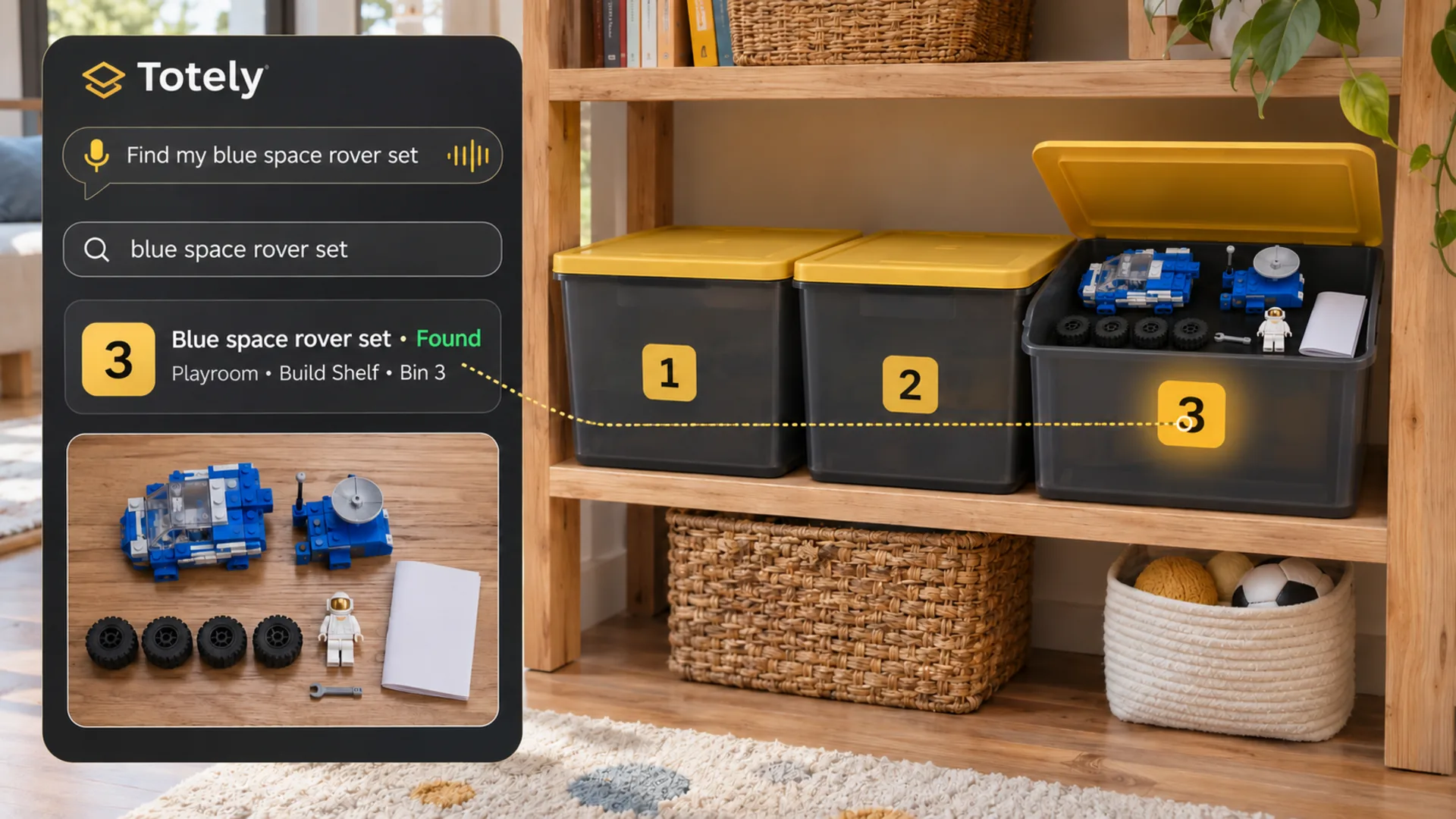
Give the outer project bin a visible number, such as 3, and take a clear photo of the reviewed contents before closing it. Totely can build a first item list from what it can see. Review and edit that list before saving. Add the set identity, inner bag count, manual location and an honest note such as “four wheels and figure seen; small pieces not counted.”
Save Playroom, Build Shelf, Bin 3 as the exact location. Later, a natural search for “blue space rover set” can point to the numbered bin and show the saved photo proof before you open other containers.
Totely does not count every brick, certify that a set is complete or know that a piece moved to another build. Those judgments stay with the person reviewing the set. The value is keeping the number, photo, reviewed item list and exact location connected so the right physical container is easier to retrieve.
For the household update habit, see how to keep track of storage bins.
LEGO Set Storage FAQs
What is the best way to store LEGO sets?
Store by build state. Give active builds a contained work surface, display models a stable supported location, dismantled rebuildable sets their own closed inner containers, loose bricks a maintainable sorting system and unmatched pieces a temporary tray.
Should LEGO sets be stored together or sorted by color?
Use set-based storage for models you want to rebuild. Color or part-type sorting can work for loose creative-building bricks. A hybrid system can keep selected sets intact while the general brick collection is sorted another way.
How do I store a dismantled LEGO set?
Keep one set in one labeled bag, pouch or small box. If it needs several inner bags, mark the set name and “1 of 2,” “2 of 2.” Put those bags in a rigid outer bin if they need support, and record whether completeness was reviewed or not checked.
How should I store LEGO instruction manuals?
Keep the booklet with the set only when it fits without bending. Otherwise, use a sleeve, folder or file and record the same set identity plus the manual's exact location. Confirm any replacement digital instructions against the actual set number.
Can a photo tell me whether a LEGO set is complete?
No. A photo can help identify visible pieces and the right container, but it cannot count hidden bricks or inspect closed bags. Record exactly what you reviewed, any known missing pieces and what remains unchecked.
Make the Next Rebuild Possible
The goal is not a perfect wall of sorted plastic. It is a collection whose current state is clear: this model is active, this one stays on display, this bag is ready to rebuild, these pieces are loose and this part still needs a match.
Solve those physical decisions first. Then connect the set to one honest note, one numbered container, one useful photo and one exact location. That is enough to stop a favorite build from disappearing into a tidy-looking mystery bin.