How to Store Patio Cushions Without Trapping Moisture
Learn how to clean, dry, map, pack, and store patio cushions as one complete set with an exact bag, box, shelf, and photo-proof location.
By Steve Watts · Co-Founder, Totely
November 22, 2026 · Updated November 22, 2026 · 15 min read
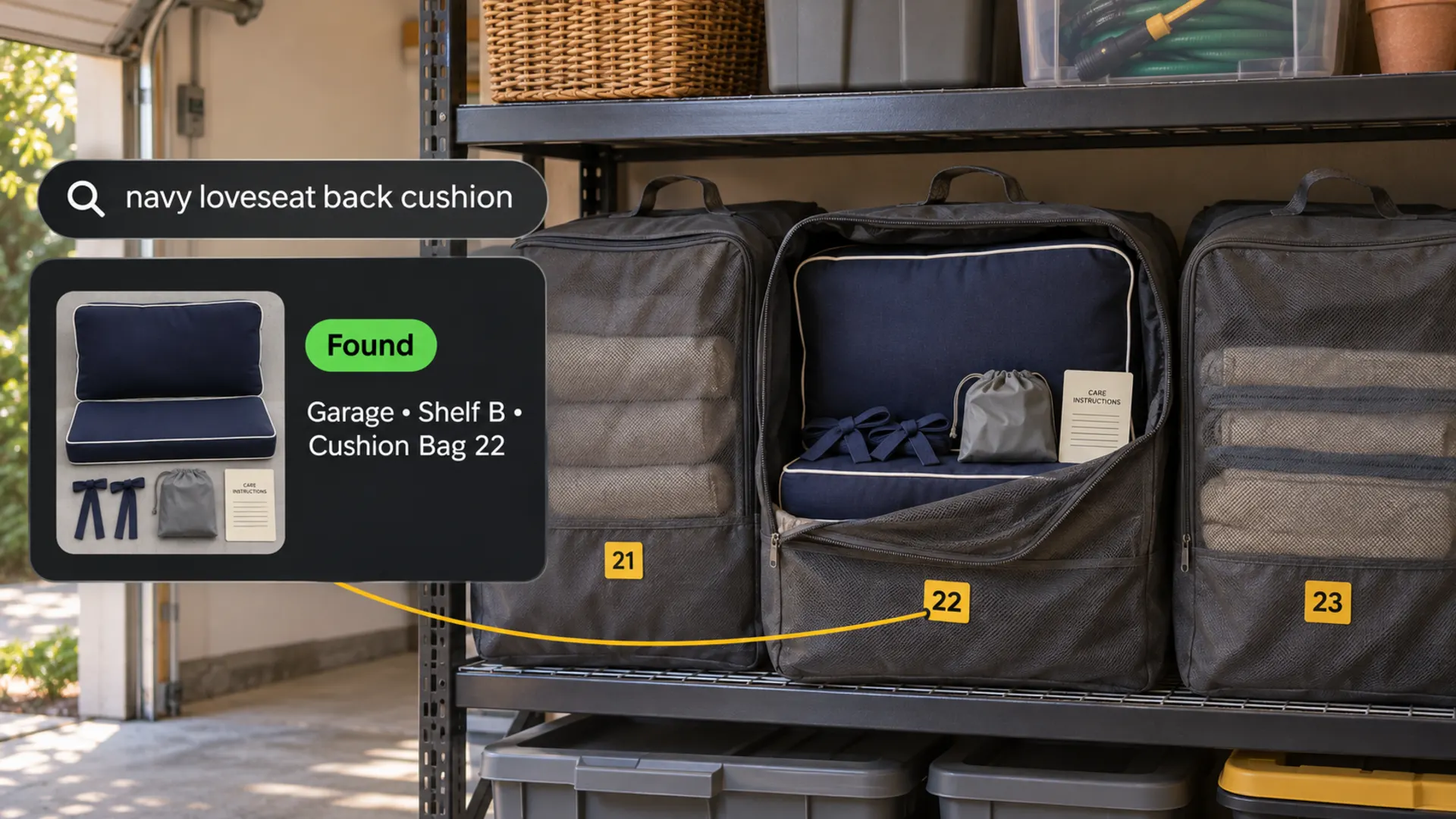
Patio cushions rarely disappear one at a time. They disappear as a system.
The seat cushions may be in a deck box. The matching back cushions are balanced on a garage shelf. Furniture ties are in a drawer, the weather cover is folded somewhere else, and nobody remembers whether the long navy cushion belongs to the loveseat or the corner of the sectional.
The right way to store patio cushions starts before anything goes into a bag or box. Map the complete furniture set, follow the care label for each cushion, let every layer dry completely, dry-fit the entire group without crushing it, keep the small companions together, and assign one exact physical address.
Only after that physical system works should you add a searchable record. A good photo and location can help you retrieve the right cushion later, but they cannot make a damp, overfilled storage bag safe.
Quick Links
- The Quick Answer
- Map the Patio Set Before You Move It
- Read the Care Label Before Cleaning
- Dry the Cushion, Not Just the Surface
- Choose a Storage Method That Fits the Full Set
- Build One Complete Cushion Station
- Give the Station an Exact Address
- Make One Cushion Searchable
- Run a Retrieval and Return Test
- Patio Cushion Storage FAQs
The Quick Answer: How Should You Store Patio Cushions?
Photograph the assembled patio furniture first so you can see where each seat, back, corner, lumbar, and accent cushion belongs. Count the pieces and note any ties, covers, inserts, or care information that must stay with the set.
Next, follow the actual care label or manufacturer instructions. Clean only as directed, then let the covers and inner cushions dry completely. Do not treat a dry surface as proof that seams, piping, zippers, or the cushion core are ready for storage.
Dry-fit the whole set in its intended bag, deck box, cabinet, closet, garage, or shed location. The container should close without forcing the lid, bending thick cushions into sharp folds, or stacking heavy objects on top. Use the cool, dry, protected location the manufacturer specifies.
Keep matching ties, a furniture cover, and care information in a secured companion pouch. Assign the station an exact address such as:
Garage • Shelf B • Cushion Bag 22
Then add a visible number, a reviewed item list, and a photo showing the stored cushions and companions together. Test the system by asking someone to find one specific cushion—such as the navy loveseat back cushion—and put the complete set back in the correct place.
Map the Patio Set Before You Move It
Before removing a cushion, take one clear photo of the furniture fully assembled. If you have a sectional or several matching chairs, take a second photo from above or from the opposite corner.
The goal is not a styled patio picture. It is a return map.
Count each piece by function and position:
- loveseat left seat cushion
- loveseat right seat cushion
- loveseat left back cushion
- loveseat right back cushion
- chair 1 seat and back
- chair 2 seat and back
- sectional corner wedge
- lumbar or accent pillows
- ties, straps, clips, inserts, or non-slip pads
- fitted weather cover or individual furniture covers
If two pieces look almost identical, compare their seams, piping, dimensions, tie placement, label, or model information while the set is still assembled. Do not depend on memory after every cushion is stacked in the garage.
A simple temporary note is enough:
| Furniture piece | Cushions expected | Small companions | Condition note |
|---|---|---|---|
| Navy loveseat | 2 seats + 2 backs | 4 ties, loveseat cover | right back has small mark |
| Navy lounge chair 1 | 1 seat + 1 back | 2 ties | ready to store |
| Navy lounge chair 2 | 1 seat + 1 back | 2 ties | inspect bottom seam |
This is the first completeness check. If the map says eight cushions and only seven reach the storage area, stop before packing. Find the missing piece while the patio setup is still fresh in your mind.
Read the Care Label Before Cleaning
Outdoor cushions can use different fabrics, coatings, liners, foam constructions, removable covers, and drainage designs. A cleaning method that is correct for one model can be wrong for another.
Check the sewn-in label and the official instructions for:
- whether the cover may be removed
- whether the cover or inner cushion may be machine washed
- the approved water temperature and detergent
- whether bleach, solvents, abrasives, or pressure washing are prohibited
- whether tumble drying is allowed
- how the cushion should be positioned while drying
- whether a protector or other treatment is approved
- the recommended off-season storage environment
Harbour Lifestyle's cushion care guide warns that an inner liner may be difficult to refit and says machine washing is suitable only when the label confirms it. IKEA Canada's patio-cushion guide also separates instructions by product and tells owners to follow the care label.
That is the useful rule: treat the label as the instruction for the cushion you own. Do not substitute a universal online recipe.
If the label is missing, look for the furniture brand and model before cleaning. Save the official care page or manual with the set. If you cannot verify a cleaning method, limit the work to what the manufacturer supports or contact the manufacturer.
Dry the Cushion, Not Just the Surface
Storage begins only when the cushion is completely dry according to its instructions.
A cover can feel dry while moisture remains around piping, a zipper, a seam, a fold, or the inner cushion. Give the set enough time and airflow to dry. Turn or position each cushion only as its care guidance allows, and check the underside before packing.
Several first-party sources make this drying gate explicit:
- Restoration Hardware's outdoor-cushion care sheet says cushions must be completely clean and dry before storage and gives zipper-down drainage guidance for wet cushions.
- IKEA's VRENEN storage-box manual says stored outdoor cushions and pads must be completely dry before they go into the box.
- Cinas cushion instructions recommend a dry indoor winter location and warn against folding or rolling cushions too tightly.
These are product or brand instructions, not permission to copy every step to every cushion. Use them as evidence for the general decision point: storage does not fix hidden moisture, and the actual label still controls the cleaning and drying method.
Before packing, check:
- both broad faces
- every edge and corner
- piping and stitched channels
- the zipper area
- tie attachment points
- the inner cushion when its instructions allow inspection
- the underside of the storage bag or box
If any part is damp, return the cushion to the approved drying position. Do not seal one questionable cushion in the middle of a dry stack.
Choose a Storage Method That Fits the Full Set
Choose the container and location after you know how many cushions you have and how the manufacturer says to store them. The right method is the one that keeps the complete set dry, protected, supported, and retrievable without crushing it.
Dry-fit the whole set before you commit. Load the cushions in their natural shape unless their instructions say otherwise. Close the lid or zipper with light, even pressure. If the container bulges, the lid rests on the foam, or a thick cushion must be bent into a hard crease, use a larger container or divide the set into clearly linked stations.
| Storage method | Works best when | Check before using it | Keep the set findable by |
|---|---|---|---|
| Deck box | Cushions are used often and the approved box fits the full set | Water entry, ventilation, internal dimensions, lid clearance, manufacturer guidance | one numbered box plus a position map |
| Breathable cushion bag on shelving | A dry indoor, garage, or shed shelf is available | label guidance, shelf stability, floor clearance, no heavy objects above | one numbered bag and exact shelf address |
| Indoor closet or utility area | The set fits without blocking household access | clean, dry space; no sharp hardware; enough room for natural cushion shape | one shelf zone and secured companion pouch |
| Dry garage or shed | The actual space meets the cushion and bag requirements | leaks, condensation, pests, sharp tools, temperature or moisture concerns | named shelf, numbered station, periodic check |
| More than one bag | One bag would overfill or distort the set | both bags use the same set name and piece count | linked numbers such as Bags 22A and 22B |
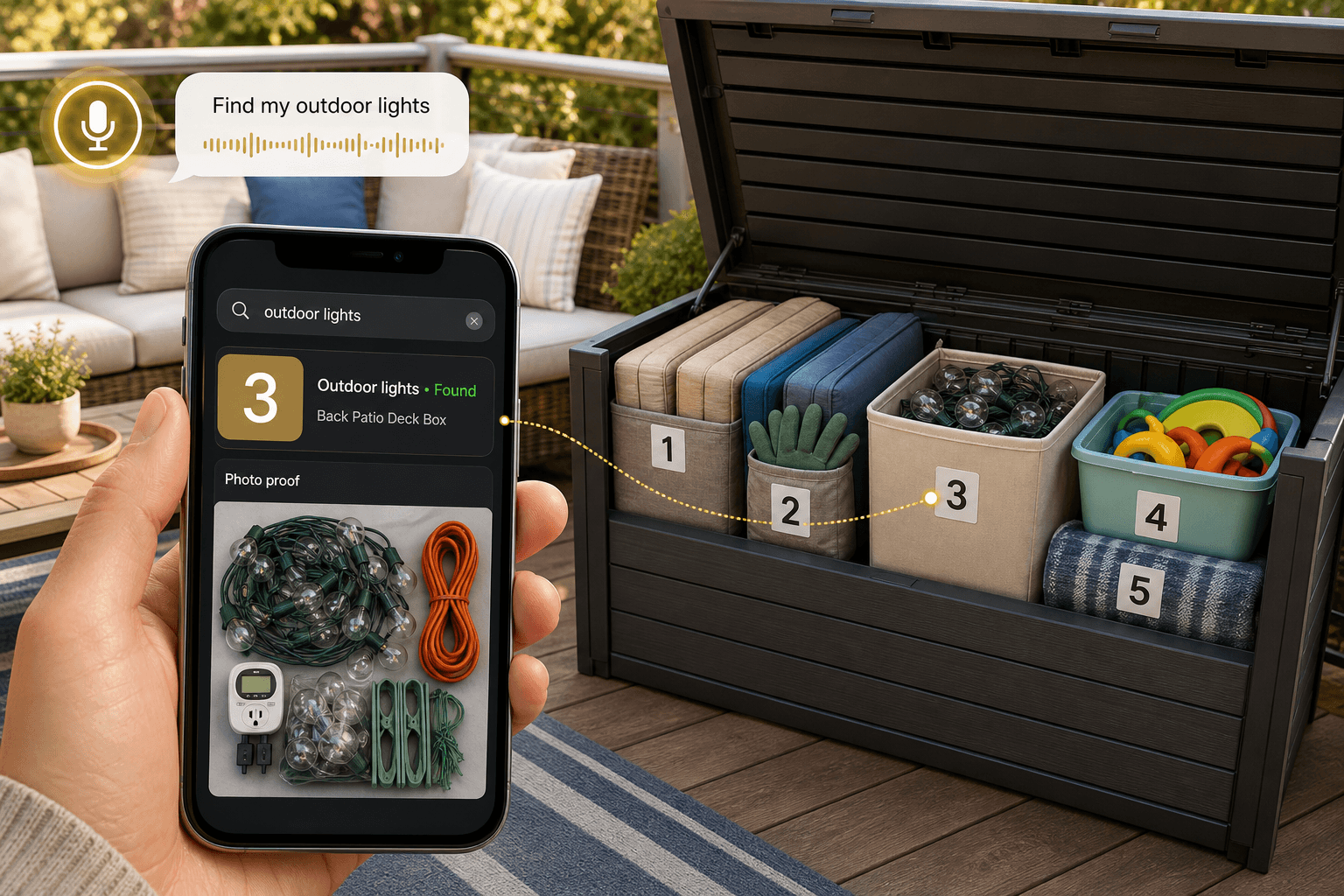
If a deck box is the best physical option, use the deck storage-box guide to plan zones without turning the box into one large pile. For off-season decisions in a tight home, the seasonal-storage guide can help you choose which items deserve the easiest access.
Do not advertise an outdoor container to yourself as “waterproof” unless its actual instructions support that claim and your setup meets its placement requirements. A box cannot compensate for a wet cushion, a leaking location, blocked ventilation, or an overfilled lid.
Build One Complete Cushion Station
The physical system is complete when every cushion and every necessary companion has one defined home.
Patio cushion storage station
- Every seat, back, corner, lumbar, and accent cushion from the set
- Furniture-position map or assembled reference photo
- Matching ties, straps, clips, inserts, and non-slip pads
- Correct weather cover or individual furniture covers
- Care label photo, official manual, or model note
- Short condition note for any stain, seam, insert, or repair to address
- One suitable bag, box, cabinet zone, or shelf location
Put loose companions in a small pouch so they do not fall behind a shelf or disappear under the cushions. Secure the pouch to the station without placing a hard buckle, tool, or fastener against the fabric or foam.
Do not combine two patio sets simply because their cushions share a color. A navy loveseat back may fit into the wrong bag while still looking plausible. Use furniture position, model information, dimensions, or distinctive details to keep the sets separate.
If the complete set needs two bags, write the division before packing:
Patio Set • Bag 22A • Loveseat seats and backsPatio Set • Bag 22B • Two chairs, ties, and cover pouch
That is one linked station, not two mystery bags.
Give the Station an Exact Address
“In the garage” is not a storage location. It is a building.
A useful address moves from the broadest place to the smallest retrievable unit:
Garage • Shelf B • Cushion Bag 22
Other examples:
Hall Closet • Upper Shelf • Patio Bag 7Garden Shed • North Wall Rack • Cushion Bag 4Deck • Bench Box • Left Zone • Cushion Set 2
Use terms that are already visible in the room. If the garage has no Shelf B, add a small shelf marker or choose a description such as Garage • Back Wall • Middle Shelf. Do not invent a precise-sounding address that a helper cannot follow.
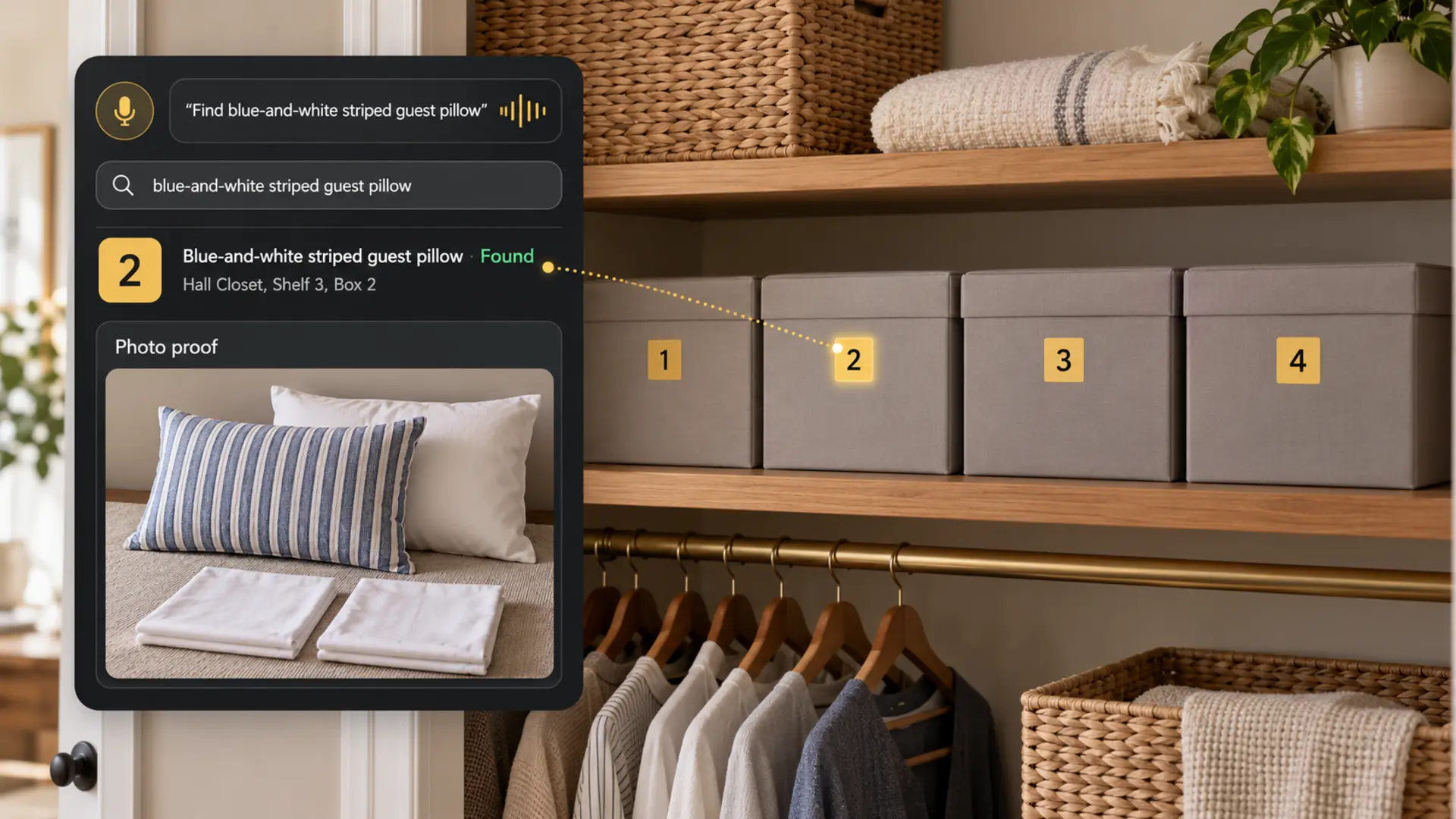
Place one yellow number on a stable, visible tag or surface. Do not cover a care label, zipper, vent, handle, or warning. If the bag is soft, a rigid hanging tag may be more stable than a sticker placed directly on fabric.
The storage-bin labeling guide can help you choose a number that stays readable without turning the outside of the bag into a long contents list.
Make One Cushion Searchable
At this point, the storage problem is already solved. The cushions are mapped, cleaned and dried by their instructions, packed without crushing, grouped with their companions, and assigned a real physical address.
Now remove the memory problem.
Take one wide photo that shows:
- the selected cushion clearly enough to recognize it
- the matching pieces in the set
- the companion pouch and care card
- the yellow number on the physical station
- enough surrounding shelf context to confirm the location
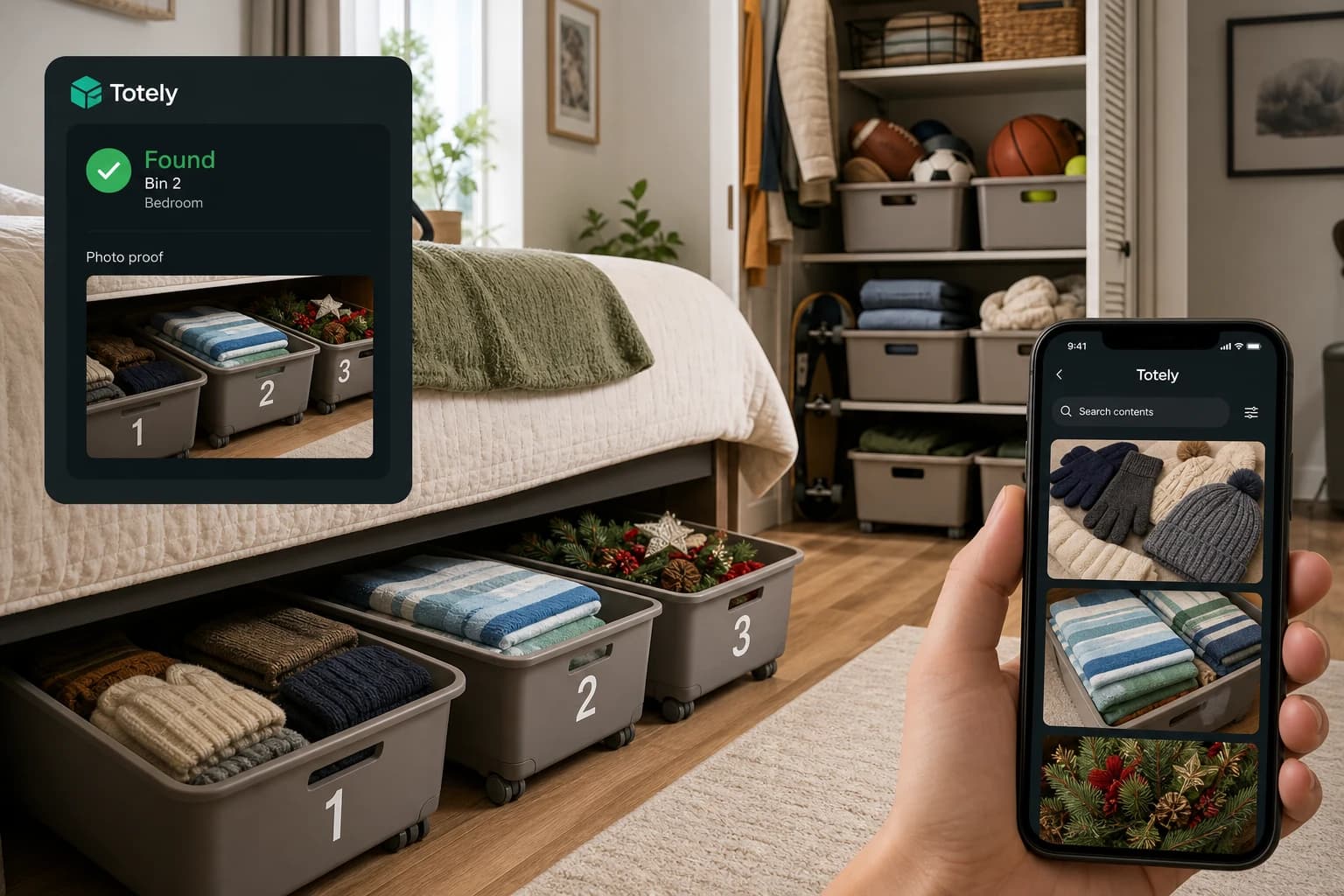
In Totely's storage system, that image can produce a first item list for you to review. Correct the list before saving it. A useful reviewed record for Bag 22 might include:
- navy loveseat back cushion
- navy loveseat seat cushion
- two navy furniture ties
- gray loveseat-cover pouch
- patio-set care card
Save the exact location as Garage • Shelf B • Cushion Bag 22.
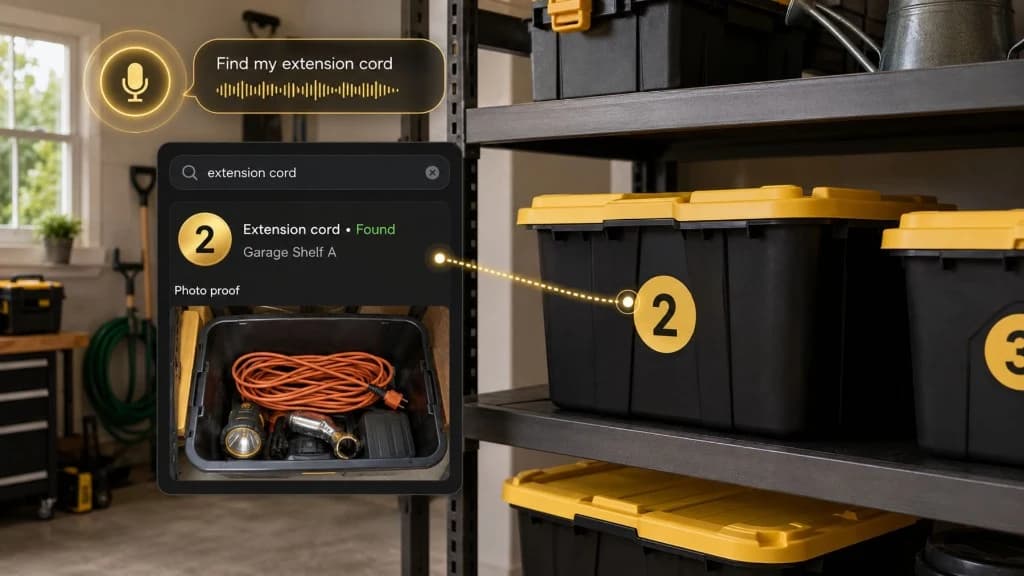
Natural search should match the way someone will actually ask. Search navy loveseat back cushion, not only outdoor textile. The useful result is the one that returns the correct physical station, green Found state, exact address, and matching photo proof.
If the photo suggests the wrong cushion or misses a companion, update the physical group or the reviewed list. Do not keep a tidy digital record of an incomplete bag.
Run a Retrieval and Return Test
Test the system while you can still fix it.
Ask another person to find the navy loveseat back cushion using only the saved record. They should be able to:
- reach the correct garage shelf
- identify Bag 22 without opening Bags 21 or 23
- confirm the navy loveseat back cushion in the photo
- remove the cushion without pulling down unrelated storage
- return the cushion, ties, pouch, and care card to the same station
- leave the bag in the same dry, supported position
If the test fails, diagnose the physical cause first. The address may be vague. The number may be hidden. Two bags may contain similar cushions. The shelf may be blocked. The photo may not show the actual stored arrangement.
Repeat the check before a long off-season and again when the cushions return to the patio. Compare the assembled furniture with the original set map. Update the record if the bag number, shelf, cushion count, condition, or companion pouch changes.
Patio Cushion Storage Mistakes to Avoid
- Packing before the inner cushion is dry. A dry-feeling cover is not enough; follow the actual drying instructions and check seams, piping, zippers, and the underside.
- Cleaning every cushion with one online recipe. Covers, inserts, coatings, and labels differ. Use the official instructions for the product you own.
- Buying a box before counting the set. Dry-fit every seat and back cushion so the lid closes without force.
- Forgetting the furniture positions. Photograph the assembled patio and name left, right, corner, seat, and back pieces before removal.
- Separating the small companions. Ties, straps, covers, clips, and care information belong with the correct cushion station.
- Calling a whole garage the location. Save the wall, shelf, bag or box, and number.
- Recording an unreviewed photo. Confirm the item list and photo proof match what is physically inside.
- Skipping the return test. A system that finds one cushion but scatters the rest is not finished.
Patio Cushion Storage FAQs
Can patio cushions stay in a deck box all winter?
Only if the cushion manufacturer and the box instructions support that use, the cushions are completely dry, and the actual box location stays suitable for the full storage period. Some first-party guidance prefers a cool, dry indoor off-season location. Check both products rather than assuming every outdoor box is appropriate for every climate or cushion.
Should patio cushions be stored in plastic bags?
Use the bag or container type supported by the cushion guidance and the storage environment. Do not seal damp cushions in any bag. For long storage, check whether the manufacturer calls for ventilation, a breathable bag, or indoor storage, and do not compress the cushion just to make a smaller bag work.
Can outdoor cushions be vacuum-packed?
Do not vacuum-pack them unless the manufacturer explicitly allows it. Long compression can conflict with the intended cushion shape or construction. Keep the natural shape and use a larger bag, box, shelf, or linked two-bag station when the full set does not fit comfortably.
How do I know patio cushions are dry enough to store?
Follow the label or official drying instructions, then inspect both faces, every edge, piping, seams, zipper areas, tie points, and the underside. When the product allows you to inspect the inner cushion, confirm that it is dry too. If any area is questionable, continue the approved drying process before packing.
Where is the best place to store patio cushions?
Use the cool, dry, protected location specified for the cushions you own. That may be an indoor closet, a suitable deck box, a breathable bag on stable shelving, or a dry garage or shed that meets the product guidance. The best location also fits the full set without crushing it and can be described precisely.
How do I keep matching patio cushions together?
Photograph the furniture while assembled, count cushions by furniture piece and position, place ties and covers in a companion pouch, and keep the set in one numbered station or clearly linked bags. Save the exact location and a reviewed photo that shows the same cushion group, then run a find-and-return test.